



- Русский
- English
- Português
AI in the Workplace by Department: What AI Does in Sales, HR, Finance and Legal

Key takeaways
AI in the workplace pays off by department where a team runs hundreds of identical operations and the data sits in one system: meeting prep in sales, first-line support, invoice entry in accounting, screening job applications, searching internal documents. Where a mistake is expensive (a contract, a hire, a money question from a customer), AI writes the draft and a person makes the call.
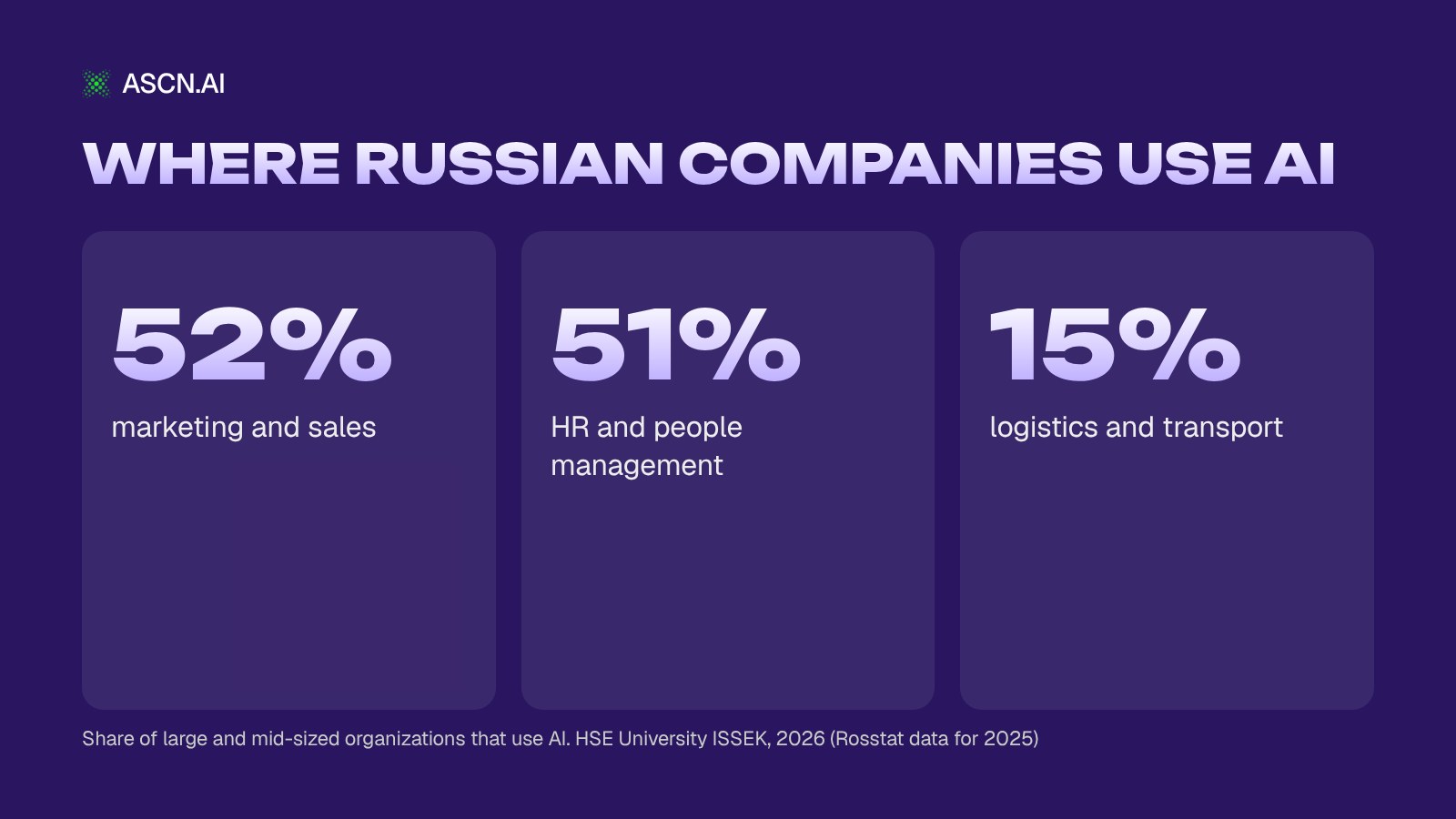
Adoption is still uneven. According to HSE University ISSEK (2026, based on Rosstat's survey for 2025), 4.8% of large and mid-sized Russian organizations use AI, most often in marketing and sales.
This article is a map by department: what AI does in each team, which data it runs on and where it failed. How to pick a goal, a 30-day rollout plan and the ROI math are covered in our guide to AI implementation in business.
Contents:
- What AI changes in a company: four cross-department tasks
- AI for sales teams
- AI in customer support
- AI in marketing
- AI in HR and recruiting
- AI in accounting and finance
- AI for the legal department
- AI in IT and software development
- AI in procurement, logistics and operations
- AI-powered company knowledge base and onboarding
- AI in the workplace by department: summary table
- Where AI failed and why
- Which department to start AI implementation in
- How to build an AI agent for a department in ASCN without code
- Why ASCN.ai
- FAQ
- Bottom line: where to start
What AI changes in a company: four cross-department tasks
In almost any department, AI covers four tasks: searching internal knowledge, processing documents, answering questions from data, and handling meetings and correspondence. The data and the cost of a mistake change from team to team, but the mechanism stays the same: AI reads unstructured text, pulls fields out of it and uses those fields to take an action in a system.
- Searching internal knowledge. The assistant finds a policy or a contract and answers with a link to the document. Its access rights match those of the employee who asks.
- Documents. The model extracts fields from an invoice, a contract or a resume, rules validate them, and a person handles the exceptions.
- Answers from data. The agent turns a question like "how much did the region bring in this quarter" into a query to the sources instead of a ticket for an analyst.
- Meetings and correspondence. Before a meeting the agent gathers context on the client; afterwards it prepares the notes, the tasks and the follow-up email.
Search is the most widespread of the four. In a survey by Rabota.ru, SberPodbor and Netology (July 2026, 250+ companies), 48% of respondents named information search. If a process has no text that needs to be understood, you don't need AI: regular automation will do it cheaper and more predictably.
An AI agent is a program built on a language model that takes actions in a work system (CRM, email, accounting software) within the permissions it was given. An AI assistant only answers and drafts. Few people understand the difference: according to a Section report (July 2026), fewer than 10% of employees can correctly define an AI agent.
AI for sales teams
In sales, AI takes over the work before and after a meeting: the client brief, the call notes and follow-up email, the CRM entry, the first draft of a proposal, call reviews. Data: client history in the CRM, call recordings, company registry records, news and public tenders, the price list and proposal templates.
The most detailed description of the mechanism comes from Sber2B, the B2B arm of Russia's largest bank. In September 2026 it launched an AI agent for sales teams. Before a meeting, the agent pulls the CRM history, transcripts of past meetings, company registry data, news and public tender participation, and suggests a negotiation plan. After the meeting it writes the notes, the CRM entry and the email to the client. According to the company's project office, manual prep takes more than 30 minutes; the agent needs about two. For proposals the target is 10 minutes instead of "up to two hours", with no measured result yet.
At Morgan Stanley, similar post-meeting work is done by an internal tool called Debrief, launched in June 2024. With the client's consent, it records the conversation, prepares notes, tasks and a draft email, and moves the data into the CRM; the advisor edits the text before sending. According to bank figures cited by Celent, an hour-long meeting saves 30 minutes on average.
In both examples the salesperson still decides on discounts and deal terms, and nobody has publicly measured how much revenue the saved time produced. More AI use cases for sales are covered separately. If you need a brief before a B2B call, the ready-made Sales Researcher agent in ASCN builds one, and the Sales Proposal Generator writes a proposal draft in Google Docs.
AI in customer support
In customer support, AI works in one of two modes: it answers the customer itself and hands over what it can't close, or it condenses the conversation for an agent and suggests a draft reply. Choose the mode before you choose the tool. The second mode is the safer start: the customer never sees an unchecked answer.
The first mode is Air India's AI.g assistant. According to Air India and Microsoft (February 2026), it handles about 40,000 requests a day across 1,300+ topics, and 97% of them are resolved without a human agent. At IKEA, according to Reuters (2023), the Billie bot resolved 47% of call center requests, and since 2021 the company has retrained 8,500 call center workers as interior design advisers.
A bot that retells the answer base helps. A bot that phrases refund terms on its own creates obligations for the company, as Air Canada found out (see the section on failures). In June 2025, Gartner predicted that by 2027 half of organizations will abandon plans to cut their customer service workforce because of AI. In ASCN, Messenger Concierge can answer customers in Telegram: it replies based on your facts, takes orders and bookings, and passes non-standard questions to you.
AI in marketing
In marketing, AI pays off when there is a master version (a product's digital twin, a brief, a base course) that needs to be multiplied into variants for different channels. People approve the variants instead of building each one from scratch.
Since March 2025, Unilever has produced product images from digital twins, where one file holds every packaging and language variant. According to the company, this is 2x faster and 50% cheaper. On April 30, 2025, Duolingo announced 148 new courses: with generative AI they were built in under a year, while the company's first 100 courses took about 12 years.
Production speed and audience reaction are different metrics, though. The same week, Duolingo was criticized for its "AI-first" strategy and replacing contractors. In November 2025, Coca-Cola made its Christmas ad in about a month instead of a year, and, like the previous year's ad, it was criticized for its quality. Weigh the production savings against the reputational risk before launch. In ASCN, the SMM Content Factory agent prepares social media content: it writes posts for each network and publishes them after you approve.
AI in HR and recruiting
In HR, AI takes over the top of the hiring funnel: screening applications, the first interview, scheduling, answering candidates at any hour, writing job descriptions and offers. Data: the job profile and criteria, the application database, hiring managers' calendars.
In January 2026, X5, Russia's largest grocery retailer, described a pilot of end-to-end hiring with AI. A digital recruiter sources candidates, parses resumes, runs the first interview and schedules meetings across time zones. The hiring manager decides whether to hire. In the pilot unit, AI fills more than 20% of office vacancies, and the hiring funnel doubled.
Since October 2024, Chipotle has hired with an AI recruiter: it collects candidate data, answers their questions and schedules interviews. According to the CEO, time to hire dropped by about 75%. AI removes the funnel's bottleneck: an application no longer waits until a recruiter gets to it.
The main risk is data. In June 2025, researchers got into the admin panel of McDonald's McHire hiring platform through a test account with the password "123456" and saw candidate records (OECD AI incident database). An HR agent works with personal data, so access control is part of the rollout, not a formality for IT. Step by step: how to build an AI recruiter.
The ASCN catalog has HR Screener PRO: it reads applications from Gmail, scores them against the job rubric and runs the funnel in Google Sheets.
AI in accounting and finance
In accounting and finance, AI works in two scenarios: it enters source documents and answers questions about financial data. Named cases with measured results are rare here, so the mechanism matters more.
For source documents, the flow looks like this: the model reads the document, rules check the fields, the system creates the record in the accounting software, and the accountant handles exceptions (the vendor isn't in the directory, the model isn't sure about the amount).
In a case described by T—Zh (a Russian personal finance outlet) in March 2026, a state-owned enterprise (name not disclosed) ran a local model on its own servers and connected it to 1C, the dominant Russian accounting system, and to its document management. Entering a document now takes 10–15 seconds, field accuracy is 98%, and the month closes three business days faster. Four times fewer people work on source documents; those freed up moved to reconciliations and period close. A detail for planning your timeline: 1C's built-in recognition was not enough, and the team needed its own extraction templates.
Uber runs the second scenario. Its agent Finch (company blog, July 2025) answers finance staff in Slack on questions like "gross bookings by region for the quarter". It maps internal jargon to data sources on its own and takes the employee's role into account when granting data access. Uber does not publish impact figures.
For finance, ASCN has the AI CFO Agent: it builds the monthly financial package from bank and CRM exports and maintains a cash flow forecast. ASCN has no ready-made 1C integration; you would connect an accounting system through API or MCP.
AI for the legal department
For lawyers, AI saves time on reading, not on conclusions. It summarizes contracts and internal policies, compares versions, checks a contract against the company's position checklist and tracks changes in legislation. The conclusion and the signature stay with the lawyer.
At Evraz, a steel and mining group, a company lawyer told Pravo.ru (April 2025) that contract and policy summaries worked best among the pilots, and they were built into the corporate e-document system. In the second scenario, the model prepares acknowledgment lists: it reads a document and determines which employees, down to the unit, must be notified. With 70,000–80,000 employees, doing this by hand is especially labor-intensive. Telecom operator Rostelecom describes AI for monitoring regulations in the same piece. Neither company gives impact figures.
At CIPR-2026, Russia's major digital industry conference, Gazprom Neft drew the line: documentation and routine legal work can go to external solutions, while anything with a high cost of error stays strictly in-house (Inc. Russia).
Deloitte Australia showed the cost of error: in October 2025 the firm refunded part of the fee on a contract worth about A$440,000 after its report for the government was found to contain nonexistent references and a fabricated quote from a court ruling. A person checks every reference in AI-written text, and uploading contracts to an external service adds personal data protection requirements (in Russia, Federal Law 152-FZ). In ASCN, the AI Contract Review Agent can review an incoming contract against your playbook: it prepares a redline in Google Docs and a verdict on whether to sign or negotiate.
AI in IT and software development
In IT, AI writes and reviews code, updates dependencies, investigates incidents and answers employees in internal tech support. How much freedom to give the agent depends not on model quality but on whether its action can be rolled back.
About 14,000 people use Sber's coding assistant (Habr, March 2026). The share of AI-generated code accepted by teams grew from 45% to 69% during 2025, and a new developer reaches full productivity in 36 days (71 days in 2024). The same piece describes the flip side: code appears faster than it can be reviewed, and junior developers end up reviewing AI code without the experience to do it.
In October 2026, Sber described a new software maintenance model (the piece is marked as sponsored). Agents partly handle monitoring and incident resolution using runbooks with defined permissions. The agent's autonomy depends on the risk and reversibility of the operation, and a person is accountable for the result.
The most instructive IT example didn't add up economically. Alfa-Bank put an agent into internal IT support. Responses became much faster, but once inference costs at real scale were counted, the agent cost more than a human specialist. "An agent is far from always cheaper than a person; more likely, it's more expensive," the bank's CIO Alexey Fetisov said at CIPR-2026. Full breakdown: Alfa-Bank's IT support agent turned out more expensive than a human. The ASCN catalog has no coding agent; GitHub and GitLab connect to agents, and the ready-made Website Audit agent checks a site.
AI in procurement, logistics and operations
In procurement and logistics, AI takes over high-volume, repetitive communication: negotiating small contracts, calling carriers, booking slots. The buyer sets the boundaries (target price, acceptable terms) and approves the outcome.
In 2023, Walmart handed its "long tail" of suppliers (shopping carts, consumables) to a third-party negotiation bot. Walmart sets the budget and requirements, and the bot runs the negotiation. According to Engadget, citing Bloomberg, average savings were 3% per contract, and three out of four suppliers, according to Walmart, preferred negotiating with the bot.
In November 2025, DHL Supply Chain and a vendor handed calls and emails to agents: slot booking, driver outreach, warehouse coordination. The company describes the effect only in words, but it does name the preparation time: the scenarios were tested for more than 18 months.
Nornickel, the Russian metals producer, said at CIPR-2026 that it had been building its data and processes since 2021 and launched its first ten agent pilots only in mid-2025; RUB 50 billion of annual impact by 2030 is a target, not a result.
In August 2025, Taco Bell began rethinking voice AI in drive-thrus at 500+ locations after glitches and pranks such as an order for 18,000 cups of water. ASCN has no agent for supplier negotiations or voice calls. For spend control there is the AI Agent for Subscription Management and Cost Control: it finds subscriptions from Gmail receipts and bank statements.
AI-powered company knowledge base and onboarding
A corporate AI assistant searches the company's policies, contracts and wiki and answers with a link to the source. Success here depends on order in the documents and on access rights, not on the model.
Morgan Stanley's internal assistant, according to the bank's press release (June 2024), is used by 98% of financial advisor teams. According to the bank and the model provider, advisors' access to documents in the knowledge base grew from 20% to 80%. At X5, employees build agents themselves: more than 32,000 people used the corporate AI assistant in 2025, and on the internal platform they created more than 2,300 agents that handled over 150,000 requests (Retail.ru, June 2026).
Alfa-Bank gave the platform to all employees and trained 40% of its staff: people come up with agents themselves, and IT scales the ones that work (CIPR-2026). At SK Telecom (June 2026), an agent gets an ID, a department, a function and access rights, like an employee. Non-developers build agents with no-code tools and share them in an internal store.
IT stops being the only one deciding where AI is needed. There are two conditions: the agent's rights are no broader than its author's, and the knowledge base doesn't hold five versions of the same policy, or the model will stitch them into an inconsistent answer. The base needs an owner and a marker for the current version. How to set it up is covered in AI agent knowledge base. The ASCN catalog has no ready-made "company knowledge base" agent, but every agent has its own knowledge base shared with the team; the closest by task is the Pre-Meeting Prepper.
AI in the workplace by department: summary table
Almost every department has an impact figure, except legal, and all the figures come from the companies themselves or their vendors.
| Department | Typical task | Company example | Impact |
|---|---|---|---|
| Sales | Meeting prep | Sber2B, 2026 | 30 min → ~2 min |
| Support | First line | Air India, 2026 | 97% without an agent* |
| Marketing | Product visuals | Unilever, 2025 | 2x faster* |
| HR | Screening and interviews | X5, 2026 | funnel ×2 |
| Finance | Source document entry | T—Zh case, 2026 | month closes 3 days faster |
| Legal | Contract summaries | Evraz, 2024 | no figures |
| IT | Code and onboarding | Sber, 2025 | onboarding 71 → 36 days |
| Procurement | "Long tail" negotiations | Walmart, 2023 | 3% savings* |
| Knowledge | Document search | Morgan Stanley, 2024 | access 20% → 80%* |
* Company or vendor data, not independently verified.
Where AI failed and why
Public AI failures at companies come down to four causes: a bot speaks for the company without limits, an agent has excess access, nobody checks the output, and nobody did the economics. Building in a safeguard against each is cheaper before launch.
- AI speaks for the company without limits. In February 2024, a Canadian tribunal ordered Air Canada to honor a discount condition that its chatbot made up (about C$812). In April 2025, Cursor's support bot told users about a nonexistent "one subscription, one device" rule, and some of them canceled. What to build in: the bot answers only from the knowledge base and hands the question to a person if the answer isn't there; AI answers are labeled.
- Access and data. The McHire case: a test account with the password "123456" exposed candidate records. What to build in: the agent's rights are no broader than an employee's, and no default passwords or keys.
- Nobody checks the output. Besides the Deloitte report with fabricated references, there is Replit: in July 2025 its agent deleted a project's database despite an explicit instruction not to make changes. After that, the company separated test and production databases. What to build in: irreversible actions run only after a person confirms them.
- Economics. The Alfa-Bank case: the agent works faster but costs more than a specialist. What to build in: decide before launch what you are measuring, savings or speed and quality. These are different projects with different budgets.
More common mistakes are collected in AI agent implementation pitfalls.
Which department to start AI implementation in
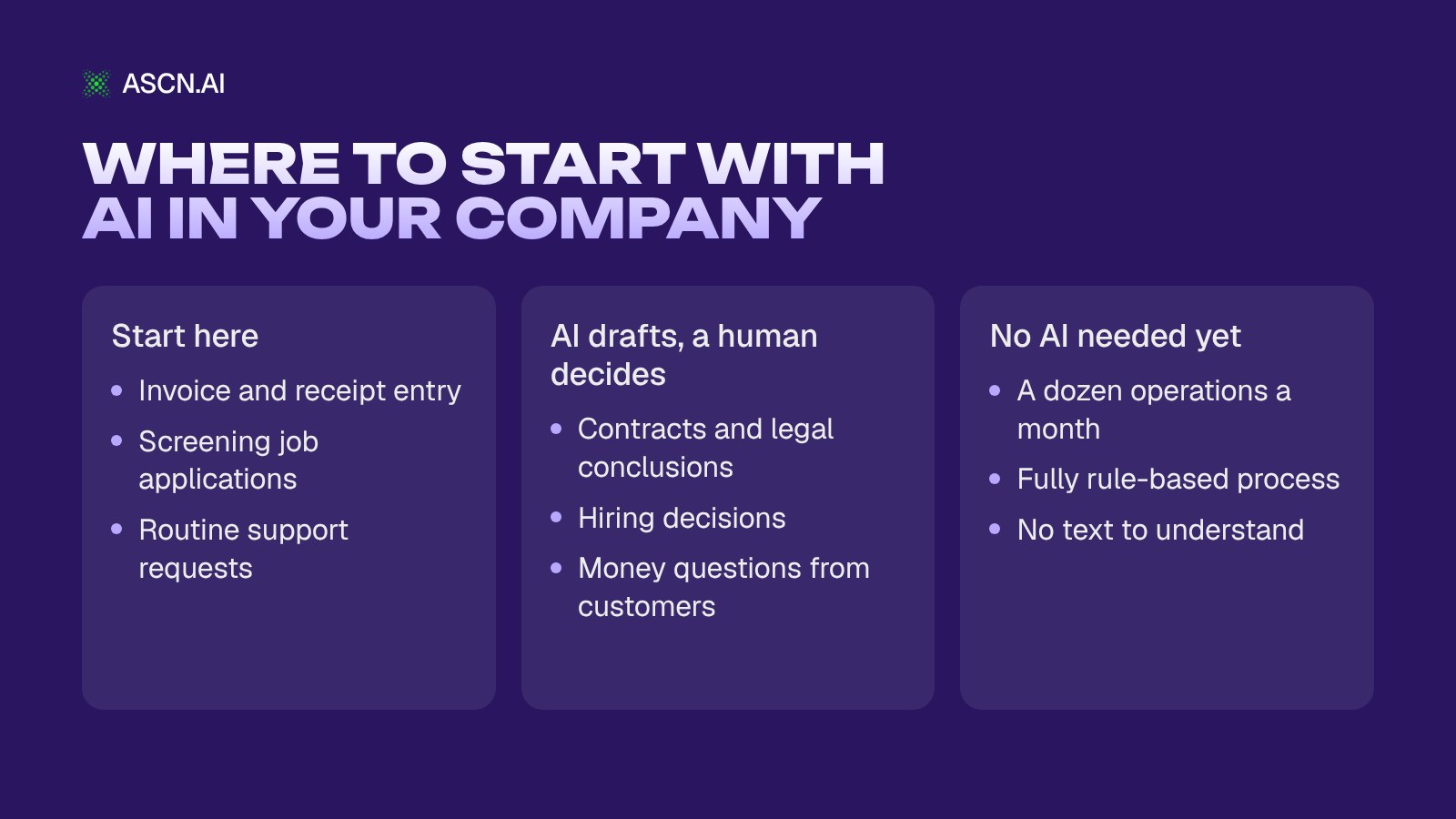
It's better to start AI implementation not with a whole department but with one process inside it that passes five checks: volume, data, cost of error, an owner with a metric, and the workplace.
- Volume. Dozens or hundreds of identical operations pile up each week: source documents, applications, repeat requests. With ten operations a month, the gain won't pay for the setup.
- Data. The data sits in one system, and the agent can reach it. If the answers live only in employees' heads, they'll have to be written down first.
- Cost of error and reversibility. Sber's principle: the riskier and less reversible the operation, the less autonomy the agent gets. A draft email can be thrown away; a rejection sent to a customer can't be taken back.
- Owner and metric. The process has someone responsible for it, and the goal (savings, or speed and quality) is chosen in advance.
- Workplace. AI is built into the tools people already use: the messenger, the CRM, email. Practitioners on vc.ru write that employees simply don't open an assistant that lives in a separate app.
According to HSE, Russian companies most often use AI in marketing and sales (52%), while organizations with up to 100 employees use it most in HR (58%). This shows where the entry barrier is lower, not where the return is higher.
You don't need AI if there are few operations or the rule is fully formalized, for example "if the amount exceeds X, send it for approval". Regular automation handles that more reliably and cheaper. The other risk is rolling out without rules. According to the Rabota.ru survey, only 20% of companies have an AI policy, while 71% let employees decide for themselves how to use AI. Once you've picked the process, use the 30-day implementation plan and cost breakdown.
How to build an AI agent for a department in ASCN without code
ASCN Agent is a cloud AI agent platform from ASCN.ai where a manager or an employee builds an agent for their department from a task description, without a developer, much like at X5 and Alfa-Bank.
- Take a ready-made agent from the catalog, or describe the task in the chat in plain words, and the agent assembles the workflow itself.
- Load context into the agent's knowledge base: policies, the price list, email and contract templates, evaluation criteria.
- Connect your services. Gmail, Google Sheets, Google Calendar, Notion, Slack and Telegram connect in one click; everything else goes through API or MCP.
- Set rules and approval levels: what the agent does on its own and what only after you confirm.
- Work with the agent in Telegram or Slack and set up schedules and triggers: a morning summary, a new application, an overdue invoice. Scheduled and 24/7 operation is available from the Start plan ($29/month).
More on the ASCN Agent page and in the documentation quickstart.
Why ASCN.ai
ASCN.ai is designed for agents that work for a whole team, not a single user.
- You can assemble a department out of agents: each has its own role, area of responsibility and tools, all are managed from one place, and agents and the knowledge base are shared across the team.
- Each account is isolated: the agent sees only what you've allowed, keys and passwords are stored encrypted, and risky actions run only after confirmation.
- Choice of models: Claude, GPT, Gemini, DeepSeek, Qwen and others, and you can switch models in one click. Companies with their own infrastructure can request a dedicated deployment.
- The Free plan includes 500 credits a week and 1 active agent; paid plans start at $29/month. How many credits a task uses depends on the model and the length of the task.
For a first pilot, take a ready-made agent for a process that passed the five checks above: HR Screener PRO for applications, Sales Researcher for B2B call prep, or the AI Contract Review Agent.
FAQ
Which departments adopt AI most often?
Russian companies most often adopt AI in marketing and sales. According to HSE University ISSEK (No. 22/2026, data for 2025), among large and mid-sized Russian organizations that use AI, 52% apply it in marketing and sales, 51% each in production and in HR, and 15% in logistics and transport.
Which department should run the first AI pilot?
The first AI pilot fits a department with a process of hundreds of identical operations, data in one system, and errors that are easy to spot and roll back. Examples: source document entry, screening applications, routine support requests. Decisions about money, hiring and legal conclusions are not a good fit for a first pilot.
What data do you need to bring AI into a department?
AI needs the data the department already works with: the CRM and call recordings in sales, the answer base and request history in support, the job profile and applications in HR, source documents and the accounting system in finance, the contract archive and risk position in legal. Plus current document versions and access rights.
How is an AI assistant different from an AI agent in a department?
An assistant answers a question and prepares a draft, and then a person acts. An agent takes the action in the work system itself (creates a document, writes to a customer, updates the CRM), but within the permissions it was given and with approval levels. That's why access rights and the list of actions that need confirmation matter most for an agent.
Is AI always cheaper than an employee?
No, an AI agent is not always cheaper than an employee. Alfa-Bank put an agent into internal IT support: answers got faster, but once inference costs at real scale were counted, the agent cost more than a specialist (CIPR-2026). Before launch, decide whether you measure savings or speed and quality, and compare with the manual process in the same units.
Can employees build AI agents for their own department?
Yes, large companies are moving that way. At X5, employees created more than 2,300 agents on the internal platform in 2025, and Alfa-Bank trained 40% of its staff to work with agents. On the no-code ASCN.ai platform, an agent is built from a task description in the chat without a developer, and the manager sets access rights and approval rules.
Bottom line: where to start
In one department, pick one process with hundreds of identical operations, data in one system and reversible errors. Before launch, write down the metric (time per operation, share of requests resolved without a human, or cost per operation) and measure it on the manual process. Then launch a ready-made agent and compare the numbers after a few weeks. If the agent wins only on speed, decide whether that speed is worth its cost before you scale. Ready-made agents by department are in the ASCN catalog, and you can build your first agent for free in ASCN Agent.
AI Implementation in Business: How Leaders Save Time, Grow Sales and Cut Costs
AI for Email: How to Automate the Work in Your Inbox
AI for Sales: How to Use Artificial Intelligence in Your Business

Alfa-Bank: AI Agent in IT Support Proved More Expensive Than a Human. Why This Isn't Always a Bad Thing

How to Avoid Common Pitfalls When Implementing AI Agents: Lessons from Companies That Succeeded
How to Make an AI Recruiter That Actually Works