



- Русский
- English
- Português
How to Make an AI Recruiter That Actually Works

I’ve always been frustrated with recruiting. There I am, reviewing the 87th resume of the day and I realize that these people have simply been reduced to a set of characteristics of “communicative,” “stress tolerant,” or “has happened to have experience working in dynamic teams.” Then three days later, the candidate who I would have deemed a perfect fit is now happily building new relationships with a competitor, and I didn’t act fast enough to parallel process those applications.
This is the point where artificial intelligence recruiting magic begins; no, a human resource (HR) professional will not be replaced by a robot, but the grunt work of all the mechanical tasks gets done by a machine. I entered the space with my first software product for crypto projects launched in 2023—the day the market dropped by 40% in one night. Do you know what made us successful? Speed. While other companies sat around waiting to set up their systems, I was able to aggregate metrics, analyze sentiment on Telegram and track the activity of large players in 30 seconds or less. As a result, clients were able to generate a profit, while the rest of the market asked: ”What are we paying for?”
The same logic applies to recruiting: just as we used on-chain metrics to evaluate performance, here we use resumes. The essence remains the same, the automation of HR and the reduction of redundant loads means that HR can now spend their time communicating directly with candidates to determine cultural fit with the company. As opposed to being a soul-destroying filter that reduces hundreds of resumes to find keywords.
What is an AI Recruiter and the need for one?
An AI Recruiter is a neural network (usually built on GPT) that automates the recruitment process, from resume parsing to initial interviewing through chat. AI differs from a standard ATS (Applicant Tracking System) in that it actually analyzes text: it matches skill sets with job openings, communicates with candidates and asks follow-up questions.
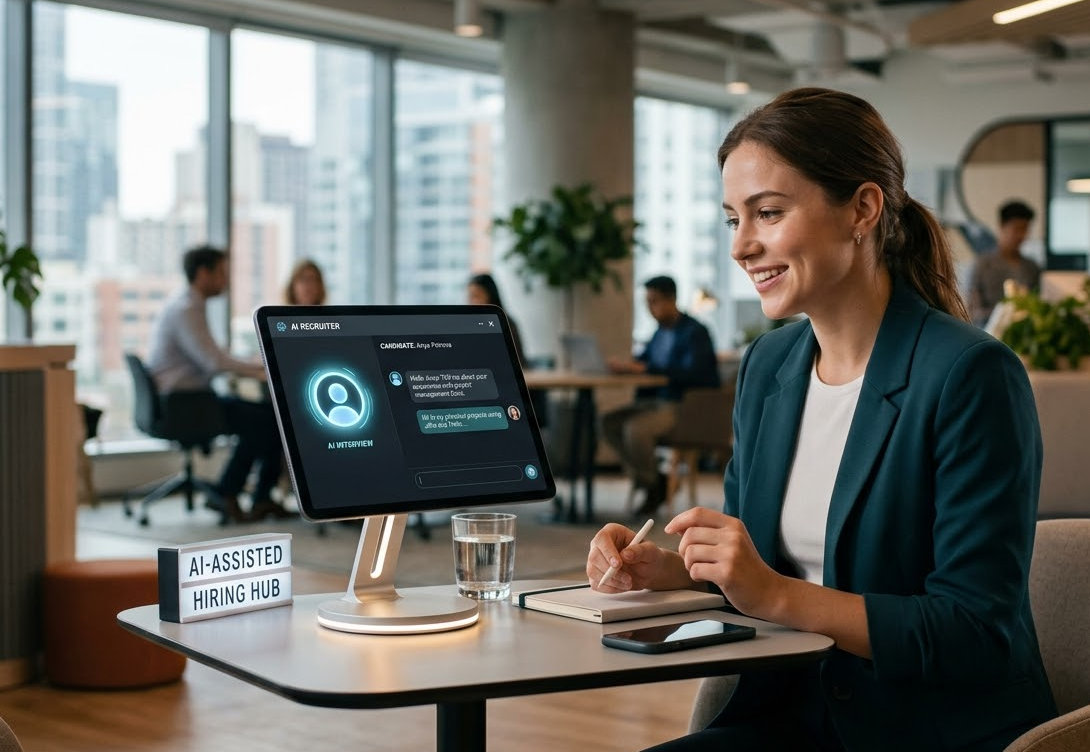
What an AI Recruiter Can Do:
- Automated screening: Extracts key skills from resumes (Python, Project Management, B2 English) and ranks candidates based on inclusion for the position.
- Initial interviews: A chatbot asks questions regarding experience, salary expectations and willingness to relocate. It will automatically record responses and prepare a candidate database for HR.
- Job parsing: Automatically generates job descriptions and posts them on job boards via API.
- ATS integration: Uploads candidate data and hiring statuses.
From my own experience: In our ASCN.AI project, we created a GPT-4 Based Skills Test Bot on Telegram to assist in finding blockchain developers.
Why Neural Networks and GPT are a perfect fit for HR
Companies can use NLP (Natural Language Processing) and GPT (Generative Pretrained Transformer) to attract candidates more effectively. Recruiters could use the technology to accomplish three primary goals:
- Help recruiters determine the qualifications, backgrounds, and experience of prospective hires through semantic analysis of open-ended responses to job postings (free text).
- Create individualized questions for applicants rather than using a standardized template.
- Evaluate a candidate’s soft skills and competencies (such as communication skills, motivation, etc.) through the analysis of their responses to open-ended questions during the interviewing process.
Research has shown that organizations utilizing NLP have reported an average time saving of 35% in filling positions, and have seen their retention rates increase by 12% due to better and more objective hiring.
| Parameter | ATS (no AI) | GPT for recruitment |
|---|---|---|
| Resume Screening | Uses only keyword matching and seniority filters | Uses contextual analysis and semantic matching |
| Interview Process | 30 - 60 minutes | 5 - 10 minutes |
| Personalization | Fulfillment emails | Automatically revised applicant questions |
| Time to Screen One Resume | 2 - 5 days | 10 - 30 seconds |
An implementation example for 2025 in an e-commerce company is that a chatbot built on the ASCN.AI platform was developed in 7 days to process 450 applicants and create 310 candidate records for the HR department. The end result was that hiring 50 candidates took 10 days, rather than the usual 3 weeks.
What an AI Recruiter consists of: Components and Technologies
Machine Learning (ML) is a subset of AI that allows a computer application to learn from past instances and build predictive models to enable the application to operate autonomously without explicit programming. As applied to recruiting, this would typically include:
- Classifying resumes as either a "Fit" or "No Fit."
- Predicting employee attrition based on prior historical data related to employee attrition.
- Optimizing interview questions through the identification of questions that correlate to higher probabilities of success when candidates accepted offers and were subsequently hired.
The complete NLP software suite consists of:
- Tokenization, which is the breakdown of complete sentences into single words/phrases.
- Named Entity Recognition (NER) helps identify important entities, such as names, locations, dates, and job titles.
- Sentiment Analysis evaluates the emotional sentiment of written text.
- Embeddings provide a numeric representation of text and allow for the measurement of how close different pieces of writing are semantically.
When applied to recruiting, this enables job openings and resumes to be structured similarly, so job descriptions and candidate profiles can be compared with cosine similarity, as well as generate unique lack of opportunities letters and automated responses.
The tech stack utilized might include spaCy, Sentence Transformers, GPT-4, BERT.
Chatbot Architecture — How it works behind-the-scenes
In general, the following is a simple representation of how you’d build a basic HR chatbot:
- Front-end: messaging apps (Telegram, WhatsApp), web chat, job platform API.
- Back-end: Webhook to receive messages, natural language processing engine, dialogue manager (finite state machine or large language model), and a database.
- Integration: With ATS, Google Calendar, and email/SMS notifications.
In this instance, here is an example of how you’d build a simple Telegram bot:
[Telegram API] → [Webhook] → [GPT API: questions] → [Answer analysis and saving] → [Upload to Google Sheets]Here is an example of a no-code workflow in ASCN.AI:
Telegram Trigger → AI Agent (data extraction) → Logic (filtering) → HTTP Request to ATS → HR Notification → Candidate ResponseThe functions of a chatbot could include: to collect simple information (name, contact details, and city), to measure hard skills and soft skills, to assess motivation and expectations, and schedule a job interview in a calendar.
Data and ATS Integration
An ATS (Applicant Tracking System) is an automated database that provides CRM functions for recruitment (Greenhouse, Lever, BambooHR, etc.). Integration with an AI recruiter allows you to create candidate cards automatically, update candidate status, manage the applicant pipeline, and obtain reports through analytics.
The key advantages of integrating these systems include:
- Consistent use of data with no duplicates.
- Fully automated recruitment process – easy to track the recruitment process.
Example Workflow of ASCN.AI:
Trigger: New message in Telegram
↓
AI Agent: Data extraction
↓
Logic: Filtering by experience and skills
↓
HTTP Request: Sending data to ATS (JSON)
↓
HR Notification (Telegram)
↓
Response to Candidate
How to Create an AI Recruiting Agent: Step-by-Step Approach
Step One
The first step is to determine the requirements of the system. Without clear requirements or criteria, no matter how well the system was designed, it will not be utilized. A recruiter must determine:
- What recruitment phases will be included in the automation (i.e., screening, initial interviews, and meeting scheduling).
- The volume of applications (i.e., the number of applications for basic bots – 50 per week; the number of applications for scalable builds – 500 + application volume).
- Who the intended audience will be (i.e., internal HR, agencies, candidates from websites, or messengers).
- How important each of these criteria is (i.e., HR time spent on recruiting, conversion rate, time to fill positions, retention rate).
Common Missteps to Avoid:
- Vague or unclear recruiting criteria.
- Ignoring formal regulations (i.e., GDPR, EEOC).
- Failing to have fallback scenarios in place for extreme cases.
Example Specification: Automating the screening of a Python developer with at least 1 year experience, an understanding of Django/FastAPI, no less than B1 level English, and a GitHub portfolio. Integrate into Notion and reduce the HR staffing hours needed to process applications from 12 to 3 hours per week.
Step Two: Selecting and Configuring the AI Model
Most common available models:
- OpenAI GPT-4 / GPT-4 Turbo: High levels of accuracy, can be integrated via paid API.
- Anthropic Claude 3: Very large contextual window, this model is well suited for longer resumes.
- Data control & specialized HR modeling: Control your data on your own servers with Meta's Llama 3, Mistral systems and be aware that they will require some technical skill to run them successfully. For larger companies, examples of specialized HR modeling are HireVue and Pymetrics.
Training Methodologies:
- Fine-tuning: An additional training process using historical data for better accuracy.
- Prompt Engineering: Careful enhancements to how the system responds to commands/instructions from users.
- Few-shot Learning: Fewer examples of what desired answers look like in the prompt.
An example of a simple prompt would be:
You are an HR bot for a Python Developer position. Ask 4 questions: experience, frameworks, English, and portfolio.
Justify your answers and evaluate the candidate's resume:
Experience < 1 year - Not suitable;
No portfolio - Verification needed;
English less than two sentences - Not suitable;
Otherwise good - Proceed to interview.
Tone — Friendly-professional.
Step Three: Using the Chatbot in HR Workflow
The key points to integrate using your chatbots would include:
- Channels: Use Telegram, WhatsApp, web chat or Email as your primary channels.
- Storage systems: Use ATS (Applicant Tracking System), Google Sheets or Notion as your primary storage systems.
- HR Notifications: Use Telegram, Slack, push Notifications/SMS as your methods.
An example of an added value tool is ASCN.AI (no-code tool) that allows you to create a pipeline (workflow) consisting of a trigger in Telegram → AI Agent will filter results by sending HTTP requests back to ATS → Notify HR of outcome via HR Notifications → The candidate receives responses from the AI agent. It is all visual and done through a no-code platform.
Common Problems and Solutions:
- Misunderstanding the content of voice messages — You can use transcription services (via Whisper API).
- Resume files are in PDF/Word and can be uploaded and parsed using various API or library functionality.
- Multilingual messaging works using multilingual AI Models or auto-detecting the Language.
Using HR Bots integrated into messenger services will typically increase the application rate by 40%. The primary reason is that people prefer messaging apps over filling out forms on websites.
Step Four: Optimize and Test
When you launch your AI Bot, you need to understand that this is only the beginning of your journey. Improvement is then realized through iterative processes.
Testing Criteria:
- A/B test the prompts.
- Review selected dialogue manually.
- Assess metrics, such as Precision, Recall and False Positive.
- UX survey to evaluate the candidate experience.
Optimization:
- Refining / Expanding the Prompt.
- Flexibility of selection criteria.
- Decreasing response time from 3–5 seconds.
- Fall back on live HR Professional for negative responses/errors.
Case Study ASCN.AI: In one week after changing the prompt to incorporate adjacent experience, precision increased from 40% to 72%. This is all due to one simple change!
Benefits & Challenges of AI Recruitment Automation
Quantitative:
- Decreased time to hire by 30-40%.
- Increased output: From 15-20 resumes per day, to more than 100 with no loss of quality.
- Reduced cost to hire by eliminating tasks commonly performed manually through Robots.
Qualitative:
- Objectivity in the process - reducing subjectivity and bias throughout the entire selection process, which results in an 18% drop in legal claims.
- Each candidate evaluated consistently using identical evaluations/questions.
- Scalability - The ability to scale the system without degrading quality.
Examples:
- An E-commerce company used a bot to assess stress tolerance which correlated with an increase in retention from 55% to 68%.
- An IT Start up utilized GitHub portfolios to analyse, double the amount of senior hires.
Ethics and Transparency: An Important Consideration
- Bias: Discrimination risk due to biases inherent in our historical data. Solutions are conduct regular audits, debiasing methods, and ensuring diversity in training data.
- Transparency: Candidates should be made aware of the reason(s) for the rejection.
- Consent: Informing candidates of the use of AI and processing of their data.
- Data Storage: Delete data upon request, and comply with local laws and the GDPR.
To ensure that Explainable AI (XAI) and human-in-the-loop systems are used to minimize errors and maintain trust in an AI Hiring Solution (AIHS), you will need to implement specific validation methods. For example, after Amazon discovered that its AI recruiting tool was unfairly biased against women due to its training data, the company discontinued that project. These types of anecdotes provide insight into the risks of using automated tools for recruiting purposes.
Ways to minimize risk and reduce error:
- Technical failures: Monitor the implementation of your system; have email backups; create multiple copies of the data.
- Rejecting qualified candidates: Use "soft" criteria to compare resumes, and re-evaluate candidates who were not selected in the initial round.
- Data security: Use SSL, encrypted communications, and limit access to sensitive data.
- Modelling assumptions: Focus on data diversity and use prompt-based models to obtain the best outcome.
- User Experience: Provide clear instructions, use progress indicators, and respond to users quickly.
Commonly Asked Questions About Creating an AIHS
Do I need programming experience to create an AIHS?
It is not necessary if you use no-code platforms like ASCN.AI. However, additional customization beyond basic functions may require familiarity with the Python language, as well as interacting with application programming interfaces (APIs).
How long will it take to launch a bot?
It can take anywhere from 2 hours (to create a simple Telegram bot with 3 questions), to 2 days (to fully integrate the bot with an applicant tracking system and develop the business logic).
Which model is better — GPT-4 or open-source?
Use GPT for small and medium-sized enterprises; or use the Open-source option for large enterprise applications where privacy will be of utmost importance. I suggest compromising on using GPT-4 Turbo, as it will balance cost with quality.
How can a bot read a resume in PDF and Word?
Resume parsing is accomplished through the use of specialized software and/or APIs which allows for the conversion of resumes into digital formats (.pdf/.doc). Candidates may also submit their resumes in .txt format.
How do I protect candidate data?
Some examples of protecting candidate data include the use of SSL encryption; limitations of access; performing regular backups; and deleting candidate data upon request in compliance with GDPR guidelines.
What do you do if the bot evaluated the candidate incorrectly?
You should work to improve the prompt by adding examples of candidate responses and decreasing the temperature at which the bot generates responses. Implement human-in-the-loop verification to verify the correctness of the bot's evaluation.
Can I integrate AI with my ATS without using an API?
Yes! You can use RPA (Robotic Process Automation) or connect with intermediate services (e.g., Google Sheets, Airtable) to store the desired information.
How do candidates feel about being interviewed by a bot?
68% of candidates have a positive view of an AI interview when they are given transparent explanations and relevant questions.
How do I assess the ROI of an AI recruiter?
ROI = (time saved by HR staff) + (reduced cost-per-hire) + (improvement in offer-acceptance quality).
What happens if HR does not support automation?
If HR does not support automation, you should conduct a pilot project; involve HR in the initiative; demonstrate results to HR; and give HR time to adapt to the change.
Conclusion and Recommendations
- The AI recruiter and HR Manager will never replace any portion of one another because AI Recruiters relieve HR from low-value routine tasks and thus improve their productivity.
- No-code platforms allow for the rapid and efficient launching of systems with little cost and no programmers needed.
- The success of an AI recruiter implementation is contingent upon properly defining the tasks that the AI will perform, accurately configuring AI, and consistently improving the system.
- When implementing the AI recruiter, the implementation should adhere to a corporate philosophy of ethics and transparency to candidates.
- Pilot initiatives provide the best environment for validating hypotheses before expanding the implementation.
Disclaimer
The information in this article is generalized in nature and does not substitute for investment, legal, or security advice. A person should utilize AI assistants with care and have a clear understanding of the functionality offered by the individual platforms.