



- Русский
- English
- Português
AI Implementation in Business: How Leaders Save Time, Grow Sales and Cut Costs

Key takeaways
AI implementation in business pays off when you start with one goal, not with a tool. That goal is usually one of four: less routine work, more sales, lower support costs or cheaper hiring. Almost every large company already uses AI, but only a minority sees money from it. Below: the goals a business leader can set, real company results, a 30-day plan and an ROI formula.
Contents:
- What AI implementation in business means
- AI in 2026: almost everyone uses it, few profit
- Where to start: pick a goal, not a tool
- How to cut the time your team spends on routine
- How to grow sales with AI
- How to lower support and operating costs
- Hiring and headcount: will AI replace employees?
- Documents, reports and oversight
- Companies that already implemented AI: wins and failures
- How to implement AI in business: a 30-day plan
- Build in-house, go turnkey or use a ready-made agent
- Why ASCN.ai
- How much AI implementation costs and when it pays off
- AI implementation mistakes: why projects don't pay off
- FAQ
- Bottom line
What AI implementation in business means
AI implementation means you hand a specific task to a model or an AI agent and measure the result in hours, dollars or conversion. No measurement, no implementation. It's just an experiment.
There are two levels. An AI assistant helps a person: it drafts an email or summarizes a meeting, and the employee still makes the call. An AI agent acts on its own: it replies to a customer, updates the CRM and sends a report to the manager.
For a business owner, the difference is big. An assistant saves each employee a few minutes. An agent takes over a whole piece of work. More on the types in our article on AI agents for business.
AI in 2026: almost everyone uses it, few profit
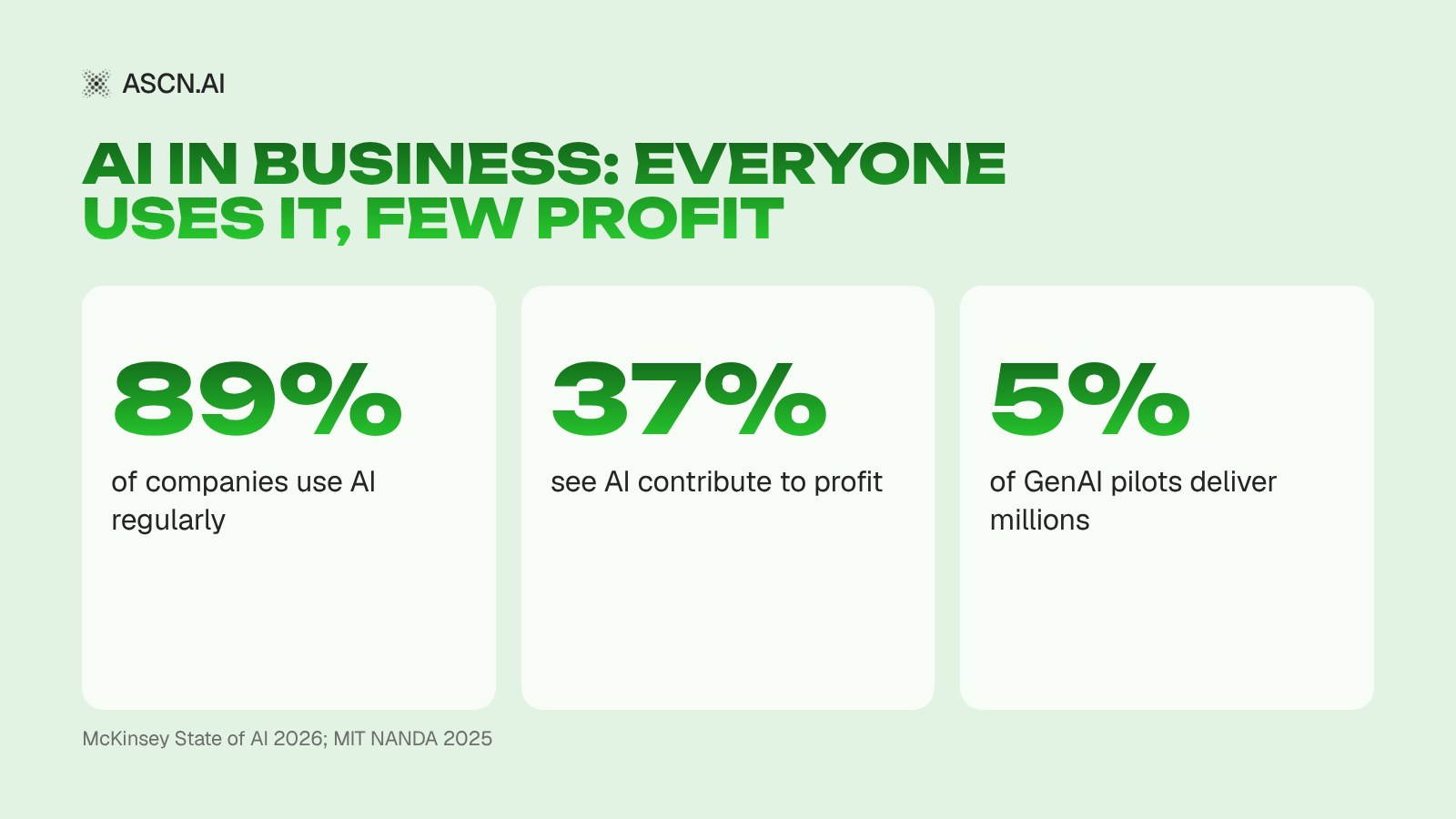
AI is now standard in companies, but profit from it is not. According to McKinsey's State of AI 2026, 89% of organizations use AI regularly. Only 37% see AI contribute to EBIT.
McKinsey also found that 40% of companies with revenue above $1 billion are scaling AI agents in at least one function. Among smaller organizations, the share is 22%.
Russia shows a similar pattern. In the Yakov & Partners study "AI in Russia 2025", 71% of large companies use generative AI (Rossiyskaya Gazeta). Almost 80% report a financial effect. For companies that use AI systematically, the contribution reaches 8% of EBITDA.
Now the other side. The MIT NANDA 2025 report found that only about 5% of generative AI pilots generate millions (Fortune). Gartner expects more than 40% of agentic AI projects to be canceled by the end of 2027. The reasons: rising costs, unclear value and poor risk control.
A September 2026 review by Solyanka (Inc. Russia) counted 51 publicly disclosed AI agent deployments in Russia. Just AI estimates that about 25% of AI initiatives pay off.
What does this mean for you? Everyone has roughly the same technology. The difference is the goal a company started with.
Where to start: pick a goal, not a tool
Start with a metric, not with choosing a model. First decide what you want to change: hours, conversion or cost per request. Then look for a task you can hand to AI.
Here is a cheat sheet. The last column shows ready-made ASCN agents for each goal.
| Goal | What to hand to AI | Metric | Ready-made agent |
|---|---|---|---|
| Less routine | email, reports | hours per week | Personal Assistant |
| More sales | lead replies | conversion, response time | Inbound Sales Pro |
| Lower costs | common questions | cost per request | Messenger Concierge |
| Hiring without bloat | screening applicants | cost per hire | HR Screener PRO |
| Documents and control | contracts, KPIs | time per document | Contract Review Agent |
Pick one row. For the first 30 days, that's honestly enough.
How to cut the time your team spends on routine
Most hours go to boring repeat work: email, meetings, a report stitched together from several spreadsheets, answering colleagues' same questions. Each task is small. But there are many of them, every day.
A typical example. Every Monday a manager builds a report from the CRM, the ad account and the sales sheet. It takes about 45 minutes. Over a year that adds up to almost 40 hours, a full work week. An agent builds that report on its own and sends it to Slack or Telegram by 9 a.m.
A big-company example is IBM. Its internal HR assistant AskHR resolves 94% of routine employee questions without HR staff (IBM case study).
There is one metric here: hours per week on the task, before and after. A practitioner's tip: start with a task people do every day. The quarterly report can wait.
Two ready-made agents fit a business owner. Personal Assistant triages your email and briefs you by morning. AI Agent for KPI Reports builds a management summary and a dashboard. Both run on their own, on a schedule and on triggers (scheduled runs start on the Start plan).
How to grow sales with AI
AI lifts sales where a company loses customers because it's slow. A lead fills in a form in the evening and waits until morning. A rep spends an hour on a call with someone who was never going to buy. A prospect goes quiet after the proposal, and nobody follows up.
Large companies already have numbers. Amazon launched an AI shopping assistant, and CEO Andy Jassy says it is on track for $10 billion in extra annual sales (Fortune). Verizon gave its support agents an AI assistant. Calls got shorter, and agents had time to sell. Sales through the service team grew by almost 40%, according to an executive (Reuters).
A small business doesn't need Amazon's scale. In an ASCN B2B sales case, a company cut lead response time "from 4 hours to 3 minutes". Conversion rose "from 12% to 34%". The logic is simple: whoever replies first has the best odds.
The metrics are time to first response and lead-to-deal conversion. Measure both before launch.
For inbound leads, use Inbound Sales Pro. The agent replies to leads in Telegram within seconds and qualifies them. It follows up on prospects who went quiet. For outbound B2B sales there is the AI Agent for B2B Lead Generation, which runs cold outreach on autopilot.
How to lower support and operating costs
Costs drop when AI takes over the flow of routine questions: order status, bookings, "where is my payment", overdue invoice reminders. A person answering these is expensive. An agent replies instantly, including at 3 a.m.
Microsoft saved more than $500 million in its call centers in a year, according to its chief commercial officer (Reuters). T-Bank's AI employee takes part in processes that cover about 30% of customer service (according to the bank). That's the share of processes, not the share of requests AI resolved alone.
Octopus Energy is an interesting case. The company spent three months testing AI on customer email replies. Customers rated AI replies higher than human ones: 76% vs 72% (Octopus Energy press release). There's a catch for anyone who wants to hand everything to a machine. At Octopus, vulnerable customers, complex complaints and sensitive cases are handled only by people.
In your own business, start with a ticket audit. In an ASCN support audit, 42% of tickets covered just 8 topics. The forecast is that an agent will take about 40% of the load off the first line. That's a forecast, not a result.
The metrics are cost per request and the share of requests resolved without a person. Add CSAT. Otherwise it's easy to repeat Klarna's mistake, covered in the case section.
Ready-made agents for this: Messenger Concierge, an AI front desk that answers customers and takes orders. For finance, AR Collector Pro chases overdue invoices. And the AI Agent for Subscription Management finds the services you pay for and don't use.
Hiring and headcount: will AI replace employees?
Short answer: large companies hire less more often than they lay people off. Mass layoffs "because of AI" have so far been smaller than expected.
According to a McKinsey chart, 32% of companies expected AI-driven job cuts in 2025. In fact, 14% reported them (figures as summarized from the chart). US numbers are harsher. The Challenger report for September 2026 says AI was cited as the reason for 120,136 job cuts since the start of the year. That's about 21% of all layoffs and the top reason of the year.
Here is what companies say themselves. Sber's CFO said in October 2025: "we're not exactly cutting staff, it's more that we're simply hiring less" (The Moscow Times). Shopify's CEO introduced a rule: before asking for more headcount, a team must show why AI can't do the job (TechCrunch).
Hiring is a task for AI too. In an ASCN high-volume hiring case, a retail chain cut time to contact a candidate "from 6 hours to 40 seconds". Cost per hire fell "from RUB 12,000 to RUB 4,800". For screening applicants there is HR Screener PRO: it reads resumes and scores candidates.
My take: the hours an agent frees up turn into money in two cases. You moved people to sales. Or you didn't open a new position. If employees are simply less busy, there are no savings.
Documents, reports and oversight
Documents are a quiet area where AI saves days: contracts, deal packages, summaries, deadlines and KPIs.
In an ASCN case, a real estate agency cut the time to prepare a deal document package "from 1–2 days to hours". We break down that project's budget below, in the ROI section.
A large-scale oversight example is X5, a Russian retailer. AI runs its pricing, demand forecasting and inventory. According to the company, in 2025 this delivered about RUB 5 billion in extra operating profit (ComNews).
One rule here has no exceptions. A person makes any legally binding decision. The agent prepares a draft and redlines. A lawyer or a manager signs.
For contracts there is the AI Contract Review Agent: redlines plus a risk verdict.
Companies that already implemented AI: wins and failures
Below are examples of AI in business with numbers. One caveat up front. The numbers come from the companies or their executives, and most have no independent audit. That's why every row has a source.
| Company | What they deployed | Effect | Year | Source |
|---|---|---|---|---|
| Amazon | shopping assistant | ~$10B sales/year* | 2025 | Fortune |
| Verizon | agent assistant | sales +~40% | 2025 | Reuters |
| X5 Group | pricing, demand, inventory | +RUB 5B profit | 2025 | ComNews |
| Sber | 700+ AI initiatives | RUB 450–475B | 2025 | TASS |
| T-Bank | AI support employee | ~30% of processes | 2026 | Investfuture |
| Microsoft | AI in call centers | −$500M costs | 2025 | Reuters |
| IBM | HR assistant | 94% without HR | 2025 | IBM |
| Octopus Energy | email replies | CSAT 76% vs 72% | 2026 | Octopus |
| Salesforce | AI support agents | staff 9,000 → 5,000* | 2025 | Outlook Business |
| Cloudflare | internal AI agents | −1,100 employees | 2026 | TechCrunch |
| Klarna | support assistant | 700 FTE → reversal | 2024–25 | Entrepreneur |
| Commonwealth Bank | voice bot | layoffs reversed | 2025 | Bloomberg |
* according to the CEO in an interview or on an earnings call.
Sales growth
250 million shoppers used Amazon's assistant over the year. Those who use it are 60% more likely to complete a purchase. At Verizon, the AI assistant supports 28,000 agents. At X5, employees built more than 2,300 AI agents themselves on an internal platform.
Less hiring and smaller teams
Salesforce. According to Marc Benioff, AI handles about half of all conversations, and the support team shrank from about 9,000 to 5,000. The company's official line is different: there are fewer requests, and open support roles are no longer backfilled.
At IBM, according to the CEO, AI replaced several hundred HR employees (People Matters). But total headcount grew, and the money went into engineering and sales. In May 2026, Cloudflare cut 1,100 people, about 20% of its staff, while revenue hit a record. Salespeople with quotas were not affected.
Lower costs
Sber launched more than 700 AI initiatives in 2025. The effect is RUB 450–475 billion: 475 billion per the SberUniversity report (TASS), 450 billion per Reuters. T-Bank put the direct effect of AI in its operations in 2025 at "tens of billions of rubles" (Finmarket). According to the SberUniversity report, Alfa-Bank's robots do the work of about 870 employees, and VTB's AI effect is about RUB 15 billion.
When it didn't work: Klarna and Commonwealth Bank
In 2024 Klarna launched an AI assistant in customer support. In its first month it handled two-thirds of chats. That's the workload of 700 people, and the company expected a $40 million effect (Klarna press release). A detail: the 700 people weren't laid off, they were outsourced contractors. In May 2025 the CEO admitted that cost had been too dominant a factor. Quality dropped. The company is hiring people for support again (Entrepreneur).
Commonwealth Bank of Australia cut 45 support roles. The bank expected a voice bot to reduce calls by 2,000 a week. Calls went up instead. In August 2025 the bank reversed the cuts and apologized (HC Mag).
One lesson. Measure first, then make headcount decisions.
What the success stories have in common:
- one measurable goal and a baseline metric before launch;
- a person handles complex cases;
- the effect is measured not only in payroll but also in quality: CSAT and repeat contacts.
How to implement AI in business: a 30-day plan
You can put AI into a business process within a month if you take one task. This plan works for small and mid-sized businesses.
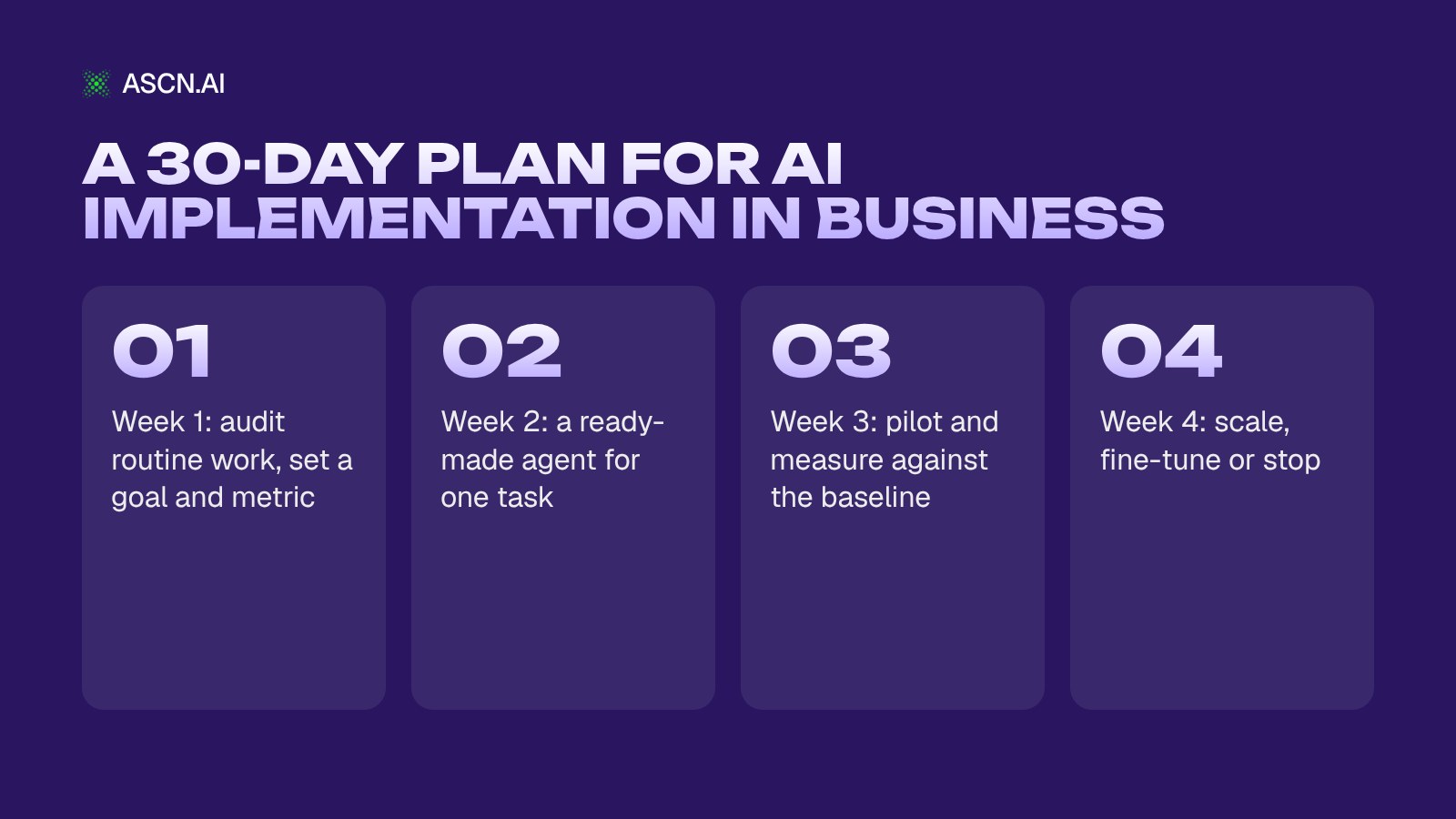
Week 1. Audit and goal
List 10–15 recurring tasks. For each, note frequency, time spent and the cost of a mistake. Pick a frequent task that affects revenue. An impact × frequency matrix makes the choice easier.
Record a baseline metric before launch. Without it, in a month you won't be able to prove the effect even to yourself. The ASCN lesson "What to automate" helps you pick the task.
Week 2. Launch on one task
Take a ready-made agent from the ASCN template catalog. Load your knowledge base: price list, policies, answers to common questions. Spell out when the agent should hand off to a person. Then run it against real requests from last month.
Week 3. Pilot and measurement
Launch the agent for one team or one channel. Compare the result with your baseline: response time, conversion, CSAT. All week, a person reviews the agent's replies and fixes the knowledge base.
Week 4. Decision
There are three options: scale, fine-tune or stop. If the metric went up, connect the next channel and train the team. BCG estimates that up to 70% of success depends on people and processes, not technology.
Don't launch five agents at once. One scenario that really works beats five pilots.
Build in-house, go turnkey or use a ready-made agent
There are three paths: build your own, hire a turnkey implementation or use a ready-made agent. According to MIT NANDA, buying from specialized vendors and partnering succeed about 67% of the time (Fortune). In-house builds succeed about a third as often.
In Russia, companies still mostly build. In the Solyanka review, 45 of the 51 public cases were in-house or custom builds. Even so, the authors recommend off-the-shelf solutions for small and mid-sized businesses.
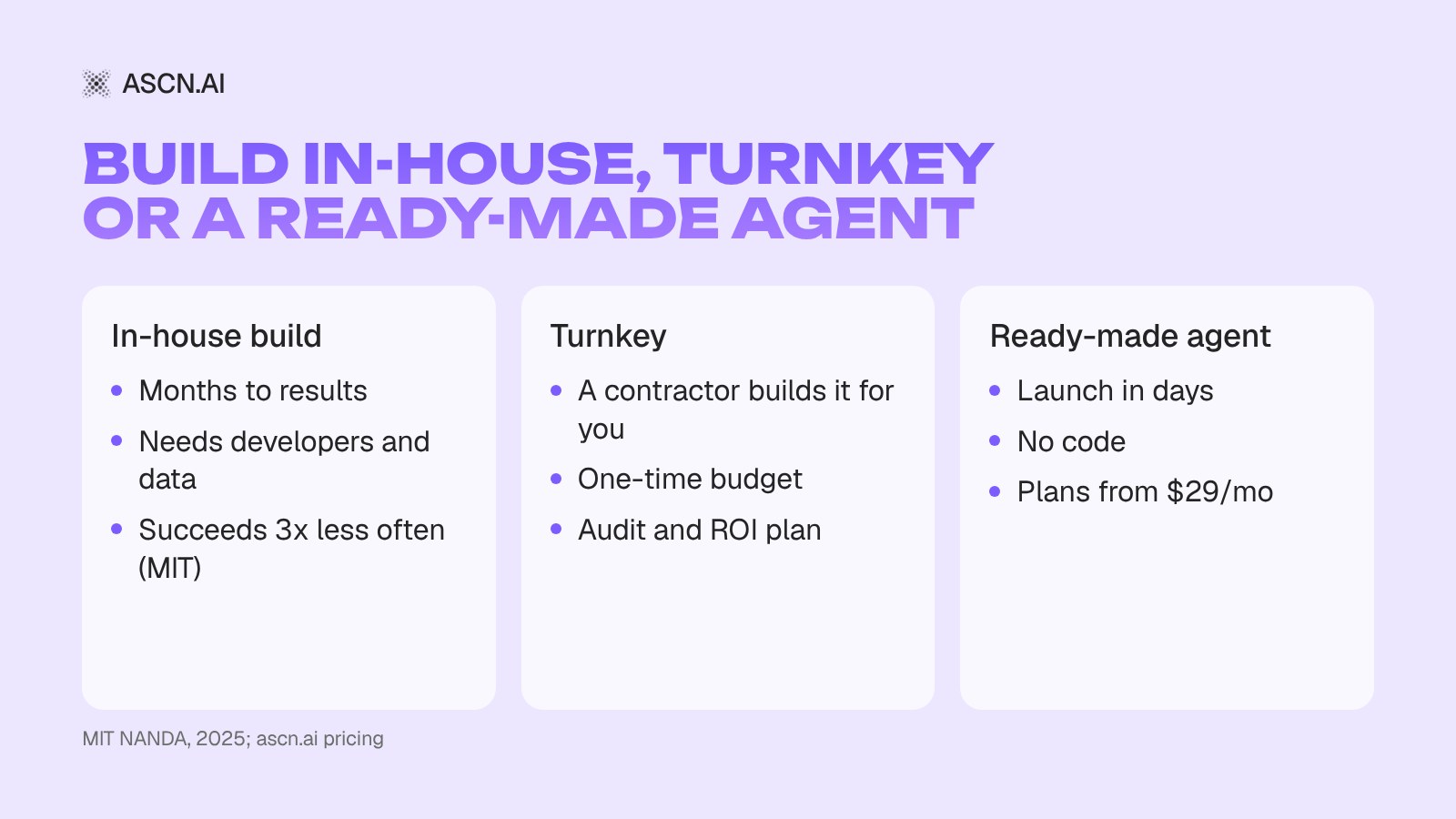
An in-house build means months, developers and data. It makes sense if AI is the core of your product. Turnkey fits when the process is complex and touches several systems. A ready-made agent is the choice when there's one clear task.
For small and mid-sized businesses, the practical route is ASCN. You pick a ready-made agent from the catalog, set it up without code and launch it in days. The ASCN team helps you set up your first agent. For complex processes there's turnkey implementation: a diagnostic with an ROI plan and launch in 30–40 hours (per the ASCN website).
Why ASCN.ai
ASCN.ai is a cloud platform for AI agents: you take a ready-made agent for your goal and launch it with no code and no server of your own. Here is what that gives a business owner on the first pilot.
- Complete ready-made agents. The catalog has 100+ agents with the logic, integrations and schedule already built. You add your knowledge base and rules.
- Your tools in one click. Gmail, Google Sheets, Google Calendar, HubSpot, Notion, Slack. The agent connects other services through APIs and MCP.
- The agent lives where you work. You can dictate a task by voice and get the report in chat. Telegram and Slack connection, 24/7 operation and scheduled runs start on the Start plan ($29/month).
- A human stays in control. The agent sees only what you allow, and risky actions run only after your approval. We cover how to set up these rules in how to reduce the risks of AI agent implementation.
- Help at the start. The ASCN team sets up your first agent with you. On the Free plan (500 credits per week, 1 active agent) you can test the scenario before you pay.
Start with one row from the cheat sheet above. If your first goal is less time on reports, take the AI Agent for KPI Reports: it builds the management summary and dashboard on its own.
How much AI implementation costs and when it pays off
The cost of AI implementation is a subscription, setup and support. Payback follows a simple formula.
Monthly effect = hours × hourly cost + leads × margin − subscription and support. Payback = one-time costs ÷ monthly effect.
Hours are the time the agent took over. Leads are the ones you would have lost without the agent. Below is a sample calculation. All numbers except the plan price are assumptions, so plug in your own.
- 3 employees answer routine questions 2 hours a day. Over 22 working days that's 132 hours a month.
- An employee hour costs $25 with taxes. Routine questions cost you $3,300 a month.
- The agent takes 40% of those questions, based on the forecast from the ASCN audit. That's 52.8 hours, or $1,320.
- The agent answers at night and on weekends. Say this saves 4 leads a month at a $300 margin each. That's $1,200.
- The Start plan costs $29 a month.
- Setting it up yourself takes 20 employee hours. That's $500 one-time.
| Item | Calculation | $ per month |
|---|---|---|
| Employee time | 52.8 h × $25 | +1,320 |
| Night and weekend leads | 4 × $300 | +1,200 |
| Subscription | Start plan | −29 |
| Total effect | ≈ +2,490 |
With these assumptions, the one-time $500 pays back in the first month. Keep credit usage in mind. It depends on the model and conversation length, so with heavy traffic you may need a higher plan.
Turnkey costs more. Implementing one agent costs $1,500 on the turnkey page. In the ASCN real estate agency case, the budget was: audit $600, implementation $1,500, training $400. Divide the total by your monthly effect.
More on budgeting in our article on the cost of implementing AI agents.
AI implementation mistakes: why projects don't pay off
A project usually fails to pay off for one of six reasons. Each has a real-world example.
- Counting only payroll savings. Quality drops and customers get unhappy. That's what happened at Klarna.
- Cutting staff before measuring. Commonwealth Bank later reversed its layoffs and apologized.
- No knowledge base and no handoff rules. The agent answers in generalities and gets the details wrong.
- AI on top of an old process. Nobody redesigned the process, so the agent just speeds up the chaos.
- The team pushes back. According to Russia's Association of Managers, 33% of companies face open employee resistance (vc.ru; the authors did not disclose their methodology). The same source gives an example: a retailer invested RUB 40 million in AI for procurement, and six months later buyers were still working in Excel. A pilot group and training help.
- Underestimating operations. Integrations, data and support keep costing money after launch.
More examples in our breakdown of AI agent implementation pitfalls.
FAQ
How much does AI implementation in business cost?
A ready-made agent you set up yourself costs a subscription from $29 a month plus a few days of setup. There is also a Free plan: 500 credits per week and 1 active agent. Turnkey implementation starts at $1,500 per agent. An in-house build means months of work and a budget for a team.
How do you start implementing AI in a company?
With an audit of routine work and one goal. Pick a frequent task that affects revenue. Record a metric before launch: hours, conversion or cost per request. You choose the model and the platform later, as step two.
Do you need developers to implement AI?
For a no-code ready-made agent, you don't need developers. You pick a template, load your knowledge base and set the rules in plain text. You'll need developers if you build your own model or connect many internal systems.
How long does AI implementation take?
A pilot on one task takes 2–4 weeks, including measurement. Launching a ready-made agent takes a few days, and the rest of the time goes to checking the effect. Turnkey implementation on ASCN takes 30–40 hours of work after the spec, per the ASCN website.
Will AI replace employees?
More often, companies hire less rather than lay people off. Sber says so openly, and Salesforce no longer backfills support roles. Those who cut staff before measuring later reversed course, like Klarna and Commonwealth Bank.
Should you implement AI yourself or go turnkey?
If there is one clear task, do it yourself with a ready-made agent. If the process touches several systems and integrations, go turnkey with an audit. The contractor will estimate ROI before you start.
Is it safe to give AI access to company data?
Give the agent access only to the data it needs for the task. Keep sensitive actions behind human approval. By default, an ASCN agent runs in the ASCN cloud, and dedicated hosting is available on request. Before connecting anything, check what data you are sharing.
Bottom line
The working formula is short. One goal, one metric, a ready-made agent and a check after 30 days. If the number went up, scale. If not, fine-tune or stop.
Start with one task. Launch your first agent for free, for example Inbound Sales Pro for leads (connecting Telegram requires the Start plan) or Personal Assistant for your inbox. If the process is complex, book a free process audit and a turnkey implementation.
AI Agents in B2B Sales: A Case of Conversion Growth from 12% to 34%
Cost of Implementing AI Agents: A Full Budget Breakdown (Build vs SaaS vs Hybrid) — How Much Does It Cost to Implement an AI Agent?

AI Agent Implementation: How to Avoid Mistakes and Mitigate Risks in Business Process Integration

How to Avoid Common Pitfalls When Implementing AI Agents: Lessons from Companies That Succeeded

Companies lose up to 40% of AI projects: how to successfully implement an AI agent and achieve real ROI
AI Agents for Business — What They Are and Why They Are Needed