



- Русский
- English
- Português
Recruitment Automation: A Retail Chain Case and 100 Hires a Month

In high-volume hiring the first fifteen minutes decide everything. Miss them and the candidate is already working at the store next door, where somebody picked up. Recruitment automation starts with reply speed here, long before anyone draws a funnel. A 50-store retail chain learned this the hard way: three recruiters, two hundred applications a day, and tills standing empty.
Calling everyone back was physically impossible. By the time a recruiter reached someone from the morning batch, that person had started a shift with a competitor around the corner. Turnover among floor staff kept climbing and the headcount plan had been missed three quarters in a row.
Familiar nightmare for retail HR? The chain launched one AI agent in four days and closed the gap without complex integrations.
What recruitment automation delivered
First contact with a candidate fell from six hours to forty seconds, filled vacancies went from 25 a month to 100, and cost per hire dropped from 12,000 to 4,800 roubles. The HR team stayed exactly the same size.
The problem: recruiters working as answering machines
The segment is retail. The roles are simple: sales assistants, cashiers, loaders. One hire cost 12,000 roubles, and seventy percent of a recruiter's day went into cold calls and repeat questions about schedules and health certificates.
"We spent the budget on job boards and then watched candidates not pick up the phone. Recruiters burned out on endless rejections and identical conversations," says the head of HR.
They needed something that reaches a person the minute they press Apply and carries them through to an interview at a specific store.
The fix: an AI agent that messages first
The agent was built on the ASCN platform and set to pick up applications from every source at once. The candidate clicks Apply on a job site and gets a WhatsApp message seconds later.
Screening follows: age, experience, health certificate, preferred schedule. For anyone who fits, the agent offers interview slots at the nearest store and books the meeting in the store manager's calendar. The recruiter steps in at the end, when the person is already selected and scheduled.
One detail matters more than it looks: the agent works at night. Floor staff look for jobs in the evening and on weekends, and those were exactly the hours when half the applications used to die.
From application to interview
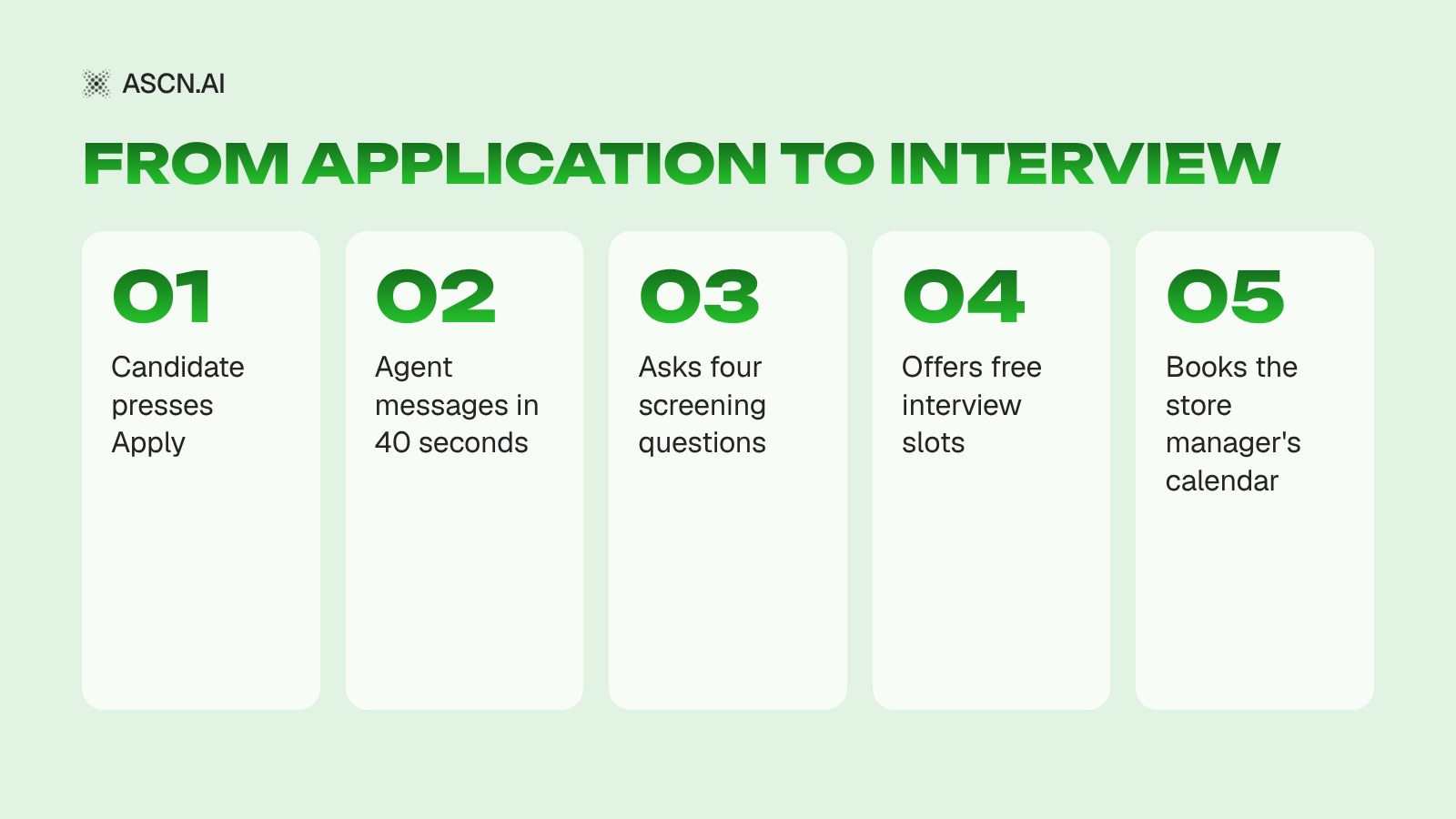
The flow is identical across all fifty stores. The application reaches the agent, the agent messages the candidate, asks four questions and checks the answers against the vacancy requirements. Candidates who do not fit get a polite decline right away instead of a week of silence. Those who do pick a time from the manager's genuinely free slots.
We covered the same selection-and-booking pattern in the cases on lead qualification in real estate and on patient booking at a clinic. The questions and criteria change, the logic does not.
The numbers after three months
| Metric | Before | After |
|---|---|---|
| Time to first contact | 6 hours | 40 seconds |
| Vacancies filled per month | 25 | 100 |
| Cost per hire | 12,000 roubles | 4,800 roubles |
| Application to interview show-up | 18% | 45% |
| Store staffing level | baseline | 98% |
The show-up rate is the telling line. It grew two and a half times not because the candidates got better, but because of speed: people agree to a meeting while they are still interested.
"The agent does not sleep and does not take rudeness personally. It handles applications at 11pm, which is when people actually look for work. That is a breakthrough in our operational efficiency," notes the chain's COO.
What to keep in mind in volume hiring
Keep messages short. Someone applying for a cashier role will not read a paragraph of corporate welcome. Three lines, one clear question, an obvious next step.
Send a reminder. A message an hour before the interview with the address and directions lifts show-up rates by roughly 20%. It is the cheapest change in the whole scenario.
Sync with the managers' calendars. The agent should only offer slots when the store manager is genuinely available. Otherwise you trade a lost candidate for a fight with the store.
Decide what happens to rejections. An automatic polite decline right after screening saves the candidate a week of waiting and saves you from reviews on employer sites.
Frequently asked questions
How long did the rollout take?
Four days. The longest part was agreeing screening criteria with HR and getting access to the store managers' calendars. The agent itself configures faster.
Does messaging a bot put candidates off?
In volume hiring it seems to work the other way: show-up rates went from 18% to 45%. Answering four questions in a messenger is easier than taking a call from an unknown number mid-shift.
What if a candidate asks something outside the script?
The agent answers from the knowledge base about the role and conditions, and passes anything beyond it to a recruiter. It is not supposed to invent working conditions, and it does not.
Do you need a developer?
No, the agent is built in a no-code interface. Code only comes up if you run a custom ATS with no open API.
Does this work without 200 applications a day?
Yes, though the gain is speed rather than volume. Even at twenty applications a day, replying in a minute instead of six hours changes conversion noticeably.
The bottom line
In volume hiring, whoever answers first wins. The chain stopped chasing candidates by phone and started meeting them at the moment they apply. The same three recruiters now fill four times as many roles, at less than half the cost per hire.
Ready-made hiring and screening agents are in the ASCN marketplace, with questions you tune to your own vacancies. For help with ATS integration, message a manager on Telegram.
AI Chatbot for Hotels: A Country Club Case and 40% Ancillary Revenue Growth

AI Agent for Real Estate: An Agency Case and 2-Minute Lead Qualification
AI Chatbot for Logistics: A Trucking Case and 75% Fewer Calls
AI Chatbot for Clinics: Cutting Patient Acquisition Cost Threefold
AI Chatbot for Instagram: A Furniture Showroom Case and 2.7x More Bookings
AI Agents in B2B Sales: A Case of Conversion Growth from 12% to 34%