



- Русский
- English
- Português
AI for Small Business: Where to Start and What to Hand Off to an Agent

Key takeaways
AI for small business is most useful where the same work repeats every day: answering customers, taking bookings, sending reminders. That is also where to start. An AI agent takes that work over: it replies to customers in Telegram using your facts, logs requests in a spreadsheet and forwards tricky questions to you. Start with one task and a list of ten common questions. You can test a ready-made ASCN.ai agent on the free plan (Telegram and 24/7 operation start with the Start plan).
It is evening, the coffee shop is closed, and there are three new questions in Telegram: what time do you open tomorrow, do you have lactose-free milk, can I order a cake for Saturday. The owner knows every answer by heart but will only get to them in the morning. That is a typical small business situation, and by morning the customer may have ordered the cake somewhere else.
Contents:
- AI chat vs AI agent: what is the difference
- What it looks like in a cafe, salon and auto shop
- Where to start: the first task for an agent
- When a small business does not need AI
- Why ASCN.ai and how to try it
- FAQ
AI chat vs AI agent: what is the difference
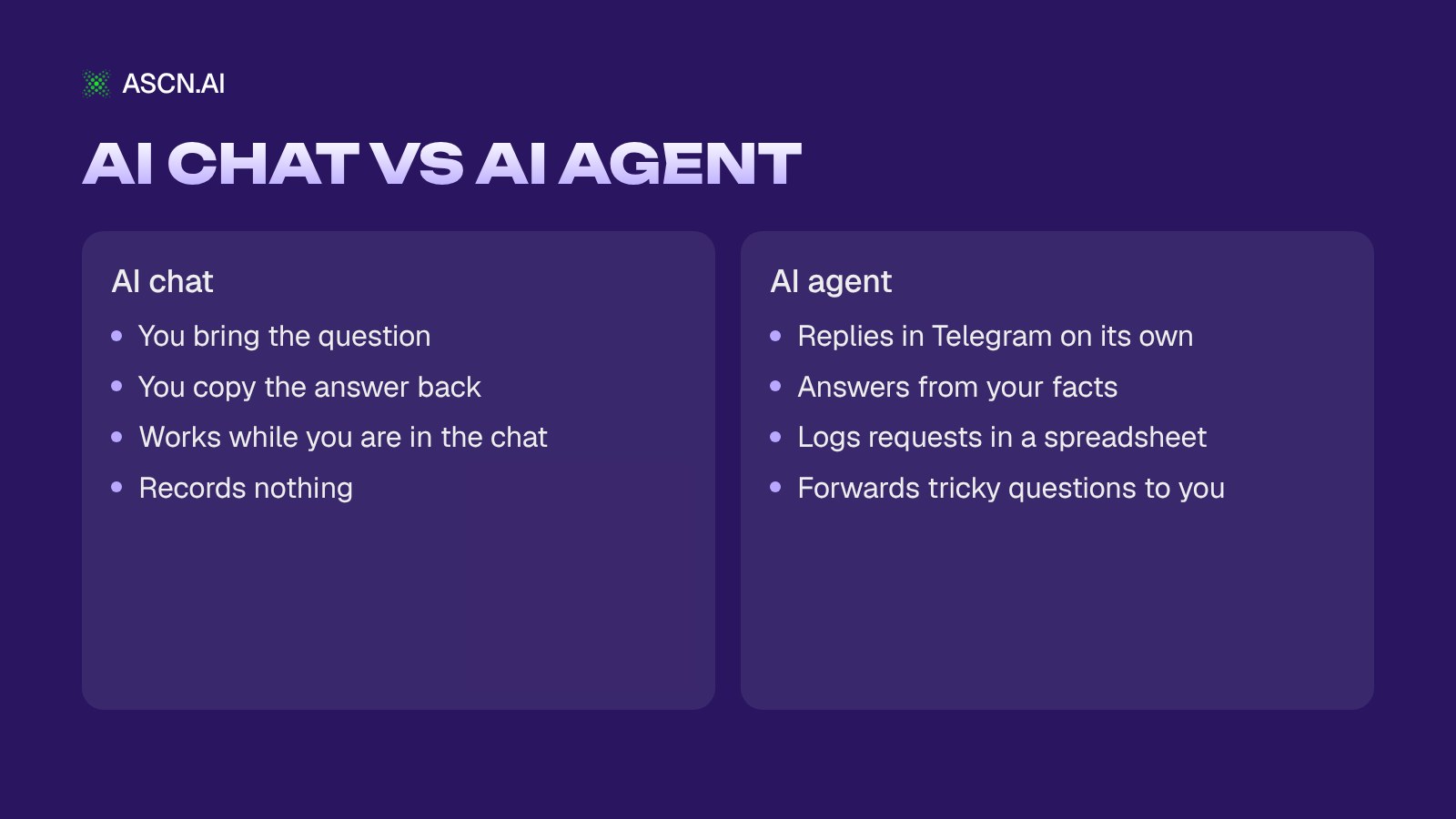
An AI chat answers only when you ask it something. An AI agent works without you, right where customers write to you or where your data lives. An AI agent is a program connected to your messenger, spreadsheet or calendar that handles repetitive work on its own, following the facts and rules you gave it.
With a chat, everything depends on you. A customer asks about delivery: you copy the question, paste it into the chat, read the answer, edit it and paste it back into the messenger. That works well for texts, ideas and emails. But once you close the tab, the work stops.
An agent works differently. It reacts to an event: a new message arrives, a customer has been silent for three days, it is Monday morning. It answers from facts you gave it in advance: services, prices, opening hours, rules, tone of voice. It takes the conversation to an outcome, for example by logging a request in a spreadsheet. If the agent does not have an answer, it forwards the question to you.
A simple example. A customer asks how much a haircut costs, and the agent answers from the price list and saves the contact. The customer asks for a discount, and the agent passes the question to the owner and tells the customer that a person will reply.
If you want to dig deeper into how agents work, we have a separate piece: what an AI agent is in simple terms.
In a survey of Russian small business owners reported by Sostav, roughly every second entrepreneur already uses AI tools. Among the main obstacles, respondents named the lack of clear use cases: it is not obvious which task to apply AI to. So the rest of this article is about tasks from an ordinary working day.
What it looks like in a cafe, salon and auto shop
In a small business, the agent takes over repetitive messaging and bookings, while money, complaints and unusual cases stay with the owner. The situations below are typical scenarios, not stories of specific customers.
Coffee shop: questions in the evening
Back to the coffee shop from the start of the article. The agent gets the menu, opening hours and pre-order rules in advance: how many days ahead you take cake orders and whether you need a deposit. It answers the opening-hours question right away and the lactose-free milk question from the menu. It logs the cake order in a spreadsheet and sends it to the owner for confirmation, and tells the customer the order has been passed on and they will hear back in the morning.
Custom orders and complaints stay with the owner. For this kind of work there is a ready-made agent, Messenger Concierge, an AI front desk in Telegram. If you are still choosing between a simple bot and an agent, see our overview of Telegram bots for business.
Beauty salon: bookings from chat
On Saturday morning a client writes: "Can I book a manicure on Thursday after six?" The receptionist is busy with a guest at the front desk and will reply in a couple of hours. The agent replies right away: it asks which stylist, offers open slots and adds the booking to the calendar or spreadsheet. The day before, it sends a reminder, and a month later it suggests booking again.
The owner keeps the staff schedule and disputed cases such as last-minute rescheduling. The same AI front desk handles this work: it needs a list of services and access to the calendar. A fair caveat: if online booking through a widget on your website already works, you do not need AI for the booking itself. A standard automation can send the 24-hour reminder.
Auto repair shop: reviews and complaints
Reviews of an auto repair shop often go unanswered for weeks: the mechanics are busy with cars, the owner with parts and customers. The agent drafts replies following the owner's rules: thank people briefly, skip the canned apologies, give the shop's phone number when someone asks about the warranty. Once a week it collects recurring complaints into one summary. For example, three people in a week wrote that it took too long to get their car back after a repair. A summary like that shows what to fix in how the shop runs.
The owner personally answers reviews that complain about money or a damaged part. Other replies are also best published after the owner has looked at them. The Clara customer support agent in the ASCN catalog fits this task (available from the Start plan).
Small shop: posts and customers who went quiet
The owner of a small shop often writes social media posts late in the evening, and in a busy week does not write them at all. The agent gets a list of new arrivals and a couple of example posts you like. It prepares drafts for the week and publishes them after you approve. That is how the SMM Content Factory agent works.
The second task is customers who asked for a price and went quiet. A few days later the agent writes to that customer again: it reminds them about the product or suggests a similar one. The owner checks product photos and sale prices. One follow-up is usually enough, because frequent reminders annoy people.
Online school: the same student questions
A course coordinator answers the same things day after day: where to find a lesson, when an assignment is due, what to do if access does not work. The agent answers from the course materials and the school's rules. If the materials do not have the answer, it passes the question to the coordinator along with the conversation. The same AI front desk works here too: instead of a menu, you load it with the course rules.
AI will not replace a substantive review of homework. A conversation with a student who is about to drop out also stays with a person.
One task suits any owner: expense tracking. For example, you message the agent "paid $1,500 for rent", it adds a row to a Google Sheet, and at the end of the month it shows where the money went. That is how the AI Financial Assistant for Small Business works. It does not replace your accountant.
Where to start: the first task for an agent
In almost every case, start with customer replies and pick the AI model second. The owner of a small business will barely notice the difference between models. What they will notice immediately is whether the agent knows your answers or not: you can see it from the first message to a customer.
A good first task repeats every day, you know the answers by heart, and an agent's mistake does not cost money: you can correct it with the next message. Customer replies fit these conditions for almost everyone and also take up the most time. In a Yandex Go for Business survey of Russian entrepreneurs, owners named working with customers the most time-consuming routine task.
The first step comes before any setup: write down the ten most common customer questions and your answers. It usually takes one evening. If an evening is not enough, the problem is not AI: the answers have not been agreed on even inside your team, and the agent has nothing to answer from. The finished list does two jobs at once. It shows that the process is ready, and it becomes the agent's knowledge base, the set of facts it answers from.
| Task | When to hand off | What the agent does | What stays with you | Ready-made agent |
|---|---|---|---|---|
| Customer replies | Messages every day | Answers from price list | Complaints and disputes | Messenger Concierge |
| Bookings and reminders | Bookings come via chat | Books and reminds | Staff schedule | Messenger Concierge |
| Posts and promotions | You write posts yourself | Drafts for the week | Photos, prices, approval | SMM Content Factory |
| Expense tracking | Expenses in notes | Rows in a spreadsheet | Taxes and accounting | AI Financial Assistant |
| Review replies | Reviews go unanswered | Draft replies | Complaints in person | Clara (from Start) |
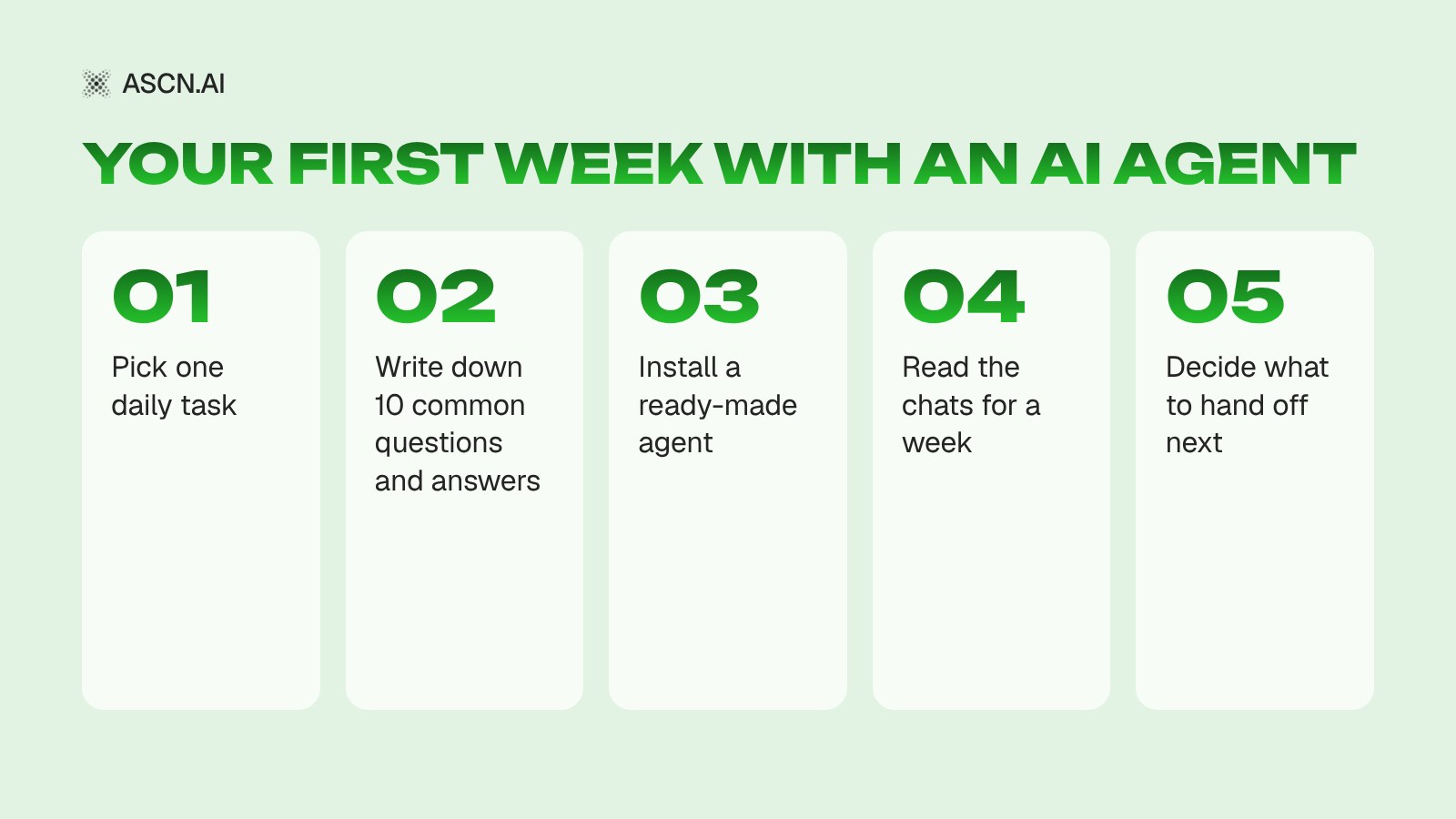
Take on the rows below the first one once the first task runs without your constant supervision. If you have a team and several tasks at once, our 30-day AI implementation plan will help. For a detailed launch order across five agents, see the one-week playbook of AI tools for small business.
When a small business does not need AI
You do not need an AI agent where there is little messaging or simple automation already covers it, and where a mistake costs money. Here are those cases:
- Few messages, a handful a day. A pinned message and quick-reply templates in your messenger are enough.
- Online booking already works. A standard automation can send the visit reminder; you do not need AI for that.
- The process is not written down: there is no price list, rules keep changing, orders get lost in direct messages. An agent will only speed up the mess, so put things in order first.
- Decisions about money: discounts, refunds, the price in a quote. Customers take what the agent says as a promise from the business, so these decisions stay with the owner.
- Contracts and other legally binding documents. An agent can sketch a draft, but a lawyer should check it.
The agent takes on the routine part of the work. Responsibility for the business stays with you.
Why ASCN.ai and how to try it
You do not need to code to try an AI agent on ASCN.ai: a ready-made agent installs from the catalog in a few minutes, and you can describe the task in plain words in the chat. People usually launch their first agent in one evening. Most of that time goes into describing your business: services, prices and rules.
- Complete ready-made agents. Messenger Concierge, SMM Content Factory, AI Financial Assistant and Clara install from the catalog with their logic and connections already set up. You only add the facts about your business and your rules.
- Connections without code. Google Sheets, Calendar, Gmail and Notion connect with a button; the agent connects services outside the list through APIs and MCP.
- Switch models in one click. You can give the agent Claude, GPT, Gemini, DeepSeek, Qwen and other models, so choosing a model does not hold up the launch.
- Help with your first agent. The ASCN team sets up your first agent together with you in chat or on a call.
- Sign up at ASCN.ai.
- Pick a ready-made agent from the catalog for a task from the table above. Messenger Concierge, the AI front desk for Telegram, is a good first choice.
- Give it the facts: services, prices, opening hours, address, rules and tone of voice. Add your list of ten common questions. You do not need a website; offline businesses work too.
- Specify which questions to forward to you and connect a spreadsheet or calendar, and Telegram from the Start plan.
- For the first week, read the conversations and add the answers the agent was missing.
The Free plan gives you 500 credits per week and one active agent. Credits are the internal unit of payment: they are spent while the agent works. That is enough to test one task: on Free you can send the agent customer questions in the ASCN chat and see how it answers. Connecting it to Telegram and running it 24/7 starts with the Start plan at $29 per month. For other tasks you can give to agents, see our overview of AI agents for business.
The easiest place to start is Messenger Concierge: it answers customers and takes requests. Sign up, find it in the agent catalog and give it that list of ten questions.
FAQ
How much does AI for a small business cost, and can it be free?
ASCN.ai has a Free plan: 500 credits per week and one active AI agent. Paid plans start at $29 per month, and from the Start plan the agent connects to Telegram and works around the clock. How many credits you use depends on the model and the length of conversations, so test one task on the free plan first and check the usage.
Do I need to know how to code to set up an AI agent?
No. On ASCN.ai a ready-made AI agent installs from the catalog, you can describe the task in plain words in the chat, and you do not need your own website. The list of answers to common customer questions will take the most time. The setup itself is usually shorter.
Will the agent make things up or be rude to customers?
An AI agent answers from the facts you gave it: services, prices, opening hours, rules. You also set the tone, and the agent forwards complaints and unusual questions to the owner. If the list of answers is empty, the replies will be generic, so read and update the conversations during the first weeks.
Is it safe to give an AI agent customer data?
An AI agent sees only what you gave it access to. Every ASCN.ai account is isolated, keys to connected services are stored encrypted, and the agent performs risky actions only after you confirm them. It is better not to pass unnecessary personal customer data to the agent.
Will AI replace the receptionist at a salon or cafe?
Not completely. The AI agent will take over routine replies, bookings and reminders. Decisions, conflicts and personal contact with regular customers stay with a person. More often, the receptionist simply stops answering the same questions in chat and spends more time with the people who walk in.
AI Implementation in Business: How Leaders Save Time, Grow Sales and Cut Costs
AI Assistant: What It Is and How to Use It at Work
AI Tools for Small Business: 5 AI Agents to Launch in One Week (2026 Playbook)
AI Agents for Business — What They Are and Why They Are Needed

Telegram Bots for Business: A Complete Guide
What is an AI agent in simple terms?