



- Русский
- English
- Português
Telegram Bots for Business: A Complete Guide

Businesses around the world are currently using Messenger Bots to automate customer service through the use of Telegram Bots. Consumer demand is growing each year for Messenger Bot solutions by 40% every year. This will become more critical over time to reduce the burden of repetitive responses from human customer service representatives to automated responses via Messenger Bots. However, as of today, 70% of companies that have Messenger Bots still provide answers to frequently asked questions via manual responses, which costs companies and their customers time and money. My experience in the automation of customer services spans the last 8 years — I've worked with companies from those with less than a million-dollar turnover to the largest corporations, yet to this day I'm constantly amazed why most of these companies do not take advantage of a tool like Messenger Bot that pays for itself within 1 month and does not take a vacation. With Telegram Bots for Business being very popular in today's marketplace, this marketing automation tool is no longer viewed as a "geeky" feature, but a tool all businesses should have — if they don't want their competitors to grow faster than them.
In 2023, we tested 43 different automation workflows with the Telegram APIs, and the findings were as follows: the majority of leads companies receive — 60% of them are lost simply because a company rep does not reply to an initial inquiry within the first five minutes of contact. Messenger Bots reply instantly and do not take a lunch break.
What is a Telegram Bot for Business?
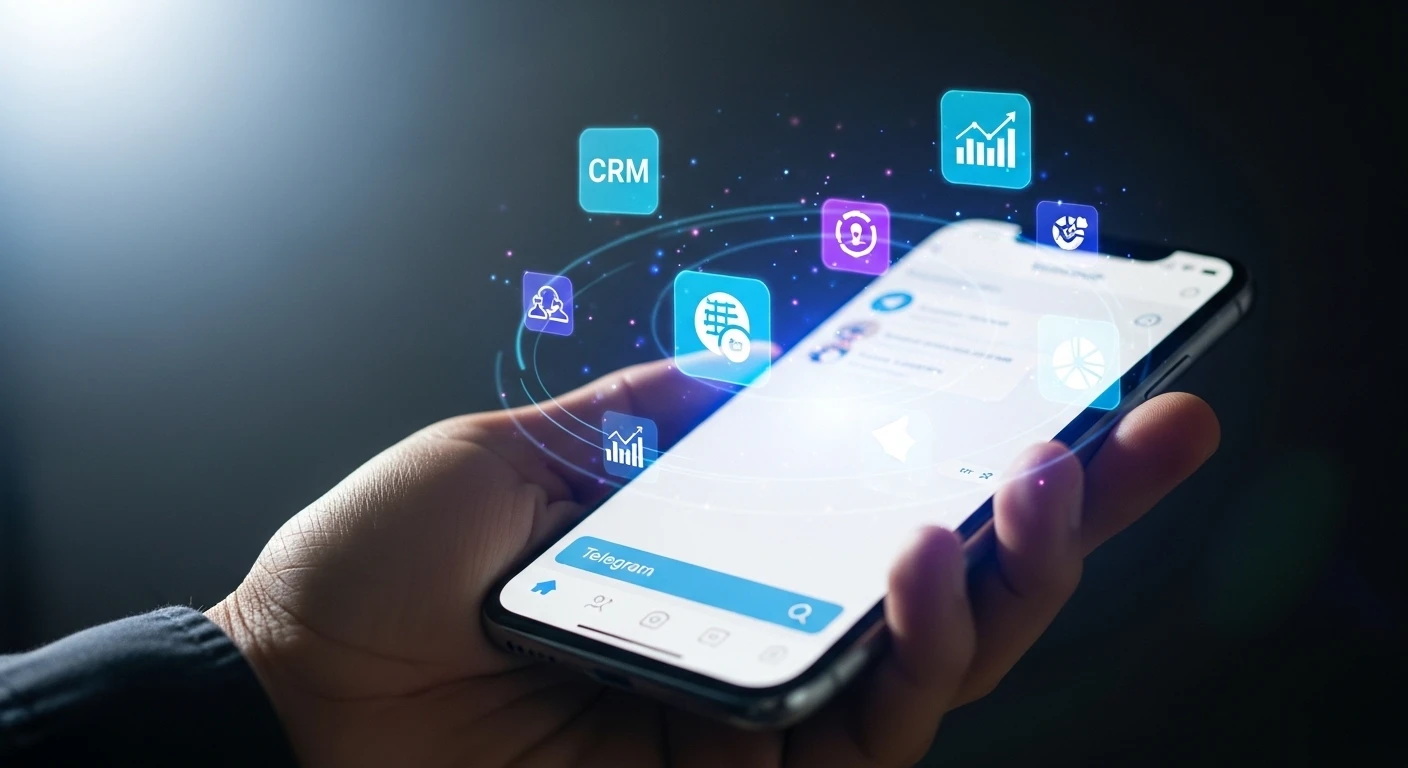
A Telegram Bot for Business is a software application created to enable communications with customers using the Telegram APIs. Telegram Bots can replace traditional FAQs and contact forms for answering frequently asked questions or collecting customer information. Instead, Messenger Bots allow for real-time interactions between a customer and a company.
Three key benefits:
- Eliminates common questions from your employees' workload by directing clients to your site to review order status.
- Enables you to collect leads anytime — while you're sleeping, the bot is up working for you.
- Provides integration with all other technologies — CRM, analytics, warehouse inventory.
According to statistics compiled by Telegram Business (2024), it is anticipated that by 2025, 85% of client communications will be conducted via a bot or an AI-powered voice assistant with no human intervention.
Speed of response is critical in the cryptocurrency marketplace. If the market fluctuates 10% in 1 hour, and you've been waiting 3 days for support, that is unacceptable. With a bot, your response time is instant, regardless of whether your team is attending a conference or sleeping.
Advantages of Automating Processes — Why You Shouldn't Ignore Automation as Just a Passing Fad
Time Savings — A GPT Bot is capable of managing around 80% of routine inquiries: order status inquiries, product recommendations, etc. As a result, operators can focus on more complicated issues where they actually require expertise.
Cost Savings — Payroll, taxes, office space, plus all the various costs required to support 3 operators runs approximately 150,000 rubles/month. By comparison, subscribing to a no-code AI-based platform begins at $29. The savings represent 20 times the cost versus the same support level.
Customer Experience — Bots can respond to inquiries in less than 10 seconds; they do not tire or become frustrated. A Zendesk survey (2024) indicates that 67% of customers prefer a bot with an instant response over a human who will provide an answer, albeit delayed.
Scalability — When traffic suddenly increases 5x as a result of a media mention, the bot handles all requests without breaking a sweat — you do not need to bring in additional staff to meet demand. On October 11, 2024, at ArbitrageScanner, our bot received 8x the amount of requests during the flash crash. Clients received real-time updates with arbitrage instructions. Analytics are generated from every bot-client conversation, giving insights into the most frequently asked questions, where clients drop off in the process, and common objections — to improve both product and marketing.
Automating the Selling Process and Providing Customer Support
The main purpose of business bots is automating the selling process and providing customer support.
Automating sales via bot is done through the use of pre-defined scenarios. When a customer writes to the bot and says "I am interested in purchasing," the bot will ask clarifying questions, show the catalog, create a shopping cart, accept payment, and send access. All of this occurs in real-time, with no need for phone calls or long back-and-forth text conversations.
A typical sales scenario would include the following steps:
Lead Qualification. A bot asks for specific details such as budget, timeframe, and nuances associated with the task. If the customer does not meet your minimum budget, for example, the bot is upfront about it and provides alternatives — articles, videos, e-books, guides, or an opportunity for a later consultation.
Product Presentations. Instead of using generalized phrases, present concrete cases. For example: "Company X was able to reduce processing time by 60% over a 2-month period."
Handling Objections. If a customer asks "Why is it so expensive?", a bot won't dodge the question. Instead, the bot will offer a comparison:
"Our offering replaces three subscriptions: Glassnode ($29/month), Messari ($50/month), and Nansen ($150/month) — with a monthly savings of $271."
Lastly, a bot closes the deal for your company.
Using bots can significantly reduce the number of repetitive questions from clients. For example, 80% of all inquiries received by an organization are the same. Questions such as "How do I reset my password?", "Where is my order?", or "When will my order be delivered?" can easily be answered by a bot in seconds, leaving customer service operators free to handle only more complicated cases — refunds, technical issues, or conflicts.
Real-World Example: ASCN.AI Crypto Analytics Bot
In this use case, ASCN.AI has built a bot for handling cryptocurrency trading analytics. A trader may ask the bot "What happened to the price of XRP?" The bot immediately retrieves the XRP price from a variety of sources — blockchain data, news aggregators, and social media platforms (Telegram) — and responds in under 10 seconds. For example, it would inform the trader that XRP price has increased by 18% within the last 24 hours, with the reason being approval of an ETF in the USA by the SEC on October 11, 2024, increased trading volume by 12% from large holders, and positive sentiment in 47 Telegram channels.
Customer Segmentation and Personalization
Customer segmentation and personalization are accomplished based on activity. The bot categorizes clients into one of three categories: new, active, or dormant. New clients receive educational material; active clients receive promotional material; and dormant clients receive time-limited promotions (30-day shelf life) or exclusive offers.
The bot sends a personalized message to the client — their name, when they signed up for a newsletter, and what's been added since their last visit. For example: "Ivan, you subscribed to the weekly crypto trading newsletter and have not visited the site since that date. The following three additions have been made since then..." The bot will also remind clients of an unfinished action if they go inactive for at least one week.
One example of a re-engagement trigger: a user browsed the catalog and left without purchasing — within one hour they received: "Company Y solved exactly this kind of task in 14 days..."
Telegram vs. Email
Email has an open rate of only 15–25%, while Telegram has an open rate of 70–90% because messages are delivered as personal notifications. The click-through rate for Telegram is three to four times that of email.
Integrations
A bot is not a stand-alone application — it works together with CRM systems, spreadsheets, warehouses, and payment gateways. Without these integrations, the bot remains a toy with little practical function.
Primary integrations include:
CRM (AmoCRM, Bitrix24, HubSpot) — A new lead received from a bot is automatically added to the CRM, and the record is labeled "source: Telegram bot." The manager has access to all previous messages from the bot.
Google Sheets / Excel — The bot logs the person's name, requests, and results in a spreadsheet. This is useful for small businesses that don't have a full CRM system.
Payment systems (Stripe, YooKassa, crypto-processing) — Payment can be made directly within the chat; a receipt is generated and the client is added to the customer database.
Third-party service APIs — The bot can communicate with delivery services via the Russian Post API, retrieve exchange rates, or query the blockchain. Connectivity with Ethereum and Solana nodes allows a balance to be retrieved by address within 3 seconds.
How it works technically:
A webhook is triggered when the bot receives an event (new message, payment received, link clicked). A request is sent via HTTP to the CRM or another service via an API. The response is processed — for example, saving the deal ID created by the CRM for later use.
If you don't have a developer, no-code platforms such as ASCN.AI can help you set this up using simple visual editors. According to Salesforce statistics for 2023, companies that have integrated a CRM system with communication channels increase their lead-to-customer conversion rate by 27% and reduce the time to close deals by 32%.
Types of Telegram Bots for Business
Chatbots for Communication and Customer Support
A chatbot functions similarly to an FAQ page — it has a question-and-answer system. When a client asks a question, the bot analyzes the text, provides an answer, or transfers the conversation to a live agent if the question is too complex.
There are a few types of chatbots:
Rule-based chatbots operate on a rigid scenario structure. When the word "price" is entered into the chat, the bot sends a price list. Easy to set up, but inflexible — they produce forced responses rather than natural conversation.
NLP chatbots understand the context of a user's question. For example, if the client asks "How much is your crypto analytics?", the NLP chatbot shows the currently available pricing.
AI chatbots (GPT / Claude) generate the best answer according to the context of the query. If a client asks "I am a beginner, where do I start?" — the AI chatbot provides a comprehensive, personalized guide. And if a client asks something like "I submitted a withdrawal request, why is it taking so long?" — the bot can ask for the transaction ID, retrieve the status from the blockchain, and inform the client of its current status and estimated completion time. No generic answers — an accurate, customized response.
Internal Business Process Bots
These bots do not communicate with clients — they assist the company's internal departments. Examples include:
- Reporting bots — collect data from Google Sheets, CRMs, ad accounts, generate a dashboard, and send it to the appropriate staff.
- Risk monitoring bots — monitor advertising budget levels and remind users to replenish when necessary.
- Interdepartmental communication bots — send automated notifications to the appropriate departments.
At QuickShock's crypto agency, we built a bot that reduced folder creation and assignment to managers from 20 minutes down to 30 seconds.
Platforms and Services to Build Telegram Bots
There are three options for building Telegram Bots:
- Development from scratch (custom code) — Full control, requires a solid project team; minimum budget starts from 300,000 zł.
- Bot constructors with templates (no-code light) — Manychat, Chatfuel — quick to build but less customizable.
- No-code automation platforms — ASCN.AI, Make, Zapier — visually build all logic flows, connect to any third-party platform, and get AI support. Launch an MVP within hours, with payment integrations included. Subscription fees start from $29/month.
My recommendation: start with a no-code platform to quickly build and deploy your bot and get real feedback — before investing in a custom-built solution.
Bot Selection and Implementation Considerations

Before deciding to launch a bot, consider these 3 factors:
- What specific issue does the bot address? Without a measurable outcome (e.g., reduce response time to leads, process 500 inquiries), an automated solution has no clear value.
- How many requests do you expect daily? Generally speaking, a bot starts delivering real value once you're handling at least 100 requests daily.
- How repetitive are the requests? If the majority of questions repeat, a bot delivers significant value. If most questions are unique, a human support specialist will likely have more impact.
Selection Checklist:
- CRM and database integration capability
- Ability to accept payments directly from the chatbot
- Analytics: how many users initiate chat, how many convert, where they drop off
- Ability to scale with your business
Implementation Checklist:
- Create a basic prototype in one day: receive a message, send back a simple response. Test on 10 users.
- After one week of testing, improve functionality — add lead qualification, CRM integration, trigger-based emails. Do not use the chatbot as the only source of customer service.
- Train employees. Managers should know how to use the chatbot; analysts should monitor engagement metrics.
- Iterate every two weeks — add new scenarios, simplify dialogues, and eliminate bottlenecks.
Common Mistakes:
- Too much text — long paragraphs drive users away. Use short messages (2–3 sentences) and buttons.
- No option for a live person — complex questions should be transferred to a manager quickly.
- Ignoring analytics — without data, it's nearly impossible to improve your scenarios.
Conclusion and Recommendations
Telegram Bots are not just a passing trend — they are a viable means for businesses to engage with clients. They're available 24/7, shorten the path from inquiry to purchase, and reduce support costs. Businesses can build their own bots using a no-code platform or order a custom bot from a developer; no-code is the preferred starting point for businesses that want to move fast.
Steps to Build Your Bot:
- Register with BotFather and receive a token.
- Choose between no-code and custom development.
- Set up your message processing logic and product catalog.
- Integrate a payment gateway (YooKassa, Stripe, Cryptomus).
- Set up automated order processing with notifications and confirmations.
- Drive traffic through advertising, referral channels, and partners.
- Add advanced features: personalization, loyalty programs, analytics.
Note: While building a new bot, focus on establishing an MVP and collecting user feedback. An active, functioning chatbot today is more valuable than a perfect one in 3 months.
Future Development and Scaling
- Use AI-generated voice and video messages to build credibility.
- Use MiniApps for richer UI options within Telegram.
- Connect user behavior analytics tools such as Google Analytics and Yandex Metrica.
- Scale by creating franchise or white-label bots.
- Explore AI assistants to handle complex requests without manager involvement.
- Open new traffic channels through advertising and SEO experimentation.
Overall, Telegram continues to evolve, and businesses that adopt new features quickly gain a real market advantage over competitors.