



- Русский
- English
- Português
What is an AI agent in simple terms?

The last few years have seen a departure from traditional methods of performing tasks to the introduction of new forms of AI capable of completing tasks autonomously.
When I am analyzing many transactions on my own time or working on crypto projects, I continually ponder if current autonomous AIs will be necessary for businesses operating in 2060.
The characteristics of an AI agent can be summed up as having 24/7 availability, low cost of operation with minimal human supervision, and the ability to perform tasks without any manual assistance before being requested or provided with permission.
Let’s examine some of the characteristics, functionalities, and benefits associated with implementing AI as part of your business strategy.
"It’s clear that I have automated many repetitive functions within the last 8 years (from basic bots to very complex AI systems) and that an effective AI solution will not eliminate the entire workforce, but will replace 60%–70% of the work being done by the workforce that can be typically performed by machines or performed without human input. As an example of this, our project ASCN.AI has managed hundreds of thousands of dollars in transactions, and created reports from many data sources in under 10 seconds compared to the hours a person would spend to do the same things based on their historical records."
Introduction to AI Agents
In this section, we will provide an overview of AI agents, and how these agents work and why businesses should consider using AI. An agent can change its plan when it receives new information about its environment and use technology to decide what actions would be appropriate to take. This is very different from a traditional bot that will perform its tasks only according to a set of rules provided by the user.
Think about it this way: your virtual assistant will respond to your requests for information, and will also gather all relevant data that you need in order to create the solution you desire (and omit anything that is not relevant). An AI agent helps many businesses perform tasks that require collecting real-time market information, analyzing it, and making decisions on behalf of their clients.
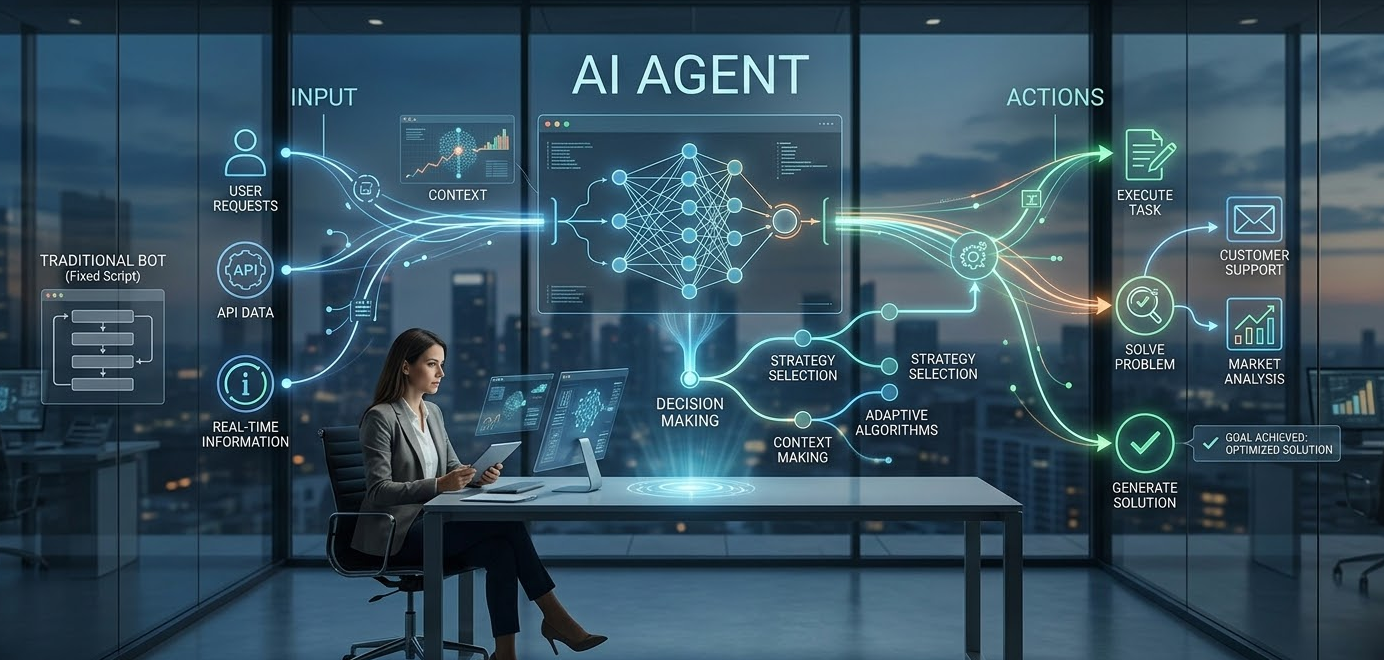
Here are some of the major differences between traditional software programs and AI agents:
- Autonomy: The ability to choose a sequence of actions autonomously (on one's own).
- Reactivity: The ability to react to changes in incoming data streams and the surrounding environment.
- Proactivity: The ability to start processes without waiting for an external command (e.g. sending alerts when the price of tokens drops).
- Social ability: The ability to communicate with other agents, systems and users using API calls, chatbots or databases.
Businesses that use autonomous AI-based systems generally reduce their operating costs by 30% to 40% and can process client requests 5–10 times faster than manual means. The crypto sector is one particular area where due to the urgency of making timely decisions to create revenue, using AI is more than helpful; it is an imperative.
How an AI Agent is Built: System, Model, and Workflow
An Agent consists of three core components: Perception, Analysis, and Action. All three components are necessary for the performance of an Agent's functions.
Environmental Sensor Agents & Their Data Sources
The agent continuously gathers outside data sources through: exchange APIs, blockchain nodes, Telegram bots, web scraping, and knowledge bases. Within ASCN, specialized AI agent nodes perform the data indexing for Ethereum and Solana. Agent nodes also parse Telegram channels and news aggregators collecting several types of events such as "whale" events, new token listings, and macroeconomic events, etc...
In addition to the raw data being sent haphazardly, the system will also apply careful filtering methods, such as examining the source for reliability, deleting duplicate entries and ranking records according to importance. This can be thought of as a functioning editorial office where only important news is selected to be used from among hundreds of messages.
The Internal Memory System and Data Storage of the Agent
The agent will maintain contextual data that contains the entire history of actions taken, previous requests, as well as analysis outcomes by storing all of these data points in the agent's memory, therefore allowing the agent access to its memories in order to recall previous dialogues with a user or past trades in order to provide them with accurate, relevant recommendations on today's action.
There are two types of memory available to the agent:
- Short-term memory: which relates to current session data, or active session variables, i.e., anything that pertains to the present time.
- Long-term memory: which consists of all of the previously accumulated knowledge bases, trained models, rules, and/or scenarios that the agent retains across its sessions, keeping them available for use on an ongoing basis.
With this information, when a client asks about Token X and one hour later makes an inquiry about a similar company Token Y, then the agent can link the two events together and perform an analysis of Token X vs. Token Y, rather than simply providing an answer for each Token that is not connected.
Decision Modelling Mechanism of the Agent
What the agents are actually using is their modelling methodologies, i.e., Large Language Models (LLM), Decision Trees, Neural Networks, and/or any combination of the three. Once the model has analyzed incoming data, it associates it with the appropriate task (e.g., answer a question, create a report, send a notification) and executes whichever action is required.
The LLM created by ASCN.AI is built specifically to work with data on Web3, meaning that the agent uses its proprietary on-chain metrics, historical charts, fundamental indicators and niche analytics instead of simply crawling through public articles for information, like general-purpose models such as ChatGPT or Grok; therefore, ASCN.AI's LLM is more accurate than competitors by 40%–50%, as they do not have access to the real-time blockchain data needed for accurate decision making.
After the agent has determined which action to take, it may return a response as a JSON formatted message, issue an HTTP request, execute an automated script using a no-code platform, post to a Telegram chat or update a CRM.
An example of this would be on Friday, October 11, 2024, when a flash crash occurred as Bitcoin fell by 8% in 15 minutes. ASCN.AI agents monitored the situation, identified the abnormal trading volume and sent timely alerts to clients. Those who reacted gained profits from high volatility (read more in the case study at the link).
What an AI Agent Can Do and What Tasks It Solves Successfully
An AI agent can complete many types of tasks related to data gathering, data analysis, and decision making. Here are its main capabilities:
NLU (Natural Language Understanding)
The agent can process user input in Russian, English and other languages, derive user intent from input and generate a structured response. For example, if you enter the request, "Show the price difference for SOL between Binance vs. Kucoin", the agent will access the APIs of the relevant exchanges to compare prices for those exchanges and give you an arbitrage spread table.
Data Aggregation/Compilation
The aggregator agents will combine data from numerous sources (blockchain, exchanges, social networks, RSS feeds) into one concise view, eliminating the need for manual checking of 15 different sites by a trader (which takes the agent only 10 seconds) and providing that trader with a summary of prices, trading volume, large holder activity, the number of mentions in Telegram and on-chain metrics (such as number of holders, total number of transactions, and burned tokens) so that they can make faster decisions (60% vs. 35% error rate).
Automation
The agent can automate the following tasks: if a token rises more than 15% in price over 1 hour, it will send a message to the trading group's Telegram channel; if a client sends a message indicating they want to buy, it will send the request to the appropriate manager and save the contact details; and it will process transactions on behalf of customers when the balance of their wallet is below a certain threshold. Automating these types of routine processes will result in significant efficiency. For instance, an overview of the token can be generated in 30 seconds, covering the team's background, business information, tokenomics, risks, network activity and how often it's been mentioned in the media, all in one concise document.
Forecasting & Recommendations
The agent examines past performance and identifies trends to give you insights into what could happen; however, it does not provide investment advice or guarantee returns. It gives a more comprehensive view about what may happen based on what has been seen in previous patterns. For example, if token X has seen an increase in the funding rate and a decrease in trading volume, it could indicate that a correction is coming, but only you can decide how to act on this information. Companies using AI agents for analyzing their data report a 25% increase in forecasting accuracy, and a 40% decrease in the number of errors reported.
Examples of Practical Applications of AI Agents:
- Customer Service: AI will respond to 80% of requests from customers, leaving only the complicated requests to a live customer service operator.
- Marketing: AI helps you analyze the effectiveness of your ads, create potential leads and customize ongoing communications.
- Finance: AI creates expense reports, keeps records of limits, and reminds you when payments are due.
- Human Resources: AI tracks communication patterns, gathers employee input, and identifies potential problems with employee communication (e.g., conflict via chat).
AI Agents Offered to Business: Tools, Assistants, and Bots
The need for faster, more accurate and scalable decision-making has driven the growth in AI agent usage within organizations. The most common uses of AI agents are:
Automating Processes
Up to 40% of your working hours will be spent doing repetitive work such as data entry, creating reports, moving data from one system to another etc. All of these functions can be performed by an AI Agent. Automate your processes with ASCN.AI No Code Platform! For example, if a customer submits an inquiry in Telegram asking for a consultation; you can use ASCN for the entire automation process. The process: Save the contact to Google Sheets, send the confirmation message and inform the manager. When customers use this method, the time to complete the entire automation process takes only 5 seconds, in comparison to 3–5 minutes when processed manually.
Analytics and Virtual Assistant
The agent (VA) is a personal analyst to the business. The VA answers questions based on the company's knowledge base, compiles information for reports or presentations and provides current trending information. In the cryptocurrency world, the VA works 24 hours a day to find out what type of capital is moving, what the current regulations are, what crypto will be listed and what funds are being moved. For example: If I ask the VA: "What types of projects have been invested in by A16Z Fund?"; the VA will have access to the data base of such funds with available investment dates and amounts. This is the information the VA provides to users to aid in their decision making process.
Case Studies
Case Study #1 - Making Money During The Falcon Finance Drop
In March 2024, the Falcon Finance (FF) token dropped 90% due to issues with the smart contract audit. The ASCN.AI agents noticed that several abnormal trades had occurred that were much larger than normal and that in Telegram (where all the FF discussion took place) negative sentiment was being expressed. Users who received the alerts and closed their positions before the price dropped were able to save money. The agents also provided an opportunity for users to arbitrage. The FF token last traded on one of the exchanges for $0.12 and the other one for $0.04, so customers had an opportunity to take advantage of a price difference and make $1,000 by asking questions of the agents (VA) and completing a request to transfer money from their account (for more about this, see case study "ASCN.AI And The Falcon Finance Drop").
Case Study #2 - Crypto Fund Report Automation
Over 50 tokens are tracked daily by the crypto fund; prior to automation, analysts spent four hours each day collecting this data, including historical prices, volume, and distribution of each token held in the portfolio. By using an agent to automate that reporting, the metrics of all tokens are retrieved from the respective exchanges by the system and a PDF report is created at 9:00 a.m. and sent to the team via Telegram chat. This saved the analyst approximately 80 hours each month. The analyst can now devote their time to strategy instead of manual data collection.
Case Study #3 - Scalping with AI Analysis
The trader will routinely use the agent to evaluate hourly indicators (moving average, relative strength index, KDJ, and volume) to create a buy/sell scenario within 15 seconds. The agent will analyze multiple scenarios for buying and selling with entry points, stop losses, and targets; this does not constitute a call to action, but rather a structured analysis that will assist with human decision making, especially when market conditions are highly volatile (e.g., following regulatory announcements).
AI Agent versus Traditional Bot
Traditional bots will execute a specific concept as programmed (i.e., if a user enters a greeting, then respond with greeting. If user enters btc price, will make api call to obtain price). An AI agent will evaluate the context surrounding the request or command. For example, if someone asks, "Why did Bitcoin go down?," the AI agent will evaluate the macro, the amount of liquidations, and the activity of a large holder and generate a complete answer.
An example of Siri is an assistant that will respond to commands but does not have extensive knowledge related to that specific command. An AI agent is not like a physical robot, rather it exists only as an interface, which can take the form of a chat window, an API endpoint, a no-code workflow, or a dashboard.
What an AI Agent Is and How It Is Characterized
At ASCN.AI, you have three ways to interact with an AI agent:
- Chat Assistant: You can chat with the AI agent through a web app or via a Telegram bot by sending questions to it and then wait for the response from the AI agent, typically within 10 seconds. Although it appears as though two colleagues are chatting with each other, behind this interaction are numerous nodes, integrations, and models.
- No-code Workflow: An example would be using the visual builder to create a scenario that automates communication between multiple applications, e.g., if a token increases by 10%, send a message to the Telegram board and store the information in a data table; everything is automatic.
- API Integration: If you're a developer, the AI agent provides a set of API endpoints so that you can invoke it programmatically. Make a POST request with a question and get a JSON response; now you can integrate this agent into any CRM, trading bot, or analytical solution.
AI agents are intelligent systems that determine their own course of action (they select the best path through potential options to complete an identified objective). It isn’t simply a series of “if then” instructions; rather, AI agents use transformative integration points to analyze, adjust, and engage with external services in a self-directed manner.
Here is an example of how an AI works in practice:
- An arbitrary request is made by a user: “Compare SOL price between Binance and Kucoin”.
- An agent will decode this request through natural language processing techniques so that they can understand what type of information is being requested and find out the price of the SOL token on both exchanges.
- Subsequently, HTTP requests are made through the Binance API and Kucoin API to obtain that specified information.
- The two results received were: $105.3 for SOL on Binance and $104.8 for SOL on Kucoin.
- The agent will calculate the end results of both. “Price for SOL on Binance ($105.3) and Kucoin ($104.8). Differential/Spread: 0.50% (Approx. $0.50). Arbitrage opportunity; minimum transaction volume = $1,000.”
- Returned to the user.
This entire process should take approximately 5–10 seconds. The human user only sees the final result; however, the agent completed 6 steps to create those results by querying different data sources.
FAQs
What is an AI Agent?
An AI agent is a software system capable of processing data from various sources (APIs, database, or nodes) and independently reach and execute decisions based on the model inputs to achieve a defined goal. Unlike bots, AI agents adapt based on their experience and initiating events via state change.
How is it different from a standard program?
Standard computer programs run an algorithm (if this, then that) and execute those tasks in terms of the input they receive. An AI agent will analyze an instance in context to historical data associated with the event. For example, an agent would be able to analyze the token type, the relevance of the current price, and the news surrounding that event; therefore the AI’s response would have been generated based upon each specific user’s individual interests' context.
What types of tasks should be performed by AI agents?
There are three distinct tasks best suited for AI agents:
- Data Analysis of a large quantity, aggregation of news articles, and collection and aggregation of metrics.
- Automating repetitive processes, e.g. report creation, email notification, spreadsheet updates.
- Decision making under conditions of uncertainty, e.g. filtering signals, classifying or tagging text, detecting anomalies.
They should not be used in cases that require emotional intelligence, creative thinking in non-standard situations or in highly complex strategic decision-making due to a lack of overt criteria.
Disclaimer
The contents of this article are for informational purposes only and not intended to be investment advice, legal advice, or security advisory services. You must exercise your own due diligence and utilize AI Assistants with a full understanding of the various functions of the given platform.