



- Русский
- English
- Português
How to Improve Business Performance: What Large Companies Do and Where AI Fits In

Key takeaways
Revenue dipped last month, and the first answer to how to improve business performance is usually "run more ads." Sometimes that works. But often there are enough leads, and they get lost later: a sales rep replied three hours later, and by then the customer had bought from someone else. In that case, ads just send more people to the place where you are already losing them.
So improving business performance starts with one question: where exactly do customers and money slip away? There are only a few such places, and each one has a clear fix.
To improve business performance, find the stage where you lose customers or money and fix that stage specifically. There are five of them: leads, response and sale, average order value, repeat purchases and costs. Large companies grow because they notice problems quickly and respond by rules set in advance. In 2026, an AI agent can do this work (watch the numbers, answer customers, bring back the ones who left), and you don't need a team of developers for it.
Contents:
- How to improve business performance: five levers
- How large companies do it
- Why AI is the key to growth in 2026
- Which tasks to hand to an AI agent
- Where AI won't help
- Why ASCN.ai
- How to start on ASCN
- FAQ
How to improve business performance: five levers
Almost any business breaks down into a simple chain. A person hears about you and gets in touch. They get a reply and buy. They pay some amount. They come back, or they don't. Subtract costs from what they paid, and what's left is profit. Each link can be improved on its own, and growth in even one of them shows up in the bottom line.
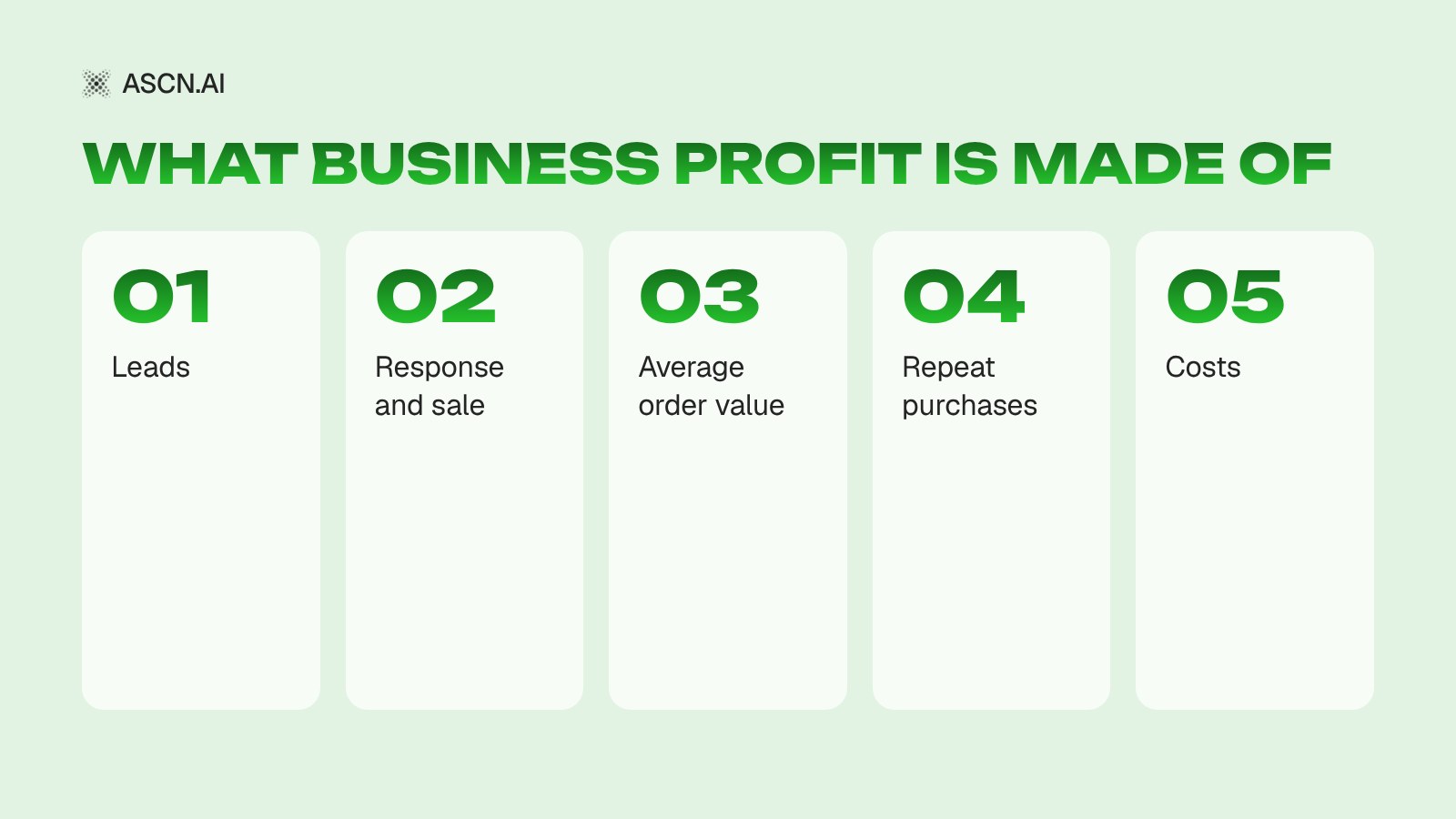
- Leads. How many people reach out to you: from the website, social media, referrals.
- Response and sale. How many of those who reached out end up buying. This is where money is lost most often: the customer waits too long for a reply, nobody calls back, nobody follows up after "I'll think about it."
- Average order value. How much a customer pays per purchase. It grows when you offer a fitting add-on to the main product: styling with a haircut, a case with a laptop.
- Repeat purchases. How many customers come back. Someone who already bought and was happy is easier and cheaper to bring back than a new customer is to find.
- Costs. Subscriptions nobody uses, forgotten payments, staff hours spent on manual reports.
It's better to start with one metric. Take last month and estimate, even roughly: how many inquiries you had, how many of them bought, what the average order value was, how many customers came back. The number that looks worse than the others is your first task.
How large companies do it
Global leaders have no secret method. Look closely at their well-known practices, and each one solves one of the tasks above. Behind each is one habit: the company finds out quickly what is happening and acts right away.
Toyota: problems surface immediately
At Toyota plants, a worker who spots a defect sends a signal by pulling a cord or pressing a button. A shift leader comes over right away, and the problem is dealt with on the spot, before the defective part moves further down the line. The core rule: you learn about a problem the same minute, not at the end of the month from a report.
For an ordinary business, this means something simple. If leads dropped on Tuesday, you need to know on Wednesday, not at a meeting three weeks later.
Amazon: decisions are made fast
In his letters to shareholders, Jeff Bezos split decisions into two types. Some are nearly impossible to reverse, and they deserve long deliberation. Most others are easy to roll back, and they should be made quickly, without waiting for perfect data.
In a small company, something else slows decisions down: the numbers simply aren't at hand. To see whether a promotion worked, someone has to merge three spreadsheets in the evening. By the time they finish, a week has passed.
Netflix: something different for each customer
Netflix shows each viewer their own selection of titles. According to the company itself, people find most of what they watch through recommendations rather than search. Netflix also links this to people canceling their subscription less often.
A small business doesn't need a complex algorithm; the principle works at a small scale too. For example, a beauty salon only needs to remember that a client comes in for hair coloring every two months and message her after seven weeks. That is a personal recommendation.
Klarna: AI in support and the lesson from it
In 2024, the payments company Klarna launched an AI assistant for customers. In its first month, it handled two thirds of all support chats, and the company estimated this as the work of about 700 employees.
A little over a year later, the CEO admitted they had gone too far with cost cutting: answer quality dropped, and Klarna started hiring people again so that customers could always talk to a human. The most useful takeaway from this story: AI handles routine questions well, while complex and conflict cases are better left to people.
Why AI is the key to growth in 2026
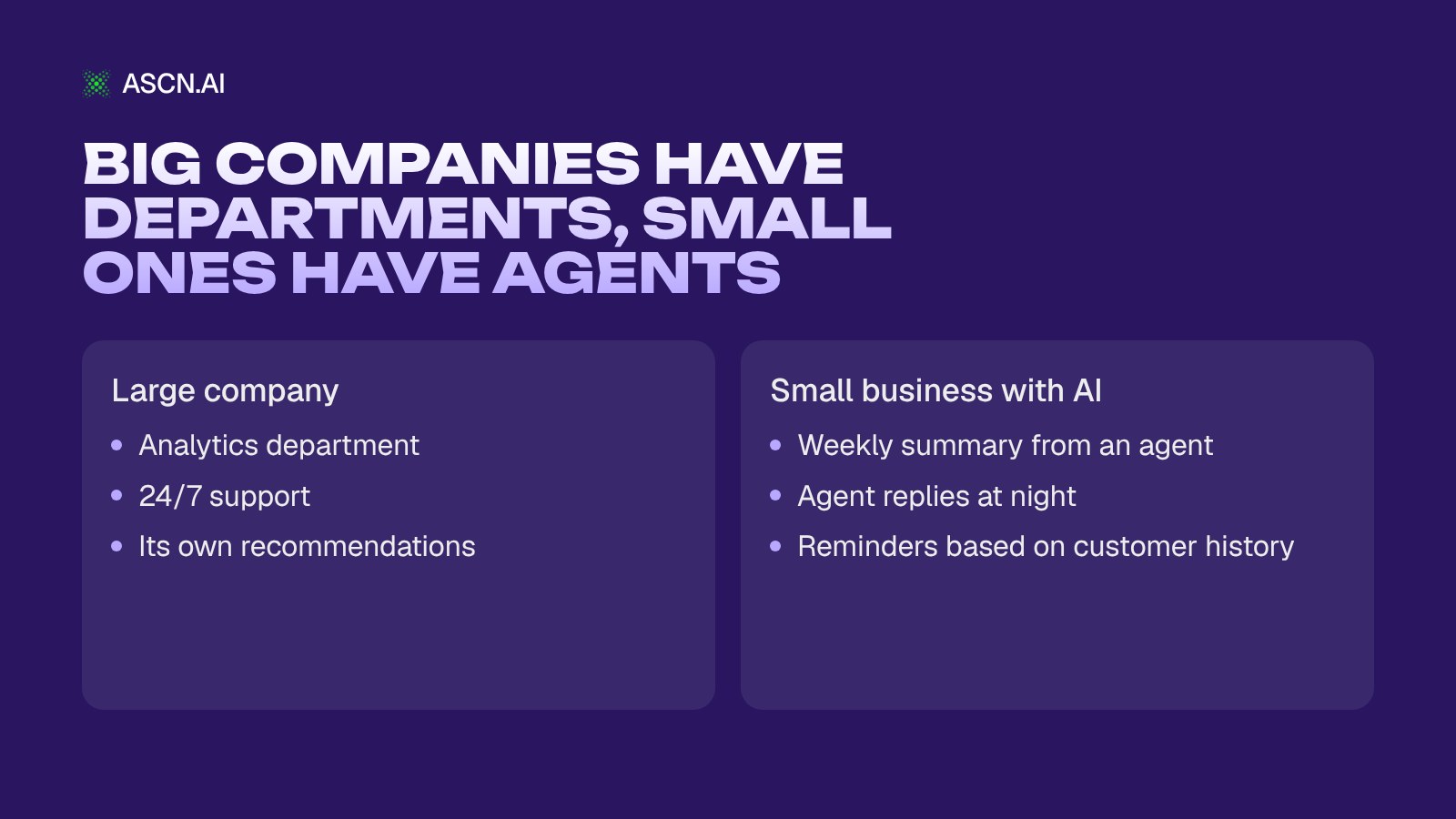
These four stories have one thing in common. In each, something constantly watches what is happening and acts right away: it spots a defect, brings numbers to a decision, remembers a customer's history, answers a question. At large companies, whole departments and years of development stand behind this.
A small company couldn't afford this before. An analyst, a dedicated manager who brings customers back, and a night-shift support agent are expensive. In 2026, an AI agent can do a large part of this work.
An AI agent is a program built on a neural network that carries out a task by your rules on its own: it reads customer messages, checks a spreadsheet, writes a reply or a report and hands over to a person whatever a person should decide. Unlike a chat with an AI model, it works without your prompt. It triggers by itself when a message arrives, when Monday comes or when a customer has been silent for three days. More on this in what an AI agent is and which tasks it handles.
That's why we believe AI is the most affordable way to lift business performance today. One caveat: an agent speeds up what you already have. If the product is weak or the price is above market for no reason, the agent will get that message to customers faster, but it won't fix it.
Which tasks to hand to an AI agent
Below is one task for each metric from the start of the article. All of these agents are ready-made: you install them from the ASCN catalog and set them up in plain language.
Leads and sales: a reply in seconds
A customer messages you on Telegram at 11 p.m. asking about the price. The agent answers from your price list, asks a couple of clarifying questions and responds to the customer's doubts. It passes a hot lead to a sales rep with a short summary: who the customer is and what they want.
In the morning, you get a summary of all leads. This is how Inbound Sales Pro works. We collected more sales scenarios in a separate guide on AI for sales.
Average order value: the right add-on
In the agent's rules, you write what to offer with what: top coat with a manicure, candles with a cake, a pump with water delivery. The agent offers it during the conversation, once the customer has already chosen the main item. For orders and bookings in a messenger, Messenger Concierge, an AI front desk in Telegram, is a good fit.
Repeat purchases: a message at the right time
The haircut-and-coloring example works for any business with regular purchases. Lifecycle Email Builder takes a description of your business and builds an email system: whom to remind, when and about what, so the customer comes back.
Numbers every week: your own andon cord
This is the task from the Toyota and Amazon stories. The AI Agent for KPI Reports pulls metrics from your spreadsheets and sends a weekly summary that explains what went up, what went down and how far that is from normal. How to automate the rest of your reporting is covered in how to automate reports.
Costs: overspending shows up right away
The AI Financial Assistant keeps track of income and expenses in a Google Sheet, builds a profit report and notices where you spend more than usual. You message it "paid rent, $3,000," and it adds the row itself.
| Metric | Usual obstacle | What the agent does | Ready-made agent |
|---|---|---|---|
| Leads and sales | Slow replies | Replies in seconds | Inbound Sales Pro |
| Average order value | No add-ons offered | Offers them by rules | Messenger Concierge |
| Repeat purchases | Customer forgotten | Reminds on time | Lifecycle Email Builder |
| Tracking numbers | Monthly report | Weekly summary | KPI Reports |
| Costs | Tracked in your head | Keeps a spreadsheet | Financial Assistant |
Where AI won't help
An AI agent is useful where there is a lot of repetitive work and there is data. In other cases, you don't need it:
- Few customers. If five people message you a day, saved quick replies in your messenger are enough.
- No order. Sales aren't recorded anywhere, and the price list lives in the owner's head. The agent has nothing to rely on, so put things in order first.
- Money decisions and conflicts. Discounts, refunds and complaints are better left to a person. This is the main lesson of the Klarna story.
- The problem is the product itself. If customers don't come back because they didn't like it, reminders won't change that.
Why ASCN.ai
ASCN Agent is a cloud platform for AI agents: you take a ready-made agent from the catalog or build one by describing the task in a chat. For the tasks in this article, it offers:
- Ready-made agents for each metric. All five agents from the table above are in the catalog and available on any plan, including Free.
- Runs on events and on a schedule. The agent reacts to a new message, sends a summary every Monday and follows up with a customer who has been silent for three days. 24/7 and scheduled runs are available from the Start plan.
- No-code connections. Google Sheets, Gmail, Notion and HubSpot connect in one click, and the agent connects services that aren't on the list by itself via API or MCP.
- Price list and rules in a knowledge base. Documents, price lists and FAQs are uploaded to the agent as files and persist between conversations.
- Access control. The agent sees only what you allow, keys are stored encrypted, and risky actions run only after your confirmation.
If you lose money between the lead and the sale, start with the ready-made Inbound Sales Pro agent.
How to start on ASCN
On ASCN.ai, you can launch your first agent in an evening, without coding:
- Pick the one metric that is sagging more than the others.
- Sign up on ASCN.ai and find a ready-made agent for that task in the catalog. The table above shows which one.
- Give the agent the facts: price list, common questions, rules, access to a spreadsheet. You can describe the task in plain language in the chat.
- For a week, read what it does and add rules where it got things wrong. After a month, compare the metric with the previous one.
The Free plan is enough to try it: 500 credits per week and one active agent. Credits are spent when the agent works. Paid plans start at $29 per month (Start), and from that plan the agent runs 24/7 and on a schedule.
If you don't know which metric to start with, start with the weekly KPI report: within a week you'll see what is sagging, and you'll pick the next agent based on numbers. Launch your first agent for free.
FAQ
Which business metric should you improve first?
The one that looks worst. For last month, count inquiries, sales, average order value, repeat purchases and costs. Most often, money is lost between the lead and the sale: the customer waits too long for a reply, or nobody follows up after "I'll think about it." That is also the easiest thing to fix.
Can you improve business performance without spending a lot?
Yes. The cheapest improvements come from speed and attention: replying faster, not forgetting about customers, seeing the numbers every week. You can hand this to an AI agent. ASCN.ai has a Free plan, and paid plans start at $29 per month.
Which is better: an AI agent or another employee?
It depends on the task. An agent fits repetitive work: answering routine questions, reminders, reports, bookkeeping. An employee is needed where decisions, negotiations and accountability are required. Often the best option is this: the agent takes the routine, and the employee handles difficult customers.
When will you see results?
You'll see the agent's work in the very first week: in conversations and in reports. Changes in your metrics are more honestly judged at the end of the month, compared with the previous one. If the number hasn't moved in a month, check the agent's rules and whether you picked the right metric.
AI for Business Analytics: Which Questions It Can Answer and How to Check Its Numbers
AI Implementation in Business: How Leaders Save Time, Grow Sales and Cut Costs
AI for Sales: How to Use Artificial Intelligence in Your Business

How AI Agents Boost KPIs: From Routine to Strategic Business Growth

What is an AI agent in simple terms?

Report automation: four ways to build a report without hands, and how to pick yours