



- Русский
- English
- Português
How to Automate Chat in Telegram: A Complete Guide


Have you ever noticed how many little annoyances there are in Telegram—answering the same question over and over again, sending out product spreadsheets, copying and pasting links? They take a lot more time than you think. After doing the same action hundreds of times during the course of a day, it equals weeks' worth of time wasted on repetitive tasks. While other companies, who have been through multiple technology changes, have been able to quickly use and process their incoming leads in a matter of seconds; you continue to manually type your responses.
"Within three weeks, we were able to automate approximately 80% of our daily tasks in Telegram—without programmers. We simply combined readily available artificial intelligence (AI) solutions with various workflow tools and created our own setup using common knowledge. Now we have five people performing the work that was performed by fifteen previously. We have saved $300,000 annually on employee salaries alone."
Introduction to Telegram Chat Automation
A Quick Reference Guide on how to transition to Telegram chat automation. Telegram chat automation is a technology that takes over the repetitive functions of your business, such as sending messages, collecting leads and managing mailings, thereby eliminating the need for humans to do these same tasks manually. Automate the rules you have put in place, and automate the functionality to run itself!
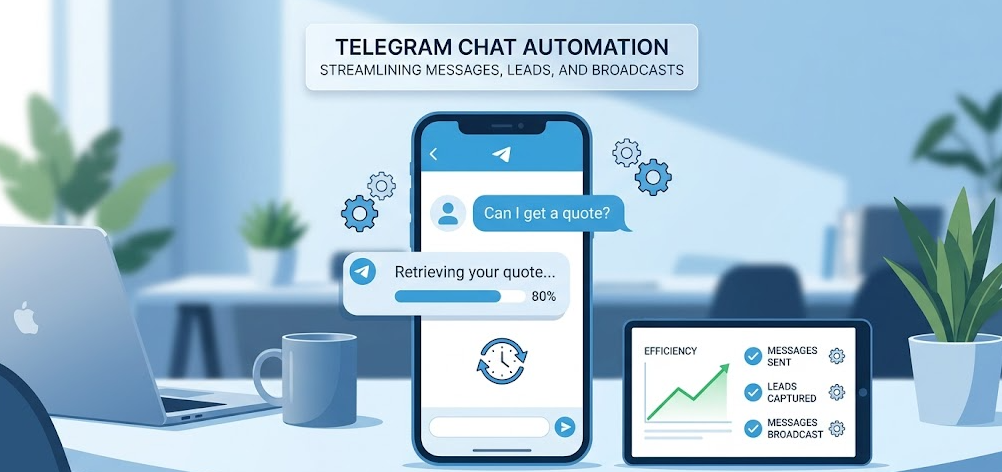
- Speed of Processing: The time from message receipt to client response is now under 3 seconds as opposed to 20 minutes previously.
- Scalable: One bot can handle up to 10,000 messages a day with no slowdown in speed.
- Reduction of Resources: Automated messages can do the work that used to require two or three human operators.
- Reduced Errors: Bots never get tired, and always respond with the correct information.
Companies using AI Chat Bots are seeing an average 67% increase in lead conversions due to their ability to respond instantaneously to consumers. In an e Commerce setting Chat Bots are responding to over 85% of standard questions with no human intervention.
Automation can work for everyone from eCommerce retailers to B2B businesses. The time it requires for implementation of this type of solution varies from several days for basic simple implementations to as much as three weeks for more complex implementations, including multi-tiered implementations including the use of AI and integrations to other systems.
Main Methods of Automation: Bots, AI, and Workflow Platforms
Automation methods include:
1. Telegram Bots
These are applications built on the Telegram Bot API. You develop a bot, link the bot to a channel or group and the bot performs actions based on user commands/messages.
- Responds to specific commands and key words.
- Gathers details: name, phone number, e-mail.
- Sends notifications and mass mailings.
- Integrates with CRM systems, Google Sheets, and payment processors.
- Can be utilized to allow users to access simple tasks: e.g. a user types in the command "price", the bot will respond back with the price and send the document, but cannot create a full conversation.
2. GPT-based AI Chatbots
These chatbots use large language models like GPT-4 or Claude. Based on the conversational context and history of the messages exchanged, these chatbots can create meaningful responses to questions posed to them.
- Able to interpret questions without being bound by keywords and sense what the response should be.
- Maintain the flow of conversation using the contextual information of the conversation between the two users.
- Can assist with sales by qualifying leads and handling objections.
3. Workflow Platforms (n8n, Zapier, Make)
These are event workflows that exist without the use of coding. An example of this would be leads submitted by users through Telegram get pushed automatically into a CRM, manager are alerted of the new leads, and the customer receives a reminder in 2 hours.
- All of the different services that perform the actions of this workflow are able to interact with each other: Telegram, CRM, Database.
- Interconnectedness of the services allow for complex workflows to be set up based on criteria and looping. The goal is to automate full business processes, not just chat interactions.
In general, you would use a multi-channel approach to accomplish this. For example, you might use a Telegram bot to automate easy responses, an AI chatbot based on GPT for response to more complex situations, and then connect those together with an integrated workflow.
What to choose?
- If you want to automate simple tasks then you can use Telegram Bot.
- If you want to automate more complicated tasks, then you can use a GPT-based AI chat.
- If you want to automate business processes then you would use a workflow platform.
Telegram Bots for Automation
To build your own Telegram bot is relatively simple and does not require you to have programming skills. The following is an outline of how you can build your own Telegram bot:
Your token is similar to a password. Therefore, use either a password manager or an environment variable to store your token as it should not be publicly exposed.
To make it easier for users to find their way around the bot, create custom commands within BotFather.
If you are using no-code platforms like ASCN.AI or n8n, make sure you paste the token you received in the previous step into the settings for the connection you plan to use ie Webhook or Polling.
To test your Telegram bot, send it a message using the command /start and make sure the bot replies back to you.
- Create your bot, find the Telegram @BotFather.
- Send the command
/newbotto the BotFather. - Set your new bot's username to something unique made up of letters, numbers, and underscores (e.g. shop_helper_bot).
- Store your token securely using a password manager or environment variable, and never publish it publicly.
- Create custom commands for your bot.
- Integrate your bot into automated workflow(s).
- Test your bot.
An example of this process is a beauty store that was able to launch a new bot in 40 minutes that allows users to browse their /catalog and place /order through the bot. During the first week, the site received a total of 230 inquiries and the conversion rate was 34%, which was an increase of 18% from the site form.
Telegram Bot API: Capabilities and Integrations
There are several methods of integrating the Telegram Bot API with users:
- sendMessage: to send text messages;
- sendPhoto: to send images;
- sendDocument: to send documents;
- getUpdates: to receive incoming messages in polling mode;
- setWebhook: to connect to a webhook to receive messages and notification of incoming messages in real-time.
When an event occurs that triggers an automated action:
- New message;
- Inline button click;
- A user joined the conversation;
- User mentions the bot;
- Scheduled time.
There are also several limitations the bot has when using the API:
- A bot can send no more than 30 messages per second to different users;
- The maximum uploaded file size is 50 MB, and downloaded file size is 20 MB;
- The bot cannot initiate a conversation; it can only respond to the user after they have contacted the bot first;
- If Privacy Mode is enabled, the bot can only see messages directed at it; unless explicitly configured, it cannot see messages sent in a group chat to another member of the group (but can see when an inline button is clicked on).
The API can be used in conjunction with other services (CRMs, Google Sheets, Payment Gateways) through HTTPS requests. For example, by using n8n with Telegram, leads can be automatically entered into a CRM to reduce lost customers and increase operational efficiency.
Artificial Intelligence and Chatbots in Telegram
AI-powered chatbots, like those based on GPT-4 and similar technologies, are able to analyze the meaning of a user's message, remember what has been said in the past, and respond appropriately. Unlike bots that use only scripted responses to answer user inquiries, AI-powered chatbots can understand natural language and respond to any situation in a flexible manner. AI understands vague requests and is capable of keeping track of the context from previous conversations, automatically qualifying leads and assisting with sales.
However, there are some limitations. For starters, there is a cost associated with each request to GPT ranging anywhere from $0.002 to $0.03 depending upon the load. The quality of the output will also depend upon how clearly the input (prompt) has been written. GPT does not have the ability to change or influence the amount of leads processed or the speed at which leads are processed and therefore must be integrated with an existing workflow.
For instance, an education platform processed a total of 4,800 different conversation logs with users within 3 months of launching a GPT bot; and this equated to 15% more conversions than their online form.
Setting up GPT in Telegram
Connection Methods:
- No-code platforms (ASCN.AI or n8n): These platforms allow you to create a workflow which includes a New Message trigger, an AI agent with a prompt, and the sending of the response back to Telegram.
- Code (Python): You could write a simple script that calls the OpenAI API and forwards the response to the user in the chat.
Another method would be to optimize your prompts based upon business objectives. Instead of saying "Answer questions," you would say "You are a store manager. Please respond to the customer as politely as possible, clarify information if necessary, and loop in a human manager if required."
Auto-replies and Mass Mailings in Telegram
To improve your mailing results, keep under the threshold of 30 messages per second, and segment messages by audience so that the recipient receives a more relevant message. An exemplary case of this is a Telegram mailing for online courses. These mailings resulted in a 72% open-rate and a 19% increase in sales.
To avoid being banned for spam:
- Msg Frequency: do not send more than 1 message in a week;
- Must have an “unsubscribe” link or command included;
- Segment your audience and send only worthwhile information.
Practical Examples of Telegram Chat Automation
With ASCN.AI, you can build a three-stage process of operation such as following: New Message Trigger, In-process through AI Agent, Responding to Telegram. There is also a condition of escalating the issue to a human operator if AI is uncertain about the answer. In this manner, you're able to reduce your Support Load by 60%-70%.
In Crypto Consulting, ASCN.AI has automated all 2,100 dialogues, and of those 340 were considered "difficult" cases, which saved over 80 hours/month.
Smart Assistant
- Scheduling consultations—tied to Google Calendar for automated confirmations;
- Assisting customers in picking products based on their inquiries using GPT;
- Guiding customers through the decision-making process by addressing concerns and recommending suitable products.
A single bot here replaces 3 employees and saves 150,000 rubles or $5,000/mo. For upkeep, anticipate spending anywhere from $50-$150/mo.
Support Automation
These 70%–80% of requests cover typical customer support topics (status update, return, and hours of operation). Questions that are complicated require a response from a human operator.
An online shop for electronics had to cut back the number of operator-staff (from 4 to 2). The time it took for customers to be waited on dropped from 15 minutes to 3 minutes - a great improvement in relation to customer service.
Online Sales and Marketing via Telegram Bot
Sales Funnel: Through advertising to purchase - done directly in telegram.
Customer Reactivation: Personalized offers and dynamic discounts based on customer classification. The bot can also manage objections, issue discounts, and suggest relevant products.
Frequently Asked Questions (FAQ)
Is it possible to automate a personal chat in Telegram?
Yes — but only if a client starts the dialogue and messages the bot first. A bot cannot reach-out with any type of offer on a self-initiated basis (per the telegram policy) to prevent unwanted spam. When using a bot in a group - due to privacy mode being set on the Bot, the Bot is unable to see any messages in a group except those sent as a reply to the bot.
Is programming knowledge required?
No — if you are using no-code platforms such as (ASCN.AI, n8n, Zapier) you can set-up very basic scenarios in approximately 15-30 mins. Programming will only be needed for any custom-built, high-load projects or complex integrations.
What are limitations within the Telegram API?
- No more than 30 messages can be sent from a bot per second;
- Only files under 50MB may be uploaded;
- The bot may not start a conversation by sending a message to someone first;
- When in group, the bot will NOT see any message that is not addressed to it;
- Sending multiple complaints may cause the bot to be banned.
Conclusion and Tool Recommendations
No-Code Platforms:
- Development (from 15 minutes to 2 days);
- Cost range (from $20-$150 per month);
- Ideal for small to med-sized companies with standard tasks;
- Limited capabilities of customization/high-load capacity.
Custom Development:
- Complete control of project & high degree of flexibility;
- Advanced features;
- Priced significantly higher & longer development time;
- Constant maintenance & updates needed;
- Suitable for high-load projects with serious intent.
It is recommended to start no-code and convert to custom if needed. Just ensure you evaluate prior to starting: message volume, scenario complexity, type(s) of integrations, and budget.
Future Prospects of AI Automation in Telegram
- Full integration of GPT-5 & subsequent versions will make it impossible to distinguish between a bot's messages and a human's;
- Advancement in no-code will decrease the barriers for all inexperienced users;
- Acceptance of payments using Telegram Payments directly in the messenger will become more popular;
- New trends will be ushered in using Voice AI chat-bots (Voice GPT);
- Autonomous agents will be able to perform advanced levels of work without the input of humans.
Companies that take action on automation sooner, will have a competitive advantage for a minimum of 2-3 years.
Disclaimer
Information provided is solely for general guidance and does not offer, equate to or replace any investment, legal, or security advice made by you. Know that the use of AI assistants, or using applicable services require educated guidance & an understanding of the functions of various platforms.