



- Русский
- English
- Português
How to Start a Business With AI in 2026: A 5-Step Plan for Solo Founders

Summary
If you're working out how to start a business with AI in 2026 on your own, give an AI employee the routine work of five roles from day one. Those are the jobs founders used to hire for: client intake, finding clients, proposals, content, and bookkeeping. Pricing, decisions, and live conversations with clients stay with you.
- An AI employee starts work on its own, on a schedule or when something happens. A client writes on Telegram, and it replies, asks for details, and logs the request in a spreadsheet.
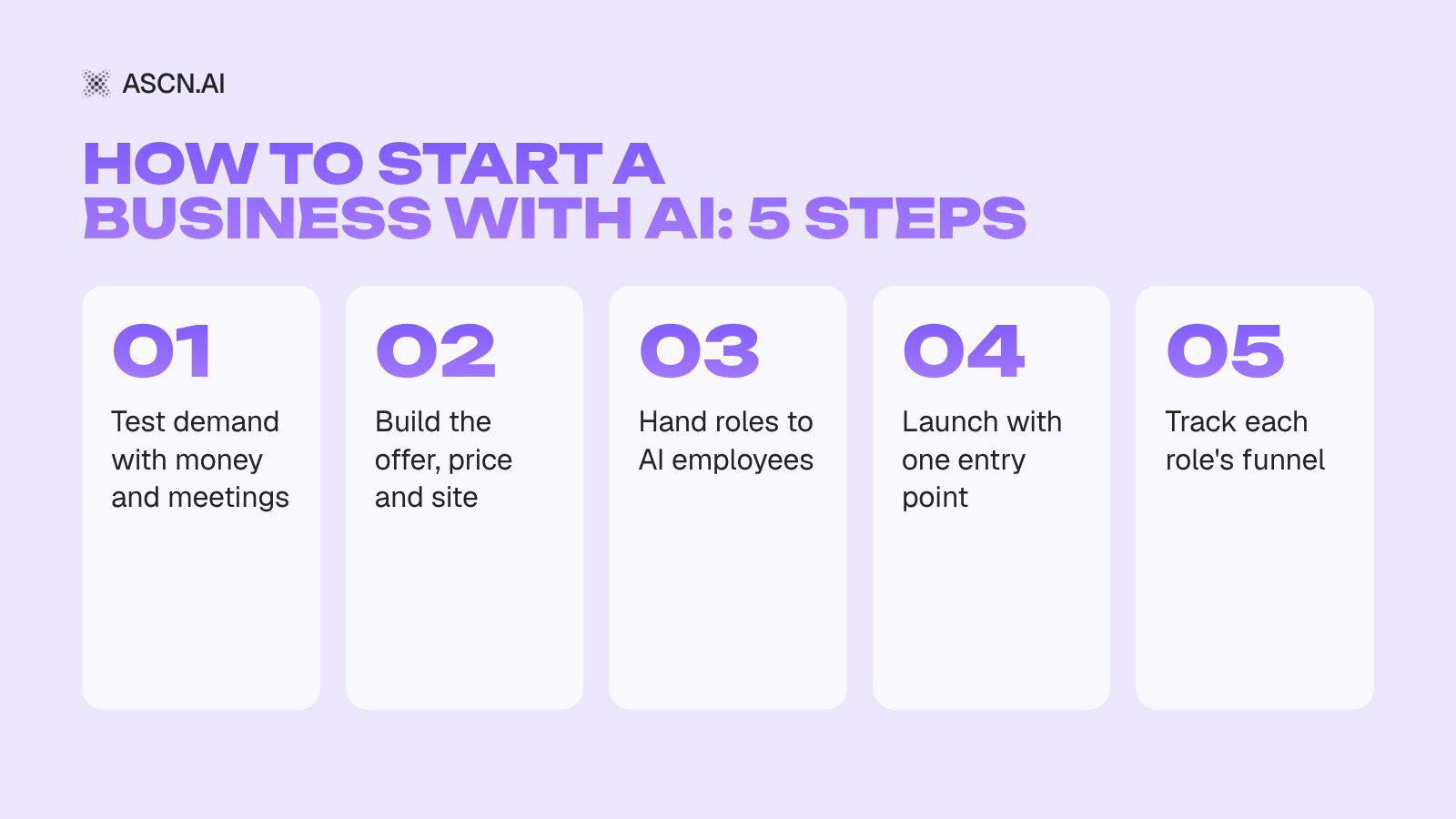
- The plan has five steps: test demand, build the offer and the site, hand out roles, launch, and track results for each role.
- You keep the pricing, the promises to clients, the first sales, business registration, taxes, and personal data.
- Starting on ASCN: the Free plan costs nothing and gives you 500 credits a week and 1 active agent. Start is $29/mo with 10,000 credits and 5 agents. How many credits you burn depends on the model and the length of each conversation.
Every step below uses one running example: IT support for small offices, where one person looks after the computers, network, and printers at companies with 5–30 seats. The example is hypothetical and is here for illustration only.
Contents:
- What it means to start a business with AI in 2026
- One founder, five roles
- How to start a business with AI: 5 steps
- Which role to hand off first
- How much it costs to start a business with AI
- What AI won't do for you
- FAQ
- Bottom line
What it means to start a business with AI in 2026
If you're asking how to use AI to start a business, picture software that takes over part of the day-to-day work from the first day: it starts itself and finishes the task. A chatbot answers the question you asked and stops there. An ASCN AI employee gets a task once and keeps doing it: on a schedule ("every morning at 9:00, send me a summary of new requests"), on an event (a new email in Gmail, a change in Google Calendar), or when a client messages it on Telegram.
It has three parts. The "brain" holds connected services, skills, a knowledge base, and memory; that's where your price list, your on-site visit rules, and your tone guidelines go. "Tasks" set when it works. "Channels" set where people talk to it: ASCN chat, Telegram, Slack, WhatsApp. You set it up in a chat, with no diagrams or code. In ASCN's words, you describe in plain language what the agent should do, and it builds the workflow and connects the services it needs.
That changes the founder's job. You stop doing every small task by hand and spend your time setting tasks, checking results, and talking to clients. If your business is already running and the question is what to automate in existing processes, read our guide to AI for small business. This article covers starting from scratch.
One founder, five roles
In the first months of a service business, one person covers at least five roles, and each one eats hours. A one-person business with AI starts from the same list:
- Website and positioning. A page that makes clear what you do, for whom, and what it costs.
- Marketing. Posts, email newsletters, answers to questions in your channel.
- Sales. Finding companies, the first email, the follow-up, the proposal, and the invoice.
- Client intake. Reply to a client within minutes, find out what broke, book a visit.
- Bookkeeping. Income, expenses, who owes what, when taxes are due.
Hiring people for these roles at launch is premature for two reasons. You have no proven cash flow to pay salaries from, and no working process to hand over. A salaried employee costs the same in a month with one request as in a month with fifty. An ASCN subscription is a flat fee, credits inside it are spent as the work gets done, and if you cancel, access stays open until the end of the paid period.
In the IT support example, the founder spends the day at a client's office swapping a toner cartridge and setting up a router. Meanwhile a new company writes on Telegram: the accounting team's printer won't print. If nobody answers for an hour, the office manager calls the next provider in the search results. That lost client decides the order in which you hand out roles.
How to start a business with AI: 5 steps (using IT support as an example)
Each step builds on the result of the one before it. If you jump from the idea straight to content, the AI employee will quickly and neatly promote an offer nobody asked for.
1. Test demand before you spend money
The goal of this step is to confirm that people will pay for the service before you spend on a website and ads. An AI employee speeds up the prep work, but it won't have the sales conversation for you.
Web search and page reading work in an ASCN AI employee out of the box, with nothing to connect. Ask it to collect in Google Docs what office managers and small business owners complain about when their tech breaks: discussions, reviews of local IT providers, forum questions. Second task: list in Google Sheets the packages and terms other providers in your city offer. On the ASCN site this role is the business strategist (Max), and it's also handy for working out the unit economics: how many offices on a monthly plan cover your costs and your travel time.
Check two things yourself. First, the sources: open some of the links and make sure the quotes are real and come from your segment. Second, the numbers in the calculation: you supply the rates, taxes, and travel time, because the model doesn't know them and will fill in plausible ones.
How to know the step is done: demand means money, a prepayment, or a booked meeting. A prospect saying the idea "sounds useful" tells you very little. Set the bar before you start calling, for example: out of twenty offices you call yourself, three agree to a paid visit or a meeting. If you don't hit it, change the segment or the offer and repeat the step.
2. Build the offer, the price, and the site
You come out of this step with a one-page plan, service packages with prices, and a page you can send clients to.
The plan fits in a few lines: who you sell to (offices with 5–30 seats and no in-house IT person), what you promise (a reply to every request within the business day, a scheduled visit once a month), what it costs, and where the first clients will come from. Ask the AI employee to quiz you on each point and pull your answers into a document. That quickly shows where you don't have an answer yet.
Sample packages: "Managed support" priced per seat, "One-off visit," and "New office setup." The AI employee drafts proposals and invoices from a description of the deal and saves them in Google Docs. It can also build the landing page: ASCN makes landing pages and dashboards from a description, and you can send it a link to a page with a structure you like and ask for something similar.
Check the price yourself, because the model doesn't know your costs and will confidently suggest any number. Check the promises too: response time, guarantees, what the monthly plan includes. Every line in a proposal or on the site becomes a client complaint if you don't deliver on it.
3. Hand roles to AI employees
You hand out roles in a chat: you describe the work in plain words, the AI employee asks clarifying questions, suggests the services to connect, and creates the tasks. While requests are few, one AI employee covers several roles. As the load grows, you split the roles across separate AI employees, each with its own role, area of responsibility, and set of tools. That gives you a department of AI employees, and ASCN puts it briefly: "build an entire department of AI agents and manage everything from one place."
The ASCN homepage gives the roles names: Leo handles sales, Kevin lead generation, Mike support, Anna social media, Max business strategy, and Ella email marketing. For an IT support business the set looks like this:
| Role | What the AI employee does | What you check |
|---|---|---|
| Client intake | Replies on Telegram, logs the request in a spreadsheet | Prices and response times in the knowledge base |
| Finding clients | Collects offices in Google Sheets | Who to call first |
| Sales | Prepares the proposal, invoice, and follow-up | Price and terms |
| Content | Writes posts from the content plan | Every post before it goes out |
| Bookkeeping | Tracks income and expenses, sends a summary | Reconciliation with the bank |
For client intake, the AI employee answers clients on Telegram and takes requests around the clock. WhatsApp also works as a channel. Load your price list, your service area, and a rule like "forward urgent breakdowns to me right away" into the knowledge base. The knowledge base is read before every reply, so the rule holds at three in the morning too.
Finding clients runs as a scheduled task: every morning, find companies of the right size in your area from public sources, check their websites, remove duplicates, and add them to the sheet. It writes cold emails in Gmail, as drafts by default, and asks for confirmation before sending. If a company hasn't replied in three days, it follows up on its own.
For content, it writes posts for your Telegram channel from a content plan: breakdowns of common failures, a checklist before an office move. Put the rule "don't publish without my approval" in the knowledge base instead of the chat. When memory and the knowledge base disagree, the AI employee follows the knowledge base. There's more on this role in our article on AI for marketing.
Bookkeeping can start with a voice note on Telegram: "payment from the Oak Street office for November." The AI employee adds a row in Google Sheets and once a week sends a summary of what came in, what went out, and who hasn't paid. Until you have a few dozen clients, the spreadsheet also works as your CRM. When it stops being enough, see our CRM comparison.
The plan sets a limit here. On Free, one agent is active, so one AI employee does every role. Start allows up to five, which fits all five roles from the table. For the kinds of AI employees and how they differ, see our roundup of AI employees for 2026.
To build your first AI employee, sign up for ASCN, start with client intake, and describe the work the way you'd explain it to a new assistant. The ASCN team helps set up your first agent in a chat or on a call, and there's a step-by-step walkthrough in our guide to building AI agents without code.
4. Launch and find your first clients
Set up a single entry point: a Telegram bot, or a landing page with a button that opens Telegram. Posts, emails, and proposals all point there. Every inquiry then reaches the AI employee, which replies and logs it, so you aren't collecting requests from five places.
Call and meet your first 10–20 clients yourself. The reason is practical: in those conversations you learn the objections and the words clients use to describe their problem, and then you move them into the knowledge base and the copy on your site. The AI employee's job here is prep. Before a meeting it puts together a brief on the company, and after the call it writes up the outcome and the next step in the spreadsheet.
In the IT support example, you can end the first meeting with a free network check. The AI employee turns your notes from the check into a proposal with two package options, and you send it the same day, while the client still remembers the conversation.
5. Measure what the AI employees delivered and add the next role
Each role has its own short funnel, and you should track each one separately:
- client intake: inquiries → booked visits → payments;
- finding clients: companies found → replies → meetings;
- sales: proposals sent → signed contracts;
- bookkeeping: mismatches between the spreadsheet and the bank statement for the month.
The AI employee builds the report on these numbers on a schedule, say Friday morning on Telegram. The rule for adding roles is simple: switch on the next role only when the current one runs without daily fixes. Each fix means a rule is missing from the knowledge base, so add it there. If you're still correcting client replies every day, a new role just adds another source of mistakes.
Which role to hand off first
Start with the role where you're losing money right now. Most often that's missed inquiries: in on-site services, a client with something broken usually goes with whoever answers first.
| If | Start with |
|---|---|
| You reply to clients an hour later or more | Client intake |
| You get no inquiries at all | Finding clients |
| You have meetings, but proposals go out a week later | Sales |
| You can't tell whether you're making a profit | Bookkeeping |
| Clients are happy, but nobody knows about you | Content |
Content sits at the bottom on purpose: posts pay off over months, while a missed inquiry is lost the same day.
How much it costs to start a business with AI
You can start a business with AI on ASCN for free, and the paid Start plan is $29 a month. The plans differ in credits, the number of active agents, and scheduled work.
| Plan | Price | Credits | Active agents |
|---|---|---|---|
| Free | $0 | 500 a week | 1 |
| Start | $29/mo | 10,000 a month | 5 |
Credit use depends on the model and the length of the conversation, so there's no way to price a single client reply in advance. Every run of a scheduled task uses credits, and calls to Gmail, Google Calendar, and other services also use integration credits. To save credits, check email once an hour instead of every 15 minutes, and don't put a trigger on your whole inbox.
Free is enough to build one AI employee and see how it answers from your knowledge base. The plan comparison on the site puts 24/7 and scheduled work under Start. Paid annually, Start comes to $18.85 a month ($226.20 for 12 months).
Your launch budget also has costs that have nothing to do with AI: registering your LLC or sole proprietorship, a business bank account, an accountant or accounting software, a domain and hosting for the site, phone service, tools and spare parts for on-site visits, and ads if you decide to run them.
What AI won't do for you
AI won't register your business, take responsibility for its mistakes, or decide on prices and clients.
Registration, taxes, and banking are for you and an accountant or lawyer: choosing between an LLC and a sole proprietorship, your tax setup, opening an account. The AI employee can prepare a list of questions for them and a draft client contract, but a lawyer should review the contract before you sign it.
Mistakes delivered in a confident tone are the next risk. The model can quote the wrong price or promise a turnaround that isn't in your price list, and sound convincing doing it. The protection is to keep prices, timelines, and restrictions in the knowledge base and to send emails and posts only after you approve them. Check the numbers in proposals and reports yourself, at least spot-check them.
Decisions and judgment stay with you: who to work with, which client to turn down, whether to raise prices. The AI employee gathers the data for the decision, and the choice and its consequences are yours.
Names and phone numbers of your clients' contact people are personal data. Privacy law where you operate (GDPR in the EU, for example) usually requires the person's consent to process it and a privacy policy on your site. In ASCN, an agent sees only what you give it access to, and it's best to keep file edit permissions to a minimum. Never put passwords for client equipment in the knowledge base. More on this in our article on AI risks in business.
FAQ
Can you start a business with AI alone?
No, a business won't start without a founder: AI takes over the routine, while sales, pricing, and responsibility stay with a person. A realistic split for how to start a business with AI: you test demand, run the first negotiations, and make the decisions, while the AI employee answers inquiries, prepares proposals, keeps the spreadsheets, and drafts posts.
How much does it cost to start a business with AI?
You can start the AI part for free: the ASCN Free plan gives you 500 credits a week and one active agent. The Start plan is $29 a month with 10,000 credits and 5 agents. Credit use depends on the model and the length of the conversation. Registration, an accountant, and a domain are paid separately.
Can AI run a business or replace employees?
AI can take over part of an employee's tasks, but it can't run a business on its own. It answers clients, keeps the books, prepares documents, and works on a schedule. The founder still decides who to work with, what to charge, and what to promise. The AI employee's mistakes are your responsibility too, so important actions go through your approval.
Can AI write a business plan?
Yes, AI can write a draft business plan and run the numbers in a spreadsheet, but you need to check the figures. The model doesn't know your rates, taxes, or real workload, so it fills in plausible values. A one-page AI business plan is more useful: who you sell to, what you promise, what it costs, where the first clients come from, and the demand bar you'll test against.
Is it legal to run a business with AI?
Yes, using AI in your work is legal, and the business owner is responsible for the results. Contracts, advertising, promises to clients, and handling personal data follow the same rules as without AI. For your clients' personal data, follow the privacy law where you operate (GDPR in the EU, for example): get consent to process it and publish a privacy policy on your site.
Which role should you give AI first?
Start with the role where you're losing money right now, which is most often client intake. A client who doesn't get a quick reply goes to another provider. If you have no inquiries at all, start with finding clients. Leave content for later: it works more slowly and doesn't save you from missed inquiries.
How is an AI agent different from a chatbot when you start a business?
A chatbot answers the question you ask, while an AI agent does the work itself on a schedule, on an event, or when a client messages it. For a new business, that means a request gets taken at night, the summary arrives on Friday without a reminder, and the proposal shows up in Google Docs. If you plan to sell agents to other businesses, read how to make money with AI agents.
Bottom line
How to start a business with AI as a solo founder: test demand with money and meetings first, then build the offer and the site, then give an AI employee the role where you're losing clients, and add the next ones only after the current one stops needing daily fixes. Pricing, promises, and the first sales stay with you. You can see what an AI employee does on the ASCN Agent page, and start with client intake on the free plan after you sign up for ASCN.
AI for Marketing: 6 Tasks You Can Hand Off to AI and What to Check Yourself
AI Implementation Risks: What Can Go Wrong and How to Avoid It
AI for Small Business: Where to Start and What to Hand Off to an Agent

Best AI Employees in 2026: 8 Platforms Ranked by Price, Channels and Roles

How to Make Money with AI Agents: The Complete 2026 Guide

How to Build an AI Agent: An Honest Guide (2026)