



- Русский
- English
- Português
AI for Marketing: 6 Tasks You Can Hand Off to AI and What to Check Yourself

Key takeaways
AI for marketing means using AI models for the repetitive groundwork: posts, customer replies, ads, email campaigns, reports and competitor tracking. The AI drafts from your data; you review and decide. In a chat with a model, this works only as long as you keep asking. An AI agent does the same work on a schedule and brings you a draft to approve.
Contents:
- What AI does in marketing, and what it doesn't
- AI for marketing: 6 tasks you can hand off
- Where AI gets it wrong
- Chat or agent: which fits when
- Why ASCN.ai: making it run on its own
- FAQ
What AI does in marketing, and what it doesn't
According to HubSpot, 86% of marketing teams already use AI for at least part of their work. For most, whether to try it is settled. The more useful question is which work you can trust it with and where it will let you down.
AI knows nothing about your product, prices or customers. It works only with what you give it: a price list, your best-performing posts, an export from your ad account, reviews. From that, it handles groundwork well: it rewrites, shortens, suggests ten headline options, sorts reviews by theme and boils a large spreadsheet down to five lines.
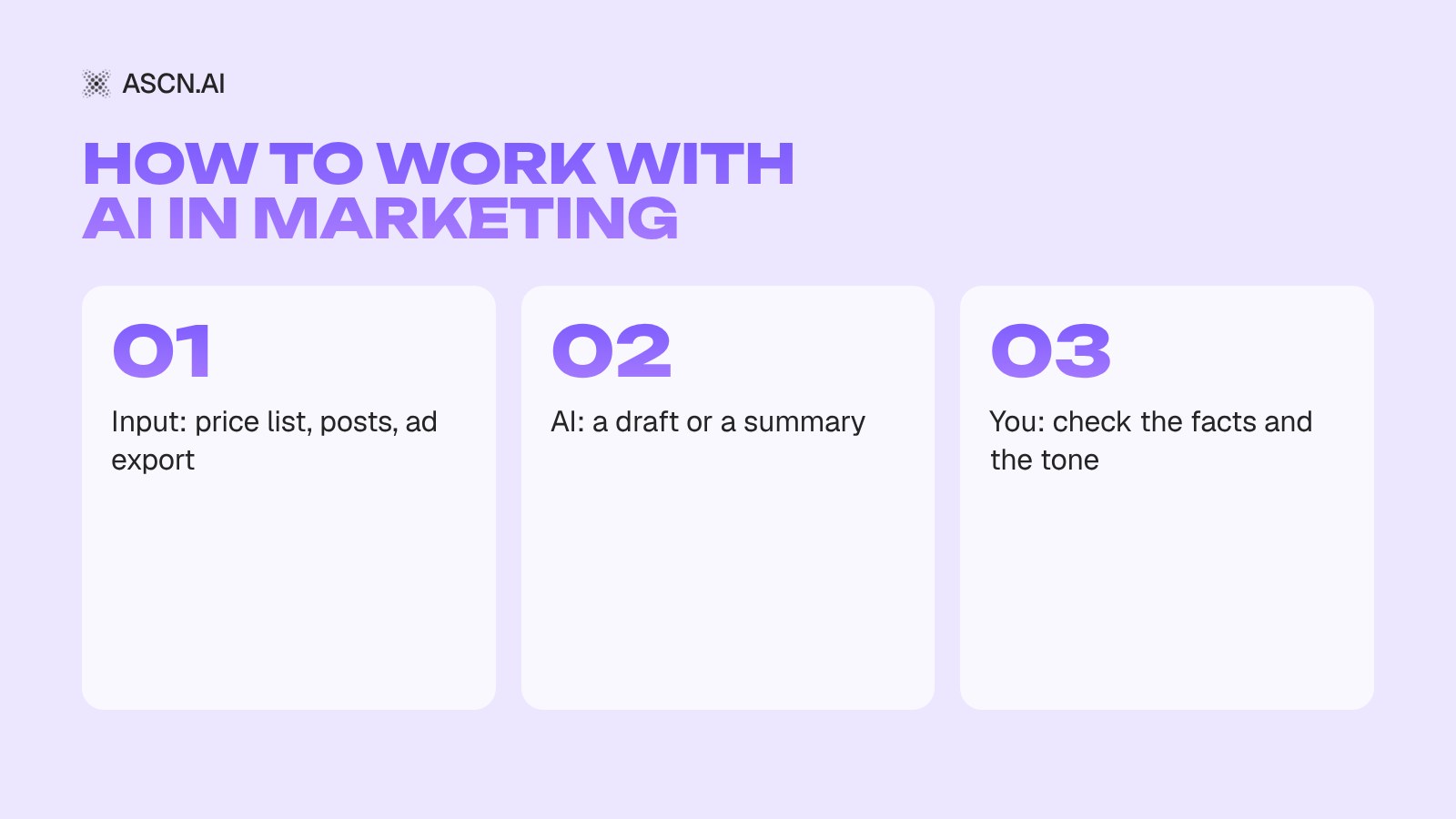
AI is only as good as the data you feed it. The final call is yours.
It does worse with whatever is missing from the input. It won't decide who to sell to, won't come up with your positioning and won't know a fact you didn't share. It fills the gap with plausible fiction. That's why every task below follows one pattern: you provide the data, you get a draft, you check it yourself.
AI for marketing: 6 tasks you can hand off
The tasks run from the simplest to the more involved. For each one: what to give the model, what you get back and what to check before the result goes live.
Posts and a content plan
Posts are the easiest place to start: you see the result right away, and a weak draft costs nothing until someone publishes it.
- You provide: a product description, a few of your best posts and a note on tone, for example "short, no corporate speak".
- You get: a weekly plan and drafts for each social network. Give it something long, like a webinar recording or an article, and the model will cut it into several posts.
- You check: facts and promises in the text, and whether the post sounds like you rather than an average writer.
Example prompt: "Here's a description of our coffee shop and the five posts our followers read most. Suggest a weekly plan for Instagram: short, no exclamation marks, same tone." How to turn this into ongoing work is covered in our article on automating social media with AI.
Customer replies and inquiries
For a small business, this is the task closest to revenue. A customer writes in the evening or on the weekend, gets no answer and goes to whoever replied first.
- You provide: your price list, answers to common questions and booking rules: which services, which days, what to ask the customer.
- You get: the AI replies in Telegram based on your price list, asks what the customer needs, collects the request and forwards it to you. In the morning you see ready requests instead of a dozen "how much is it?" messages.
- You check: read the first conversations in full. After that, make sure it hands tricky cases, such as complaints or requests for an unusual discount, to a person instead of handling them itself.
A one-off chat prompt won't cover this: every message needs an answer, including when you're away. More on that below, in the section on chat versus agent.
Ad copy and ad spend reviews
In advertising, AI helps in two places: when you need lots of copy variations and when you need to find where the budget is being wasted.
- You provide: a product description and customer segments, plus an export from your ad account for the review.
- You get: ten headline options for different segments and a list of campaigns and keywords that spend money but bring no leads.
- You check: pick two or three headlines to test. Pause campaigns yourself, after looking at the numbers.
Example prompt: "Here's last month's campaign export. Find where there's spend but no leads, and for each row explain what the conclusion is based on." An export is enough to start: the model sees the numbers but has no access to the ad account itself.
Email campaigns
Email campaigns often get postponed because the whole sequence has to be planned first. That is exactly the part a model handles best.
- You provide: a description of the business and customer types: first-time buyers, regulars, and people who haven't come back in a while.
- You get: segments, an email sequence (a welcome series for new customers, a win-back series for lapsed ones), the copy and the gaps between emails.
- You check: offer terms and deadlines, which models easily mix up. Then load the emails into your email service.
Weekly report
Pulling numbers together across channels is tedious, so the report often doesn't get done at all. AI turns the spreadsheet into a short text that reads faster than any table.
- You provide: a spreadsheet with the week's numbers by channel.
- You get: a five-line summary: what went up, what went down, what to look at.
- You check: the conclusions against the raw numbers. A model can mistake coincidence for cause: sales grew the week a newsletter went out, but not necessarily because of it.
What customers and competitors are saying
This is the most useful task and the riskiest. Useful, because real customer phrases make good headlines and landing pages later. Risky, because without data the model starts making things up.
- You provide: reviews of you and of competitors, forum discussions, links to competitor websites.
- You get: customer pain points in their own words, grouped by theme, each with a link to the source. Plus a short summary of what changed at competitors.
- You check: that every conclusion has a link. Don't accept a conclusion without one: it may have been invented.
We described how to collect this data regularly in our article on AI agents for market research.
Where AI gets it wrong
AI mistakes are predictable: almost all of them happen where the input lacked data or the output wasn't checked.
It makes up facts in a confident tone. For example, a model may add compliance with an ISO standard to a product description when that standard doesn't apply to the product at all. It sounds authoritative, and without a check the line ends up on your website. Numbers, specifications, prices and promises always need a human check.
It builds a customer profile out of thin air. Ask it to describe your audience without data and you'll get convincing pain points and statistics without a single source. Ask the same question again and the answer will be different. It can analyze real reviews, but it can't invent your customer for you.
It doesn't replace strategy or brand voice. AI doesn't know your market, your margins or your agreements with partners, and unedited copy sounds like everyone else's. One more thing: don't paste customer phone numbers, names or conversations into a public chat.
Chat or agent: which fits when
The difference is who starts the work. In a chat, you do. An agent starts on its own.
According to Gartner, as reported by AdIndex, 70% of CMOs admit their processes aren't mature enough for AI. Everyone has access to the models, but most don't have an established way of working with them, and a one-off chat prompt doesn't become one.
In a chat, you copy the data, write the prompt and move the result to where it's needed, every time. An agent starts on a schedule or on an event: a customer message arrives, Monday comes around. It pulls data from connected services and brings back a ready draft.
If the task is one-off, like a holiday post or ten headlines to test, a chat is enough. An agent would be overkill. It earns its place where the same work repeats every week or every day. For a broader look at the options, see our overview of AI agents for marketing.
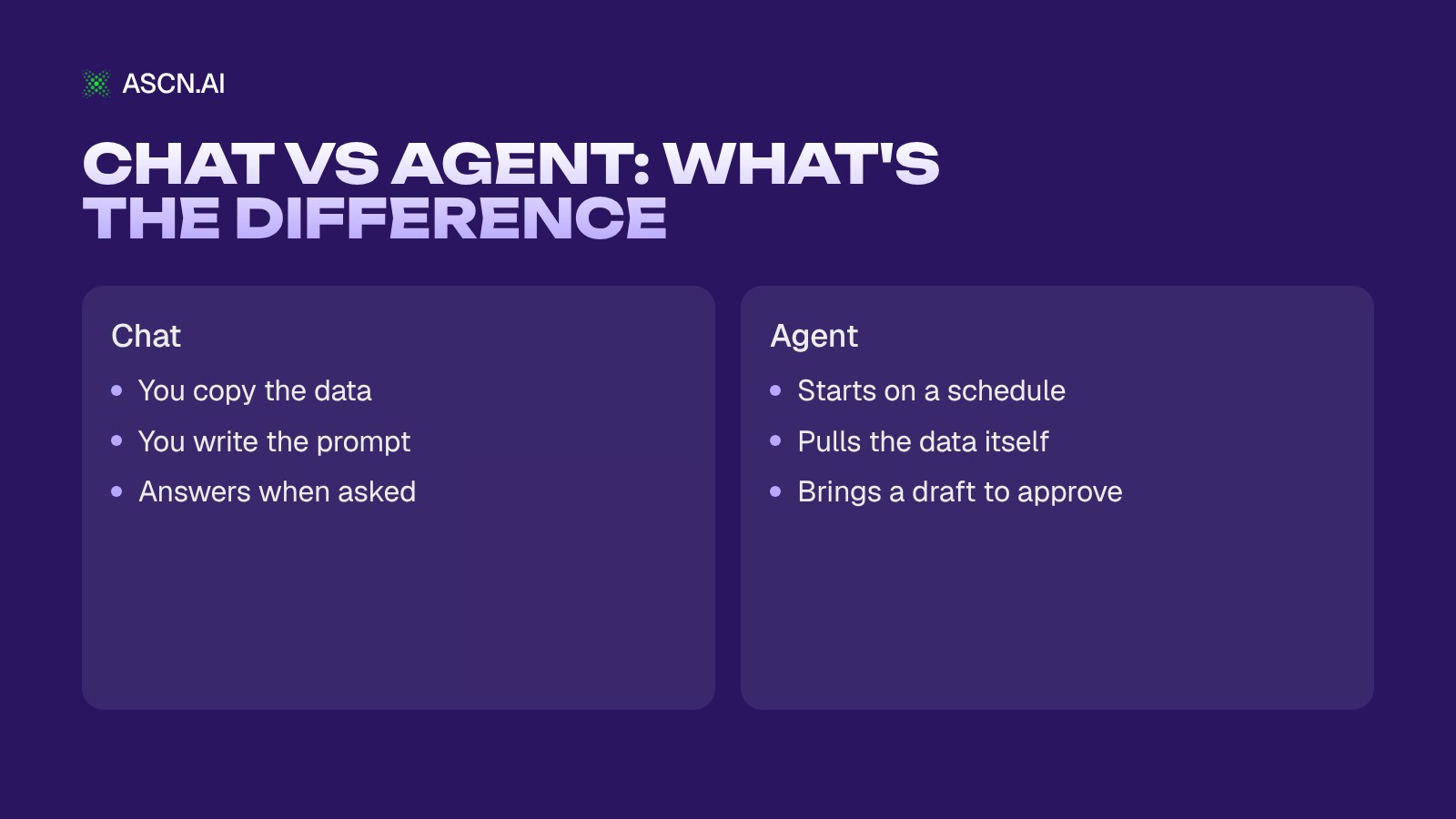
A chat answers when you ask. An agent starts on its own and brings you a draft.
| Task | Chat is enough | Agent needed | Human checks |
|---|---|---|---|
| Posts | one-off post | weekly plan | facts, tone |
| Customer replies | — | every message, 24/7 | tricky cases |
| Ads | ten headlines | regular spend review | what to pause |
| one email | event-triggered sequence | offer terms | |
| Report | one-off summary | Monday summary | conclusions |
| Competitors | one-off review | morning digest | sources |
A human check stays in every row. The agent takes over starting the work and collecting the data; you make the decision.
Why ASCN.ai: making it run on its own
ASCN Agent is an AI agent that runs on a schedule or on an event and works with your services: Google Sheets, Gmail, Telegram. By default it prepares a draft and asks for confirmation before sending, so the decision stays with you.
There are two ways to build an agent. The first is to describe the task in the chat in plain words, the way you'd brief a new hire. Here's an example prompt from the ASCN documentation:
"Every Monday at 9:00, search for mentions of [brand] and competitor activity, classify them by sentiment and send a digest to Telegram."
The second is to take a ready-made agent for one of the tasks above:
- Messenger Concierge answers customers in Telegram based on your price list and collects requests;
- SMM Content Factory prepares posts and publishes them once you approve;
- Market Radar sends a morning summary on competitors and your niche.
You can try it for free: the Free plan (500 credits a week, one active agent) lets you build an agent and test it on one task. Ongoing scheduled and 24/7 work starts with the Start plan ($29/month).
Start with one recurring task, not all of marketing at once. For a small business, we recommend starting with customer replies rather than posts: that's where leads get lost.
Build your first agent and test it on the task that takes up most of your time.
FAQ
Can AI replace a marketer?
No. AI takes on the groundwork: copy, summaries, sorting reviews. Decisions on strategy and budget, as well as fact-checking, stay with a person. A marketer who hands routine work to AI gets more done, but choosing the market and the positioning is not something a model will do for them.
How do I write an AI prompt for a marketing task?
Give context: what the product is and who buys it. Attach examples of copy that worked, describe the output format and the constraints, such as length and tone. A line like "you are a highly experienced marketer" adds nothing without data: the model still doesn't know your customers until you describe them.
Can I use AI for marketing for free?
Yes. Chat-based AI tools have free versions, and ASCN has a free plan where you can build an agent and test it on one task. Ongoing scheduled work is available from the Start plan ($29/month), so treat the free option as a trial.
Is it safe to upload customer data to AI?
Not to a public chat: don't paste customer phone numbers, names or conversations there. Tasks involving customer data need a service where the data is connected from your own systems and you set up and control the agent's access to it.
How is an AI agent different from an AI chat like ChatGPT?
A chat answers when you ask and works with whatever you paste into it. An agent starts on its own, on a schedule or on an event, pulls data from your services and brings the result to you for review. For one-off tasks a chat is enough; for recurring ones an agent is more convenient.
AI for Sales Managers: 8 Weekly Tasks to Hand Off and Where AI Gets It Wrong
AI for Marketers: How Marketing, Social Media and SEO Pros Do More in the Same Time
AI for Email: How to Automate the Work in Your Inbox

AI Agents for Market Research: Complete Guide to Automation & Tools

AI Agents for Marketing: A New Era of Automation

Automating Social Media Management with AI: Tools and Best Practices