



- Русский
- English
- Português
How to Build an AI Agent: An Honest Guide (2026)

“I’ve worked in the areas of Information Technology (IT) and cryptocurrency for nearly nine years and have employed a variety of automation techniques (some successful and others less than successful). I’ve created ad-hoc Python scripts and also systems that process millions of requests per day. The majority of my findings support one conclusion: approximately 90% of the tasks we perform are not done by programmers but rather accomplished by an effective combination of both AI agents and no-code development environments. These days, you no longer require an entire development team just to launch a product.”
Manually searching for information and writing algorithms by hand have lost their effectiveness by 2026. Due to the nature of business today, speed to respond to data is vital, and companies require rapid delivery of solutions derived from real-time information. Traditional scripts and template-based robots cannot provide these speeds.
Do you need to have market research performed? Do your customers need to be serviced in a unique manner? With the tireless energy of an AI agent, these types of activities may be accomplished 24 hours per day without risk of human error.
Grounded in real-world experience, this guide walks step by step through everything someone needs to build their own AI agent without any software development or platform engineering background.
What is an Artificial Intelligence Agent and Why is it Needed at All?
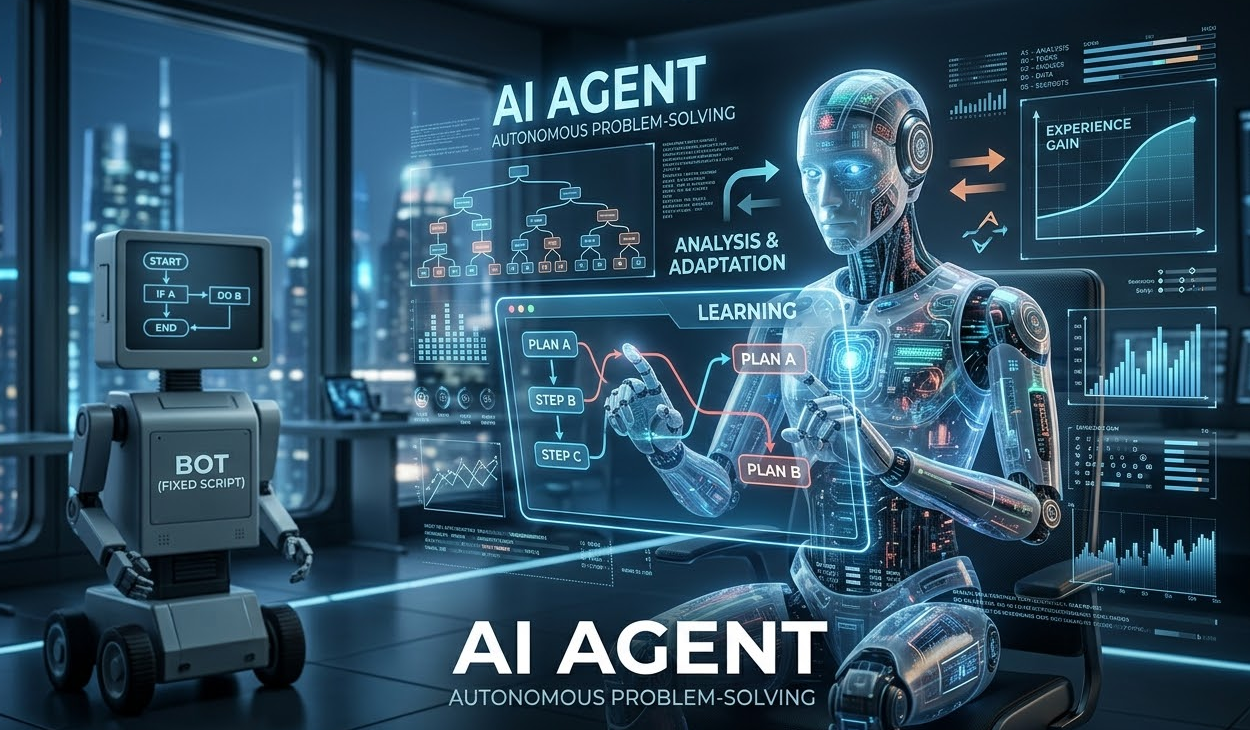
An Artificial Intelligence Agent is software that can intelligently solve problems on its own and is capable of evaluating the outcome from the point of resolution and making automated decisions about how to proceed without the direction of a person. An AI Agent is able to adapt to different circumstances and learn from its prior experiences, while a traditional bot will strictly follow a predetermined rule that states, "If A occurs, then B should occur." The primary benefit of AI is that it is capable of processing data in an unstructured way. When there are changes to the format of data, a standardized script may fail, whereas an AI agent merely interprets its meaning correctly and continues to be able to perform its task. This is especially important for business processes requiring arbitrary content such as addressing envelopes, analyzing financial market news, or generating customized responses.
- Autonomy: Agents develop their own strategies for accomplishing a task, without needing to be actively managed (for example, ASCN.AI's aggregated data from over 40 crypto platforms to provide summary statistics every ten minutes).
- Reactivity: Agents react immediately to any environmental change (i.e., they recalculate risk in real time when an asset loses 15% of its value within 60 minutes).
- Proactivity: Agents will anticipate events and act potentially before such events may occur (For instance: a warehouse agent may create purchase orders based upon projected future demand).
- Learnability: Agents become incrementally better as they are trained according to the user's settings and through operant (or reinforcement) learning. A generic GPT will produce a generic answer, while an agent that has been specially trained for a particular user will provide a tailored response.
How do they differ from chatbots? A chatbot is a relatively rudimentary form of interface, with a limited number of commands. In contrast, an agent is a very sophisticated system, capable of accurately understanding context; retaining a history of prior interactions; and determining independently what actions to take.
Types of AI Agents and Their Functions
There are several different kinds of AI agents based on their levels of autonomy and execution complexity:
- Reactive Agents - An agent that directly reacts to an external stimulus without any retention of memory of prior stimulus interactions. The ability to moderate messages based on the content is one example of how to do that.
- Limited Memory Agents - Agents that have the ability to remember the last few times we talked or have had conversations, allowing the agent to better understand the current context. To give an example of how Limited Memory would work, GPT-4 can retain a context of approximately 128,000 tokens (roughly 96,000 words).
- Goal-Directed Agents develop a roadmap of actions necessary to complete a particular goal — for example, identifying and processing undervalued cryptocurrency projects.
- Utility-Based Agents determine the best action to take based on several different criteria. A good example of an agent using the Utility Approach would be the dynamic pricing model of e-commerce companies.
- Learning Agents continue to learn from humans by using Reinforcement Learning through Human Feedback (RLHF) or through examples of fine-tuning.
Agents are also categorized by how they perform:
- Analytical Agents - Process large amounts of data using data analysis and provide analytics/insights from processed data.
- Communications Agents - Interact with others by answering questions, responding to requests, or placing qualifying potential leads/customers.
- Executive Agents - Execute actions via APIs and/or databases.
- Creative Agents - Will create content in the form of text, pictures/images, and code for marketing and development purposes.
In many use cases (production), there will often be hybrid agents that involve multiple agents that work together and divide up work.
Technology Types that can be utilized in the development of AI Agents
The foundation for AI Agents is an attention mechanism combined with transformer neural network architecture (Attention-Based Transformer Neural Networks) which can process text-based data efficiently and will model the context of the relationship of the words in a sentence/phrase to create its next word in a sequence (via their Predictive Network Model).
Main types of learning:
- Supervised Learning: Learning using input/output pairs (e.g., Questions/Answers).
- Unsupervised Learning: Pre-Trained on large raw data sets without structured input/output.
- Reinforcement Learning Using Human Feedback (RLHF): Learning is key, as humans rate the quality of AI Agent responses received to input from the user.
Natural Language and Generative Models (GPT)
GPT models will be used to further develop Natural Language AI Agents (e.g., GPT-4), which predict the next word in a sequence. You can adjust the degree of creativity in a response by changing the temperature and top-p parameters. This lets you tune a model's output to be more conservative or more creative.
With the introduction of function calling, models can now perform requests to external APIs for up-to-date information and complete complex tasks. This is a shift away from being a simple text generator to an actual orchestrator of events.
Development Platforms & Tools (Open Source/No-Code)
There are three broad categories of tools available: 1) no-code tools designed for business users with no development experience, 2) low-code tools for developers with limited development experience, and 3) libraries and SDKs for machine learning engineers.
- ASCN.AI NoCode — A visual platform allowing you to build without having to write code, visually assembling agents targeting the cryptocurrency space via nodes and built-in call to action (Function Calling) capabilities.
- Make.com and Zapier.com — Universal SaaS platforms allowing integration with hundreds of different services, but both have limited AI functionality.
- n8n — An open-source, self-hosted workflow automation tool with support for OpenAI and Anthropic.
- LangChain, LlamaIndex, and Haystack — Allow developers to create both advanced large language models (LLM) applications and retrieve/augment/generate (RAG) systems.
- Hugging Face Transformers, OpenAI SDK, and Anthropic SDK — Core software development kit (SDKs) for working with LLMs.
- AutoGen — Microsoft's multi-agent system framework.
Your choice will depend on your specific task, level of experience, and need to scale and/or be secure.
Creating Your Own AI Agent - Step-By-Step Process
Clearly define your problem and business objectives. Develop your tasks according to the job story framework (e.g., When [event/situation], I want to [action] so that [outcome]). At the same time, establish which tasks will be 100% automated, partially automated, with some level of human control.
Approaches to Tech and Architecture
You must choose between two strategies: quickly building a focused MVP or adopting a more flexible microservices approach for ongoing expansion. A visual, code-free UI paired with custom backend code often provides the best solution.
Together, the two most widely used languages — Python and JavaScript — combined with tools such as LangChain, no-code platforms, and SDKs from vendors like OpenAI and HuggingFace, can efficiently orchestrate large numbers of AI agents.
Integrating AI Agent and Training Process
Integrate LLMs (GPT-4, Claude, and open-source options such as Llama or Mistral) and implement appropriate context management strategies such as conversation summarisation or a sliding context window. Function calling and API integration enable the use of vector databases for RAG. You may also choose to conduct additional fine-tuning to enhance performance provided by an application program.
Iterate as you develop your product. Do not aim for a perfect product from the start; build your MVP, then iterate based on results. There is less expense associated with rapid development than associated with developing a product via long periods of uncertainty.
Affordable Ways for AI Agent Development
- LangChain Community Edition — Access to an LLM, either OpenAI’s or self-hosting from a public server.
- HuggingFace Transformers — Many models can be self-hosted and others are hosted with no cost to access an Inference API via a fee structure.
- n8n self-hosted — Open Source solution for the simplest way to connect to an LLM API.
- Chroma, FAISS Vector Management systems — Good Semantic Search Solutions.
How to Use Several GPT APIs and Open Source AI Models for Free
There are numerous methods to access GPT and/or Open Source AI models free of charge. One way to get started with an AI agent is through LocalAI, Ollama, and LM Studio, which allow you to run models on local hardware (in particular on a member from the RTX 3060 and above series for the 8B parameter model).
In terms of free cloud computing options, Google Colab, Kaggle and Paperspace can all be used but they will limit your scalability specifications, reliability/functionality and security profile for production. So you will want to use SaaS solutions or self-host solutions to develop and fine-tune, so you have greater productivity in terms of scale and performance and stability.
Platforms to Build Out an AI Agent: Platform Overview
| Platform | Traits | Pros | Cons |
|---|---|---|---|
| ASCN.AI NoCode | No-code solution, integrations into the web3 ecosystem, financial analysis templates already created, GPT-4 with calculation functions. | Quick/easy set up and deep specialization into Crypto, API-first | Very narrowly defined niche, expensive use of APIs. |
| Make (Integromat) | SaaS-based platform with support for 1,500+ integrations, with a visual editor. | Very easy no-coding solution start, many services available. | Limited AI functionality, costs grow with usage. |
| Zapier | Extremely easy to use, nodes with AI features like ChatGPT. | Many integrations available. | Limited flexibility/price. |
No-code Solutions for Rapid Agent Assembly
| Platform | Traits | Pros | Cons |
|---|---|---|---|
| n8n | Open-source, self-hosted, support for OpenAI and Anthropic models. | Allows for privacy and customization. | Requires technical knowledge for implementation. |
| Flowise / Dify | No-code based solutions for LLMs, available for self-hosting. | Complete control, support for RAG functionality. | Limited integrations, can be difficult to set up. |
AI Agent Development/Benefits for Business
AI Agents have become mainstream and no longer a term from a distant future. AI agents deliver a fifty to eighty percent reduction in the cost of routine support services and reporting processes. Many companies have found 20 to 35 percent reductions in operating costs while improving efficiencies and speed of processing data by three to five times, with the implementation of AI Agents for routine tasks.
Real-world Use Case Examples
Case #1 First Line Support Agent in E-commerce
- The AI Agent was able to process an average of 500+ support requests (70%) per day, reducing first response time from 4 hours to 12 seconds.
- CSAT increased from 3.2 to 4.5 on a 5-point scale, saving approximately $15,000 in salaries per month with total costs of $3,000.
Case 2 — Monitoring the Movement of cryptocurrencies — Falcon Finance — Porter Crash
On October 11, 2024, the value of the FF token dropped 87% within a 4 hour period due to an insider leak. An ASCN.AI Agent detected the anomaly ahead of time and notified a user via Telegram. The user exited a trade with a 9.7% loss vs 87% loss or $38,000 of a total $50,000 portfolio. The value of the subscription to the ASCN.AI Agent paid for itself with one trade (see detailed description here).
Case 3 Automation of Financial Reporting for B2B SaaS
A financial report is typically created in 20 hours, but after the implementation of ASCN.AI NoCode solution, it has been reduced to 10 minutes. The ASCN.AI NoCode Employee collects data from the following data sources: Stripe, Google Analytics, CRM, and AWS, calculates the appropriate metrics, and automatically generates and delivers a PDF report.
Case 4 — Personalizing Email Campaigns
An ASCN.AI Agent generated a total of 50,000 personalised emails, each tailored to an individual user's interaction history. As a result of the ASCN.AI agent generating the emails, the average open rate increased, the average click-through rate grew by 2.3 times, and the average conversion rate increased by 28%.
Advantages and Benefits to Business
- ASCN.AI's Automation provides Companies with 50-80% Cost Reductions to the costs associated with routine support service and reporting processes.
- Scaling without a corresponding increase in personnel.
- 24/7 availability and reliability, without human error.
- Continuous improvement with greater accuracy via RLHF.
Trends & Future Directions Through To 2026
By the end of 2025, it was predicted that 40% of businesses with 100+ employees would have begun utilizing AI agents to enhance their key processes. The barriers to utilize these technologies are decreasing, the tools are becoming more affordable, and the integration methods are becoming more simplified.
How AI Agents are Assisting with Work Automation and Customer Support
Examples of Utilizing AI Agents for Automation Tasks
- Expense categorization and cash flow forecasting, automatic invoicing.
- HR Process: Resume evaluations, initial interviews, and employee onboarding.
- Marketing: Identifying leads, producing targeted content, A/B testing results.
- Operations: Monitoring systems, tracking projects.
- Example: A cryptocurrency arbitrage agency utilizing analytics, sending notifications, and offering recommendations.
Examples of Utilizing AI Agents for Customer Service
- Tier 1 — Basic FAQ and relatively simple requests are automated processing (when the AI systems have at least a 90% certainty of producing a correct model).
- Tier 2 — Partially automated processing of cases whereby an employee provides context of the incident to the AI agent and requests his/her action.
- Tier 3 — Multiple employees process complex incidents that require real-time attention from an employee.
How to Create an AI Agent; Examples of Tasks, Instructions and Code
- Install Python and langchain Dependencies.
- Generate a Knowledge Base and Index it using Chroma's Vector Database.
- Build a RAG chain utilizing a Custom Prompt w/GPT-4-turbo.
- Test and Efficiently Escalate Requests with Low Level of Certainty.
- (Optional) Configuration integration to Telegram for Agent Communication.
- API Call: Status of Order API calls (Different functions).
- Manage Dialogue Memory: Manage the stored dialogue context and how it is used within a dialogue window section.
Step-by-step instructions for each step with programming code examples. Creating an agent at ASCN.AI or similar no-code platforms requires no programming skills and takes less than 2 hours.
AI Agent Components
- NLP — Models/cloud API can logically determine and produce text.
- KD — Store knowledge data in Graph, Vector databases or traditional SQL type databases.
- MM — Short-term memory; Long-term memory; Selectively storing context.
- T/I — API/Read Web/Use Function Calls.
- O — Orchestrator that coordinates Agent's activities by coordinating the work of multiple LLMs (Language Models) and should follow LLM standards/rules/instructions.
- M and L — Collecting metrics, logging, Collecting error statistics.
Technologies/Platforms used
Python and LangChain + LlamaIndex for Developers & No-Code User Platforms (ASCN.AI, n8n, Flowise) for Commercial Users; Commercial LLMs (GPT-4, Claude) or Self-hosted LLM (Llama, Mistral) depending upon your security/software budget.
FAQ About AI Agent Creation
1. How Much Money do You Need to Make an AI agent?
Depends upon the number of configurations; Free/Open source, and can be thousands per month; By API usage - between $100-$300 based on 10,000 Calls/Day at Commercial Use.
2. Do You Need To Have Programming Skills to Make an AI Agent?
Simple AI Agents typically do not require any programming skills; however, if you want to build advanced agents and have no programming skills, I recommend learning basic ML skills and using either Python or JavaScript.
3. Can AI agents replace human employees?
No, although AI agents can automate repetitive tasks, complex process problem solving and decision making will remain an employee job function.
4. How Do I prevent bad business requests to my Agent?
Use sound business process controls, input validation, and sandboxing; and constantly monitor the agent's requests.
5. What AI Model do I Use For My Agent?
GPT-4 is the most capable model for complex tasks, but open-source alternatives also exist and may be preferable when privacy or data ownership is a concern.
6. Can I operate an AI Agent on my PC?
Yes. You can run a self-hosted Agent; but you need a specified GPU (i.e. RTX 3060>), to support up to 8 Billion Parameters Model.
Conclusion: The Growing Future Of AI Agents
AI Agents change both how organizations automate their business processes and how customers interact with those who use AI Agents, and by 2026 it is expected that 40% or more of companies will use them for their most significant processes, vastly reducing technical barriers: as more tools become available, integrating systems through standard protocols is becoming much easier.
- Build a Min. Viable Product (MVP) with No-Code; Validate and Test Concepts/Hypotheses quickly.
- Use Data Analytics to generate 70% of productivity in an enterprise organization.
- Measure/Monitor your Metrics from day one; Without proper Control over metrics no true ROI will occur.
- Allow for Human/unassisted interaction for complex issues.
- Follow an Agile Development Approach; Develop-Release to Market-Then to develop while performing development updates.
- Invest in Security, Compliance.
These are not just technical fads but now have become the accepted standards and will help increase your competitive advantage if you start incorporating AI agents today.
Disclaimer
This document is meant for discussion purposes only; it is not intended to create any obligations nor should it be interpreted as any legal or investment advice. You must take deliberate effort both in how you use AI Assistant Solutions and in understanding the specific functionalities of the platforms you may use.