



- Русский
- English
- Português
AI for Marketers: How Marketing, Social Media and SEO Pros Do More in the Same Time

Key takeaways
AI for marketers means handing repetitive work to AI tools: copy drafts, ideas, keyword clustering, review tagging, reports. A marketer, social media manager or SEO specialist gets back several hours a week. In an MIT study of writing tasks, AI cut time by 40% and raised quality by 18%. You can spend those hours on work your manager notices. The skill itself already pays: PwC finds that job ads requiring AI skills offer 62% more on average.
Monday morning. A social media manager runs three accounts. This week they need a content plan, 15 posts and a reach report for last month. Half the day goes to work they have done a hundred times before. Sound familiar?
Most of that work can already go to AI, and marketers are moving first. In Russia, the job site hh.ru reports that 82% of people in marketing, advertising and PR use AI at work, more than in any other field. Below: which tasks to hand off, what it gives you personally, and why it affects your pay, not just your calendar.
Contents:
- What AI for marketers actually means
- Which marketing tasks to hand off to AI
- What it gives you as an employee
- How companies already work this way
- Why AI skills affect your pay
- Where AI doesn't save time
- Where to start
- Why ASCN.ai
- FAQ
What AI for marketers actually means
AI for marketers is a set of AI tools that take over part of your daily workload. Usually it's the stuff that repeats every day: writing a first draft, pulling data together, summarizing a long document, sorting things into groups.
AI doesn't do the whole job for you. It produces a first version fast, and you decide what to do with it. Your expertise still matters most. Without it you can't tell where the model got things wrong, and it gets things wrong regularly.
There are two levels. The first is a chat with an AI model: you write a prompt, get an answer and move it into your work. Almost everyone starts here. The second is an AI agent. It runs a task on a schedule by itself: say, it builds the content plan every Monday or sends a competitor digest every morning. You don't have to open a chat and type the prompt again. For a broader overview of tools, see our guide to AI for personal productivity. Here we go role by role.
Which marketing tasks to hand off to AI
Below are the tasks people in three roles most often give to AI. The time estimates come from a practitioner's breakdown on ppc.world, a Russian paid-media publication (August 2026). They are project-based estimates, not lab measurements, but they show the order of magnitude well.
Marketer
Marketers have plenty of tasks that mean digging through a lot of data or writing many similar texts. That's where AI saves the most time.
| Task | By hand | With AI |
|---|---|---|
| Keyword clustering | 2–3 hours | 30–40 minutes |
| Tagging 300–500 reviews | A full workday | 20–30 minutes |
| Meeting notes from a recording | 30–40 minutes | 5–10 minutes |
| HTML email for a campaign | 2–2.5 hours | 20–30 minutes |
AI is also good at ad copy and subject-line variants for A/B tests. It can draft a brief for a designer, write spreadsheet formulas and SQL queries for data exports. By the same author's estimate, handing 5–7 of these tasks to AI frees up 5–8 hours a week. That's almost a full workday.
Social media manager
Social media is one of the most text-heavy jobs in marketing. Every day you need to come up with something, write it and adapt it for different platforms. Employers already factor this in: according to hh.ru, one in nine job ads for social media managers and content managers explicitly asks for AI skills.
What you can hand off to AI:
- a monthly content plan by content pillar;
- ideas for posts, giveaways and launch warm-ups;
- a first draft and its versions for LinkedIn, Instagram, X and other networks;
- images for posts;
- comment analysis: what people ask about and what they dislike;
- a short report on reach and engagement.
Brand voice, talking to your audience and deciding what goes live stay with you. AI will give you ten versions of a post in a minute. Picking the best one and polishing it is your job. More scenarios are in our article on automating social media with AI.
SEO specialist
SEO is full of lists and spreadsheets: thousands of queries, hundreds of pages, dozens of competitors. AI handles that kind of volume well. In an Ahrefs survey (September 2026, 301 marketers and SEO specialists), 45% of AI users already hand off keyword clustering, up from 23% a year earlier. 60% use AI for data analysis.
What you can hand off to AI:
- keyword clustering;
- a draft content brief for a writer based on the SERP;
- title tags and meta descriptions for hundreds of pages;
- query analysis from Google Search Console and Bing Webmaster Tools;
- competitor page analysis;
- checking whether AI answers in search engines mention your site.
Strategy and fact-checking stay with you. If AI gets a cluster wrong, you'll see it in rankings a month later. More on keyword work in our article on AI for keyword research and SEO.
What it gives you as an employee
The main benefit is simple: you spend less time and the result is no worse. But there are other benefits people often forget about.
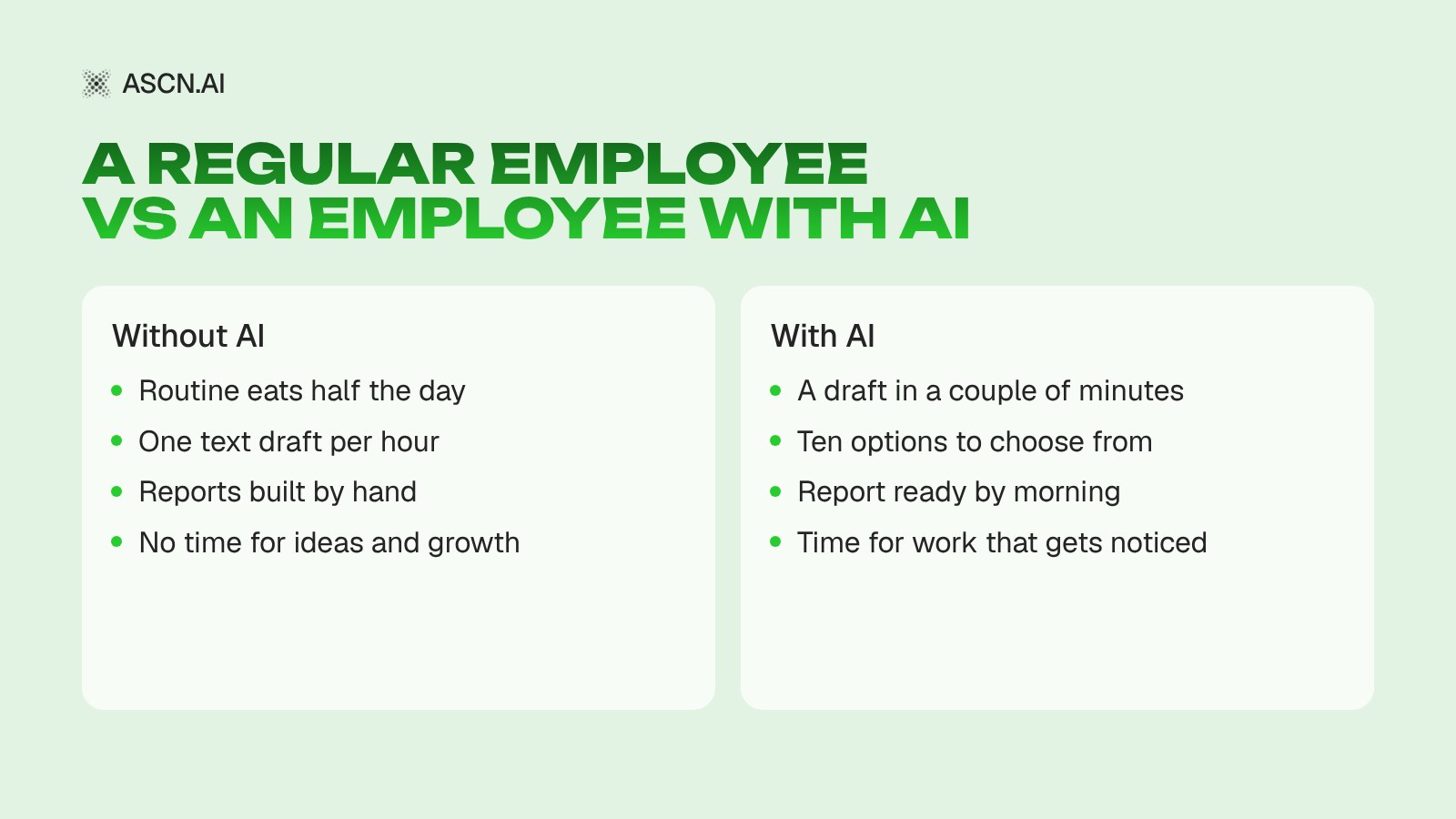
Less time on the same task
In an MIT experiment, 453 professionals wrote work documents: press releases, reports, emails. Those who used ChatGPT spent 40% less time per task. The results were published in Science in 2023.
Same quality or better
In the same study, independent evaluators rated the quality of AI-assisted texts 18% higher. In a BCG and Harvard experiment, 758 consultants using GPT-4 completed 12% more tasks and worked 25% faster. Their output was rated 40% higher in quality. The biggest gains went to people whose results had been below average.
Less busywork, more visible work
You can spend the freed-up hours on what your manager actually sees: a new hypothesis, a campaign launch, figuring out why leads dropped. According to hh.ru, 45% of employees who use AI became more productive, and 14% started leaving work earlier.
You grow faster
AI makes it easier to take on work outside your core role. A social media manager can put together basic analytics. A marketer can write a formula or an export script, and an SEO specialist can draft an article. In the same hh.ru survey, 46% of employees said they had learned new skills.
How companies already work this way
This isn't theory. At a number of companies AI is a normal part of the job, and some expect it from every employee.
Klarna: faster marketing
Swedish fintech Klarna shared its results in May 2024. Campaign images used to take six weeks to produce; now they take seven days. AI is involved in 80% of copywriting, and in one quarter the team produced more than a thousand images. The company saves about $10 million a year on marketing, and 87% of employees use generative AI daily. The figures were reported by Marketing Dive.
Shopify: AI as a baseline expectation
In April 2025, Shopify CEO Tobi Lütke sent a memo to staff. The core message: using AI is now a baseline expectation for everyone, and it counts in performance reviews. Before asking for more headcount, a manager has to explain why the work can't be done with AI.
Zapier and Duolingo: AI skills in hiring
Since May 2025, Zapier has required AI fluency from every new hire. Candidates are assessed on four levels, from "unacceptable" to "transformative." Duolingo announced an AI-first approach the same year: AI use now counts in both hiring and performance reviews.
All of these examples share one thing. AI takes the first-draft work, and people decide what comes out of it. The better someone works this way, the more they get done and the more valuable they are to the company.
Why AI skills affect your pay
Speed alone doesn't raise your salary. But the market already pays more for AI skills, and the gap is noticeable.
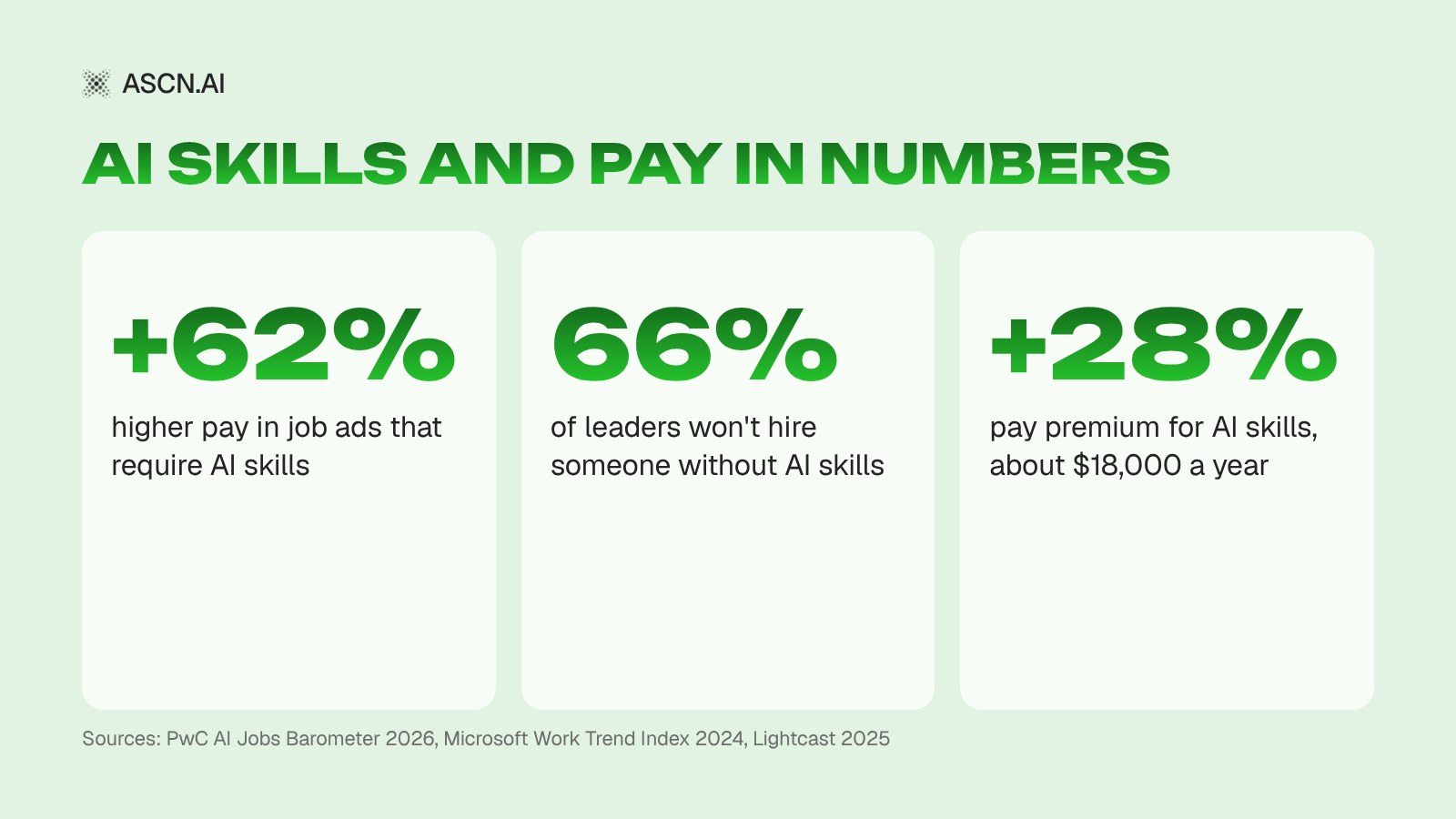
- PwC, June 2026. Job ads that require AI skills offer 62% more on average than similar roles without them. The analysis covered more than a billion job postings across 27 countries.
- Lightcast, July 2025. Jobs requiring AI skills pay 28% more, about $18,000 a year. More than half of those jobs are outside IT.
- Microsoft and LinkedIn, 2024. 66% of leaders say they wouldn't hire someone without AI skills.
- hh.ru, first half of 2026. More than 21,600 job ads in Russia explicitly required AI skills. Among marketing and social media roles, that's already 11% of openings.
The direction is clear: AI skills are moving from "nice to have" to a hard requirement in job descriptions.
There's also a simpler path to more money. If you do the same work faster, you build up spare time. You can spend it on a second project, freelance work or higher-level tasks. Say you save 6 hours a week. Over a month that's 24 hours, or three working days. That's enough to take on one more client, or to ship a project you can bring to your next conversation about a raise.
Where AI doesn't save time
AI has downsides, and it's better to know them upfront.
The first is review. In a Glean survey (June 2026), office workers estimated that AI saves them 11 hours a week, but 6.4 of those hours go to checking and fixing what the AI produced.
The second is workload. When your manager sees you've become faster, they may simply give you more tasks. According to HubSpot's 2026 data, 83.5% of marketers are expected to produce more content, and 73.1% saw their workload grow over the year. In a Content Marketing Institute survey, half of marketers took on new responsibilities without a promotion or a raise.
The third is errors. AI writes confidently even when it's wrong. Always check numbers, facts, names and prices yourself.
The takeaway is simple. Time savings turn into career growth only if you decide what to do with the freed-up time and show the results.
Where to start
Don't try to hand everything to AI at once. Start with a couple of tasks and see how it goes.
- Write down your tasks for one week. Mark the ones that repeat and take more than an hour.
- Pick two or three and hand them to AI: keyword clustering, a content plan or meeting notes, for example.
- Save the prompts that work. A good prompt is a template you can reuse every week.
- For the first two weeks, check every result. That's how you learn where the model slips.
- Measure time before and after. "The report now takes 20 minutes instead of two hours" works better in a meeting with your manager than any pitch.
- Don't paste contracts, passwords or customer data into chatbots until your company has rules for it.
Once prompting becomes a habit, the next step is an AI agent. It runs recurring tasks on a schedule and sends you the finished result. In ASCN.ai you build such an agent without code: you describe the task in plain words in a chat. There are also ready-made agents for marketing roles:
- SMM Content Factory finds trends, writes posts for each network, creates images for them and publishes once you approve.
- Market Radar scans the market and the competitors on your list every morning and sends a digest to Telegram.
- GEO Optimizer checks whether AI answers cite your site and suggests page edits.
- Content Repurposing Agent turns an article or video into social posts in your style.
All four can be launched on the free plan, which gives you 500 credits a week and one active agent. Scheduled runs, 24/7 operation and connecting the agent to Telegram start with the Start plan ($29/mo). For how agents help a whole marketing team, see our article on AI agents for marketing.
Why ASCN.ai
ASCN.ai is a platform where marketers build an AI agent without code, and the agent then does the work on its own. What that means in practice:
- An agent from a chat description. Describe the task in plain words, for example "every Monday, build a content plan by pillar," and the agent suggests which services to connect.
- Ready-made agents for marketing, social and SEO. The marketplace has 100+ ready-made agents you can take as-is and launch in a couple of minutes.
- Works inside your tools. Google Sheets, Docs, Search Console, Gmail and Notion connect in a couple of clicks; anything else connects via API and MCP.
- Your choice of models. Claude, GPT, Gemini, DeepSeek, Qwen and more in one subscription, switchable in one click.
- You stay in control. By default the agent drafts emails and asks for confirmation before sending; risky actions run only after your approval.
The free plan includes 500 credits a week and one active agent; scheduled tasks and 24/7 operation start with the Start plan ($29/mo). Start with the ready-made SMM Content Factory agent: it prepares a week of posts for each network and publishes them once you approve.
FAQ
Will AI replace marketers or social media managers?
It's more likely to change the job itself. AI drafts fast, but it doesn't know the product, the audience and the goals the way you do. The people most at risk are those who only do routine work and don't learn to work with AI. Employers already factor this in: 66% of leaders in a Microsoft survey wouldn't hire someone without AI skills.
How much time does AI really save marketers?
Realistically, 5–8 hours a week if you hand 5–7 repetitive tasks to AI, according to a practitioner's estimate on ppc.world. Big promises like "70% less work" usually ignore the time spent reviewing output. The best approach is to measure your own tasks before and after you start using AI.
Which AI tool should a marketer use?
For one-off tasks, a general-purpose AI chatbot is enough: copy, ideas, summaries, formulas. For images you need a separate image model. If a task repeats every week, an AI agent is more convenient. It runs the task on a schedule, so you don't have to write the prompt every time.
Can I use AI at work if my employer hasn't approved it?
Many people do: according to Microsoft, 78% of AI users bring their own AI tools to work. Still, it's better to be open about it. Ask whether your company has an AI policy, and don't upload contracts, customer data or passwords to third-party services.
How do I show my manager that AI helps?
With numbers. Write down how long a task took before and how long it takes now. Then show what you did with the time you saved: a new campaign, another test, another client. That way your speed becomes a reason for a promotion, not for a fresh pile of routine work.
AI Agents for Market Research: Complete Guide to Automation & Tools
AI Tools for SEO: How to Stop Doing Routine Tasks and Start Taking Control
Neural Networks for Personal Productivity: How AI Can Help You Become More Effective

AI Agents for Marketing: A New Era of Automation

Automating Social Media Management with AI: Tools and Best Practices
AI for keyword selection and SEO