



- Русский
- English
- Português
Best AI Lead Generation Tools in 2026: 14 Tools Priced on One 100-Lead Task

AI lead generation tools find and qualify the companies and people you should be talking to. In 2026 they come in four kinds: B2B contact databases that sell verified emails and phone numbers (Apollo, ZoomInfo, Lusha, Cognism, Seamless.AI, UpLead, RocketReach, Hunter), research and enrichment workspaces (Clay), intent and website-visitor tools (Leadfeeder, LinkedIn Sales Navigator) and inbound capture with forms and chat (HubSpot). The newest kind is an AI agent that builds the list itself from open sources such as Google Maps and company websites, scores every lead and writes it to your CRM. That is where ASCN.ai sits.
Starting prices hide what you actually pay for, which is the reveal: Apollo charges 1 credit for an email and 8 for a phone number, Lusha 1 and 5. So we priced one task on every tool: 100 qualified leads in one niche. Prices and screenshots were taken from the vendors' own pages on November 25, 2026. Sending sequences and AI SDRs are covered in our separate ranking of AI sales tools; this article stops at a qualified lead in your CRM.
Contents:
- Key takeaways
- How we tested
- Comparison tables
- What 100 qualified leads cost
- The 14 best AI lead generation tools
- How to measure lead quality
- What to pick for which team
- Build a lead generation agent: ready prompts
- Data rules: GDPR, CCPA and CAN-SPAM
- FAQ
- Conclusion
Key takeaways: the best AI lead generation tool for each team
For a founder or a small team that sells to local or niche businesses, the best AI lead generation tool is an agent that collects leads from Google Maps and company websites, checks each one against your ideal customer and puts the result in your CRM: ASCN.ai does that on the Free plan or from $29 a month. Teams that need verified emails and direct dials at volume buy a database (Apollo is the cheapest entry, ZoomInfo and Cognism the enterprise choice). Teams with website traffic add visitor identification and forms (Leadfeeder, HubSpot).
- ASCN.ai: a personal AI assistant with its own cloud computer; ready-made lead agents search Google Maps and the web, enrich and score every company, keep the list in Google Sheets, Notion or your CRM and draft the first message for your approval. Free plan, paid from $29/mo.
- Apollo.io: 240M+ contacts; the Free plan's 900 credits cover 100 emails plus 100 phone numbers.
- ZoomInfo and Cognism: enterprise B2B data with intent signals; Cognism is built around phone-verified mobiles in Europe. Prices on request.
- Clay: 150+ data providers in waterfalls and the Claygent research agent, from $167/mo.
- Lusha, Hunter, UpLead, RocketReach, Seamless.AI: pay-per-reveal contact finders from $33 to $99 a month.
- LinkedIn Sales Navigator: people search and buyer intent on LinkedIn, from $119.99/mo.
- Leadfeeder and HubSpot: turn your own website traffic into leads with visitor identification, forms and chat.
- Instantly: a 450M+ lead database bundled with a cold email sender.
How we tested AI lead generation tools
The current top results for this query are desk reviews. One of them counts 21 tools in the text and 24 in the table, another says 26 in the intro and 28 in the title, and none prices the same job across tools. We did three things differently.
- One task for all 14 tools. Find 100 qualified leads: marketing agencies with 10 to 50 employees in Texas, with a named decision maker (founder, CEO or head of growth), a verified work email and a phone number where the tool sells one. For each tool we took the cheapest plan on its pricing page that covers the task and wrote down what the plan leaves out.
- One date. All pricing and product pages were opened on November 25, 2026, and each screenshot in this article was taken that day.
- Six criteria with a verdict. Data source and coverage, enrichment and verification, intent signals, inbound capture (forms, chat, website visitors), CRM sync and compliance. If a vendor's page doesn't mention a criterion, the table says "Not stated".
We also queried every free source used in the prompts below. SEC EDGAR, Greenhouse and Lever job APIs, Google Public DNS and the Companies House website answered without payment; the Companies House API and the Google Maps Places API answer only with a free API key. We did not buy exports from paid databases, so match rates and bounce rates are not scored here. Prices exclude taxes.
AI lead generation tools comparison tables
Paid entry points run from $33 a month (RocketReach, billed annually) to $369 (Leadfeeder Activate), and four tools sell only by quote. The first table covers price and type, the second the six criteria.
| Tool | Type | Entry price | Free plan / trial | Best for |
|---|---|---|---|---|
| ASCN.ai | AI agent platform | $29/mo | Free plan | Founders, small teams |
| Apollo.io | B2B database | $49/seat (annual) | Free, 900 credits | Database-first teams |
| ZoomInfo | B2B database | On request | Free trial | Enterprise GTM |
| Clay | Enrichment workspace | $167/mo | Free, 14-day trial | GTM engineers |
| Seamless.AI | B2B database | On request | Free, 50 credits | Mobile numbers |
| Lusha | Contact finder | $49.90/mo | Free, 40 credits/mo | Small sales teams |
| Cognism | B2B database | On request | Demo | Europe, phone outreach |
| Hunter | Email finder | $34/mo (annual) | Free, 50 credits/mo | Email-only prospecting |
| UpLead | Contact finder | $99/mo | 7 days, 5 credits | Verified emails |
| RocketReach | Contact finder | $33/mo (annual) | Not stated | Budget email lookup |
| LinkedIn Sales Navigator | People search | $119.99/mo | Free trial | LinkedIn selling |
| Leadfeeder | Website visitors | $79/mo (annual) | Lite free | Sites with B2B traffic |
| HubSpot | CRM + inbound | $20/seat | Free CRM, 2 users | Inbound capture |
| Instantly | Database + sender | $47/mo | Not stated | List and send in one |
| Tool | Data source | Verification | Intent | Inbound | CRM sync |
|---|---|---|---|---|---|
| ASCN.ai | Maps, web, sites | No guessed emails | Your criteria, scored | Telegram, email, forms | HubSpot, Sheets, API |
| Apollo.io | 240M+ contacts | Waterfall | 6 topics (Basic) | Visitors, forms | From Basic |
| ZoomInfo | Own database | Not stated | Yes | Chat, forms | Via integrations |
| Clay | 150+ providers | Waterfalls | Signals, web intent | Webhooks (Growth) | From Growth |
| Seamless.AI | 1.8B+ emails | Verified | Buyer intent | Not stated | 6,000+ tools |
| Lusha | Own database | Verified emails | Signals | Visitor ID | All plans |
| Cognism | Europe-first | Phone-verified | Intent, hiring | Not stated | Salesforce, HubSpot |
| Hunter | Email database | Auto-verified | Lead signals | Not stated | Not stated |
| UpLead | 200M+ leads | 95%+ guarantee | Professional | Not stated | From Essentials |
| RocketReach | 700M people | Verified | Ultimate | Not stated | From Pro |
| Sales Navigator | Not stated | Buyer intent | Not stated | Advanced Plus | |
| Leadfeeder | Your web traffic | Activate | Visits, intent | Visitors | From Discover |
| HubSpot | CRM, agent | Not stated | Prospecting agent | Forms, chat | Native |
| Instantly | 450M+ leads | Bounce detection | Not stated | Website chat agent | Built-in CRM |
Vendor pricing and product pages, checked November 25, 2026. "Not stated" means the vendor's page doesn't say.
On compliance, Lusha (GDPR, CCPA, SOC 2, ISO 27701), Seamless.AI (GDPR, CCPA, SOC 2 Type II) and Cognism (GDPR, CCPA, Do-Not-Call coverage across Europe) state it on their pages; Apollo lists GDPR and CAN-SPAM tools. The rest link to a privacy policy only. If you sell into the EU, ask every vendor for a data processing agreement and the source of their records before you sign.
What 100 qualified leads cost
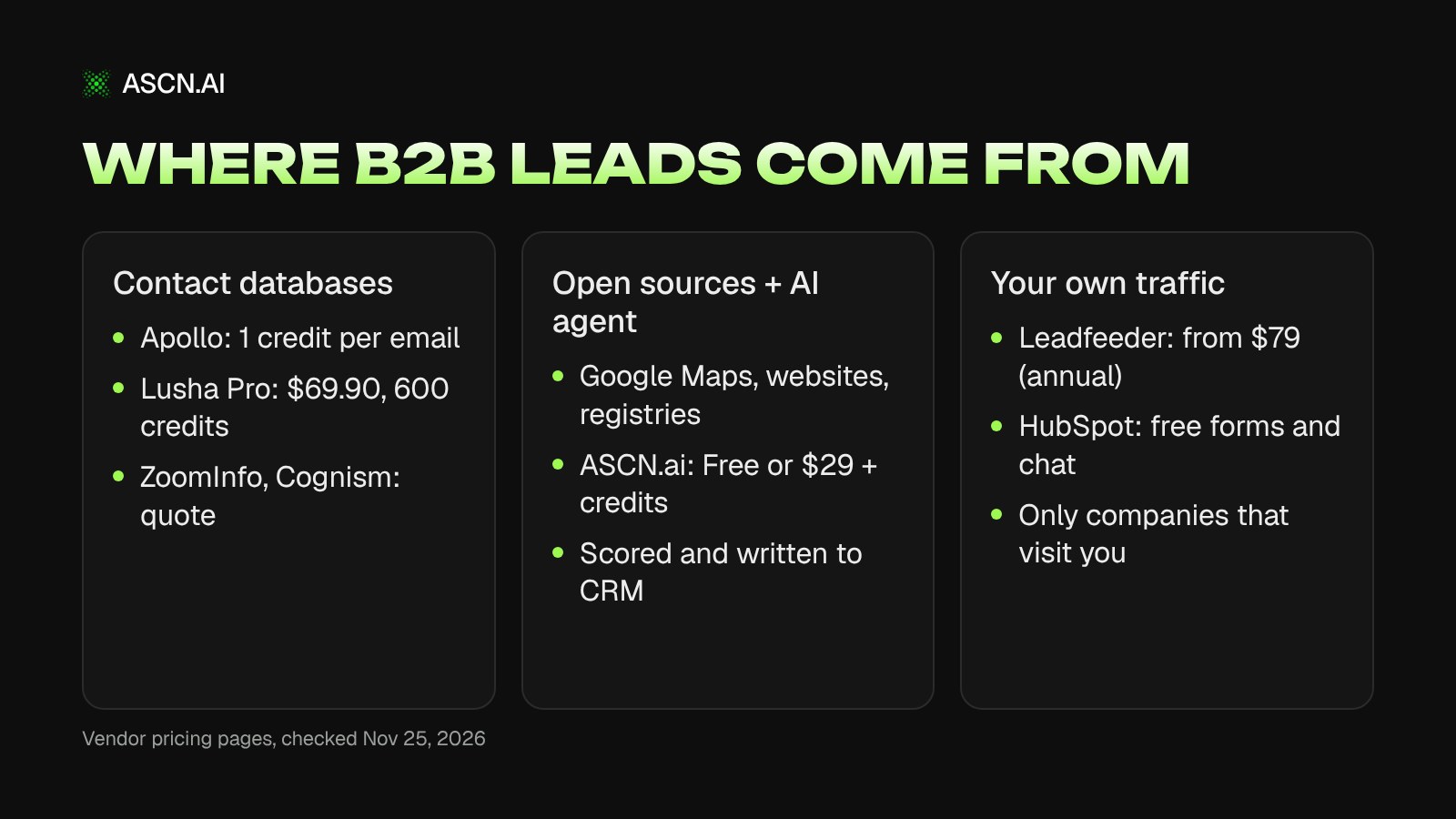
For 100 Texas marketing agencies with a decision maker and a verified email, Apollo's Free plan covers the task at $0, including phone numbers. Hunter does it for $34 a month (annual billing) without phones, and Lusha for $69.90 a month with phones. ASCN.ai does it on the Free plan, with Google Maps data paid separately to the data provider. This is our calculation from the pricing pages, not a vendor quote.
| Tool | Plan for 100 leads | Per month | What you get | Left out |
|---|---|---|---|---|
| ASCN.ai | Free or Start | $0–29 + credits | List, score, hook, CRM row | Maps data billed by Outscraper |
| Apollo.io | Free, 900 credits | $0 | 100 emails + 100 phones | Sequences limited to 2 |
| Hunter | Starter | $34 (annual) | 100 emails | No phone numbers |
| RocketReach | Essentials / Pro | $33 / $75 (annual) | 100 exports a month | Phones only on Pro |
| Lusha | Pro, 600 credits | $69.90 | 100 emails + 100 phones | Starter: emails only |
| UpLead | Essentials, 170 credits | $99 | Verified emails, mobiles | Credit cost per field not listed |
| Instantly | Credits Growth | $47 | 1,500–2,000 credits | Credits per lead not listed |
| HubSpot | Starter + agent | $20 + up to $100 | Researched leads, drafts | $1 per recommended lead |
| Sales Navigator | Core | $119.99 | Names, profiles, intent | No email or phone export |
| Clay | Free test / Launch | $0 / $167 | Waterfall enrichment | Credits vary by provider |
| Leadfeeder | Activate | $369 (annual) | Visitors + contacts | Only companies that visit you |
| Seamless.AI | Free, 50 credits | $0, then quote | 50 contacts | Second 50 needs a paid plan |
| ZoomInfo, Cognism | Quote only | n/a | Enterprise data | No public price |
Our calculation from vendor pricing pages, November 25, 2026. Apollo: 1 credit per email, 8 per phone number. Lusha: 1 credit per email, 5 per phone. Hunter: 1 credit per email found.
Apollo's free credits will reveal 100 agencies' emails, but somebody still has to check that each one has 10 to 50 people, works with your kind of client and shows a reason to talk now. That check is where an agent earns its place: the cheap rows above sell data by the reveal, while ASCN.ai, Clay and HubSpot's agent spend their budget on research and scoring.
Watch the billing unit. RocketReach and Hunter show the annual price per month; Lusha and Instantly show monthly; Leadfeeder sells only annually on Scale. Compare plans at the same billing period before you decide.
The 14 best AI lead generation tools in 2026
The order follows where leads come from: first the agent that builds lists from open sources, then contact databases, then enrichment, intent and inbound tools.
1. ASCN.ai: an AI assistant that finds, enriches and scores leads
ASCN.AI gives you a personal AI assistant with its own cloud computer. It does the work on its own: finds information, works with documents, and helps with sales, marketing and other tasks. Nothing to install, no code, no servers. The platform brings together the best AI models, 3,000+ integrations, more than 100 ready-made AI agents, free step-by-step training and the option to launch your own AI service under your brand.
Best for: founders, agencies and small sales teams that sell to local or niche businesses and want a scored list with a reason to call each lead.
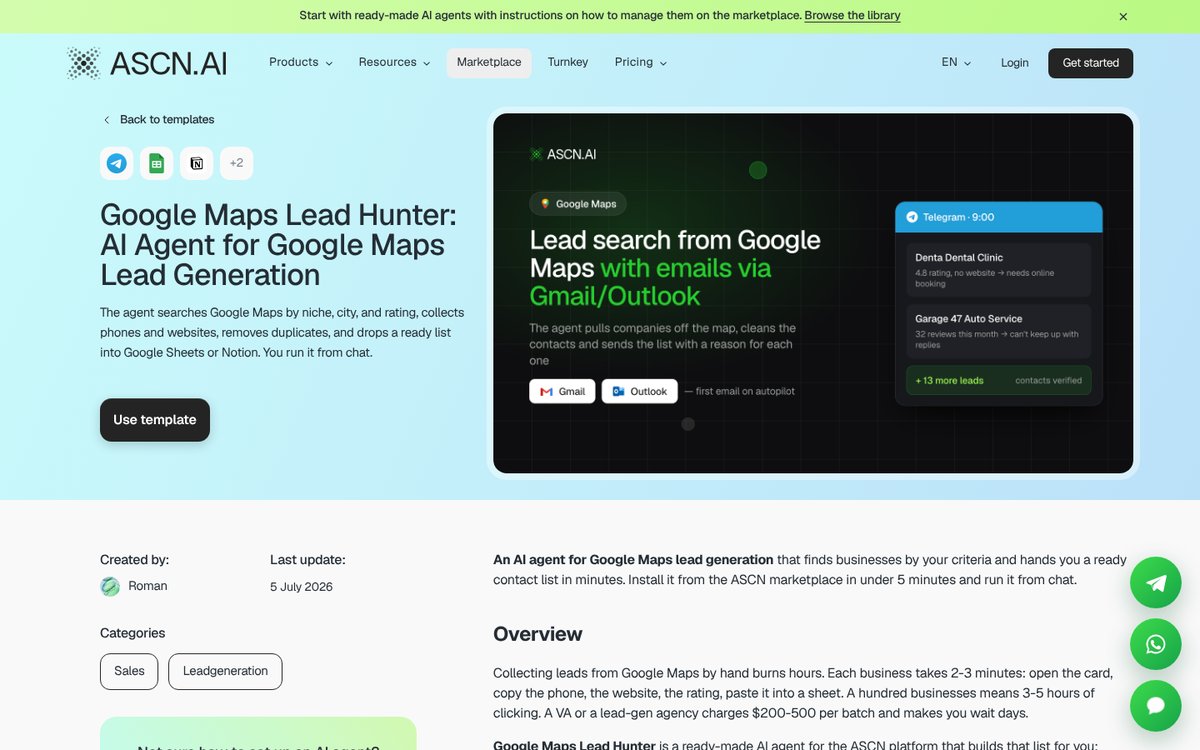
For lead generation the marketplace has ready agents that do the whole job. Google Maps Lead Hunter searches Google Maps by niche, city and rating, up to 500 places per query, collects name, category, address, phone, website, rating and review count, removes duplicates from earlier searches and saves the table to Google Sheets or Notion. On request it reads reviews and suggests the angle for the first conversation. It runs a free test on 10 real businesses before the first full search, and it never invents a contact: if a phone isn't listed, the cell stays empty.
The B2B Lead Generation agent finds companies that fit your ICP by industry, size, region and decision-maker role through web search, collects only verified emails from public sources, writes the hook for each company and keeps company, contact, status and dates in Google Sheets. Native Comment Finder looks for fresh Reddit and forum posts where people describe the problem you solve and scores each lead hot, warm or cold. On the inbound side, Inbound Request Router collects requests from email, Telegram and website forms, sorts them by type and urgency and logs them to your CRM, and Inbound Sales Pro answers Telegram leads in seconds and scores them on fit, need, budget and urgency.
You run every agent from the ASCN chat or Telegram, choose the model (GPT, Claude, Gemini, DeepSeek, Qwen, Kimi or Xiaomi MiMo) and approve the first messages before anything goes out. HubSpot is among the integrations; any other CRM connects through its API or an MCP server.
Pricing:
- Free: $0, 500 credits a week, 1 active agent. The B2B Lead Generation agent works on Free.
- Start: $29/mo, 10,000 credits, 5 agents. Scheduled 24/7 runs start on this plan.
- Personal $99/mo, Business $299/mo. Visa, Mastercard or USDT.
Google Maps data comes through Outscraper, which you connect from the chat; the template page estimates $5 to $15 a month at typical volume. Credit use depends on the model and the length of each task, so there is no fixed price per lead.
Good to know: the agents build lists from open sources, so for a director's personal mobile number in a large enterprise you still need a paid database.
Verdict: the best choice when you need qualified local or niche leads with a reason to call, scored and in your CRM, for the price of one subscription.
2. Apollo.io
Apollo is a B2B database of 240M+ contacts and 30M+ accounts with prospecting, enrichment, sequences and AI agents that research accounts and build lists.
Best for: teams whose bottleneck is getting verified emails and phone numbers at a low price.
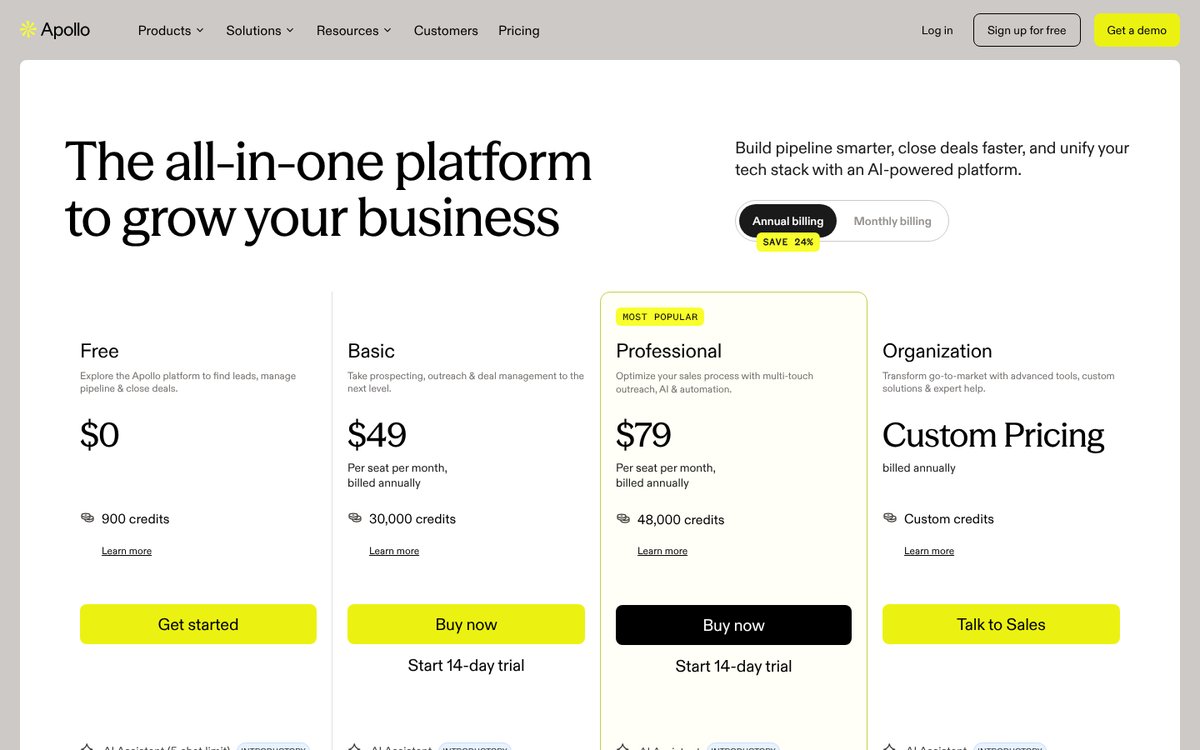
An email costs 1 credit, a phone number 8, enrichment 1 to 8, AI research 1 credit per run. Basic adds waterfall enrichment, automated CRM enrichment, 6 intent topics and identification of 100 website-visitor companies a month. An Inbound add-on with forms, lead routing and US contact-level visitor identification costs $119 a month per team, billed annually.
Pricing:
- Free: $0, 900 credits, 2 sequences, 20 visitor companies a month.
- Basic $49 and Professional $79 per seat a month, billed annually (30,000 and 48,000 credits). 14-day trial.
- Organization: custom.
Limitations: one credit pool pays for emails, phones, AI research and the dialer, so heavy phone reveals use it up eight times faster than emails.
Verdict: the cheapest way to verified contacts in this list.
3. ZoomInfo
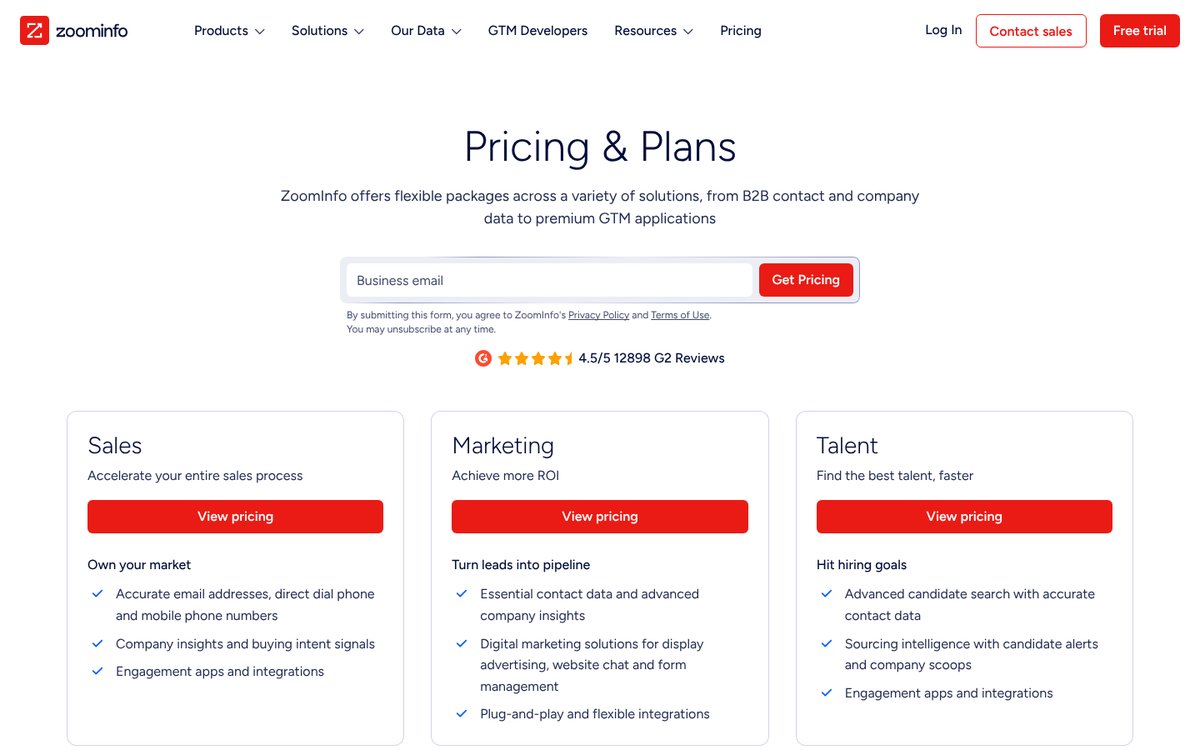
ZoomInfo sells B2B contact and company data with buying intent signals, packaged by use case: prospecting, account-based marketing, lead management, enrichment and talent search. Its marketing package includes website chat and forms.
Best for: enterprise sales and marketing teams that need one data layer for every system.
The pricing page lists accurate emails, direct dials and mobile numbers, company insights and buying intent signals for sales, and says data can be used through its platform or headless through GTM.ai.
Pricing: custom packages on request; free trial for prospecting and enrichment.
Limitations: no public price, so you can't compare cost per lead before a sales call.
Verdict: the enterprise standard for B2B data; overkill for a team that needs 100 leads a month.
4. Clay
Clay is a spreadsheet-like workspace that runs waterfalls across 150+ data providers and Claygent, an AI agent that researches the web for any custom data point, such as "does this agency work with SaaS clients".
Best for: GTM engineers and agencies that design their own enrichment and scoring.
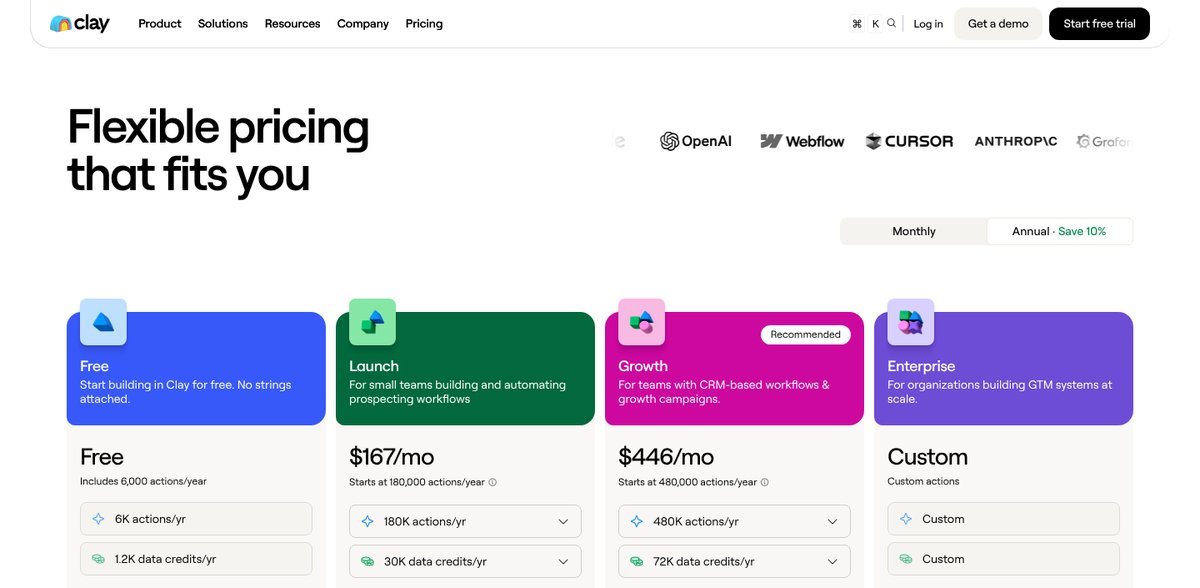
From Launch, Clay enriches phone numbers, tracks job changes, promotions, new hires and company news. Growth adds CRM auto-sync, web intent signals and any HTTP API. If you bring your own API keys for third-party data, you skip data-credit costs and pay only for actions.
Pricing:
- Free: 6,000 actions and 1,200 data credits a year, up to 200 rows per table, Claygent included.
- Launch $167/mo, Growth $446/mo, Enterprise custom. Annual billing saves 10%. 14-day trial.
Limitations: the cost of one enriched lead depends on which providers your waterfall calls, and someone on the team has to build the tables.
Verdict: the strongest research layer for people who like building; others get the same result faster from a ready agent.
5. Seamless.AI
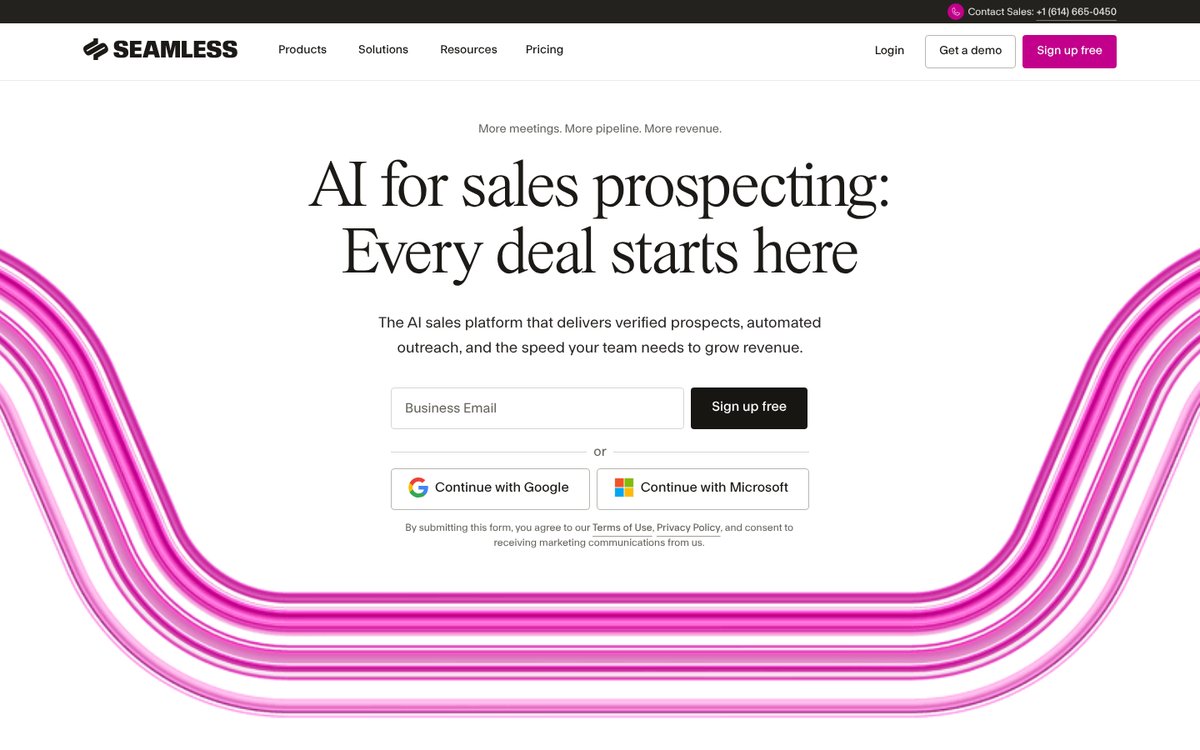
Seamless.AI is a contact search engine that reports 1.8B+ verified business emails and 414M+ phone numbers, with buyer intent, job change tracking, CRM enrichment and AI-written pitches.
Best for: reps who want mobile numbers and buyer intent in one search tool.
The site says it connects to 6,000+ tools and lists GDPR, CCPA and SOC 2 Type II compliance.
Pricing: free for up to 50 credits; paid plans by quote.
Limitations: no public price list, so the second 50 leads of our task can't be priced.
Verdict: a strong mobile-number source once you know the price your team will get.
6. Lusha
Lusha is a contact finder with a browser extension, workspace, API and MCP, enrichment, lead scoring and website visitor identification.
Best for: small sales teams that want a transparent price per contact.
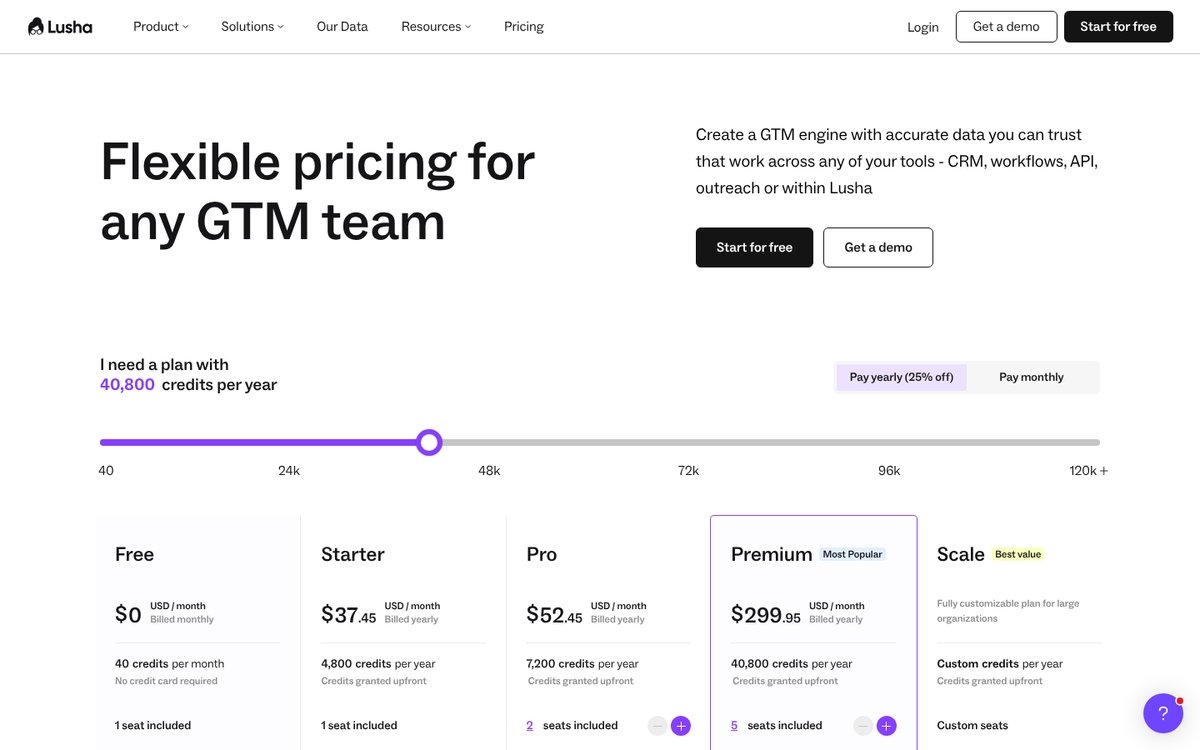
A verified email costs 1 credit, a phone number 5. GDPR, CCPA, SOC 2 and ISO 27701 are listed on every plan, including Free; a do-not-call list comes with Scale.
Pricing:
- Free: 40 credits a month.
- Starter $49.90/mo (400 credits), Pro $69.90/mo (600 credits), Premium $399.90/mo (3,400 credits). About 25% less billed yearly. Scale: custom.
Limitations: the page doesn't name its CRM integrations or database size.
Verdict: the clearest per-contact pricing among paid finders.
7. Cognism
Cognism is a B2B data provider built for Europe, with phone-verified mobiles, intent, hiring, funding and job-change signals, AI company research and MCP and API access.
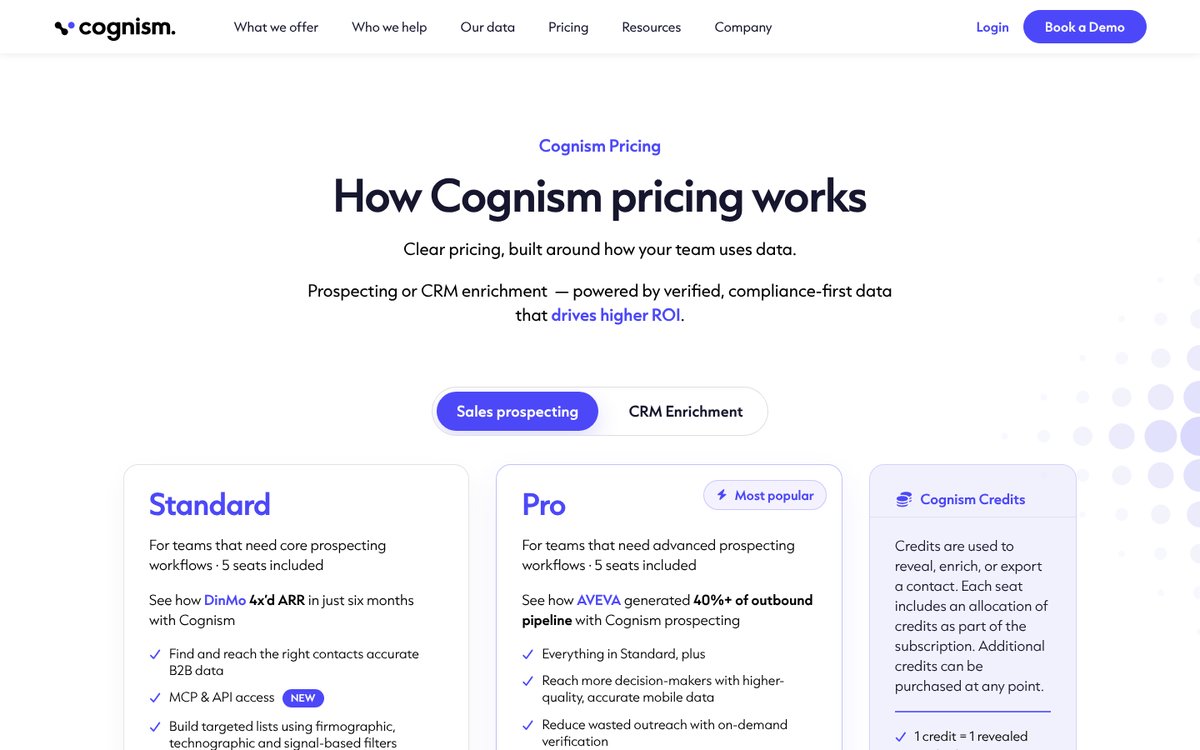
Best for: teams that cold-call into the UK and EU.
One credit reveals one contact, and viewing a contact you already revealed costs nothing. The site says the database complies with GDPR and CCPA and cites Do-Not-Call coverage across Europe. Data exports to Salesforce, HubSpot and Pipedrive.
Pricing: Standard and Pro, 5 seats included, prices on request. CRM Enrichment is an add-on.
Limitations: sold in team packages with 5 seats, which is a lot for one seller.
Verdict: the pick for compliant phone outreach in Europe.
8. Hunter
Hunter finds and verifies email addresses by domain or by name and has its own B2B database, Discover, with an AI assistant and weekly lead suggestions.
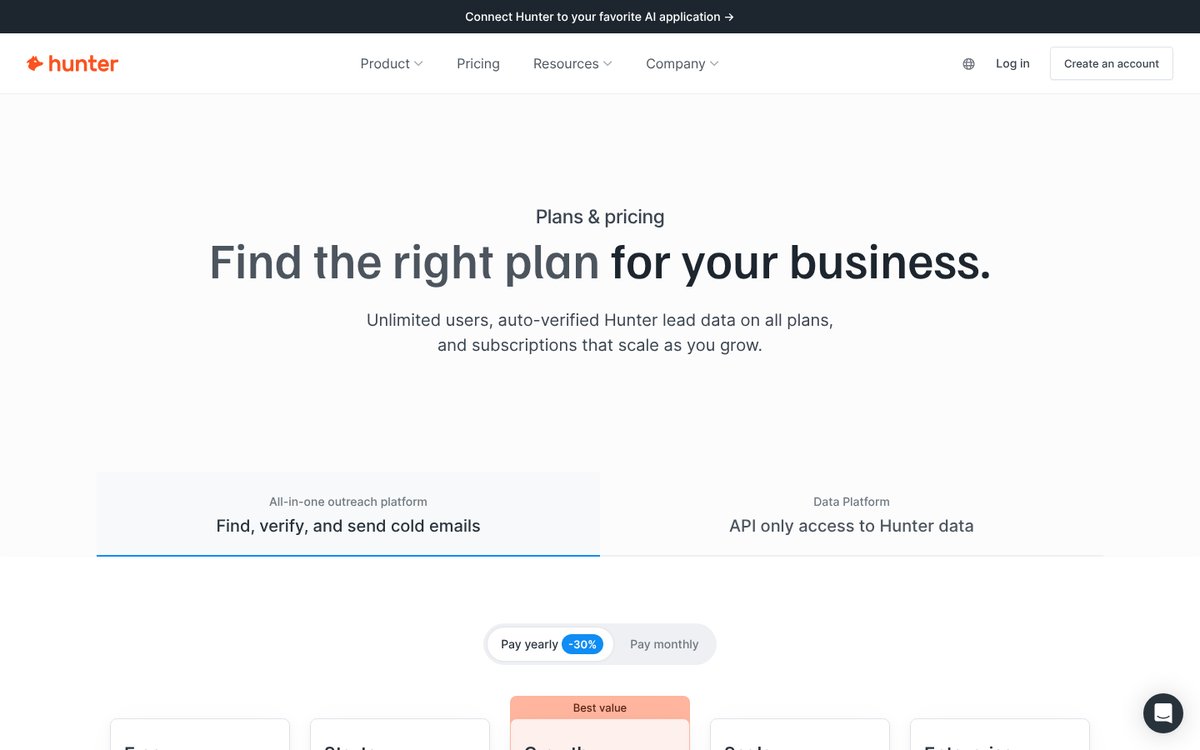
Best for: email-only prospecting at a low price, especially when you already have a list of company websites.
One credit buys one email found; a search that finds nothing is free, and a verification costs half a credit. All plans include unlimited team members, and the Starter plan connects 3 email accounts for sending.
Pricing:
- Free: 50 credits a month.
- Starter $34/mo, Growth $104/mo, Scale $209/mo, billed yearly (24,000, 120,000 and 300,000 credits a year). Enterprise custom.
Limitations: no phone numbers.
Verdict: the best partner for an agent that collects company websites: give Hunter the domains, get verified emails back.
9. UpLead
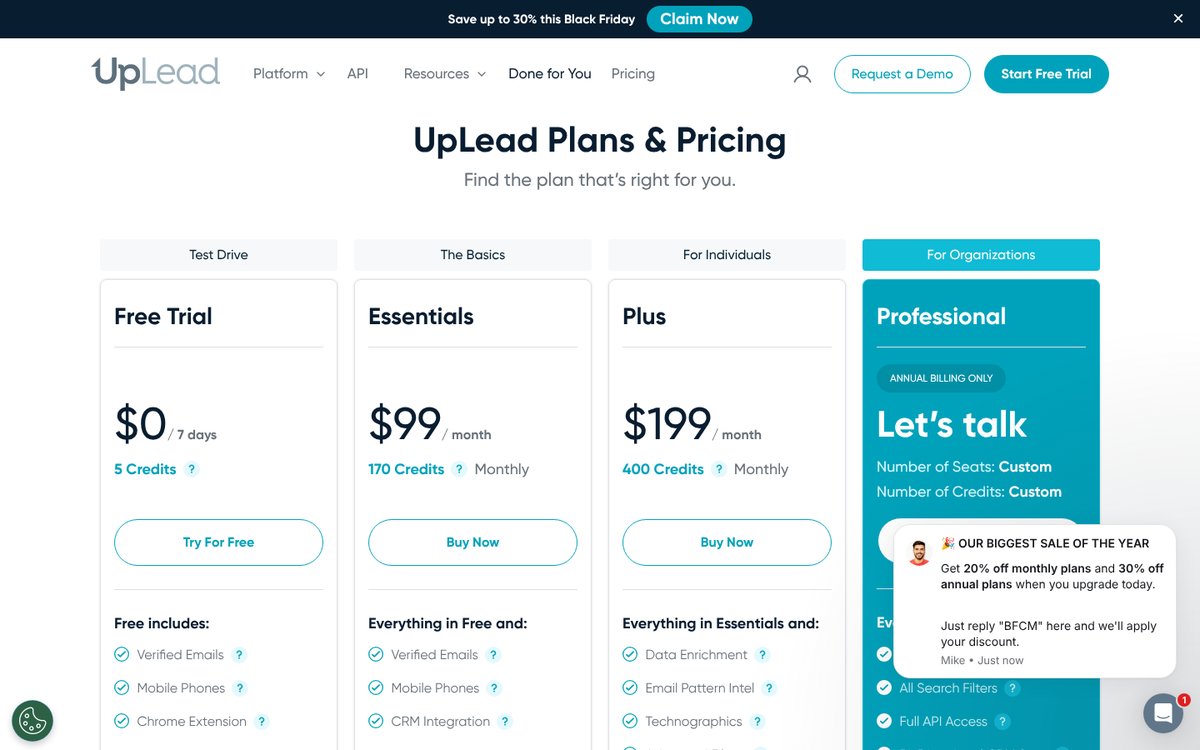
UpLead is a B2B database of 200M+ leads that verifies emails at export and promises 95%+ data accuracy, with credits refunded for bounces.
Best for: teams that care more about bounce rate than volume.
Essentials includes verified emails, mobile phones and CRM integration; Plus adds enrichment, technographics and suppression lists; Professional adds buyer intent and two-way CRM sync.
Pricing:
- Free trial: 7 days, 5 credits.
- Essentials $99/mo (170 credits), Plus $199/mo (400 credits), Professional custom, annual only.
Limitations: $0.58 per credit on Essentials, the highest per-credit price among the published plans here.
Verdict: pay more per contact, bounce less.
10. RocketReach
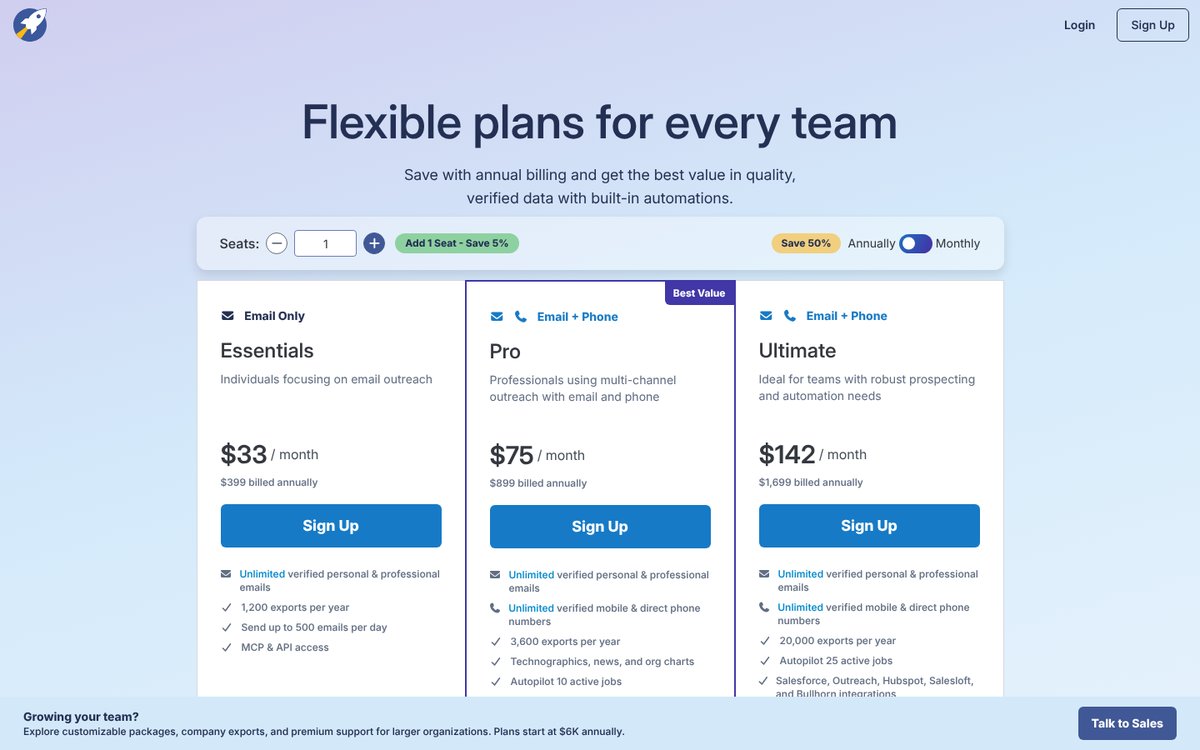
RocketReach searches 700 million professionals and 60 million companies for emails and phone numbers, with org charts, technographics and Autopilot jobs.
Best for: individuals who need a cheap email lookup tool.
Pro adds verified mobile and direct numbers and integrations with Salesforce, Outreach, HubSpot, Salesloft and Bullhorn; intent data starts on Ultimate.
Pricing (billed annually):
- Essentials $33/mo ($399/yr, 1,200 exports a year, email only).
- Pro $75/mo ($899/yr, 3,600 exports), Ultimate $142/mo ($1,699/yr, 20,000 exports). Larger packages from $6K a year.
Limitations: the monthly-billing price wasn't shown on the page we opened; monthly plans have 100 to 1,000 exports.
Verdict: the lowest published entry price for verified emails.
11. LinkedIn Sales Navigator
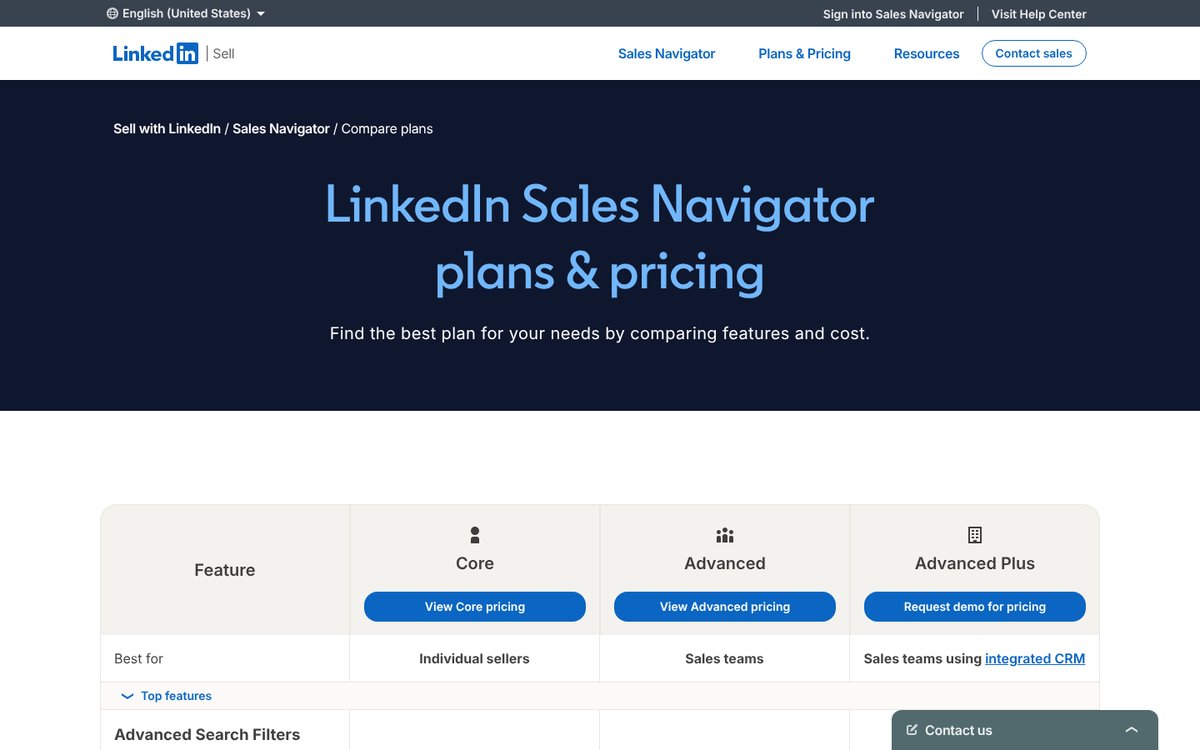
Sales Navigator is LinkedIn's prospecting tool: 50+ search filters, AI-powered Account IQ and Lead IQ summaries, buyer intent and CRM sync on Advanced Plus.
Best for: B2B sellers whose buyers are active on LinkedIn.
Advanced Plus integrates with Salesforce, HubSpot, Microsoft Dynamics and Oracle and creates leads in the CRM directly.
Pricing: Core from $119.99 a month or $1,079.88 a year per license, Advanced from $159.99 a month or $1,799.88 a year, Advanced Plus on request.
Limitations: the plans page lists no email or phone export, so contact data comes from another tool.
Verdict: the best place to find who to talk to on LinkedIn; pair it with a contact finder for emails and phones.
12. Leadfeeder by Dealfront
Leadfeeder identifies the companies that visit your website and shows which channels, campaigns and pages brought them.
Best for: B2B companies with steady website traffic and a sales team ready to call warm accounts.
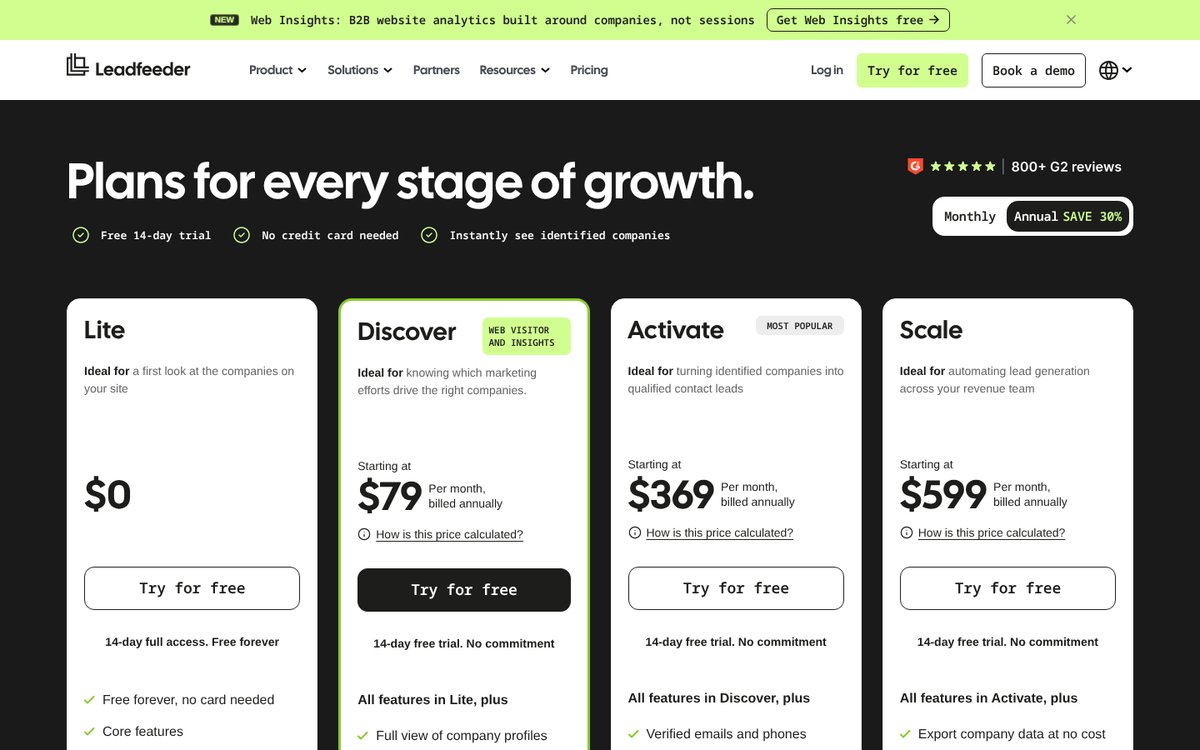
Discover adds full company profiles, real-time alerts, CRM sync and API and MCP access. Activate adds verified emails and phones, intent filters, CRM automations and AI-built prospect lists. All plans have unlimited users and tracked domains.
Pricing:
- Lite: $0, last 100 companies a month, 7-day history.
- Discover from $79, Activate from $369, Scale from $599 a month, billed annually. 14-day free trial.
Limitations: it only finds companies that already visit you, so it doesn't build cold lists for a new niche.
Verdict: the best way to find warm accounts hidden in your own traffic.
13. HubSpot
HubSpot captures inbound leads with free forms, landing pages, live chat and a chatbot builder, and its Prospecting agent researches accounts, finds contacts and drafts outreach for outbound.
Best for: companies that get leads from their website and want them in a CRM with lead scoring.
The Prospecting agent sources contacts from providers like ZoomInfo and Apollo and lets you review and edit drafts before they are sent. The Customer Agent answers questions across chat, email and forms and escalates to your team.
Pricing:
- Free: $0 for up to 2 users.
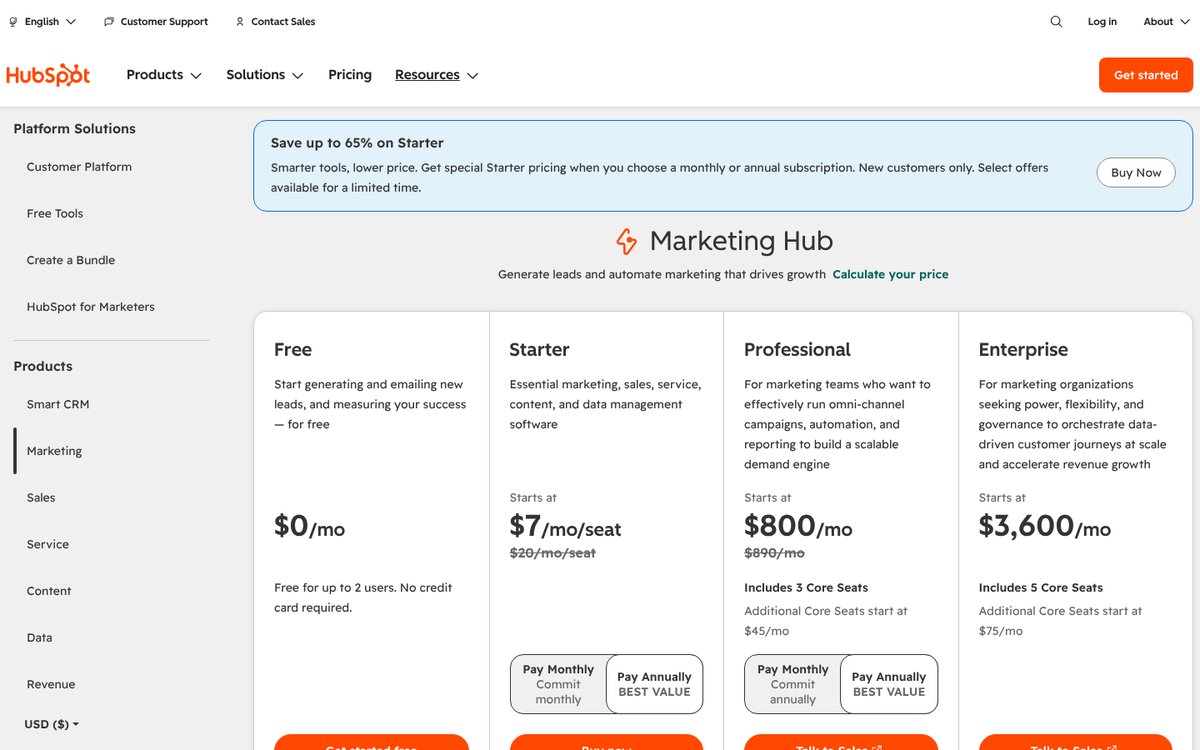
- Marketing Hub Starter $20/seat a month (new-customer offer from $7), 500 HubSpot Credits; Professional from $800/mo with 3 seats.
- Prospecting agent: $1 per lead it recommends for outreach, paid in HubSpot Credits.
Limitations: the value of the agent depends on clean CRM data; if you're still choosing a CRM, see our CRM ranking for B2B teams.
Verdict: the best inbound capture in this list, and a natural pick if the pipeline already lives in HubSpot.
14. Instantly
Instantly is a cold email platform with a lead database of 450M+ B2B leads, a Lead Finder agent and a website chat agent.
Best for: teams that want to find leads and send to them from the same account.
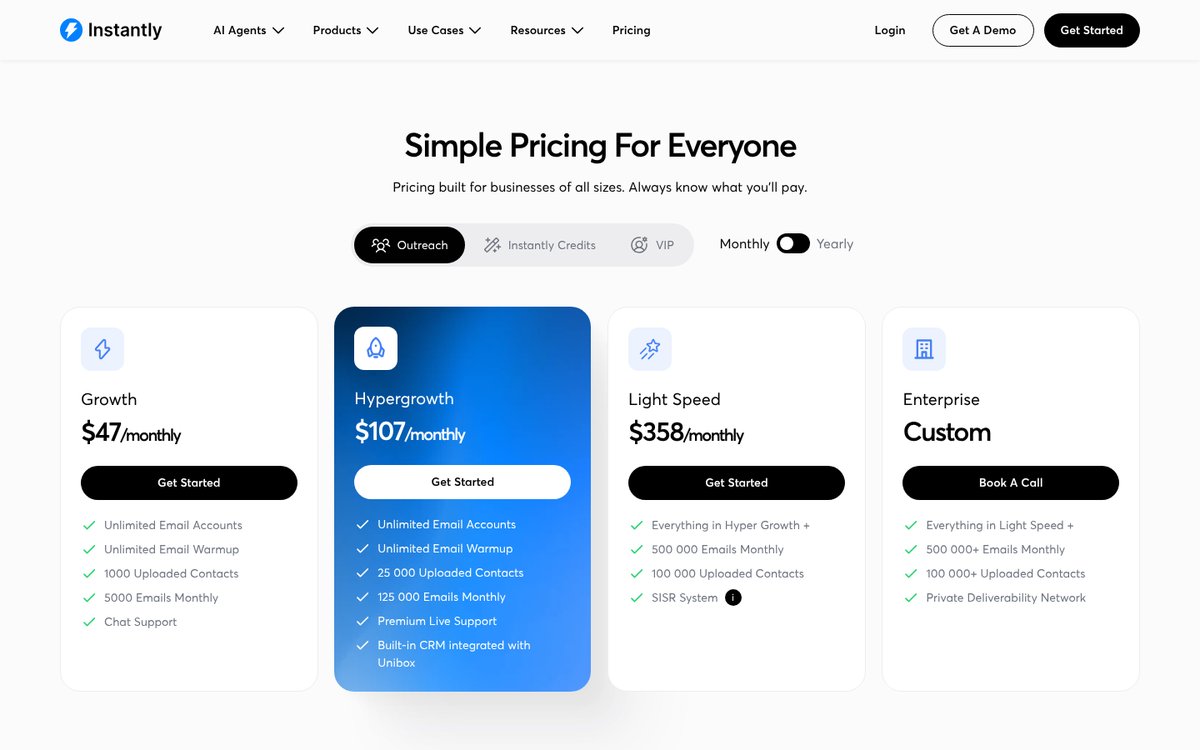
Lead credits are sold separately from the sending plans. Sending plans include unlimited email accounts and warmup, reputation protection and bounce detection.
Pricing:
- Credits: Growth $47/mo (1,500 to 2,000 credits), Supersonic $97/mo, Hyper Credits from $197/mo. About 10% less yearly.
- Outreach: Growth $47, Hypergrowth $107, Light Speed $358 a month.
Limitations: the page doesn't say how many credits one email or phone costs.
Verdict: convenient if Instantly is already your sender; for sending tools in depth see our AI sales tools ranking.
How to measure lead quality
Lead volume says little. Three numbers tell you whether a tool works for your niche, and all three come from your own CRM.
- Cost per qualified lead = what you paid for the tool and data ÷ leads that passed your ICP check. Example: $70 for 100 contacts, 40 of which fit, is $1.75 per qualified lead, not $0.70.
- Share of qualified leads = qualified ÷ all leads. If it falls below half, tighten filters before buying more credits.
- Hard bounce rate on the first send. ZoomInfo's own guide treats more than 3 to 5% as a warning sign for a data source. Test a sample export against your ICP before you sign an annual contract.
Then follow each lead past the first call. A source that gives cheap leads that never buy costs more than an expensive one that converts.
What to pick for which team
Founder or small team selling to local businesses
Start with ASCN.ai on the Free plan: Google Maps Lead Hunter for the list, the B2B Lead Generation agent for decision makers and emails, then Start at $29 for daily runs. Our guide to AI for sales shows which tasks to hand over first.
B2B sales team of 2 to 20
Apollo or Lusha for contacts, plus an agent that checks each company against your ICP before reps call. Add Cognism if you call into Europe.
Lead generation agency
Clay for custom enrichment per client, Hunter for emails at volume, ASCN.ai agents to collect lists from maps and websites and to report results to each client.
Company with steady website traffic
HubSpot forms and chat to capture leads, Leadfeeder to see which companies visit without filling a form, and an inbound agent to answer and score requests in minutes. Our older guide to AI lead generation covers the inbound side in more detail.
Enterprise GTM
ZoomInfo or Cognism as the data layer, Sales Navigator for account research, and your CRM's agents on top.
Build a lead generation agent: ready prompts
The prompts below work in ASCN.ai and in any agent that can search the web, read pages and write to a sheet. Every free source named here answered our test request on November 25, 2026, except where an API key is noted. Replace the parts in brackets.
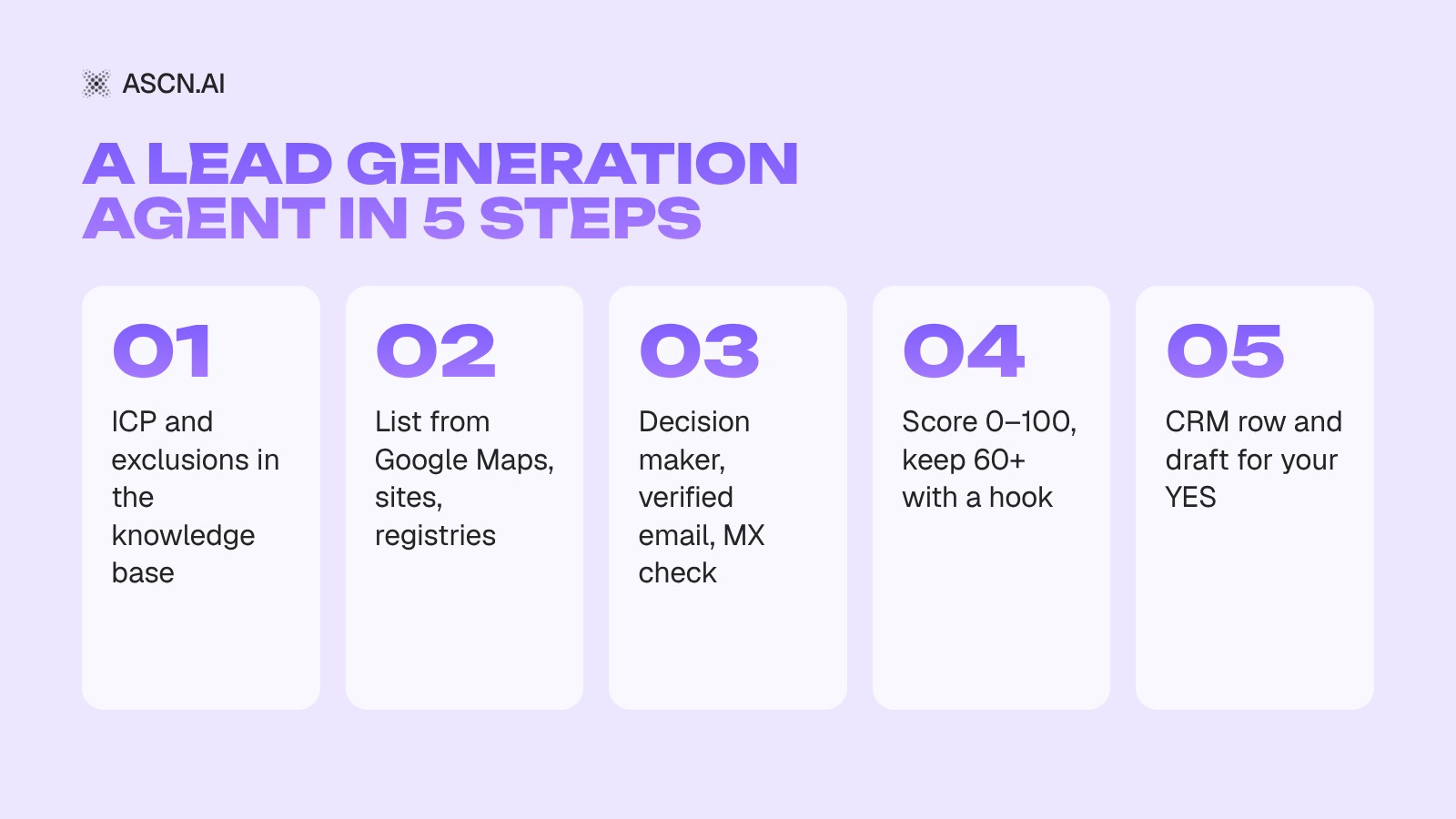
Step 1. Give the agent your ICP
Save to your knowledge base and use in every task:
Product: [what you sell, one sentence]. Price: [range].
ICP: [industry], [city/state/country], [10–50] employees, decision maker: [founder / CEO / head of growth].
Qualifying signals: [e.g. hiring a marketer, rating under 4.0 with 100+ reviews, no booking form on the site].
Exclude: current customers from [Google Sheet link], competitors, franchises and chains, companies marked closed.
Never invent facts, emails, phone numbers or names. If something is unknown, leave it empty and say so.
Step 2. Build the list from free sources
Find [150] companies that match the ICP. Use only these sources:
1. Google Maps: the Places API (Text Search) with my API key from Google Maps Platform, or the Google Maps Lead Hunter agent. Take name, category, address, phone, website, rating, review count, map link.
2. Company websites: About, Team and Contact pages for headcount hints, the decision maker's name and a public email.
3. Hiring signals: Greenhouse (boards-api.greenhouse.io/v1/boards/COMPANY/jobs) and Lever (api.lever.co/v0/postings/COMPANY?mode=json).
4. Registries: SEC EDGAR company search by state and SIC code (sec.gov/cgi-bin/browse-edgar) for US filers; UK Companies House (free API key) for UK companies.
Remove duplicates by domain and phone. Return a table: company, website, city, phone, rating, reviews, source URL.
Step 3. Enrich and verify
For each company: open the website and find the decision maker's name and role on the About or Team page. Record the page URL.
Collect only emails published on the site or on the company's official profiles. No guessed patterns like first@domain.
Check the domain's mail server with dns.google/resolve?name=DOMAIN&type=MX. No MX record: mark "no mail server".
If I connected Hunter, send the domain to Hunter Email Finder and keep only results marked valid.
Step 4. Score and qualify
Score each company 0–100: ICP fit 40 (industry, size, location), fresh signal in the last 90 days 30 (job post, new location, reviews about the problem we solve), reachable decision maker 30 (named person + verified email or direct phone).
Keep 60+ as qualified. For each, write one hook: a fact with its source URL and date, for example "hiring a performance marketer since November 3".
Show me the score breakdown for the first 10 leads and wait for my "OK" before scoring the rest.
Step 5. CRM, schedule and first message draft
Write qualified leads to [Google Sheet / HubSpot]: company, contact, role, email, phone, score, hook, source URL, date found, status "new".
Every Monday at 8:00 run steps 2–4 for new companies only and skip anyone already in the sheet or on the do-not-contact list.
For the top 10 by score, draft a first email under 90 words built on the hook, with an opt-out line. Do not send. Send me the drafts in Telegram and wait for "YES".
At the end send a summary in Telegram: found, qualified, average score, top 3 with reasons. Numbers only from the sheet. If a source fails, report it and continue.
Steps 2 to 4 exist as ready agents in the ASCN marketplace: Google Maps Lead Hunter for the list and the B2B Lead Generation agent for decision makers, verified emails and hooks. What happens after the first email, sequences and follow-ups, is covered in our AI sales tools ranking.
Data rules: GDPR, CCPA and CAN-SPAM
An agent collects data faster than a person, so a mistake in the source or purpose of the data repeats across the whole list. This is general information, not legal advice; check your case with a lawyer.
- European Union and UK, GDPR. A named person's work email is personal data. B2B prospecting usually relies on legitimate interest, which needs a documented balance test, a relevant offer, a note on where you got the data and an easy way to object. Several EU countries add stricter rules for unsolicited email.
- California, CCPA. Residents can ask what data you hold about them and ask you to delete it; keep the source of every record so you can answer.
- United States, CAN-SPAM. Commercial email doesn't need prior consent, but subject lines must not mislead, the email must include a postal address and an opt-out, and opt-outs must be honored.
In practice: store the source URL and date of every lead, keep a do-not-contact list the agent checks before each run, and prefer published business contacts over guessed personal ones.
FAQ
What are lead generation tools?
Lead generation tools are software that finds potential customers and captures their contact details. Outbound tools search B2B databases, maps and websites for companies and decision makers; inbound tools turn website visitors into leads with forms, chat and visitor identification. AI tools add research, enrichment and scoring on top.
What is the best AI tool for lead generation?
For a small team that sells to local or niche businesses, ASCN.ai, because its agents build, enrich and score the list from open sources from $0 to $29 a month. For verified contacts at volume, Apollo. For enterprise data, ZoomInfo or Cognism. For inbound, HubSpot with Leadfeeder.
How do I use AI for lead generation?
Describe your ideal customer, let an agent collect companies from maps, websites and registries, enrich each one with a decision maker and a verified email, score it against your ICP and write qualified leads to the CRM. The five prompts above do exactly that and run on a weekly schedule.
What's the best free lead generation tool?
Apollo's Free plan (900 credits) covers 100 emails and 100 phone numbers. ASCN.ai's Free plan runs a lead agent on 500 credits a week. Hunter gives 50 email credits a month, Lusha 40, Seamless.AI 50 credits, and HubSpot's free CRM includes forms and live chat. Free plans are enough to test a niche, not to run it every week.
Does AI lead generation work?
It works for the repetitive part: finding companies, collecting public contacts, checking them against criteria and keeping the list clean. It fails when the input is vague, so the result depends on how precisely you describe the ICP and the signals. Measure cost per qualified lead and conversion to meetings, not the number of rows.
How do paid B2B lead generation tools ensure data accuracy?
They verify emails at export (UpLead, Hunter), verify mobiles by phone (Cognism), combine several providers in a waterfall (Apollo, Clay) and refresh records on a schedule. UpLead refunds credits for bounces. Test a sample before buying: a hard bounce rate above 3 to 5% is a warning sign.
Are AI lead generation tools GDPR compliant?
Some state it: Lusha, Seamless.AI and Cognism list GDPR and CCPA on their pages. Compliance also depends on how you use the data: you need a lawful basis, a record of the source and an easy way for people to object.
Are lead generation tools better than an agency?
A tool costs less per lead and keeps the process in-house; an agency costs more but brings its own lists and people. An AI agent sits between them: it does the agency's research work on a subscription, and you keep control of the criteria and the list.
Conclusion
Pick by where your leads are. If they are in maps and on websites, an agent that collects and scores them is cheaper and more precise than a database. If you need direct dials of enterprise directors, buy data from Apollo, ZoomInfo or Cognism. If they already visit your site, start with HubSpot forms and Leadfeeder. To get 100 qualified leads with a reason to call in your CRM this week, create a free ASCN.ai account and start from Google Maps Lead Hunter. More about the platform: ASCN Agent.
Best AI Sales Tools and AI SDRs in 2026: 14 Tools Compared on One Prospecting Task
Best CRM for Small Business in 2026: 10 CRMs Ranked by How Much Data Entry They Remove
AI for Sales: How to Use Artificial Intelligence in Your Business