



- Русский
- English
- Português
AI Chatbot for Clinics: Cutting Patient Acquisition Cost Threefold

An AI chatbot for clinics pays off not through the number of conversations but through the patients who used to give up waiting. An aesthetic medicine clinic counted those people and found it was losing a third of its ad budget.
Fifteen doctors, four front desk staff, 300,000 roubles a month on search ads and social media. Plenty of leads. But while one administrator booked a patient on the phone, three others sat on hold or waited in WhatsApp. By evening dozens of dead conversations piled up where someone simply never got an answer.
Familiar in services? Here it was closed in a week with one agent handling booking and consultations, with no new front desk hires.
What the AI chatbot for the clinic delivered in three months
Patient acquisition cost fell from 8,000 to 2,600 roubles, enquiry-to-booking conversion rose from 15% to 42%, and clinic utilisation went from 65% to 95%. Eight out of ten standard bookings now close without a human.
The problem: expensive leads vanishing
The segment is aesthetic medicine, average ticket 15,000 roubles, a lead costs 1,200. Thirty percent of that money burned for nothing.
The front desk worked from 9 to 21. Everything arriving at night or on weekends waited until morning. By ten there were 15 to 20 unanswered messages queued, and by the time someone replied the patients had cooled off or booked wherever answered faster.
"We paid for traffic and then threw it away ourselves. Enquiry-to-booking conversion was only 15%," says the clinic manager.
What they tried before the agent
First came CRM forms. Patients would not fill them in; they wanted to ask whether it hurts, which device is used and whether tomorrow at two is free. A form answers none of that, so people called, and the missed calls returned.
Then they outsourced to a call centre. That went worse: operators did not know the procedure details, confused contraindications and booked patients with the wrong specialists. Doctors got angry, patients left unhappy.
The fix: an agent with the clinic's knowledge base
The agent was connected through ASCN and trained on procedure protocols, the price list, doctors' schedules and the contraindication list. It lives in the clinic's WhatsApp and Telegram and replies in 15 seconds around the clock, including when the administrator is busy with a guest in the lobby.
The consultation is a real one: the agent explains the difference between lasers, covers how to prepare for a procedure and shows free slots straight away. For a complicated case it asks for a photo or a question for the doctor and passes the task to the front desk.
How the agent takes a patient to a booking
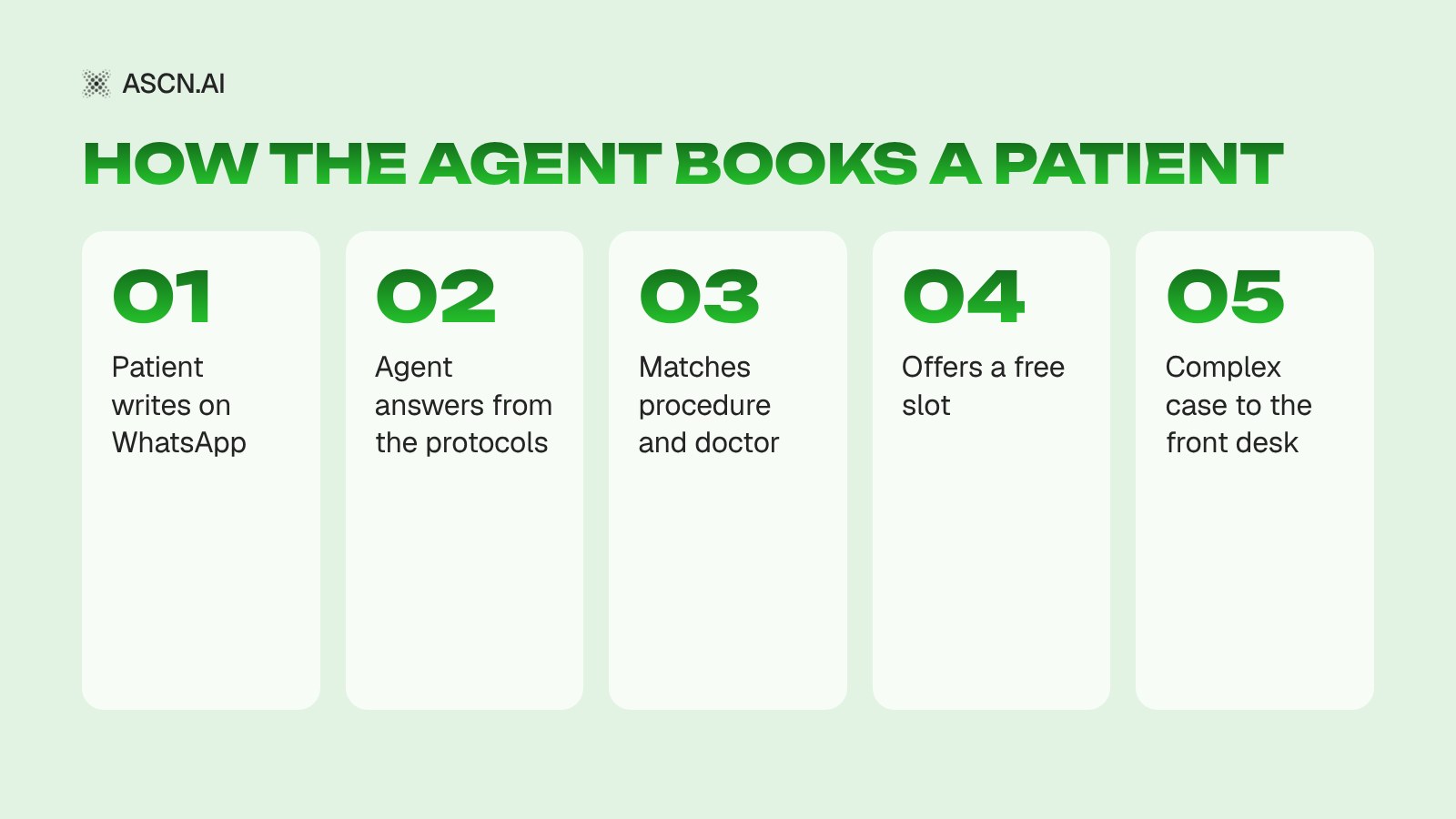
A patient asks about a procedure, the agent answers from the clinic's protocols and clarifies what the person actually needs. It then checks the doctors' schedule and offers a specific time rather than a vague invitation to drop by. Contraindications and unusual requests go to an administrator along with the message history.
We covered the same first-line consultation pattern in the cases on the hotel concierge and hiring automation.
The numbers after three months
| Metric | Before | After |
|---|---|---|
| Patient acquisition cost | 8,000 roubles | 2,600 roubles |
| Enquiry to booking | 15% | 42% |
| Clinic utilisation | 65% | 95% |
| Reply time | next morning | 15 seconds |
| Standard bookings without a human | 0% | 80% |
Utilisation at 95% means the doctors have almost no gaps left in their schedules. Most of that came from night-time enquiries, the ones that used to wait for morning and never made it.
"What surprised us most is that the agent follows up with people who went away to think. It reminds them about the procedure, offers a first-visit discount and gets them into the chair," notes the owner.
What a clinic should keep in mind
Load the doctors' answers, not just the price list. Trust in medicine is built on explanations, and an agent without an expert base reads like a price lookup.
Connect the agent to your practice management system. It has to see the real schedule live, otherwise booking turns into double bookings.
Define contraindications strictly. This is the part of the knowledge base where the agent has no right to improvise. Anything uncertain goes to an administrator and a doctor.
Do not hide that it is an agent. Speed and accuracy count for more than the illusion of a live person, and being upfront heads off complaints.
Frequently asked questions
How long did the rollout take?
A week. Collecting the knowledge base took the longest: protocols, contraindications and the doctors' answers to common questions. The schedule link configures faster.
Can the agent give medical advice?
No, and that is an explicit rule. It explains how a procedure works and how to prepare, and passes anything touching indications or diagnosis to a doctor.
What if a patient describes a complicated case?
The agent asks for a photo or a question for the doctor and hands the whole conversation, with its history, to an administrator.
Do you need a developer?
Not to build the agent. Code may be needed to integrate with a practice management system that has a closed API.
Does this work for a single-doctor practice?
Yes. There is usually no front desk at all, and the agent catches the night-time enquiries that would otherwise be lost entirely.
The bottom line
The clinic did not buy more traffic; it stopped losing the traffic it had paid for. Patients get an answer at night instead of in the morning and book while they are still interested. Acquisition cost fell threefold and the doctors' schedules are 95% full.
Ready-made booking and consultation agents are in the ASCN marketplace, with the knowledge base tuned to your own protocols. For practice management integration, message a manager on Telegram.
AI Chatbot for Hotels: A Country Club Case and 40% Ancillary Revenue Growth
Recruitment Automation: A Retail Chain Case and 100 Hires a Month
AI Agent for a Travel Agency: Doubling Sales on the Same Budget
AI Chatbot for Instagram: A Furniture Showroom Case and 2.7x More Bookings
AI Agents in B2B Sales: A Case of Conversion Growth from 12% to 34%
AI agent for clinic automation: patient scheduling, front desk management, and integration with the MIS