



- Русский
- English
- Português
AI Chatbot for Hotels: A Country Club Case and 40% Ancillary Revenue Growth

An AI chatbot for hotels is not a website widget — it is a way to sell dinner, SPA and transfers to a guest lying by the pool. A 120-room country club tested that over one season. 🏨
A huge property, a lake, a bathhouse, a restaurant and a SPA. And one reception desk buried under calls from morning to night.
Guests call about everything: the Wi-Fi password, the pool hours, one more towel please. At peak times the line is busy, guests get annoyed, and the front desk turns into a help line. There is no time left to offer a massage, an ATV rental or dinner in the room — and hotel revenue walks out with the unhappy guests.
Familiar picture for hoteliers and resort managers? The club solved it in five days: it launched an AI chatbot for hotels — a personal WhatsApp concierge for every guest.
The short version
An AI chatbot for hotels is an AI agent in a messenger that answers guest questions about the stay and takes the order right there. In this case the WhatsApp agent closed 90% of incoming questions, lifted ancillary revenue by 40%, cut the reception workload by 65% and replies in 12 seconds on average. Setup took five days with no developers: the hotel knowledge base, an upsell scenario and a QR code at the desk.
Contents:
- The problem: reception drowning in routine questions
- The fix: an AI chatbot for hotels on WhatsApp
- How an AI agent for hotels works
- Results for the season
- Five tips for the hospitality business
- Frequently asked questions
- The bottom line
The problem: reception drowning in routine questions
The segment is HoReCa, premium leisure. The average room rate is around 25,000 roubles a night. A guest paying that much expects service right here, right now. Once the phone wait goes past three minutes, loyalty drops faster than the front desk can pick up.
The real loss is not staff nerves — it is money. Someone who wants dinner in the room or a slot at the bathhouse has to get through on the phone or walk to the desk. Half of the guests do neither.
"We were losing up to 30% of restaurant and SPA orders simply because people could not get through or could not be bothered to walk to the desk. Potential money was melting away in the phone queue," says the hotel manager.
They needed a system that would take over the information routine and make ordering any service as simple as one or two messages in a chat.
The fix: an AI chatbot for hotels on WhatsApp
The agent was built on the ASCN platform with no developers. The knowledge base was filled with what the hotel already had in its documents: restaurant and bar menus, the activity schedule, the SPA price list, the property map, house rules and answers to the usual questions.
They picked a single channel: WhatsApp. Nobody installs a hotel app for a three-day stay, but the messenger is already open on every guest's phone. At check-in the receptionist hands over a card with a QR code: the guest scans it and gets a personal assistant in chat for the whole stay.
The agent suggests the breakfast menu, books the bathhouse, calls a transfer, explains the way to the lake. More importantly, it knows how to offer. Ask about the pool and it will offer to book the hammam or send drinks to your sun lounger. The full cycle from question to confirmed order takes 30 seconds with no human involved. ⚡
How an AI agent for hotels works
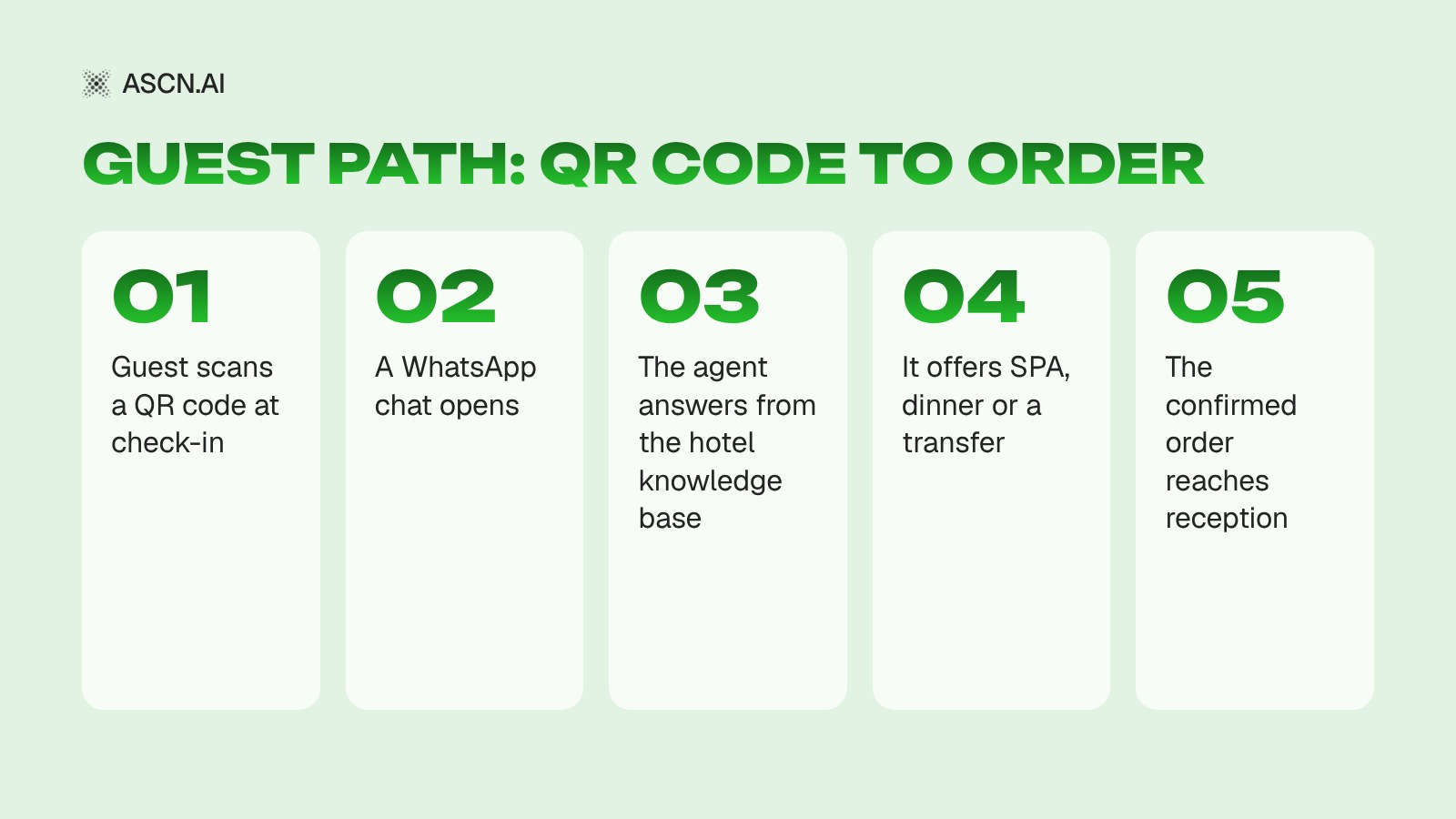
The logic is simple: the guest asks in plain words, the agent finds the answer in the hotel knowledge base and replies in the same chat. When the question gives a reason to offer a service, it offers one — following the scenario the manager wrote, not at random.
The order does not get stuck in the conversation. The agent collects the details (what, for how many people, at what time) and passes a complete request to reception, where the administrator only confirms the slot. Anything contentious — a complaint, a discount request, a non-standard ask — goes straight to a human instead of being improvised.
The same shape powers the appointment agent at a cosmetology clinic and tour matching at a travel agency: the knowledge base and the scenario change, the consulting mechanics in the messenger stay the same.
Results for the season
| Metric | Before | After | Change |
|---|---|---|---|
| Ancillary revenue | baseline | +40% | Up |
| Calls to reception | baseline | -65% | Down |
| Average reply time | 3 minutes | 12 seconds | 15x faster |
| In-room breakfasts | baseline | x2.5 | Up |
| Guest NPS | baseline | +22 points | Up |
The numbers cover one season. In-room breakfasts grew the most: ordering in chat turned out to be so much easier than calling that guests who used to go down to the restaurant — or skip breakfast entirely — started using the service. 💰
"The agent did not just take the load off the staff. It became our best salesperson. It never forgets to offer dessert or remind people about the evening show. This is the new standard of hospitality," notes the owner of the country club.
Five tips for the hospitality business
Be where the guest already is. WhatsApp and Telegram beat a branded hotel app: writing a message is easier than installing software for a three-day stay. 😊
Feed the agent what you have already written. Menus, price lists, rules, schedules — you do not need to author a knowledge base, just gather the existing files in one folder.
Use visuals. Let the agent send photos of dishes and SPA interiors straight into the chat; a picture sells better than a description. 📸
Automate confirmations. Connect the agent to your booking system so the guest gets a confirmed time immediately — otherwise you are just moving double bookings from the phone into the chat.
Define where the agent stops. Complaints, discounts, emergencies belong to people. An explicit handover rule protects your reputation far better than trying to answer everything.
Frequently asked questions
How long does it take to launch an AI chatbot for hotels?
Five days in this case. Most of that goes into collecting the knowledge base — menus, prices, schedules, rules — not into configuration. If your documents are already in order, the agent can be assembled in a day or two.
Do you need a developer?
No. The agent is built in a no-code interface: upload the documents, describe how it should behave, connect the channel. Code is only needed for non-standard PMS integrations.
What happens if a guest asks something outside the knowledge base?
The agent does not invent an answer, it hands the conversation to an administrator. That is a rule you set: anything outside the knowledge base and the scenario goes to a human.
Will the agent replace the front desk entirely?
No, and it should not. It takes over reference questions and order intake — 90% of incoming requests in this case. Check-in, conflicts and personal requests stay with the staff, who now have time for them.
Does this work for a small 20-room hotel?
Yes, and the payoff is often more visible: in a small hotel the front desk is one person who physically cannot answer calls around the clock. A related task is covered in the case on automating booking reports in a hotel chain.
The bottom line
In hospitality, service is the product. An AI chatbot for hotels made service fast and invisible: the guest gets an answer in 12 seconds, and the staff work on atmosphere instead of the Wi-Fi password.
You can assemble a concierge like this from a ready template in the ASCN marketplace — the knowledge base and the upsell scenario are tuned to your hotel. If you need help with PMS integration, message a manager on Telegram.
Recruitment Automation: A Retail Chain Case and 100 Hires a Month
AI Agent for Real Estate: An Agency Case and 2-Minute Lead Qualification
AI Chatbot for Logistics: A Trucking Case and 75% Fewer Calls
AI Agent for a Travel Agency: Doubling Sales on the Same Budget
AI Chatbot for Clinics: Cutting Patient Acquisition Cost Threefold

Hotel Business Reduced a Week of Routine to One Day: How an AI Agent Automated Booking Reporting