



- Русский
- English
- Português
AI agent for clinic automation: patient scheduling, front desk management, and integration with the MIS

I want to be upfront and honest about the situation: trying to call into a reception desk where the phone just rings over and again, only to eventually cut you off, is incredibly frustrating. Not only for the patients calling, but it also represents an absolute waste of time for the Clinic. The receptionist may be busy looking for an opening in the schedule, or possibly drinking a cup of coffee; meanwhile, the Clinic is losing money. The cold, hard statistics show that over 40% of a physician's time is spent performing paperwork and making phone calls versus treating patients. An AI solution exists to assist in this situation and will handle all routine office tasks without any back and forth chit-chat. The AI agent schedules appointments, makes phone calls, sends appointment reminders, and brings patients back into the office that have "flaked" on their appointment.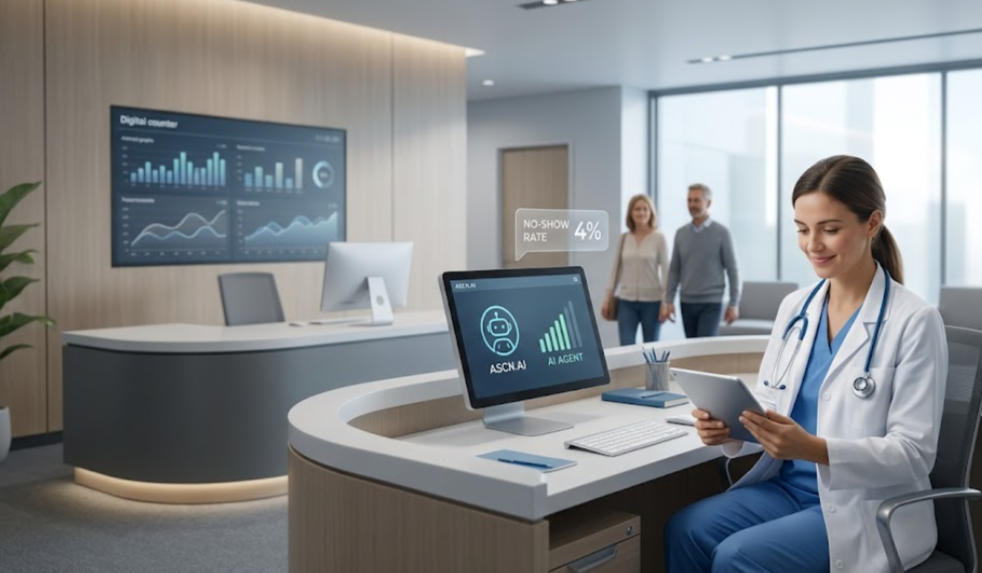
No more stupid voice menus, (i.e., "press 1"). The AI Agent understands natural speech and can hear whispered voices and understand medical vernacular. The AI agent never gets tired by the end of the day, doesn't go on lunch breaks, and operates 24/7! The AI agent operates at the capacity of three full-time receptionists.
"We trained the AI agent using a collection of 10,000 hours of actual conversation. It hears even whispered voices and understands a variety of medical terminology. The AI agent has a 98% accuracy rate, with a response time of approximately two seconds. In addition, the average cost per contact with the AI agent is twelve times less than the cost of employing a receptionist. Our mission is simple and straightforward: give physicians back the ability to do what they love — treat patients — by eliminating most of the routine tasks that tie them to their appointment calendars."
What an AI agent will actually do for a Clinic
Let's cut to the chase. Why does the chief physician or owner need an AI agent? The answer is simple. An AI agent will eliminate chaos in the Clinic's office with respect to patient scheduling by doing the following:
First, the AI agent will answer the phone immediately! Second, it calls the "forgetful" ones as well. Thirdly, it's connected with your HIS system (hospital information system) and there is no risk of having duplicate appointments booked by this system. This system does not treat patients (thank the Lord) but it does free 40% of a doctor's time.
To sum it up, this is simply the same type of AI agent used for businesses, however, it's adapted for use in the medical field. An employee who never has to take a day off sick, and will not ask for a raise.
Specific Features:
- 24/7 Phone calls. It recognizes voice, even if the patient slurs or speed talks. It finds a time slot and places that in the calendar, with no human assistance.
- Reminders. Texted/called 1 day and 1 hour prior to the actual appointment. Boring? Yes! But, because of this, no-show rates are reduced to 3-5% from 20%. Studies of telemedicine have shown that no-show rates were reduced by 60-70% with the use of automated reminders.
- Missed Calls. Did you try calling during the lunch hour? The agent will call you back in 10 minutes and offer another time.
- Unified System. You can use Telegram, WhatsApp, and VK or visit the website and it will be the same agent for you on all platforms! This is not just a simple booking agent for doctors, rather it is a very powerful entity.
- Integrated with existing systems. This system syncs with 1C:Medicine, Medoc and Infoclinica using the API. It's fully integrated in both directions; therefore, there will never be any manual data entry.
Numbers do not lie; you will quickly see for yourself the AI Agent statistics:
| Parameter | Staff Receptionist | ASCN.AI Agent |
|---|---|---|
| Working Hours | Requires 8-12 Hours of Work, Weekends and Holidays Off | Works 24 hours a Day (24/7), No Lunch, and No Sick Leaves |
| Calls | One Call at a Time, 40 Calls per Day, Average | Up to 100 Calls Simultaneously via the IVR |
| Errors | Average 5-10% Errors (Humans Make Mistakes) | Less than 1% Errors (Machines Don't Make Mistakes) |
| Cost Per Contact | Average Cost ~300 Rubles (Salary + Taxes) | Average Cost ~25 Rubles (Minute + Model) |
| Scalability | Must hire more receptionists to meet demand | 10-15 minutes to add a channel to an existing system |
An Important Point about the Agent is that it isn't pushing buttons only but the Artificially Intelligent Agent understands what the call was about. For example, when a Patient stated, "I want to see my Dentist Next Week AFTER Lunch." The Agent would be able to understand this and would verify what days and times are available, then it would give the Patient several different options to choose from. If the Patient stated, "I need to come in for Teeth Cleaning." Instead of saying, "I want to come for Hygiene." The Agent would ask which was correct, then would confirm the Appointment to the Patient. The AI Agent will be as good as EVERY office Secretary in the World.
How does it all work: Voicebot & Smart Calendar
In Simple Terms a Patient calls the office; the call goes to a Cloud Based PBX; the call goes to a Speech Module.
5 Seconds later the Call is sent to Neural Network / Language Model. The Agent then determines if the Patient wants to make an Appointment, Reschedule an Appointment or ask a Question about tests and will determine the parameters of the Appointment (i.e. which Doctor & what time is available).
Current Voice Recognition Accuracy Level within the Healthcare Industry is: 95-98+ %.
The Agent then accesses the HIS through an API. It will verify which available Appointments exist within that date and offer the Patient those available times. When the Patient accepts one of the suggested Times, the Agent will send the Appointment to the HIS and the Patient will receive an Email/Text Message with the Appointment Address. The administrator has a task in the CRM that is a simple check-box task and does not require a physical action to be taken.
Scheduled appointments sync when the appointment is scheduled in real-time using live data (e.g., someone called in sick, the virtual agent would receive this information live and would therefore not book anyone during that time, so there will be no overlaps).
It's important to note that the virtual agent understands slang (for example, uses the words therapist or dentist or where someone can get an ultrasound, etc.) because the model was specifically trained to understand medical dialogue versus just reading a book.
If there is a difficult situation that the virtual agent is trying to resolve, such as if a mother calls to schedule three children with different appointments at once, the virtual agent will honestly tell them that they will be transferred to a human since that will provide a more favorable outcome. In this instance, the virtual agent will transfer all the context from the original conversation to the human representative so that the human representative does not have to start over from a blank slate. This is an example of the smart call center model.
From a technical perspective, all calls are routed via WebRTC or SIP. There is no need to change the current configuration of any telephony, as the delay in the system is 1.5–2 seconds, making this delay unnoticeable between conversations. The virtual agent can also be utilized as a booking chatbot via text messenger platforms.
Recovering from lost opportunities; Win-back and Missed Calls
There is a line of missed calls that represents a drain on the budget. Approximately 15–20% of all calls are lost due to factors such as; the administrator's hands being busy with another call, smoking, eating lunch and in general; the clinic has lost valuable patients as a result of the call.
The virtual agent will then use the list of missed calls provided by the telephony systems and call the missed call back approximately 10–15 minutes after the missed call occurred. The virtual agent will say, “Hello, thank you for calling back. The line was busy when you called. Would you like to book an appointment?” If the missed call party does not answer the virtual agent will send a text message. This call back to the missed callers is approximately 60–70% effective. It’s purely automated call-back capability.
The appointment reminder follow-up process works flawlessly. The Win-back strategy does not stop there; it also works with “no-shows” (people who did not show up). The day after the no-show, the agent sends out a gentle message, “You missed your appointment; would you like to reschedule?” This is not spam, but it is showing care for them; 20-25% of those individuals will re-book with their provider, creating new revenue.
It allows agents that have repeat clients to give them loyalty points, and it allows agents who have never had contact with the client to build a profile for them.
AI Has Boundaries (What You Should Know)
There are certain boundaries in place, for example, an agent cannot practice medicine or be a killer robot.
- Diagnoses – No. Diagnosing is not allowed; no one should ever interpret symptoms for someone else; it is unsafe and illegal.
- Prescription Medications – No. No one other than a physician can write prescriptions for medication (only a physician can prescribe medications).
- Complex Insurance Policies – Only with caution and assistance. Because of the complexity of documentation involved in voluntary health insurance (VHI) issues, these are better suited for humans to handle.
- Benefit/Discounts – Only To Record. Only a human can verify the original certificate for example discount cards.
The technical side: How to Integrate with Your System
Your agent will not just exist on the Cloud (without a system integration). Your agent will integrate directly into your system, which means there is no duplication of data; everything is real-time live.
The connection will be made through your API; If you are using any of Bitrix24, amoCRM, or 1C, the agent will be able to route calls when they come into the system. The agent sends the calls to the bot for simple calls and to a human for complex calls. Hybrid call routing is, therefore, the typical process for routing calls.
Using official APIs from the various messenger services, patients can write to the agent from within Telegram, WhatsApp, VK, and other messenger services, and the agent will be able to respond at that location. All of these records will be stored in the same database.
If, for example, a customer has their own Excel schedule (it can happen), the agent can send a message to that schedule. You simply set it up with your mouse; a marketer can easily create an AI agent without needing any programmers to do so.
There's no need to have your own IT department. Everything in the ASCN.AI platform is designed to be intuitive to your end user. If you need something exotic, we will deliver this to you as a finished project. We perform our audits and perform the implementation of any new projects within a timeframe of 2 to 3 weeks. For the rapid growth of your business, we encourage you to use tools for automation.
The following are examples of what you can work with:
- Telephony: Mango, Zadarma, Telfin, SIP Trunks.
- HIS: 1C:Medicine, Medoc, Infoclinica, Medesk & Kleos.
- CRM: Bitrix24, amoCRM, SalesForce, HubSpot, & custom-built systems through REST API.
- Messengers: Telegram, WhatsApp, Viber, & VK.
- Calendars: Google Calendar, MS Outlook, Notion, Trello.
- Documents: Google Sheets, Excel Online, Airtable.
Integration with Medical Information Systems (HIS)
Everywhere you see HIS, the HIS is the HEART of this process, since this is where all your scheduling, testing, & charting is stored. The agent will also send/receive from the HIS.
When connecting with Russian HIS (1C, Medoc), you would use REST API/SOAP for connection. If your system does not have an API and is older than 5 years, we can install middleware which will directly access the database, but this method can be more difficult; however, it works.
Using the EGISZ (for state insurance) capability there is no way to generate documents that have to be created by the doctor (for all services provided). When the agent confirms/informs of a service being provided it has to go through SMEV & E-Signature verification. When dealing with two separate systems (for example, an outpatient clinic and a dental practice), each system will have its own agency working for them. However, this will not matter to the patient, because they will only book through one location.
What is the timeline for launching?
We will move in stages, and will not launch everything all at once.
- Week 1 - Perform an audit of the current state of your system; configure telephony; configure scripts.
- Week 2 - Create the link between the HIS system and the telephony; configure reminder system.
- Week 3 - Roll out to a few docs, and work with your staff on training to ensure everyone is familiar with the new system.
- Week 4 - Full launch and monitoring.
Security & Regulatory (to avoid fines)
This is no laughing matter. Medical data falls under a special category of protected information (152-FZ in Russia). Just like names, phone numbers, and diagnoses must be protected.
How we will protect your data:
- Servers only in the Russian Federation (i.e., Moscow & St. Petersburg); law is law.
- Encryption: Communication through TLS 1.3, files through AES-256 (encryption), direct-messaging (D2D) end to end.
- Access is limited to minimum requirements: everything in the database is visible only to the database administrator; the agent only has access to what they need, i.e., patient contact information — the agent does not have to have access to your patient’s medical history.
- Logs: Everything that is done (who called, what was discussed, when SMS was sent, etc.) is logged and can be audited with one click.
ASCN.AI does not sell data to anyone. You (the client) have the only right to the data. Upon completion of services, you may delete your data from our system. For more information on this, see our Personal Data Processing Policy.
Privileged data (disability status, etc.) will be handled separately. An agent will log the receipt of this type of data and then their supervisor will examine the documentation before forwarding to the appropriate agency.
Copies of ISO 27001 or FSTEC certificates will be available upon request. Disclaimer: The information provided in this document does not constitute legal advice. In making your decisions about the implementation of this solution, make sure to assess your own risk.
Money – Cost of the Solution & ROI
What is the cost of happiness? The cost of happiness includes a setup fee (one time), a subscription fee (monthly), and a telephony cost. It generally has a return on investment between two and four months from initial investment.
An example of costs for a 5-doctor dental clinic in Moscow:
| Expense Item | Before Implementation (₽/mo) | After AI Implementation (₽/mo) | Savings (₽/mo) |
|---|---|---|---|
| Administrative Salaries (2 employees) | ₽120,000 | ₽60,000 (1 Employee, Part-Time) | ₽60,000 |
| Cost of Scheduling a No-Show (15%) | ~₽180,000 | ~₽30,000 (3% No-Show) | ₽150,000 |
| Cost of Missed Calls | ~₽100,000 | ₽0 | ₽100,000 |
| Agent's monthly subscription and telephone support | ₽0 | ₽35,000 | -₽35,000 |
| Total Net Savings | — | — | ₽275,000 |
The estimated figures above are based on the average price of a no-show appointment multiplied by the number of times a patient would cancel an appointment (no-show). The lost revenue from canceled or missed calls represents the amount of revenue lost due to calling a competitor instead of the doctor's practice.
Projected Annual ROI ranges from 600% to 800%. There is a greater ROI for small clinics, as the doctor no longer serves as the secretary and will now be able to dedicate their time to treating the patient instead of scheduling.
Formula for determining your own ROI:
Savings = (Payroll before - Payroll after) + (Average Check * (No Shows before - No Shows after)) - Subscription Amount - Telephony Cost
Payment options:
- SaaS - beginning at approximately ₽15,000 per month plus cost of minutes.
- Turnkey solutions - begin at approximately ₽150,000 (one-time payment). This includes an audit, installation, and training.
- White Label solutions - offered to business partners interested in selling under their own brand name.
Simple chatbots annoy customers or do not provide sufficient functionality. An Agent will provide the Admin with powers beyond their normal capabilities as a human being.
Real-life Examples
Theoretical information is all well and good; practice is better.
Case 1: Dental Clinic (5 physicians)
Issue: Patient calls were being held on hold by receptionists who couldn't keep up with demand, and because of the high volume of callers holding on the line, customers were unhappy.
- Solution: Automated appointment booking and reminder system with an artificial intelligence (AI) agent.
- Outcome: Patients failed to show up for their appointment 4% of time as opposed to 18% of time previously, saving 275,000 Rubles per month.
Case 2: Medical Facility (15 physicians)
Issue: Long line of patients awaiting to be seen when they arrived to the facility; patients are hanging up before making an appointment.
- Solution: Automate first point of contact.
- Outcome: 75% of patient phone calls were handled by a call center agent. Appointment book time was reduced from 3 minutes to 35 seconds.
The means by which the aforementioned is achievable is through the process of automating all aspects of the operations of the organization in order for the organization to make a profit. Similar to Trading (refer to previous case studies "Flash Crash Profit Case Study" dated October 11th, and ASCN.AI case study on "Falcon Finance Drop"), the algorithm must remain ahead of the organization and generate the maximum amount revenue possible. Therefore, as an example, if the organization generates no profit in two months following the installation of an AI agent, the organization has installed the AI agent incorrectly. We help ensure that the organization can see a return on investments immediately.
Frequently Asked Questions
Will the AI agent replace my live receptionist?
No. The AI agent automates the routine functions of a receptionist (i.e. answering calls; making standard appointments) and does not replace the receptionist. Complex issues (i.e. surgeries; VIP appointments) will require the services of a live receptionist. The number of tasks performed by the receptionist will be greatly reduced, which also provides a task for the AI assistant.
How does the patient reach a live representative?
If a caller asks for 'operator,' the operator will be switched and the context will already have been passed to the operator. The overall functionality of the AI agent enables a quick switch (between 5 and 10 seconds) to a human representative.
Will I be able to customize it?
Yes. The configuration of the interface to customize your scripts, physicians, or rules is through a user-friendly interface and all customization will be performed as requested and defined.
Is there a maximum number of calls I can make?
No. There are no limits to the maximum number of calls. The AI agent will support 100 channels and can be scaled to meet the demand of peak loads in 15 minutes.
What are the legal implications?
The AI agent does not provide medical diagnoses (as prohibited by 323-FZ). The AI agent provides organizational information (i.e. who; when; and where) only. Patients' symptoms will be referred by the AI agent to their respective physicians.
How long will it take for me to have my AI agent up and operational?
The average length of time to have the AI agent fully operational is 2-4 weeks from the initial testing phase to the completion of the installation.
Will I need a programmer?
No. All programming will be completed through the use of a builder.
Will you connect my AI agent to Messenger applications?
Yes, we will integrate all Messenger applications, including; Telegram, WhatsApp, and VK.
Will you integrate my old HIS with my AI agent?
Yes; we will connect through middleware.
Will you provide me with an opportunity to trial the functionality of my AI agent?
Yes; we provide limited access to the AI agent through a test call flow.