



- Русский
- English
- Português
AI for Ad Creatives: Five Ads With Images From One Brief

AI for ad creatives earns its place where the number of tested hypotheses matters more than the polish of one banner. A single beautiful creative proves nothing: until you have run five different angles, you do not know what hooks your audience.
Production is usually the bottleneck. The media buyer asks the designer for five variants, the designer delivers two and moves to another project, and the test runs on whatever exists. A week later it turns out both variants said the same thing.
The short version
An AI agent takes one brief and builds five ads on different hooks, draws an image for each, checks what competitors are running and keeps a test history in a spreadsheet. The finished set arrives in Telegram and you pick what goes live. In ASCN this is a ready template, so there is nothing to build from scratch.
Contents:
- Why five variants rather than one
- How the agent builds the set
- What to connect
- Launching it in four steps
- What it saves
- Where you need a person
- Frequently asked questions
Why five variants rather than one
Advertising works by enumeration. The same service sells on price, on speed, on fear of missing out, on social proof and on a concrete result. Which hook lands with your audience is something nobody knows in advance, experienced marketers included.
The catch is that five angles cost five times one when made by hand. So in practice two get tested, and both are about price. The agent changes that arithmetic: one brief in, five different approaches out, at the cost of a single run.
How AI for ad creatives builds the set
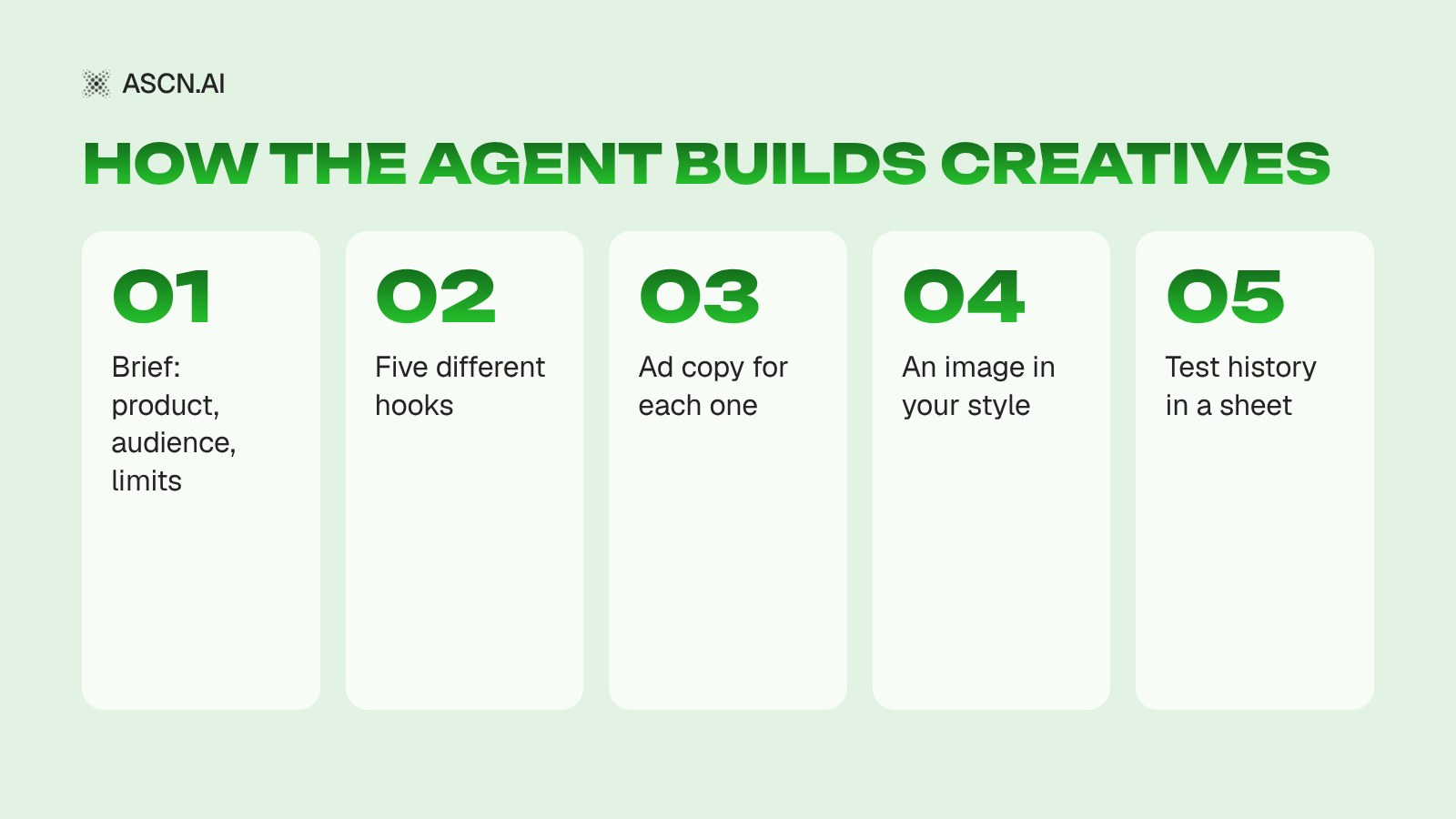
The brief goes in: what you sell, to whom, at what price, under what deadline, and what must never be written. The agent splits that into five angles, writes ad copy for each and generates an image in your style.
Along the way it looks at what is being shown on the topic in search. That is not for copying but for the opposite reason: so your creative does not become the fifth identical banner in the feed.
Results go into a spreadsheet: date, hook, copy, image link. You add the performance numbers later. After a month you have a record instead of a hunch: which angles work on your audience and which do not.
What to connect
| Component | Purpose | Required |
|---|---|---|
| Image generation | An image per variant | Yes, built in |
| Google Sheets | Test history and results | Yes |
| Telegram | Receiving and picking the set | Yes |
| Google Drive | Storing finished creatives | Yes |
| Page reading | Checking what competitors run | No |
That is exactly the stack behind the ready Ad Creative Generator template in the ASCN marketplace. It works on any plan, so you can start without building anything.
Launching it in four steps
- Take the Ad Creative Generator template from the marketplace and connect Google Sheets and Drive.
- Describe the product and audience once: what you sell, to whom, the objections you hear most, and the phrasing your legal team or brand book forbids.
- Set the image style. The easiest way is to attach two or three creatives that already worked for you and say "like these".
- Run the first brief and pick which of the five go live. Keep the rest; they stay in the history.
The same batch-content logic appears in the piece on Pinterest automation, and model selection in the comparison of image generators.
What it saves
A worked example. Assumptions: a small agency or an in-house marketer, eight campaigns a month, roughly four hours of combined designer and buyer time per creative set.
| Metric | Manual | With the agent |
|---|---|---|
| Variants per campaign | 2 | 5 |
| Time per set | 4 hours | 40 minutes to pick |
| Hours per month | 32 | 5.5 |
| Hypothesis history | in someone's head | in a spreadsheet |
This rests on the assumptions above. The point is not the hours saved but that five angles reach the test instead of two: your odds of finding the hook that works rise through sheer enumeration.
Where you need a person
Selection stays with you. The agent does not know which variant will fail platform moderation or which angle will upset your legal team. Those rules go into the brief, and you still check with your own eyes.
Numbers in a creative are their own risk. Discounts, deadlines and guarantees come from the brief, and the agent must not invent them. If they are not in the brief, they do not belong in the copy.
And it does not set up campaigns. Uploading, audiences and bids are the buyer's job; the agent hands over materials only.
Frequently asked questions
Can I try it on Free?
Free gives 500 credits a week and one active agent. How many sets that covers cannot be said in advance: the spend depends on the model and the number of images. It is usually enough for a couple of runs to judge the output.
Are the images good enough to run?
For testing hypotheses, yes, and that is the point: you are testing the hook rather than the final artwork. The winning variant is worth handing to a designer for production.
Does the agent publish the ads itself?
No. It assembles the set and sends it to Telegram. Launching the campaign stays with a person, which is right: a mistake in live spend costs more than the click it saves.
What does it do with competitor analysis?
It reads public pages on your topic and shows which angles are already in use. That is a reference point for standing out, not a template to copy.
Does this suit B2B with a long cycle?
Yes, though the hooks differ: not discounts and urgency but concrete outcomes and objection handling. That is set in the brief.
The bottom line
Advertising is won by enumerating hypotheses, and enumeration is limited by production. The agent removes that limit: one brief becomes five different angles with images, and the decision about what goes live stays with you.
The Ad Creative Generator template is in the ASCN marketplace and runs on any plan. For help tuning it to your product, message a manager on Telegram.
AI Chatbot for Instagram: A Furniture Showroom Case and 2.7x More Bookings
AI Agents in B2B Sales: A Case of Conversion Growth from 12% to 34%
AI Agents for Inventory Management: Automation Solutions and Key Benefits
The Best AI for Image Generation: A 2026 Ranking and Comparison of Neural Networks
AI Agents for Marketplaces: What They Are and How They Work
How to Create a Telegram Bot for AI Image Generation