



- Русский
- English
- Português
AI Agent for Restaurants: Table Bookings and Menu Questions

An AI agent for restaurants closes two gaps at once: the table booking a busy host is taking by phone, and the menu questions sitting unanswered in the messenger all evening.
Friday at seven, the room is full, the phone is ringing, three people are asking about vegan options, and there is one host. The guest who could not get through is eating across the street.
The short version
An AI agent for restaurants takes bookings in the messenger, checks the seating calendar, answers menu and availability questions and sends the guest a confirmation. Anything complicated — a large party, an allergy, a complaint — goes to a manager. The integrations are Google Calendar, Google Sheets and Telegram, and setup takes a day or two.
Contents:
- What the agent takes on
- How a booking goes
- What to connect
- Building it in five steps
- What it saves
- Where you need a person
- Frequently asked questions
What an AI agent for restaurants takes on
Most of the load on a host is repeat questions. What time do you close, is there parking, are dogs allowed, what on the menu is gluten free, is the set menu on tonight. The answers all live in the restaurant's own documents and do not change for weeks.
The second part is the booking itself. A guest writes with a party size and a time, the agent checks free seatings in the calendar, offers a slot and records the booking with a name and a phone number. The host sees a finished entry instead of reconstructing a phone call from memory.
How a booking goes
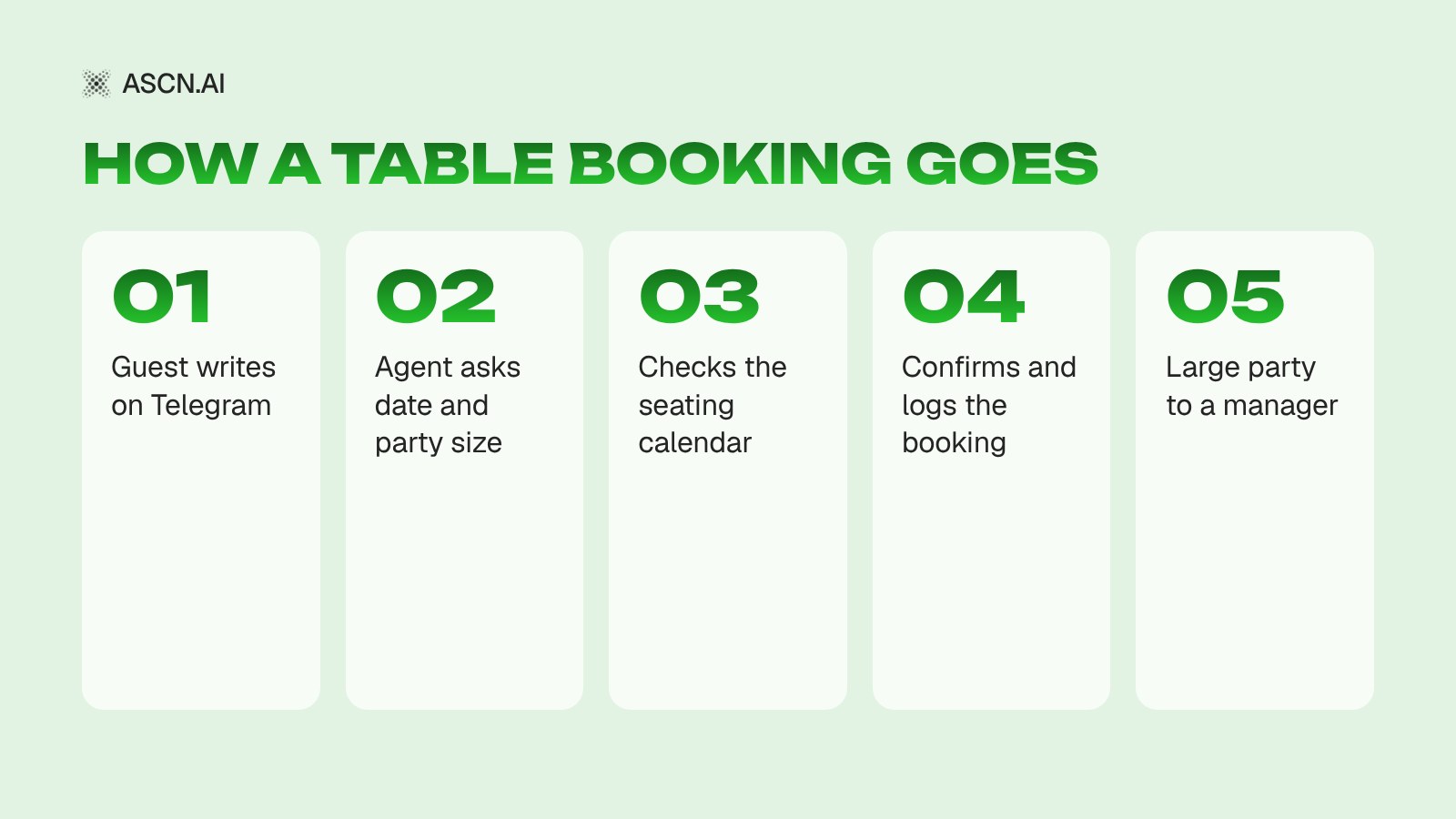
The guest writes to the restaurant's Telegram. The agent establishes three things: date, time, party size. Then it checks the seating calendar and either confirms or offers the nearest free slot.
A confirmed booking becomes a calendar event and a spreadsheet row: date, time, guests, name, phone, notes. Separately the agent keeps the 86 list, the items that are off today. That is the only part of the knowledge base needing daily updates, and it prevents the worst conversation of all: a guest who came for one dish that sold out in the morning.
What to connect
| Component | Purpose | Required |
|---|---|---|
| Telegram | Channel for guests | Yes |
| Google Calendar | Seatings and table availability | Yes |
| Google Sheets | Booking log and 86 list | Yes |
| Knowledge base | Menu, hours, house rules | Yes |
| Gmail | Private event enquiries | No |
The calendar matters most here. Without it the agent takes bookings blind, and you get two parties on the same table at eight on a Saturday.
Building it in five steps
- Gather what is already written into one folder: menu, opening hours, policy on children and dogs, floor plan, private event terms. That becomes the knowledge base.
- Create the agent and connect Google Calendar. Use a separate calendar for seatings so the manager's own meetings stay out of it.
- Connect Google Sheets: bookings on one tab, the 86 list on another. The kitchen updates that list each morning, five lines a day.
- Connect Telegram through BotFather and describe the flow: what to ask, in what order, when to hand over.
- Write the handover rules: parties over eight, allergy questions, any complaint. The agent does not handle those three on its own.
The consultation and booking logic is the same as in the clinic booking case and the hotel concierge case: the knowledge base and the schedule change, the mechanics do not.
What it saves
A worked example. Assumptions: 60 covers, about 25 enquiries a day, of which 15 are bookings and 10 are menu questions, at three minutes of host time each.
| Metric | Without the agent | With the agent |
|---|---|---|
| Host time per day | 75 minutes | 20 minutes |
| Reply at peak hours | when someone is free | immediately |
| Out-of-hours bookings | lost | taken |
| Double bookings | they happen | calendar prevents them |
This is a calculation on assumptions, not a measurement in a specific restaurant. The most underrated line is the out-of-hours bookings: guests plan dinner in the evening, when your phone no longer answers.
Where you need a person
Private events and large parties always go to a manager: there is a deposit, a bespoke menu and a seating plan. Allergy questions the agent refuses on principle, even when the dish composition is in the knowledge base, because the cost of being wrong is too high.
Complaints about the food also go straight to a human. An automated reply to a complaint about a meal reads as mockery, however politely it is worded.
Frequently asked questions
Does the agent confirm bookings itself?
Yes, when the calendar shows a free table and the party is eight or fewer. Everything else it hands to a manager with the request already written up.
What about cancellations and changes?
The agent finds the booking by phone or name, removes the calendar event and marks the spreadsheet row. It is the most frequent operation and the simplest to set up.
Do you need a reservation system?
Not for a small restaurant; a calendar and a spreadsheet are enough. A dedicated system matters when you manage seating by specific tables rather than by covers.
Who updates the 86 list?
The chef or sous chef, in one message each morning. It is the only daily manual step in the whole setup, and without it the agent will promise dishes you do not have.
Does this suit a coffee shop with no bookings?
Yes, though half the value disappears. What remains is menu, hours and availability questions, which is still a flow, just a smaller one.
The bottom line
In a restaurant, response speed is the service. The agent takes repeat questions and booking routine off the host, accepts requests at night and does not double-book, while private events, allergies and complaints go honestly to a person.
Ready-made consultation and booking agents are in the ASCN marketplace, with the menu and schedule set up for your own venue. For help building one, message a manager on Telegram.
WhatsApp AI Chatbot for Business: WhatsApp Business API Pricing After October 1 and How to Launch One
AI Chatbot for Hotels: A Country Club Case and 40% Ancillary Revenue Growth
AI Agent for a Travel Agency: Doubling Sales on the Same Budget
AI Chatbot for Clinics: Cutting Patient Acquisition Cost Threefold
AI Chatbot for Instagram: A Furniture Showroom Case and 2.7x More Bookings
How to Build a Chatbot for Business: A Complete Guide to Automating Customer Communication