



- Русский
- English
- Português
AI Agent for Online Reviews: Listing Monitoring and Draft Replies

An AI agent for online reviews is not about writing polite replies. It is about where your listing sits in local search. Google Maps and review platforms favour profiles where the owner answers, and bury the ones where feedback sits untouched for weeks.
For a small business the problem is always the same: nobody has the time. The owner logs into the dashboard once a month, the front desk never thinks about reviews at all, and meanwhile a one-star complaint sits at the top of the listing talking people out of calling.
The short version
An AI agent for online reviews visits your company listings once a day, collects new reviews into a spreadsheet, drafts a reply to each one and sends anything that needs your attention to Telegram. A human publishes the replies: the agent needs no access to your review dashboards. Setup takes an evening, and the integrations are Google Sheets and Telegram.
Contents:
- What the agent does and does not do
- How it is built
- What to connect
- Building it in five steps
- How much time it saves
- Where the agent falls short
- Frequently asked questions
What the agent does and does not do
The agent reads your public listing pages the same way a person does: it opens the link and takes the text of new reviews, the rating and the date. Then it sorts them by sentiment and drafts a reply in your tone of voice.
It does not publish. Review dashboards do not hand out API access freely, and that is for the best: a reply to a complaint, sent under your company name, is too sensitive to go out unseen. The agent saves you the hour of reading, sorting and phrasing, not the click on Send.
How an AI agent for online reviews is built
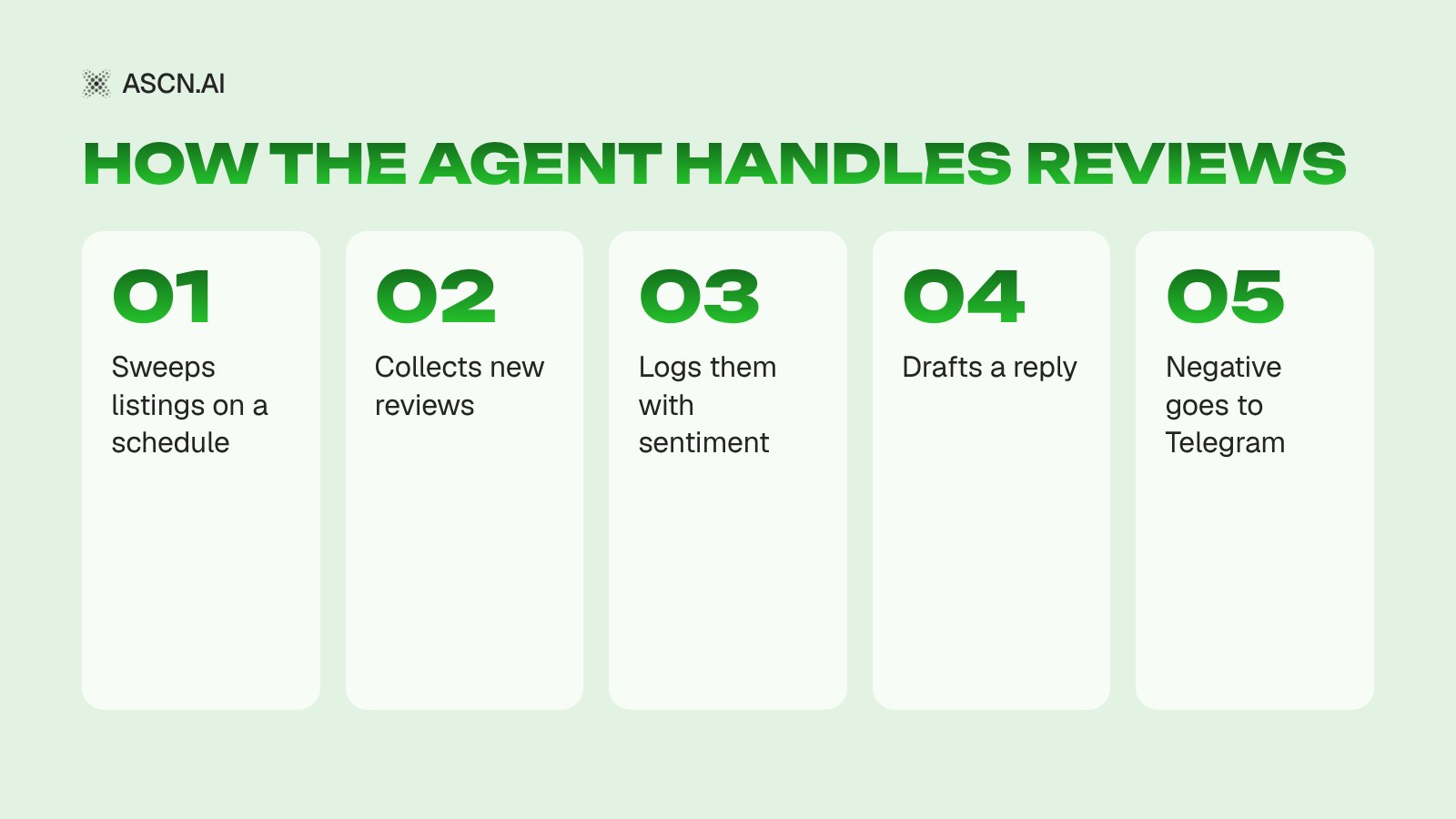
Once a day on a schedule the agent opens the list of your listings. Reviews that are not yet in the spreadsheet get appended as rows: date, platform, rating, text, sentiment. For each one it prepares a draft reply in the next column.
Then a priority rule kicks in. Four and five star reviews are simply logged with a ready reply, so you can work through them in a batch once a week. Anything at three or below goes to Telegram immediately, with the review text and the proposed answer. You see complaints on the day they appear rather than whenever you next open the dashboard.
What to connect
| Component | Purpose | Required |
|---|---|---|
| Page reading | Pull reviews from listings | Yes, works out of the box |
| Google Sheets | Review and reply log | Yes |
| Telegram | Alerts on negative reviews | Yes |
| Scheduled task | Daily sweep | Yes |
| Gmail | Weekly summary by email | No |
Web search and reading pages by link work in ASCN with no setup at all. The rest is three integrations from the Connections page and one scheduled task.
Building it in five steps
- Create the agent with the New button and describe the job in plain words: watch reviews about the company on these pages.
- Ask in chat to connect Google Sheets and make an empty table with columns for date, platform, rating, text, sentiment, draft reply and status.
- Load your tone of voice into the knowledge base: two real replies to praise, two to complaints, and a list of things never to write. Without this the agent defaults to corporate boilerplate.
- Connect Telegram through BotFather and tell the agent to send anything rated three or below straight there.
- Set a scheduled task: every morning at nine, sweep the listings and append new reviews to the table.
How an agent is assembled in general is covered in the guide to building AI agents without code, and spreadsheet techniques in the piece on Google Sheets automation.
How much time it saves
Here is a worked example. Assumptions: a salon with three listings, 40 new reviews a month, and roughly five minutes per review for the owner to read, think and write.
| Metric | Manual | With the agent |
|---|---|---|
| Time per review | 5 minutes | 1 minute to check |
| Hours per month | 3.3 | 0.7 |
| Complaint noticed | after 1-4 weeks | same day |
| Reviews left unanswered | usually half | 0 |
This is a calculation on the assumptions above, not a measurement from a client. Your numbers will differ, but the shape usually holds: two or three hours saved a month and, more importantly, complaints caught in time.
How an agent talks to customers in a messenger is shown in the clinic booking case.
Where the agent falls short
It will not publish for you. It will not work out who is right in a dispute, and it will not decide whether to offer compensation. It cannot tell a genuine review from a paid one, although it will flag odd coincidences in wording and dates.
There is also a technical limit: if a platform sits behind a bot check, the agent cannot read the page. That shows up on the first run, and those listings stay on manual watch.
Frequently asked questions
Does the agent reply to reviews itself?
No. It prepares a draft, you edit and publish. Auto-publishing replies under your company name is a bad idea even technically: one clumsy sentence in answer to a complaint costs more than the minute saved.
Does it need access to the review dashboard?
No. The agent reads public listing pages like any visitor. You do not hand over passwords or logins.
How long does setup take?
An evening, if the spreadsheet and sample replies are ready. Collecting the tone of voice usually takes longest: you need two or three real replies to praise and the same to complaints.
What about reviews on several platforms at once?
You list the platforms and the agent visits them in turn. The platform column exists precisely for this, so you can see where the rating is slipping.
Does this work for a ten-location chain?
Yes, and the payoff is bigger: nobody tracks ten listings by hand. You do not need an agent per location, just a list of links and a column with the branch name.
The bottom line
Reviews on maps are not reputation in the abstract. They are your listing position and your phone calls. The agent closes the dullest part of the work: it finds new reviews, writes the drafts and stops complaints from sitting unnoticed for a month.
Ready-made monitoring and support agents are in the ASCN marketplace, tunable to your own platforms. If you want help assembling one, message a manager on Telegram.

AI Chatbot for Hotels: A Country Club Case and 40% Ancillary Revenue Growth
AI Chatbot for Clinics: Cutting Patient Acquisition Cost Threefold

AI Chatbot for Instagram: A Furniture Showroom Case and 2.7x More Bookings

AI Agents for Inventory Management: Automation Solutions and Key Benefits

AI Agent for Email: The Complete Guide to Email Automation

How to Build a Chatbot for Business: A Complete Guide to Automating Customer Communication