



- Русский
- English
- Português
AI Tools for SEO: How to Stop Doing Routine Tasks and Start Taking Control

Forget about export tables that are boring, and having to sort through endless searches to find your information; those techniques are soooo last century. SEO teams today work in a totally different way - there is so much data you can't even begin to comprehend it all. This is where SEO agents come in.
These are not the bot-like dumb chatbots you might have used before! They are actually "autonomous systems" that make their own decisions on how to respond based on the input given to them. They are capable of examining data, determining the best approach (method) to take, and implementing it.
This is literally a transition from doing manual labor yourself to managing your digital "employees". For example, an agent logs into Search Console autonomously and looks to see what your competitors are doing; it categorizes the queries based on their meaning; it generates a brief for the author of the content; and it tracks the rankings of that content all while you are enjoying your second cup of coffee instead of going back-and-forth refreshing a report tab.
I have watched a lot of teams get burned out over the last couple of years due to the overwhelming amount of work they have to complete on an ongoing basis and/or completing the same types of jobs repetitively. The problem is not that people don't have the qualifications for the job; it's that there's a lack of time to get the job done. When you have to process 50,000 queries by a certain date, you can either hire 5 interns or delegate that task to a smart script. The smart script option will pay for itself within one month.
At ASCN, we built a system that automatically completes these tasks for you without having to set up complex integrations between the script and your systems. AI agents for an SEO team are now something that is standard for an SEO team, rather than being an exotic and luxury item.
“Correctly setting up agent prompts allowed us to reduce content planning time from 12 hours to 40 minutes.”
AI Agent for SEO Analytics: Data Collection to Insights Ready to Use
An SEO analyst can spend 80% of their time merging data from GSC and GA4 and only 20% of the time looking for insights. This is a fact, and it is very unfortunate. The typical workflow involves the following: export the data to CSV, then merge it into Excel; search for correlations in the data; compare with competitors as to why everything went down; spend 3-5 days trying to figure out why everything is different. Most people think the tools are the problem; however, the only thing wrong is that they do not provide information to you until you've requested that information.

An AI agent for SEO Analytics has solved the problem differently. The AI agent connects to an existing API and retrieves the necessary metrics in real-time. The AI agent correlates drops in position to changes to the website and then provides an immediate list of prioritized issues. Instead of just providing you with a graph of the data and telling you to figure it out, the AI agent says, “here are three major problems that exist with your website, here are the reasons behind each problem, and here's how to fix them.”
This will allow for a shift in the way a company operates, from reactive firefighting to being proactive.
What the AI agent does autonomously includes:
- Collecting data from Search Console, GA4 & CRM without having to export data manually to files.
- Conducting technical audits, including indexing, speed, duplicates & broken links.
- Comparing the companies keyword visibility in Google to their competitor's keyword visibility.
- Tracking changes to Search Engine Results Pages (e.g. snippets of new content, 'People Also Ask' Results and products).
- Generating a report that includes actionable tasks, not just a list of numbers.
In one case, the AI agent identified 18% drop in traffic to a website within three days. We could have spotted this via a report one week later than we ended up spotting it (the agent took only 40 minutes). This report did an analysis of logs, GSC exports and the index and found that there was a faulty robots.txt file that caused robots to not see portions of the pages following a CMS upgrade that had occurred right before.
The difference is obvious. A dashboard waits for you to log in to see the information you need. An agent observes, records deviations from expected performance, and knocks on your door if something goes wrong. This is proactive control.
AI Agent for Keyword Clustering: Automatic Semantic Grouping
Creating keyword clusters semantically is difficult. You have 10,000 keywords to use as a reference point. You start with your keywords and look at the search result pages for each of them, trying to determine which pages Google would want to show as a result of those keywords being queried. One week later you finally finish grouping up your keywords based on their search results and content type (website, article, etc.). If you are looking for the highest possible quality, you could spend one month doing this.
Using an AI agent for grouping keywords semantically works differently. It doesn't just look at the words on the page, but also looks at the way those pages are structured on the SERPs, the search intent of the user, and other behavioral variables related to the searcher. It can use BERT and Natural Language Processing models to determine if the user wants to buy, learn, or do a comparison. Then it will immediately cluster the search terms into their respective groups based on whether or not the query contained a commercial or informational aspect.
As an example, take the searches "how to choose a laptop," "which laptop is best for purchase," and "2026 laptop rankings." A human would classify the three together, but the agent would see all of the searches differently and assign them to their own pages; each suggesting the specific content that Google returned on its SERP. For example, the SERP returned for "how to choose a laptop" suggests that this query would return results with guide-type content; whereas, "which laptop to buy" suggests returning lists of available laptops to purchase, versus "laptop properties ranking for 2026" would suggest returning to review types of laptops. At ASCN, we evaluated a project that required 47000 queries and would have taken three SEO specialists three weeks to complete. The agent completed all of this in eight hours and provided an organized structure based on four elements: intent, priority, and page type. The SEO specialist then validated this work with corrections of only 4%. Therefore, the work was mostly ready for publication.
Comparison of Manual Versus AI Query Clustering (10,000 queries)
| Parameter | Manual Work | AI Agent Clustering |
|---|---|---|
| Time Required | 7–14 days | 4–8 hours |
| Accuracy of Intent | 70–80% (human factor) | 85–92% (BERT + SERP analysis) |
| Cost | $500–$1,000 (salary fund) | $50–$150 (subscription) |
| Behavioral Factors | Seldom considered | Analysis of clicks and time on site |
| Updates | Requires a fresh cycle | Auto-update upon SERP change |
The Agent does more than just cluster queries together; it will recommend what pages to create, and what pages to combine. It is not a substitute for strategists; it is designed to automate routine tasks.
How an AI Agent Creates the Perfect Content Brief for a Copywriter
The issue is often with the briefs given to copywriters, rather than with the copywriters. For instance, if you request, “write on laptops”, and provide a keyword, the author may be confused. What was the intent? Which LSI to utilize? How should he write? In the end, the SEO specialist will receive text from the author that has to be rewritten; therefore, it is a continuous loop of work.
An AI Agent will create a more accurate brief for copywriters. It analyzes the semantic structure, the top ten search results, the heading structures of the competitors, and utilizes this data to create a brief that includes all of the above listed aspects and follows a specific format; thus, it enables the authors to follow a clear map.
The Contents of an Agent-Generated Brief:
- Primary keyword -> Morphology (frequency, density).
- LSI phrases and synonyms used for a natural-text flow.
- H1, H2, H3 structure + volume of blocks (in words).
- Target volume compared with the top 5 competitors.
- Tone of voice (expert, casual, or formal) + examples.
- Must have: tables, FAQ's, link to sources.
- Required Technical aspects: uniqueness, fluff, keyword stuffing (using standard checking tools).
When one agency implemented this, brief creation was reduced from 1.5 hours to 12 minutes. All the SEO specialist did was provide the structure and requirements to the agent; the agent produced the remainder of the information. The number of revisions by the copywriter was reduced from 3 to 1.
An agent will not write for the author; it provides the guide to write the content. This eliminates the subjective nature of arguing "this is how I see it".
Proactive Control of Position Monitoring
Classic monitoring (i.e., Serpstat, SE Ranking) is as follows: Set up your monitoring, feed in keywords and check the graph once a week. You see your position dropped from 3rd to 7th - that's all you know. Why did you drop? You will need to do investigative work: check logs, compare with competitors, do a Google update. All manual work.
An AI Agent will not only log numbers for Position Monitoring but will provide the reason for the number change. If your position drops, the agent will check the SERP for the following: Has there been a new player in the space? Has the snippet changed? Has something appeared on the carousel? Then the agent will generate a report and diagnostic for this example (dropping from 4th to 9th). A brand-new site with an FAQ is ranked 3rd using a different site as a reference. The agent checking the site will say, "Add an FAQ section, add schema.org, and add 600 words to your product specifications section."
The agent saw a 22% drop in visibility within two days of an algorithm update by Google that penalized sites for having too many ads. It picked up a pattern in TOP 10 that showed excessive banner ads were negatively affecting their rankings. It suggested the client reduce their banners by 40%, which the client did within 3 days — rankings returned.
In addition to site tracking, it also tracks competitor changes to their content in real-time. If a competitor adds a section or increases their text length, it will notify you of these changes so that you can respond quicker.
The key difference between the agent and a rank tracker is that the agent does not wait until you log into the site's dashboard to communicate with you; instead, it actively reaches out to you.
Human Role in Autonomous SEO
SEO automation does not mean the death of SEO specialists. The responsibilities of SEO specialists will evolve and change. In the future, SEO specialists will be responsible for managing an automated SEO system rather than performing repetitive tasks. AI agents can help build out and grow SEO teams, not replace SEO teams.
GEO Visibility and AI Responses
Search has evolved to become much bigger and broader than ever before. Agents must now monitor not just URLs in the top of the search results but also brand mentions in AI search results. If your competitor appears there and not you, you either have poor quality content or have not created your content to be easily extracted by a neural network. GEO is the term for content that has good structure so that a neural network can easily extract facts from it.
Role Transformation: Executor to Operator
In the past, 60% of the work that an SEO specialist did involved report writing and clustering. Now, that time is spent on developing strategies. For example, if the house is being built, the agent digs a hole and the person decides where the hole will be dug.
Human Factors:
- Determining where and how to grow; what queries are going to be prioritized.
- Creativity, such as developing unique content, or special features.
- Quality Control, such as verifying the agent's conclusions, and testing hypotheses.
- Communicating with Copywriters, Designers, and Developers.
- Working on complicated or complex issues requiring experience/subject matter expertise.
Agent Contribution:
- Collecting data and processing it through primary sources (GSC, GA4, CRM).
- Doing the clustering and grouping of all data based on intent.
- Preparing briefs that include the keywords and structuring of the keywords.
- Monitoring positions and SERPs.
- Conducting technical audits and identifying major issues.
In a single implementation, the agent freed up 15 hours per person, per month. The work that was freed up was used to create new formats, and handled complex queries. In the first three months of using agents, traffic increased by 34%, and there was no increase in headcount.
Key Takeaway: Agents don't replace a brain. They enhance physical productivity.
Typical Implementation Mistakes
There are many occasions where the same errors occur repeatedly when implementing agents. These are errors caused by the user's approach and have nothing to do with the technology.
Error #1: Complete Trust in the Agent
Agents can provide false or incomplete information. For example, an agent could state that the decline in position was due to a title tag, when it was really because there was a core algorithm update. Solution: Use a human to validate the detail before a decision is made.
Error #2: Using Old Data
Agents only know the data that is stored in their database during the time they were trained by the user. The database contents will become obsolete because they are not being updated on a regular basis. Monitoring is also impacted by this issue, as your content will not remain relevant if it was not updated periodically. The only way to ensure that your information is being refreshed frequently enough is to automatically update it via an API.
Error #3: No Quality Control
When an agent produces a short article, he may not include an essential piece of information that is necessary in order for the reader to be able to understand the article's intent. This scenario is unacceptable and should be avoided at all costs. The first ten articles written by an agent should be manually reviewed to verify the accuracy of the content produced before the agent is allowed to continue generating content for publication, and then at least once a week thereafter.
For example, the team generated an agent to generate content for one month and found out that 30% of the content published didn't rank; the agents confused commercial intent with informational intent because the agent prompt did not consider the niche specificity of the article. After correcting the agent prompt, the accuracy increased to 92%.
Both plugins and agents are tools to help you manage your business; you still need to think creatively and utilize your own brain.
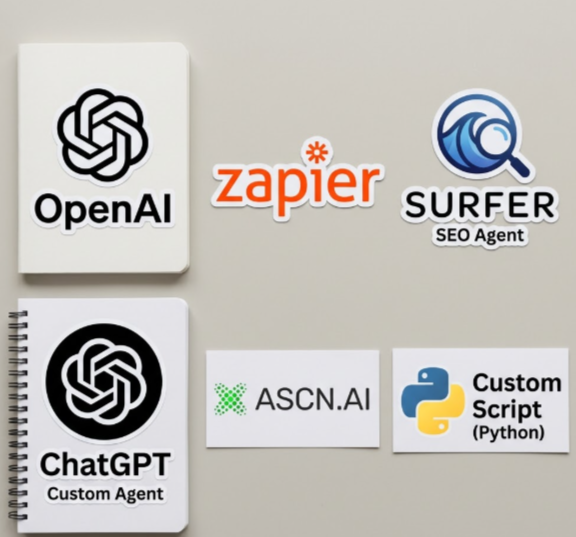
Platform Overview: Where To Get/How To Build An Agent Via APIs for eCommerce
You may build an AI Agent in two different ways: either by using a prepackaged tool or building your agent using an API. Choosing an off-the-shelf solution means you can implement your agent faster, but you are constrained by what the vendor has built. Conversely, building your own agent using an API will take longer (due to the need for coding) but can be configured to meet your business.
Tool Comparison:
| Tool | Cost | Complexity | Use Case | Disadvantage |
|---|---|---|---|---|
| ChatGPT Custom Agent | From $20/month | Low | File analysis, Q&A | No site access possible unless you install a plugin. |
| Surfer SEO Agent | From $89/month | Low | Content, Briefs | Closed ecosystem (can't integrate). |
| Zapier and OpenAI | From $30/plus token | Medium | Linking services from various applications | (Error chains take time to resolve). |
| ASCN.AI | From $49/month | Low | Multiple agent systems | Dependent on the ASCN platform. |
| Custom Script (Python) | Token based | High | Customized tasks | Requires a programmer. |
We at ASCN provide you with 100+ scenarios from which to choose, as well as 100+ scenarios that you can customize without coding. For example, you could take the "SEO Analyst" template, connect it to your data, and launch it within 15 minutes.
Step-by-Step Instructions to Create Your Agent in 15 Minutes
There is no need to be a software developer to create your first agent. You can complete the process in three steps.
Step 1. Task-Persona
Describe very clearly what you want your agent to do. For example, instead of saying "monitor the website," you would say, "track positions for 500 keywords; find out why the positions dropped; and send me a message on Telegram each morning."
Step 2. Data
Connect the agent to your data. Google Sheets, Google Search Console (GSC) Export, Notion, or CRM you use. In ASCN, we connect through integrations (i.e. Links). The steps are: 1. Select your data source. 2. Provide the key. 3. Have a cup of coffee and never connect to that source again.
Step 3. Instructions
Write the instructions for how to operate the agent. What should the agent do? For example, if you are dropped by 3 or more positions, compare your rankings with the top 5 competitors during the past 7 days and produce a report. Insert a prompt (200 – 300 words) that defines the parameters.
Agent Setup Checklist:
- Select a specific task.
- Select the data source(s).
- Connect your integrations.
- Write the prompt (Role, Task, Constraints).
- Define the schedule.
- Define a communication channel (Telegram or Email).
- Test in Sandbox.
- Verify Findings.
- Production Launch.
- Log Monitoring.
After that period, the agent is operating independently, either once daily or on demand from some event. We have observed that 80% of users deploy their first agent within the first 20 minutes post-setup. Users generally cite "lazy" reasoning as to why they have difficulty writing out their request properly; it was not due to lack of knowledge about the button functionality.
Key Benefits of Automation
When automating SEO routines it not only offers generic "efficiency", but it also provides specific measurements for these characteristics: Time, Money, and Speed.
Time: Clustering 10,000 search terms can take 4 hours instead of 14 days. A research brief takes 12 minutes vs. 1 hour. Monitoring takes 20 minutes a day vs. many hours.
Accuracy: An agent never tires; operates perfectly all the time. An agent may recognize patterns that humans miss because of "eye fatigue" and tiredness caused by prolonged focus. However, logic still has to be validated.
Free Resources: Assign & delegate routine tasks to machines, while a human is responsible for making assumptions, collecting/testing data, and creating a strategy. By automating SEO tasks, users are able to handle 2.5 x the work load without adding additional employees.
Scalability: If a company's work force doubles in size (manual) it typically requires hiring new employees. If that company makes use of a robotic agent, it simply adds an additional scenario to be automated. This scalability is critical to assume for agencies.
Proactive: Agents do not wait for a report. They will alert you when anomalies are identified. Anomaly detection has been reduced from a multi-day reaction time to a matter of hours.
One ASCN Project, in 3 months, grew from 8 to 14 clients without an increase in the workforce and has realized $4,500 in labor cost savings per quarter. Output has been produced at a 2.3x faster rate.
The concept is simple: allow robots to handle the tasks while humans run the show.
Frequently Asked Questions (FAQ)
Will artificial intelligence (AI) agents take the place of SEO specialists?
No, they will assist them. They will take over the repetitive tasks; strategy, hypotheses, and monitoring will remain with humans. In the future, those who can manage AI agents are in-demand.
What possible risks exist?
Errors in data and "hallucinations" - An AI will create an explanation for a drop or spam content without oversight. Solution: Human-in-the-loop. Humans are the ones who are providing the final filter.
Do I need to know how to code?
Not to begin. The No-Code platforms (ASCN.AI, Zapier) allow you to build everything with your mouse. To have the most custom solutions you will need to know the APIs and the prompts; you don't have to write code.
How does an AI agent determine the intent of a user?
The AI agent can look at the SERP; if the first few results are stores (catalog) then the user has a "purchase" intent when they created the search. If they are mostly articles then the user has a "look up" intent when searching for something. BERT and other models allow for deeper semantic analysis (semantic means how words work together with one another and not just their individual definitions).
How long will it take to set it up?
Using an existing template 10-20 minutes; creating a Python script specifically for your needs can take anywhere from a couple of hours to a few days. It depends on how complex your needs are.
Is it real-time capable?
Yes; as long as there is API access the AI agent can monitor SERP positions every hour and notify you if any of the critical queries have dropped.
Are you ready to implement AI agents?
Automation is not the future; it is the present. I have personally observed teams transition from manual labor to managing automated systems that work even while they sleep. Automation is quicker, produces fewer errors and less stress.
At ASCN we have created a platform where you can launch your first AI agent in just 15 minutes without needing to know code. We have 100+ different templates and can be integrated into all of the solutions you use such as Sheets, Telegram, GSC. You can try it out for free or you can schedule a Demo and see the scale.
If you require something specific to your organization, we also offer complete Turnkey solutions for AI agents: Audit, Architecture, and Education. Send me a message and let's talk about how to automate the daily tasks in your organization.
You can see a case study of ASCN.AI and Falcon Finance regarding the use of the platform by reading the Falcon Finance Drop case and the capabilities of the platform. The time to launch your AI agent is now.