



- Русский
- English
- Português
AI Agent for Tender Search: Daily Platform Sweeps and Filtering


An AI agent for tender search solves a dull but expensive problem: going through procurement platforms every day and not missing the contract that fits your company. Done by hand, that is either a salaried job or nobody's job.
The second case is more common. Someone gets to it once a week, by which point half the suitable tenders have closed and the rest have to be decided in a rush.
The short version
An AI agent for tender search sweeps your chosen platforms every morning, filters contracts by your criteria — industry, region, value, closing date — logs them in a spreadsheet and sends the matches to Telegram with a short note on each. A human decides whether to bid. The integrations are Google Sheets and Telegram, and setup takes a day.
Contents:
- What the agent does
- How the filtering works
- What to connect
- Building it in five steps
- What it saves
- What the agent will not do
- Frequently asked questions
What an AI agent for tender search does
The agent reads tender pages the way a procurement specialist does: it opens the listing and takes the subject, the starting value, the submission deadline and the requirements for bidders. Then it compares all of that against your criteria and discards what clearly does not fit.
The value is in the filter, not the search. Platforms publish hundreds of items a day and only a handful concern you, and working through that flow is what eats the time. The agent leaves a short list and explains, item by item, why each one made the cut.
How the filtering works
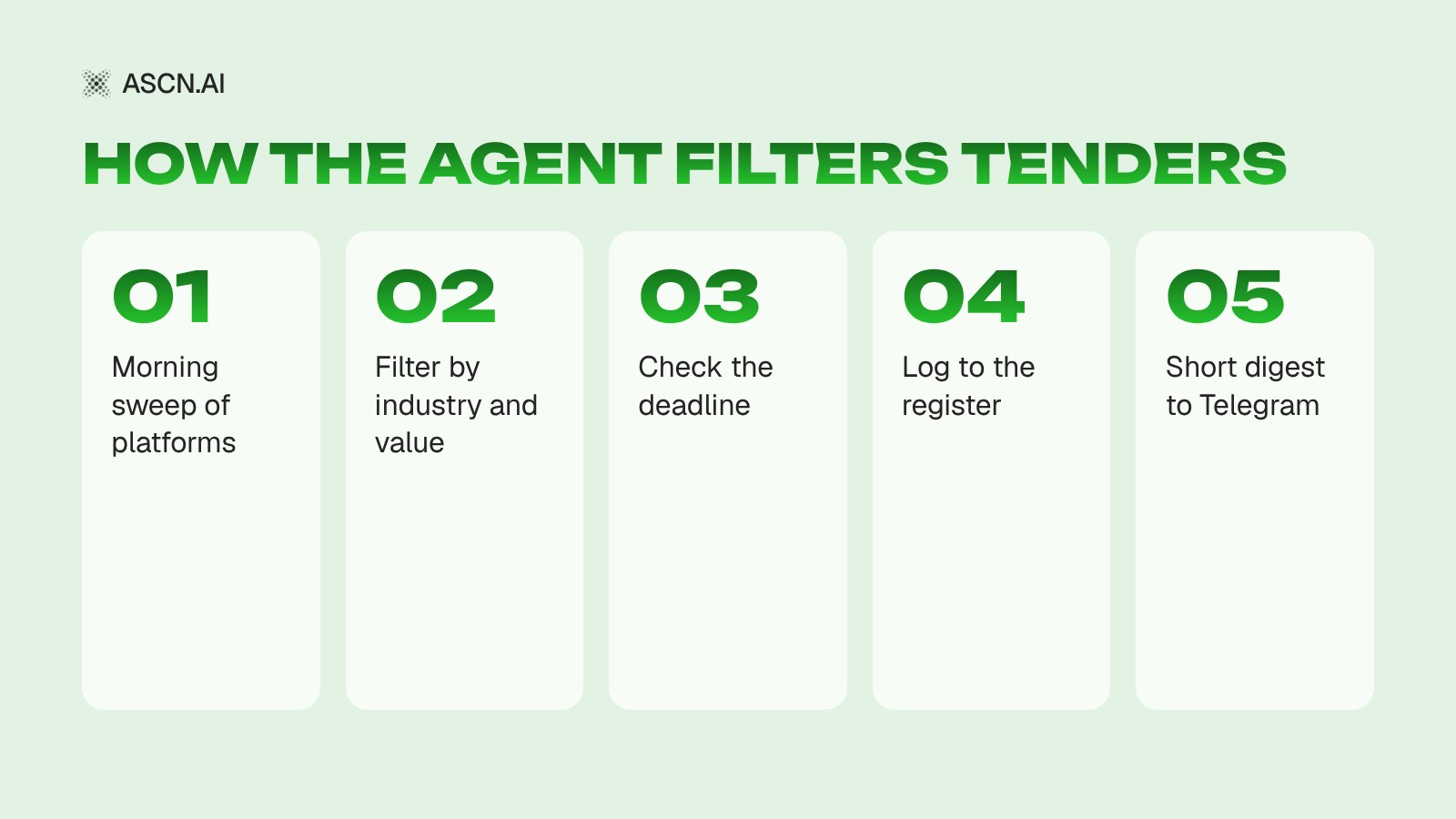
Criteria are written in plain words rather than code: industry, region, value range, minimum time to the deadline, exclusion terms. The agent runs every tender it finds through that list and assigns a status.
Matches land in the spreadsheet as a row: reference number, buyer, subject, value, closing date, link. Telegram gets a digest, usually three to five items with a note on what matched. Borderline cases are not discarded but flagged with their own status, so you can judge them yourself.
What to connect
| Component | Purpose | Required |
|---|---|---|
| Page reading | Pull tender listings | Yes, works out of the box |
| Google Sheets | Log of selected tenders | Yes |
| Telegram | Morning digest | Yes |
| Scheduled task | Daily sweep | Yes |
| Google Calendar | Submission deadlines | No |
Connect the calendar if you run more than five live bids at once: the agent creates an event on the closing date and the deadline stops being a surprise.
Building it in five steps
- Create the agent and describe what your company does: what you make or supply, which regions you cover, what contract sizes you take.
- Connect Google Sheets and set up a table: reference, buyer, subject, value, closing date, link, status, agent's note.
- Write your selection criteria in one message. Include exclusion terms: items that look like yours but are not.
- Connect Telegram and ask for a morning digest of new matches only, with no repeats.
- Schedule the task for every morning. Check the selection by hand for the first week; criteria almost always need tightening after the first few runs.
The same first-pass filtering idea appears in the real estate lead qualification case: the data source changes, the filter logic holds.
The assembly steps are covered in the guide to building AI agents without code.
What it saves
A worked example. Assumptions: the company watches three platforms, a specialist spends an hour a day on the sweep, and around eight suitable tenders appear per month.
| Metric | Manual | With the agent |
|---|---|---|
| Time on the sweep | 1 hour a day | 10 minutes on the digest |
| Hours per month | 22 | 3.5 |
| Missed deadlines | they happen | visible in advance |
| Platform coverage | as far as you got | the whole list |
These figures rest on the assumptions above. The main effect is usually not the hours saved but that the sweep stops depending on how busy someone is: the agent walks the list every day, including the days when everyone is firefighting.
What the agent will not do
It will not submit a bid or sign documents. It will not judge whether you can handle the volume, and it will not check the buyer's payment record. The decision to bid stays entirely with a person; the agent only delivers the information on time and in a readable form.
The technical limit is the same as for any page reading: sections that require a signed login stay closed to it. Those keep their manual route.
Frequently asked questions
Does the agent submit bids?
No. It finds, filters and presents. Submission requires documents and a signature, which is a human's job.
How many platforms can it watch?
The limit is practical rather than technical: more platforms mean a longer morning sweep. Start with two or three and add more as the filtering gets accurate.
What if the criteria are complicated?
Criteria are written as text rather than a formula, so a caveat like "only if there is more than a week to the deadline" is just a sentence. The hard part is remembering all the exceptions, not phrasing them.
How does the agent know a tender is new?
It checks the spreadsheet by reference number. If the row already exists, the item does not appear in the digest again.
Does this suit a company that bids twice a year?
Probably not. The agent pays off where the flow of tenders has to be reviewed regularly. For two bids a year, platform notifications are simpler.
The bottom line
Tender screening is work where regularity matters more than skill. The agent takes exactly that part: it sweeps the platforms daily, cuts the noise and brings a short list with reasons, leaving the decision to you.
Ready-made monitoring and digest agents are in the ASCN marketplace. For help tuning one to your criteria, message a manager on Telegram.

AI Chatbot for Hotels: A Country Club Case and 40% Ancillary Revenue Growth

AI Agent for Real Estate: An Agency Case and 2-Minute Lead Qualification
AI Agents in B2B Sales: A Case of Conversion Growth from 12% to 34%
AI Agents for Inventory Management: Automation Solutions and Key Benefits
AI Agent for Email: The Complete Guide to Email Automation
AI Agent for Procurement – Automation and Optimization of Business Processes