



- Русский
- English
- Português
AI Agent for Customer Feedback: Post-Deal Surveys and Alerts

An AI agent for customer feedback solves a problem companies usually notice too late: you learn a customer was unhappy from a public review rather than from the customer.
The pattern is always the same. The deal closes, nobody asks anything, the person leaves with a bad taste and writes about it online a week later. By then there is nothing left to fix; all you can do is reply to the review.
The short version
An AI agent for customer feedback messages the client a few days after the deal, asks one short rating question, follows up on the reason, logs answers in a spreadsheet and raises an alert immediately on a low score. A human handles the unhappy customer. You need Google Sheets, Telegram and a scheduled task.
Contents:
- Why ask when you already know
- How the survey works
- What to connect
- Building it in five steps
- What you get
- Where this breaks
- Frequently asked questions
Why ask when you already know
You usually do not know all of it. A company sees revenue and repeat purchases but not why half the customers never came back. The reason is often small and fixable: slow delivery, a call nobody returned, rudeness at the till.
The second effect matters more than the first. A question asked on day three catches the complaint before it goes public. A customer who got to complain privately and received an answer mostly never reaches the review sites.
How an AI agent for customer feedback works
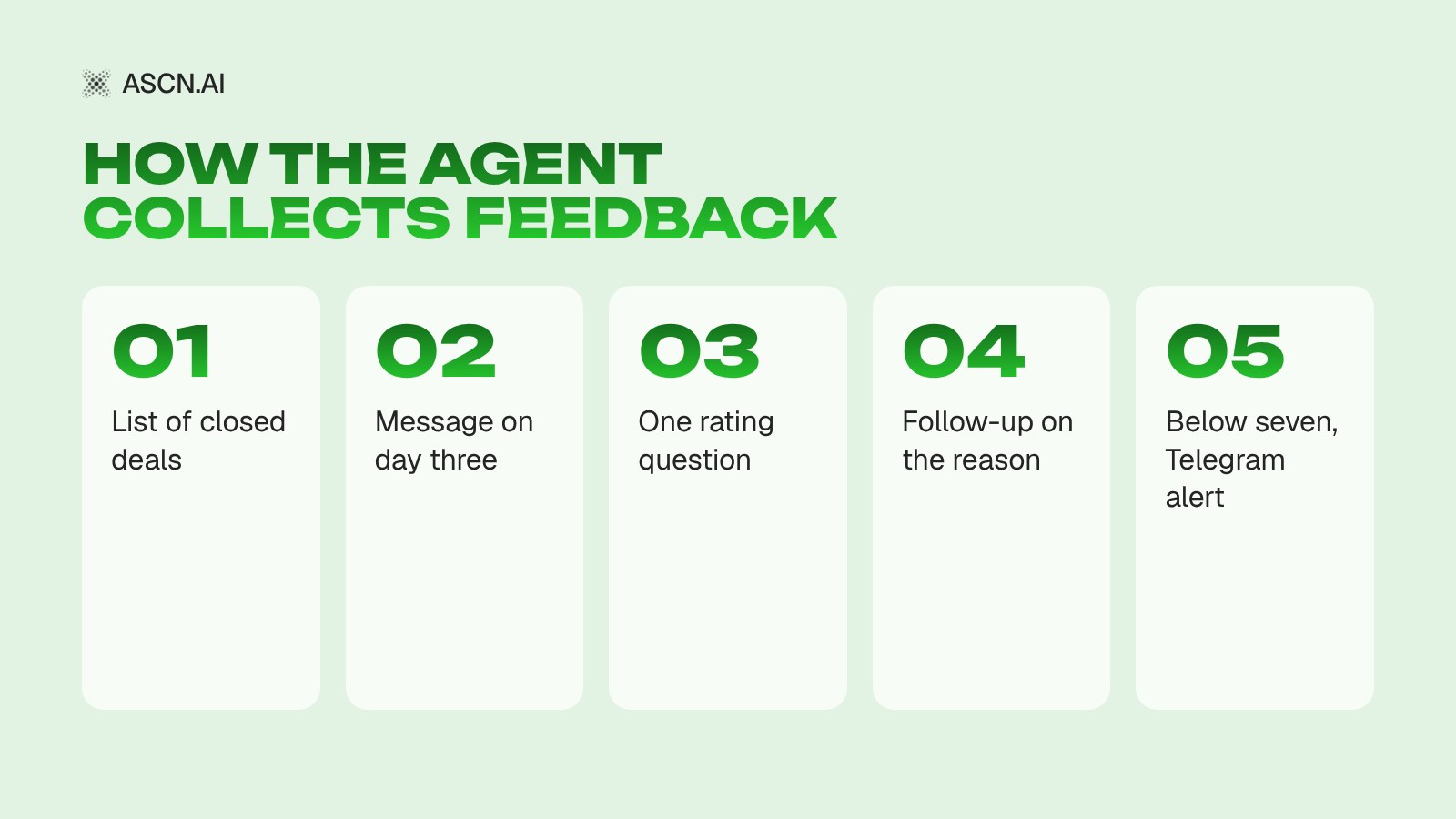
The spreadsheet holds closed deals: customer, contact, date, what they bought, who owned it. Each morning the agent picks everyone three days past the deal date and sends them one message.
There should be exactly one question. A score from one to ten, or a simple "was everything alright" — then the agent follows up on the reason once and stops. A long questionnaire in a messenger kills the response rate.
Scores go into the spreadsheet with the text. Anything below seven goes to Telegram immediately, with the customer's name, the owner and the complaint. That is the only part of the setup that needs urgency.
What to connect
| Component | Purpose | Required |
|---|---|---|
| Google Sheets | Deals and customer answers | Yes |
| Telegram | Survey and negative alerts | Yes |
| Scheduled task | Daily sending | Yes |
| Gmail | Email survey where there is no messenger | No |
| Google Docs | Monthly summary of reasons | No |
The source of deals is your spreadsheet. There is no documented direct CRM integration, so the list is exported on your side or kept by hand.
Building it in five steps
- Set up a deals table: customer, contact, close date, item, owner, score, comment, status.
- Create the agent and connect Google Sheets.
- Write one question. Not three. Spend time on it: the wording decides whether a third of customers answer or one in twenty.
- Connect Telegram and set the alert threshold. Seven out of ten is a reasonable line; below it the message goes to the owner immediately.
- Schedule the daily task and mark every send, so nobody gets surveyed twice.
The spreadsheet-driven reminder logic is the same as in the case on AI agents in B2B sales, and handling public reviews is covered in the hotel concierge case.
What you get
A worked example. Assumptions: 120 deals closed a month, no survey at all today, about ten public reviews a month of which three are negative.
| Metric | Without the agent | With the agent |
|---|---|---|
| Customers surveyed | 0 | 120 a month |
| Complaints learned from | public reviews | day three |
| Reasons for leaving | guesswork | a list in the sheet |
| Staff time | - | spent handling complaints |
This is a calculation on assumptions, not a measurement. There is no time saving here at all; quite the opposite, you acquire work handling complaints. The value is that the work starts before the public review rather than after.
Where this breaks
If nobody acts on complaints, the survey is worse than no survey. A customer who was asked and then ignored gets angrier than one who was never asked. Decide who handles the alerts, and how fast, before you launch.
The second limit is frequency. You cannot survey after every purchase: with regular orders, once a quarter is plenty, otherwise people stop answering.
Frequently asked questions
How many days after the deal?
Three days after closing works for most niches. If the product has to be unpacked and assembled, a week is better.
What response rate is normal?
It depends on the channel and the wording. One short question in a messenger gets noticeably more answers than a linked form, but you only learn your own number after the first month.
Does the agent answer complaints itself?
No. It records the score, follows up on the reason and hands it to the owner. An automated reply to dissatisfaction reads as a brush-off.
Can it ask for a public review?
Yes, but only from people who gave a high score, and in a separate message. Asking for a review inside the survey turns the survey into a marketing campaign.
What do you do with the collected answers?
Group the reasons behind low scores once a month. Usually three quarters of the complaints turn out to come from two or three repeating scenarios, and those are what to fix.
The bottom line
Feedback is useful for the reason, not the score. The agent asks one question at the right moment, keeps the answers in one place and stops dissatisfaction from reaching a public review unnoticed. People still have to handle the complaints, but now they get the chance to.
Ready-made survey and reminder agents are in the ASCN marketplace. For help setting one up around your deals, message a manager on Telegram.
AI Chatbot for Hotels: A Country Club Case and 40% Ancillary Revenue Growth
AI Agent for Real Estate: An Agency Case and 2-Minute Lead Qualification
AI Agent for a Travel Agency: Doubling Sales on the Same Budget
AI Chatbot for Clinics: Cutting Patient Acquisition Cost Threefold
AI Agents in B2B Sales: A Case of Conversion Growth from 12% to 34%
AI Agent for Email: The Complete Guide to Email Automation