



- Русский
- English
- Português
AI Agent for Competitor Price Monitoring: Daily Sweeps and Alerts

An AI agent for competitor price monitoring answers a question most companies ask once a quarter and should ask every day: are we above or below the market right now?
Usually it comes out in hindsight. Sales dip, someone investigates, opens the competitors' sites, and finds they cut the price on a top seller two weeks ago. For two weeks you were selling above market and did not know.
The short version
An AI agent for price monitoring sweeps competitors' product pages each morning, records prices in a spreadsheet next to yours and sends only the changes to Telegram: where you are now more expensive, where a competitor pulled an item, where a promotion appeared. A human decides on your own price. You need Google Sheets, Telegram and a scheduled task.
Contents:
- What exactly the agent tracks
- How the sweep works
- What to connect
- Building it in five steps
- What it saves
- Limits worth knowing up front
- Frequently asked questions
What an AI agent for price monitoring tracks
Tracking everything is pointless: a competitor has a thousand items, a hundred overlap with yours, and twenty move your revenue. The monitoring list is built once and holds your top sellers plus links to their equivalents at two or three competitors.
From each link the agent takes three things: price, availability and any promotion flag. That is enough to catch both an outright price cut and a hidden one, where the price is unchanged but a bulk discount has appeared.
How the sweep works
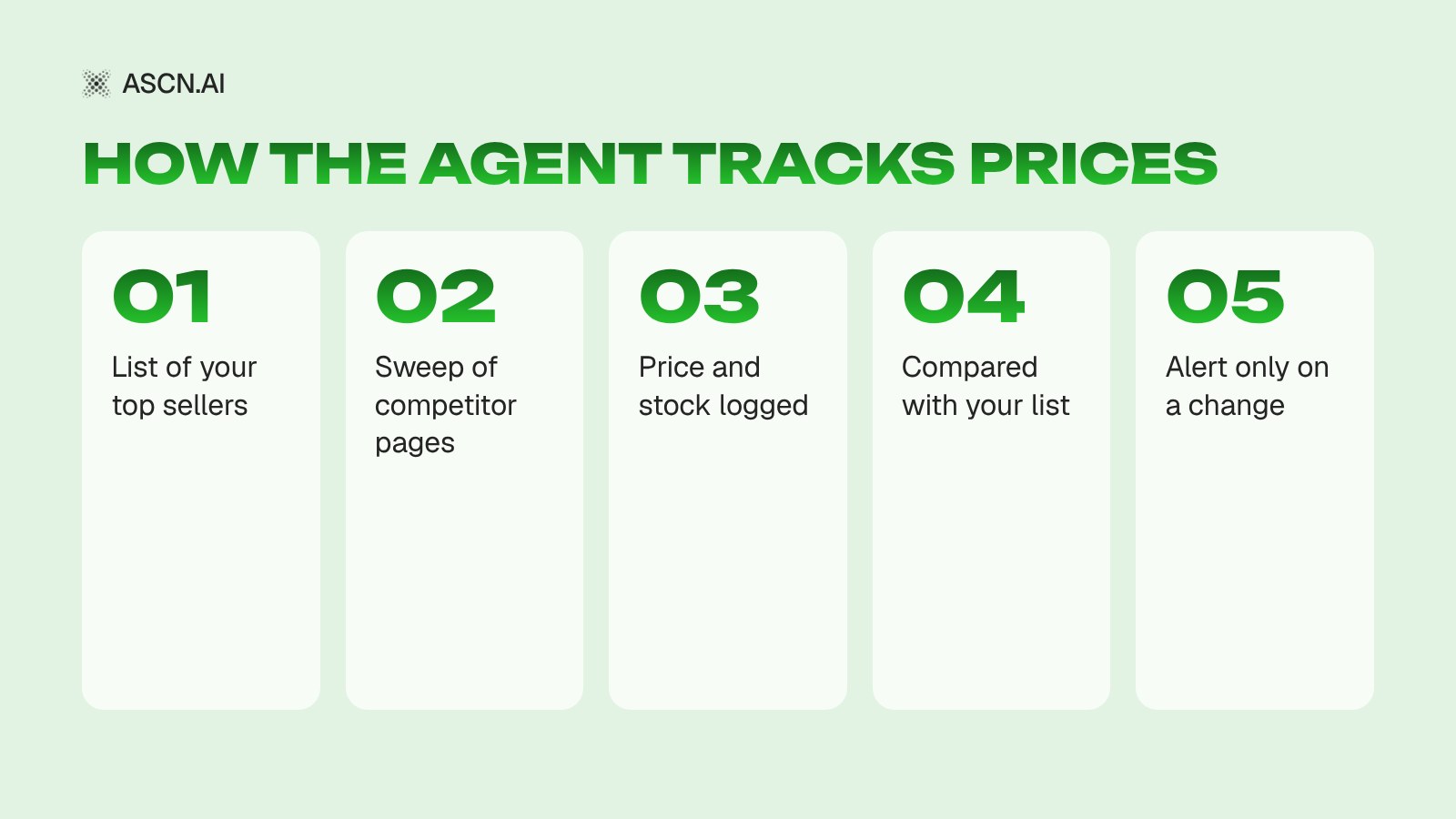
The spreadsheet is simple: one row per product, columns for your price and each competitor's, plus the date of the last check. The agent walks the list of links, updates the values and compares them with your price.
Telegram gets the delta, not the full report. A message arrives when the gap to a competitor passes your threshold, when a price moves by more than a few percent, or when an item goes out of stock. A competitor running out of stock is as much a signal as a price cut, just one in your favour.
Price history accumulates in the same sheet. After a couple of months you can see who plays with price constantly and who holds their list price and only discounts during promotions.
What to connect
| Component | Purpose | Required |
|---|---|---|
| Page reading | Pull prices from product pages | Yes, works out of the box |
| Google Sheets | Price list, competitor prices, history | Yes |
| Telegram | Change alerts | Yes |
| Scheduled task | Daily sweep | Yes |
| Gmail | Weekly summary | No |
Your own price list has to live in the same spreadsheet and stay current. Otherwise the agent compares competitors against stale data and sends false alarms.
Building it in five steps
- Pick the twenty or thirty items that drive most of your revenue. Starting with the full catalogue makes the sweep slow and the output less useful.
- Collect links to the equivalents at two or three competitors. This is a couple of hours of manual work, done once.
- Create the agent and connect Google Sheets with your price list and the links.
- Set thresholds: what percentage gap triggers an alert and what counts as a meaningful price move. Without thresholds you get a hundred messages a day.
- Schedule the morning task and ask for changes since the last check only.
A similar pattern of regular sweeps and digests appears in the piece on AI agents for marketplaces.
The general assembly principles are in the guide to building AI agents without code.
What it saves
A worked example. Assumptions: 25 tracked items, three competitors, a manual check taking two hours and happening once a fortnight.
| Metric | Manual | With the agent |
|---|---|---|
| Check frequency | every two weeks | daily |
| Manager time | 4 hours a month | 15 minutes on alerts |
| Reaction to a price cut | up to 14 days | next morning |
| Price history | none | accumulating |
This rests on the assumptions above. The gain is not the hours saved but the shorter window: you learn about a price cut the next day instead of after two weeks of selling against a stale list.
Limits worth knowing up front
Some sites sit behind a bot check and the agent cannot read them. That shows up on the first run, and those items stay on manual review.
A shelf price is not a deal price. In B2B the real number lives in a quote with volume discounts, and monitoring the public page shows only the ceiling.
Above all: the agent shows numbers, it does not decide whether to cut your price. That is a question of margin and positioning, not of data.
Frequently asked questions
Is this legal?
The agent reads publicly available pages exactly as any site visitor does. That is not the same as bulk-extracting a database: a daily sweep of thirty pages puts about as much load on a site as ordinary browsing.
How often should it check?
Once a day is enough for most niches. More often makes sense during sale seasons or when competitors change prices intraday.
What if a competitor shows no price?
Then that item does not suit monitoring. Better to drop the row than keep an empty column and check it by hand every week.
How many items can one agent handle?
The limit is sweep duration, not item count. Thirty items across three competitors runs comfortably; several hundred stretches the sweep and has to be split across days.
Can it track marketplaces?
Product pages read like any others. But marketplace prices change more often and depend on the seller, so each row should be tied to a specific seller rather than to the product in general.
The bottom line
Price monitoring is work where regularity decides everything: quarterly is useless, and nobody will do it daily by hand. The agent covers exactly that, walking the list every morning, writing only when something moved, and building the history that shows how competitors behave.
Ready-made monitoring and digest agents are in the ASCN marketplace. For help setting one up around your price list, message a manager on Telegram.

AI Chatbot for Hotels: A Country Club Case and 40% Ancillary Revenue Growth

AI Agent for Real Estate: An Agency Case and 2-Minute Lead Qualification
AI Chatbot for Logistics: A Trucking Case and 75% Fewer Calls

AI Agents in B2B Sales: A Case of Conversion Growth from 12% to 34%
AI Agents for Inventory Management: Automation Solutions and Key Benefits

AI Agent for Email: The Complete Guide to Email Automation