



- Русский
- English
- Português
SALT Cryptocurrency Price Forecast: Current Price and Outlook for Today and the Future

about cryptocurrencies.
Got questions about the crypto market? Our AI assistant can help you cut through the noise. Start your analysis right here.
| Year | Low (USD) | Average (USD) | High (USD) | Notes & Sources |
|---|---|---|---|---|
| 2025 | 0.0071 | 0.0133 | 0.0306 | Conservative outlook based on TA; ignored a $11.88 outlier from CoinLore. |
| 2026 | 0.0022 | 0.0053 | 0.0066 | Expected dip due to market volatility; mild bull signals from recent conferences. |
| 2027 | 0.0030 | 0.0070 | 0.0120 | Growth driven by regulatory clarity; data via DigitalCoinPrice. |
| 2028 | 0.0040 | 0.0085 | 0.0150 | Price stabilization phase; projections from TradingBeasts. |
| 2029 | 0.0050 | 0.0100 | 0.0200 | Movements likely tied to BTC cycles; source: CoinDataFlow. |
| 2030 | 0.0233 | 0.0427 | 0.0621 | Long-term upward trend; data consensus from CoinLore. |
| 2035 | 0.0314 | 0.0428 | 0.1908 | Optimistic "mass adoption" scenario; minimums reflect potential stagnation. |
Here is what the ASCN.AI assistant thinks about SALT’s trajectory:
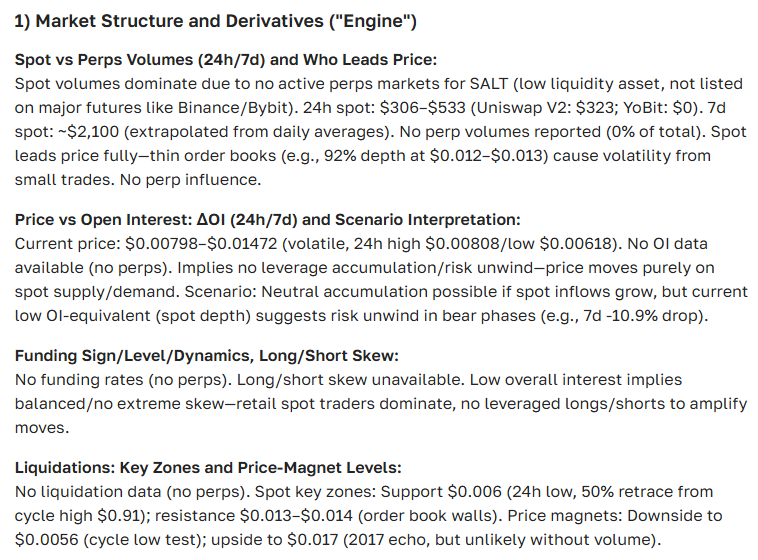
“A price prediction for SALT isn't just a set of numbers; it’s an investment perspective built on market dynamics and core fundamentals. It is a tool for making sense of the chaos in the fast-moving crypto space.”
Where does SALT stand right now?
If you're watching the charts today, SALT's price action is a classic mirror of broader market jitters. The current rate against the dollar is shaped by a mix of internal demand and external sentiment. For traders, it’s about figuring out the immediate value while trying to spot where the coin might head in the next few sessions.

Staying on top of real-time shifts is key. It helps you see if SALT is just caught in a temporary swing or if it’s building up momentum for a more serious move up—or down.
Checking the recent pulse (Hourly, Daily, Weekly)
The price of SALT moves as the market mood shifts. In the last few hours, we’ve seen the typical back-and-forth that defines smaller altcoins. Sometimes the market "rips"—meaning we see those sudden, aggressive spikes—and other times it just drifts.
| Period | SALT Price (USD) | Change (%) |
|---|---|---|
| Last Hour | $0.0081 | -1.15% |
| Last 24 Hours | $0.00814 | -1.15% |
| Last 7 Days | $0.00812 | -0.21% |
This breakdown gives a clearer picture of when to step in. It’s all about catching those support levels or seeing if the asset is hitting a wall at resistance.
So, what’s the deal with “ripping”?
In the crypto world, when someone says a coin is “ripping,” they aren't talking about something breaking. It’s slang for a sudden, high-velocity price move over a very short window. These moves are the bread and butter of day traders—huge volatility that offers big wins, but also carries the risk of getting caught on the wrong side of the trade.
For SALT, a “rip” usually happens when the coin breaks out of its usual range, often sparked by a news headline, a whale entering the room, or a sudden shift in global sentiment.
Looking ahead: Growth or just another correction?
Short-term forecasts for SALT rely heavily on current trends, news cycles, and on-chain data. Looking at the blockchain activity gives us a "behind the scenes" view of what participants are actually doing. Right now, the outlook suggests a mix of moderate gains or slight pullbacks, depending on how the big players react to the latest headlines.
Watching these metrics is crucial because it allows you to adapt before the rest of the market catches on.
The monthly outlook
Over the next month, SALT’s performance will likely be tied to seasonal shifts, the macro-economy, and whether the project rolls out any tech updates. New partnerships are often the catalyst that pushes the price higher, provided the overall market stays relatively healthy.
Mid-term trends are a bit of a balancing act between technical innovation and general market noise. It's something to watch closely if you're not planning to hold forever.
Read more on how partnerships and tech shifts move the needle for coins like SALT.
Is it worth holding for the long haul?
Long-term investing in SALT requires looking past the daily charts and focusing on the project's fundamentals. Is the community growing? Is the ecosystem expanding? If the project can clear its technical hurdles and find its niche, the door for sustainable growth stays open.
But let’s be real: long-term plays require patience and a thick skin for global market swings.
“SALT has the potential for steady growth, provided it continues to integrate into the DeFi landscape and keeps its tech stack fresh.”
News and events that move the needle
Headlines are the primary fuel for SALT’s price. Whether it’s a new collaboration or a protocol upgrade, positive news tends to create a temporary "hype" cycle. Understanding how the market reacts to these events makes any forecast much more reliable.
The bigger macro picture
Politics and macroeconomics haven't ignored crypto. Regulatory shifts, sanctions, or even geopolitical tension can send ripples through the entire market. SALT isn't immune to this; when the global economy sneezes, altcoins often catch a cold.
Keeping an eye on these factors helps you build a more balanced strategy and manage your risk effectively.
How regulatory changes are reshaping the crypto landscape.
What the community is saying
Check any crypto forum, and you’ll find plenty of debate over where SALT is headed. Users are constantly dissecting data, trying to figure out when the next “rip” might happen or if the token is showing signs of long-term resilience.
What are the experts suggesting?
The general consensus among seasoned traders often points to finding the right entry points—usually right after a correction or when a new trend is confirmed. This "wait and see" approach is often safer than chasing a pump.
Frequently Asked Questions (FAQ)
What actually drives the SALT price?
It’s a mix. You’ve got project news, market trends, and the whales (large investors). Beyond that, global economic factors and internal tech updates play a massive role. Basically, it’s a combination of on-chain data and external reality.
Can you really predict if it will go up or down?
Predicting is never 100%, but you can get close by combining technical indicators, trading volume, and sentiment analysis. When you look at blockchain data alongside news, the picture becomes much clearer.
What does it mean to “rip”?
It’s just trader talk for a price that’s moving fast and hard, breaking out of its normal daily fluctuations.
The bottom line for investors
The outlook for SALT suggests there is room for growth, but only if the news remains positive and the market stays stable. It’s smart to keep an eye on real-time data and use reliable tools to stay ahead of the curve.
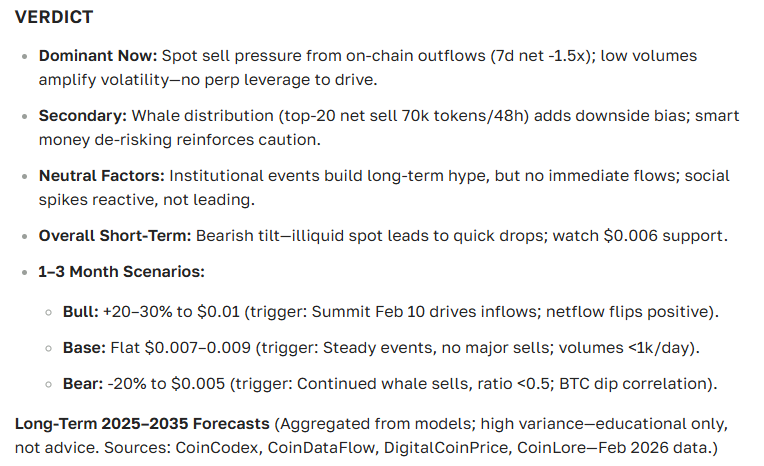
While the volatility makes it a risky bet in the short term, a disciplined approach can reveal some solid long-term opportunities. By the way, if you want a second opinion, here’s the verdict from our AI assistant, ASCN.AI:
Real-world Case: Navigating the Falcon Finance (FF) crash
Back in October 2024, when Falcon Finance took a nosedive, ASCN.AI was a lifesaver for many. By identifying critical support levels in real-time, traders were able to exit their positions before things got worse. In just two queries, some users managed to save over $1,000 in potential losses. It just goes to show how having the right data at the right time matters.
Read the full ASCN.AI case study on the Falcon Finance flash crash.
Disclaimer
This information is for general purposes only and is not financial advice. Crypto investments are high-risk. Always talk to a professional before putting your money on the line.