



- Русский
- English
- Português
Claude vs ChatGPT (2026): Models, Pricing and Which One to Pick for Your Work

Claude vs ChatGPT in one line: pick ChatGPT if you want one assistant for everything, pick Claude if most of your work is long documents and code. ChatGPT covers more ground. It generates images, offers unlimited voice on Pro, has an $8 Go plan, and gives free users unlimited text chats with GPT-6. Claude holds more text at once (up to 1M tokens on every plan, versus 54K or 256K on ChatGPT Plus depending on the mode) and includes Claude Code and scheduled tasks in the $20 Pro plan. Every model name, price and feature below comes from OpenAI's and Anthropic's official pages, checked in November 2026.
Contents:
- Quick answer
- Comparison table
- Models as of November 2026
- Context window and files
- Writing
- Coding
- Web search and research
- Images, video and voice
- Integrations and agents
- Free plan and pricing
- Privacy
- Weak spots
- Which one to pick for your task
- What if you need both
- FAQ
- Bottom line
Quick answer: Claude vs ChatGPT
Neither wins every category, and the main paid plans cost the same $20 a month. The right choice depends on what you hand to AI most often.
- Long contracts, reports, books and data exports: Claude, with up to 1M tokens of context even on the free plan.
- Coding: both ship a coding agent. OpenAI's Codex works on the free plan with limits, Claude Code starts at Pro.
- Images and voice: ChatGPT. Image generation is not on Claude's feature list.
- Free or cheap use: ChatGPT, with unlimited text chats on Free and the $8 Go plan.
- Scheduled background tasks: Claude has them in the $20 Pro plan. ChatGPT's always-on agent, Dot, needs Pro at $100 or more.
- Both at once: ASCN.ai puts Claude, GPT, Gemini and other models (10+ in total) in one subscription, with a personal AI assistant that runs on its own cloud computer and does the work for you.
Claude vs ChatGPT comparison table
| Criterion | Claude | ChatGPT |
|---|---|---|
| Models (Nov 2026) | Fable 5.2, Opus 5.5, Sonnet 5.5, Haiku 5.5 | GPT-6 (Luna, Sol, Astra), GPT-6.1 Sol, GPT-6.2 in Work and Codex |
| Context window | Up to 1M tokens | 27K–128K, up to 400K for reasoning |
| Coding | Claude Code from Pro | Codex from Free (limited) |
| Writing | Strong | Strong |
| Web search | Free plan | Free plan |
| Deep research | Research from Pro | From Free (limited) |
| Images | Not listed | Yes, gpt-image-2 |
| Video | Not listed | Not listed |
| Voice | All plans | Limited on Free, unlimited on Pro |
| Files | Creates and edits files with code | Uploads and data analysis |
| Integrations and agents | Connectors, Chrome, Microsoft 365 | Plugins, ChatGPT Work, Dots on Pro |
| Free plan | Sonnet and Haiku, 5-hour limit | Unlimited text chats with GPT-6 |
| Paid plans | $20, $100, $200 | $8, $20, $100–500 |
| Training on your chats | Opt-out | Opt-out |
Sources: claude.com/pricing, chatgpt.com/pricing, and Anthropic and OpenAI documentation, checked November 19, 2026. Prices in USD, billed monthly, before tax.
Models as of November 2026
Anthropic's current lineup has four models. It recommends Claude Opus 5.5 as the starting point for most work, especially long-running agentic coding and knowledge work. Claude Fable 5.2 is aimed at the hardest reasoning and long multi-step tasks, Sonnet 5.5 balances speed and quality, and Haiku 5.5 is the fastest. All four take text and images as input and answer in text.
ChatGPT runs on the GPT-6 family: Luna for focused, repeatable tasks, Sol and GPT-6.1 Sol for everyday work, and Astra for complex problems. Paid plans also get GPT-6.2 Sol and GPT-6.2 Astra inside ChatGPT Work and Codex. ChatGPT can pick the model for you, and higher plans give you more options.
What you actually get depends on the plan more than the marketing suggests. Free Claude has Sonnet and Haiku but no Opus. Fable costs extra usage credits on Pro and is included on Max up to half of the weekly limit. On ChatGPT, Pro reasoning with GPT-6 Astra is a Pro-only feature.
Verdict: the models are at a similar level, so the plan matters more than the brand. If Google is also on your list, read our Gemini vs ChatGPT comparison.
Context window and files
The context window is how much text the model sees at once: the chat, uploaded files and instructions. Every current Claude model offers up to 1M tokens, which Anthropic puts at roughly 555,000 words. A 300-page contract, a quarter of CRM exports or several book chapters fit in a single request.
ChatGPT counts context separately for its fast mode and its reasoning mode. The fast mode holds 27K tokens on Free, 54K on Go and Plus, and 128K on Pro. In reasoning mode Plus gets 256K (about 320 pages, according to OpenAI) and Pro gets 400K. That covers most work files. The gap shows up when you upload several large documents and ask the model to cross-check them.
Both create and edit files. Claude writes and runs code on every plan to build a spreadsheet, document or deck. ChatGPT has data analysis, file uploads and extensions for Excel, Word, PowerPoint and Google Sheets, though uploads are limited on Free.
Verdict: Claude, when the documents are big and there are many of them.
Writing
At this level, the models differ more in style than in raw writing quality. Neither vendor publishes a head-to-head writing test of Claude Opus 5.5 against GPT-6, so we won't quote scores. In practice three things decide it: how much source material the model can see at once, how well it keeps your tone, and how many edits you make afterward.
Claude has the edge on the first point because of its context window. You can load your whole blog archive, style guide and brief, and the model works from all of it. ChatGPT has memory across chats, projects and custom GPTs, which make it easy to store instructions once. Claude also has memory and projects, up to five projects on the free plan.
The fastest way to decide is to give both the same real task, such as rewriting a sales proposal in your template, and time how long the edits take.
Verdict: it depends on your text. Long pieces built from many sources are easier in Claude.
Coding
Both companies ship a dedicated coding agent that reads a repository, edits files, runs tests and proposes changes. Anthropic's is Claude Code, included in Pro, Max and Ultra and missing from the free plan. OpenAI's is Codex, with limited access on Free and Go, more on Plus and longer sessions on Pro. OpenAI recommends GPT-6.2 Astra for hard jobs such as tracing a bug across services, and GPT-6.2 Sol for everyday code edits.
Both meter usage in five-hour windows with a weekly cap. Claude Max raises the limit to 5x Pro, and Ultra removes the five-hour limit. ChatGPT Pro currently has no five-hour limit in Codex, and the $500 tier adds Ultrafast mode.
Verdict: only Codex can be tried for free. For a real project, run both on your own repository. For more options, see our ranking of the best AI coding agents.
Web search and research
Both include web search on the free plan. The difference is deep research, where the model reads dozens of sources and writes a report. ChatGPT offers deep research on Free with limits, more on Plus and the most on Pro. Claude's Research feature starts at Pro.
ChatGPT lets you connect apps to deep research and has a Study mode for learning. Claude Pro adds Claude Science for research work and Claude in Chrome, which works inside your browser.
Verdict: ChatGPT, if you want research without paying.
Images, video and voice
This is the clearest gap. ChatGPT creates and edits images with its built-in gpt-image-2 model, limited on Free and unlimited and faster on Pro. Claude's plans don't include image generation. Claude Design, Slides and Docs handle layouts, slides and documents, but Claude won't draw an illustration from a prompt. Neither plan list mentions video generation.
You can talk to both. ChatGPT Voice runs on GPT-Live, with limits on Free and Go, no limit on Pro, and a voice-with-video mode. Claude's voice mode is on every plan.
Verdict: ChatGPT. If you make images often, compare dedicated tools in our guide to the best AI image generators.
Integrations and agents
Both products are moving from chat toward assistants that work in the background. Claude connects apps through connectors on every plan, and from Pro it can take tasks and run them on a schedule, work in Chrome, and work inside Microsoft 365 and Outlook.
ChatGPT has plugins, office extensions and ChatGPT Work, a workspace for long tasks. Scheduled tasks are part of Plus. Its most advanced feature, Dot, is Pro-only: an always-on agent with its own cloud computer and browser that you can message in ChatGPT or Slack, or call.
Verdict: Claude on entry price, ChatGPT on what the top plan can do.
Free plan and pricing
Free ChatGPT gives you more volume: unlimited text chats with GPT-6 (with abuse guardrails), plus limited images, voice, research and Codex. Free Claude gives you Sonnet and Haiku with a limit that resets every five hours and a weekly cap. It already includes web search, memory, connectors, file creation and the 1M-token context.
| Tier | Claude | ChatGPT |
|---|---|---|
| Free | Free, $0 | Free, $0 |
| Entry | None | Go, $8 |
| Main | Pro, $20 ($17 annual) | Plus, $20 |
| Power | Max, $100 | Pro, $100 |
| Top | Ultra, $200 | Pro, $200 or $500 |
| Teams | Team, $25/seat ($20 annual) | Business, $25/user ($20 annual) |
Claude Pro costs $17 a month on the annual plan, with $200 billed up front. Max and Ultra include $100 and $200 a month in API credits. ChatGPT Pro comes in three usage tiers at $100, $200 and $500, each with API credits. OpenAI notes that the Go plan may include ads.
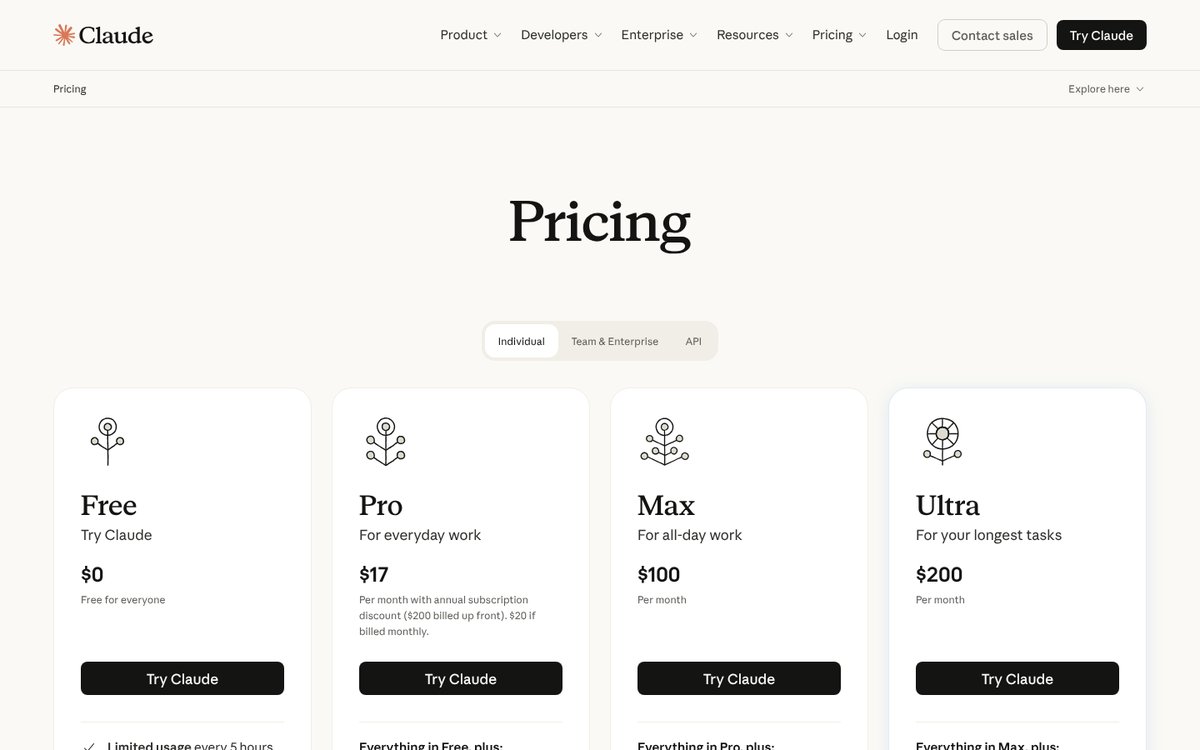
Claude plans: Free, Pro, Max and Ultra. Screenshot of claude.com/pricing, November 2026.
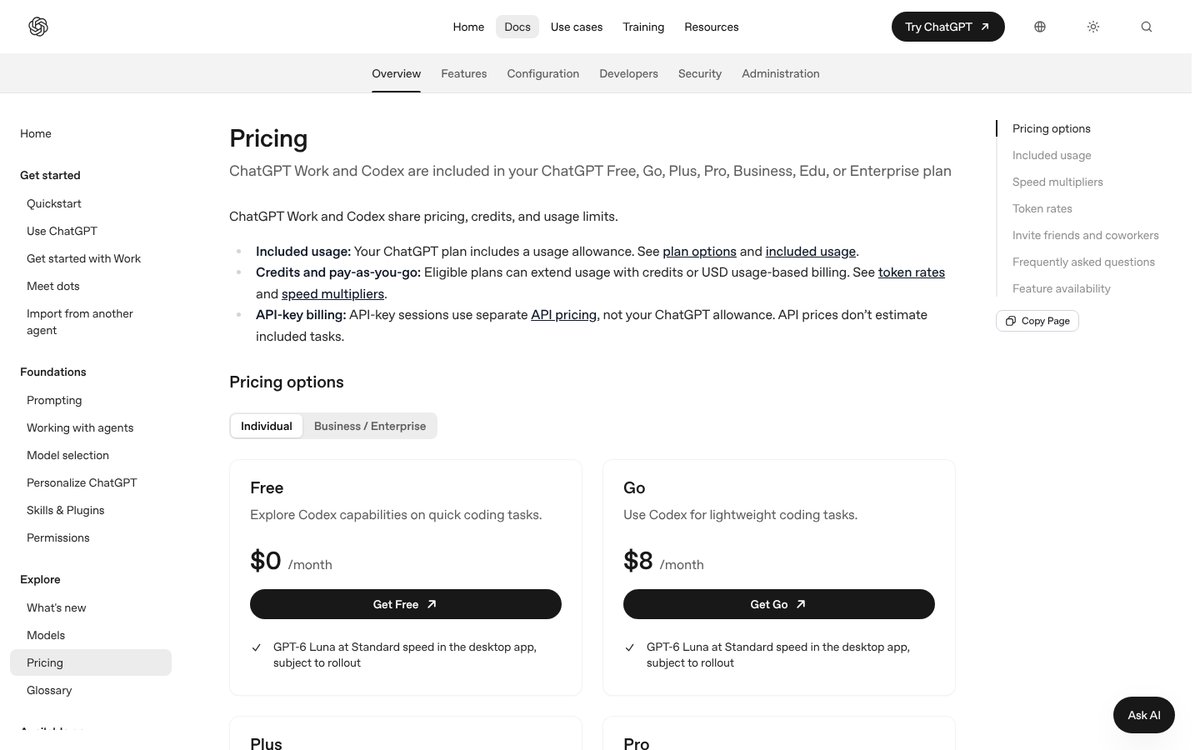
ChatGPT plans: Free $0, Go $8, Plus $20, Pro from $100. Screenshot of OpenAI's ChatGPT documentation, November 2026.
Verdict: ChatGPT for free and low-cost access, Claude if you pay annually.
Privacy
On personal plans, both companies may use your chats to train models, and both let you opt out in settings. Team plans work differently. Claude Team doesn't train on your content by default, and OpenAI says the same for ChatGPT Business and Enterprise data. If you upload client contracts or financials, use a team plan or check the setting before the first upload.
Verdict: a tie.
Weak spots
Claude
- No image or video generation.
- The free plan resets every five hours, has a weekly cap and no Opus.
- Claude Code and Research require Pro.
- No plan under $20.
ChatGPT
- Smaller fast-mode context on Free and Plus: 27K and 54K tokens.
- The Dot agent and Pro reasoning require Pro at $100 or more.
- The Go plan may show ads.
- Lots of similarly named models, so it takes effort to see what your plan includes.
Which one to pick for your task
| If you need to | Pick | Why |
|---|---|---|
| Review a long contract or report | Claude | Up to 1M tokens |
| Make an image for a post | ChatGPT | Built-in gpt-image-2 |
| Use it free every day | ChatGPT | Unlimited text chats |
| Code in your own repo | Test both | Claude Code and Codex |
| Schedule tasks for $20 | Claude | Included in Pro |
| Talk by voice all day | ChatGPT Pro | Unlimited voice |
| Use different models for different jobs | ASCN.ai | Claude, GPT, Gemini in one plan |
If you're choosing among all the major models rather than these two, start with our overview of the best AI models of 2026.
What if you need both: ASCN.ai
Plenty of people end up paying for both: Claude for long documents, ChatGPT for images and quick questions. That's $40 a month, two chat histories and a lot of copy and paste. There is a simpler setup.
ASCN.AI gives you a personal AI assistant with its own cloud computer. It carries out tasks on its own: finding information, working with documents, helping with sales and marketing. You don't install anything, write code or set up servers. One subscription covers 10+ models, including Claude, GPT, Gemini, DeepSeek, Qwen, Kimi and Xiaomi MiMo, and you can switch an agent's model in one click. For images and video it connects Nano Banana, Veo, Kling and Seedance.
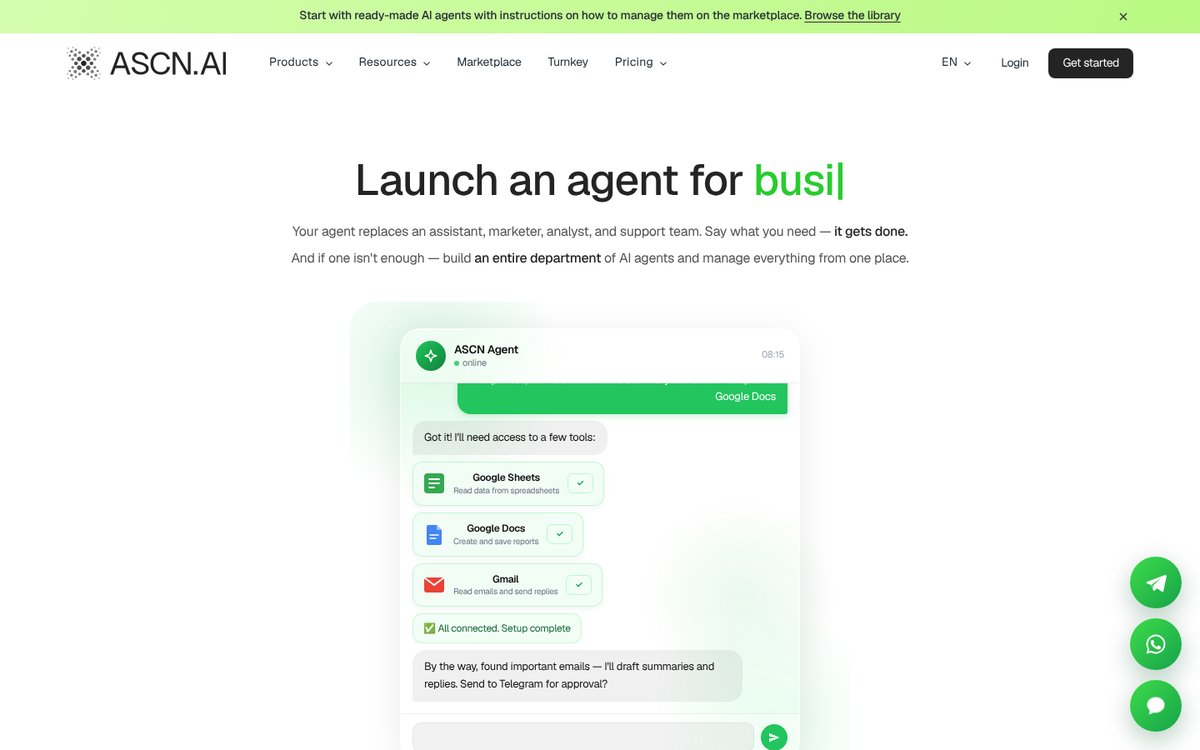
ASCN Agent connects Google Sheets, Docs and Gmail on its own. Screenshot of ascn.ai/agent, November 2026.
The difference from a chat app is that the assistant finishes the job. It runs on a schedule or on triggers, connects to 3,000+ services from Gmail and Google Sheets to your CRM, and reports back in Slack, Telegram or WhatsApp. The platform has 100+ ready-made AI agents: pick one or describe your own in plain words. For example, one agent on Claude reads your inbox every morning and sends a summary, while another prepares post covers from your content plan with Nano Banana.
The free plan includes 500 credits a week and one active agent, and paid plans start at $29 a month. We cover other services that bundle several models in our review of AI aggregators.
Good to know: credit usage depends on the model and the length of the task, and larger models use more.
Frequently asked questions
Is Claude better than ChatGPT?
Not across the board. Claude is better for long documents and code thanks to its 1M-token context and Claude Code in Pro. ChatGPT is better when you need images, voice and a free plan without a tight message cap. The main paid plans cost the same, $20 a month.
Claude or ChatGPT for coding?
Both work, and each has its own agent: Claude Code from the Pro plan, and Codex, which is available with limits even on free ChatGPT. OpenAI recommends GPT-6.2 Astra for hard tasks, and Anthropic recommends Claude Opus 5.5. The best test is the same task in your own repository.
Are Claude and ChatGPT free?
Both have free plans. Free ChatGPT gives unlimited text chats with GPT-6 plus limited images, voice and deep research. Free Claude gives Sonnet and Haiku with a five-hour usage limit, web search, memory and up to five projects.
Can Claude generate images?
No. Image generation isn't part of Claude's plans: the models take text and images as input and reply in text. Claude Design and Slides cover layouts. For illustrations from a prompt, use ChatGPT or a dedicated image generator.
How much do Claude and ChatGPT cost?
The main plans cost the same: Claude Pro and ChatGPT Plus are $20 a month each. Claude Pro drops to $17 a month on an annual plan. ChatGPT also has Go at $8, and both have power tiers from $100 to $200, with ChatGPT Pro going up to $500.
Can I use Claude and ChatGPT in one subscription?
Yes, with ASCN.ai. One subscription includes 10+ models, among them Claude, GPT and Gemini, and you can switch an agent's model in one click. Paid plans start at $29 a month, and there's a free plan.
Bottom line
If your work is long documents, contracts and code, start with Claude Pro. If you want an all-round assistant with images and voice, or you'd rather not pay at all, go with ChatGPT. If your tasks vary and you don't want two subscriptions and constant switching, put everything in one place: sign up for ASCN.ai for free and pick a ready-made agent on the ASCN Agent page.
Best AI Coding Agents in 2026: Rating, Comparison, and Practical Guide
Is There an AI Better Than GPT? A Comprehensive Comparison of the 2026 Leaders
The Best AI for Image Generation: A 2026 Ranking and Comparison of Neural Networks