



- Русский
- English
- Português
AI Neural Network for Data Analysis: Best Tools and Practices 2026
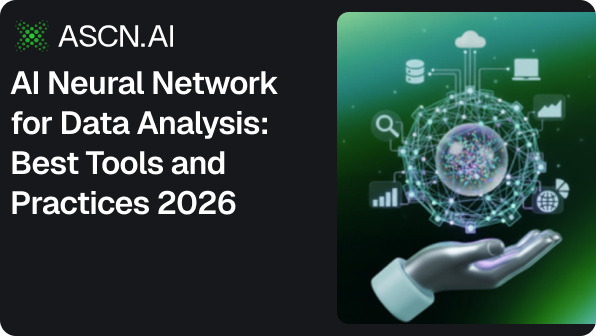

“AI for data analysis isn’t just another buzzword you can ignore—it’s a practical fix for the information overload we all face. It’s about making accurate calls in seconds, not hours,” the team at ASCN.AI points out.
So, what’s the big deal with AI in data?
At its core, a neural network is a bit like a digital mimic of the human brain. It doesn't just "run code"; it learns from massive piles of data, spots patterns that would give a human a headache, and makes educated guesses about what’s coming next.

When people talk about AI in analytics, they’re usually referring to models that can chew through complex datasets, automate the boring stuff, and help you make decisions based on logic rather than gut feeling. We’re moving past simple algorithms and into the era of intelligent platforms that actually "understand" the context.
How it actually works (minus the jargon)
The magic happens through machine and deep learning. You feed the model data, it figures out how different variables talk to each other, and then it builds a roadmap for predictions or classifications.
The workflow is pretty straightforward: you put data in, the neural net processes it, and you get results and recommendations out. But here’s the kicker—AI gets better over time. It adapts. It learns from its own mistakes to sharpen its accuracy.
Deep learning takes it a step further by using multi-layered networks to dig up "hidden" patterns. These are the kinds of insights traditional spreadsheets could never dream of finding.
“Deep learning uses those layered networks to pull out complex patterns that usually stay buried in the noise.”
What can it actually do for you?
In practice, it looks like this:
- Automating the heavy lifting of data processing.
- Sniffing out hidden trends or weird anomalies.
- Forecasting based on historical stats and system behavior.
- Merging data from five different sources into one clear picture.
For an analyst, this is essentially a superpower. It cuts down on human error and takes the guesswork out of high-stakes business moves.
“With ASCN.AI, we’ve seen firsthand how AI handles complex Web3 data. Honestly, doing this manually would be impossible; you need specialized neural nets to keep up with that kind of speed,” — the ASCN.AI team.
Where do people actually use this stuff?
AI isn't just for Silicon Valley labs anymore. It’s everywhere:
- Business: Killing the manual report, optimizing workflows, and figuring out what customers actually want.
- Finance: Predicting market shifts and catching fraudsters before they disappear.
- Science: Sifting through experimental results to find the next big breakthrough.
- Medicine: Looking at X-rays or scans to catch things the human eye might miss.
- Crypto and Web3: Keeping an eye on on-chain moves and gauging market sentiment in real-time.
The goals change depending on the industry, but the result is the same: faster, sharper, and way more efficient.
Real-world wins: A few success stories
Take ASCN.AI as an example. It saves traders and analysts hours of manual digging by serving up deep insights in a couple of heartbeats. Remember the Falcon Finance (FF) crash? By leaning on AI, users were able to spot the red flags early and dodge heavy losses—we’re talking saving over $1,000 with just two simple prompts.
Another big win is the ability to cross-reference news with on-chain data instantly. If a token's price starts wobbling, you don't have to wonder why; the AI tells you. That’s a massive edge in a market that never sleeps.
Read the full breakdown of how ASCN.AI handled the Falcon Finance crash.
Getting started (The easy way)
If you’re just starting, don't feel like you need to learn Python overnight. No-code platforms like ASCN.AI are the way to go. You just set up your triggers, define your logic, and let the AI agents do the work.
Here is the basic game plan:
- Decide exactly what you’re trying to solve.
- Pick your tools: set up triggers (like a price alert), logic nodes (the "if this, then that" part), and AI agents to analyze the result.
- Plug in your APIs and secure your variables—standard stuff for keeping things automated and safe.
The Toolkit: Which AI should you pick in 2024?
Choosing a platform is a bit like choosing a car; it depends on where you’re driving. Keep an eye on these factors:
- Does it specialize in your field? (e.g., ASCN.AI is built specifically for Web3).
- How fast and accurate is it?
- Can it handle big data without choking?
- Is the setup a nightmare or a breeze?
- What’s the price tag?
- Are there ready-to-use templates?
Top 10 AI platforms to keep on your radar
- Study — A solid choice for those who want GPT-5 and Midjourney in one place without needing a VPN. It’s great at explaining its "thought process."
- Chad AI — Very localized, very versatile. It’s particularly good with financial and scientific data.
- NeyrosetChat — A straightforward chat-bot style tool for basic table and text analysis.
- TensorFlow Analytics — The open-source powerhouse. It’s great, but you’ll need some dev skills to use it.
- DataRobot — A heavy hitter for medical and enterprise business, though it can be pricey.
- Databricks AI — Built for the big leagues. If you’re handling petabytes of data, this is it.
- IBM Watson Analytics — The old guard. Enterprise-grade security and cognitive analysis.
- H2O.ai — Very flexible and scalable for researchers who know their way around ML.
- RapidMiner — Uses visual programming, making it a decent bridge for beginners.
- Perplexity — Not exactly a data cruncher, but the best assistant for quick research and fact-checking.
| Platform | The Good Stuff | The Catch |
|---|---|---|
| Study | No VPN needed, multi-model, free trial | You still need to prep your data manually |
| Chad AI | Great localization, high accuracy | Requires a subscription after the trial |
| NeyrosetChat | Super easy to use, conversational | Not deep enough for heavy-duty analytics |
| TensorFlow Analytics | Open source, incredibly powerful | Steep learning curve; you need ML knowledge |
| DataRobot | Automated and very accurate for medical use | Expensive and a bit rigid |
| Databricks AI | Scales perfectly, works with BI tools | Overkill (and too expensive) for small biz |
| IBM Watson Analytics | Secure and highly "cognitive" | Pricey licenses and complex deployment |
| H2O.ai | Free version available, very flexible | UI is a bit clunky; requires ML experience |
| RapidMiner | Easy to start, plenty of templates | Struggles with truly massive Big Data |
Going Local: OLLAMA + DeepSeek-R1
If you're paranoid about privacy (and in this day and age, who isn't?), local AI is the answer. Combining OLLAMA with DeepSeek-R1 lets you run analysis directly on your own hardware. No cloud, no leaks. It’s a bit more work to set up, but the peace of mind is worth it for sensitive data.
The Tech: Under the hood
Machine learning is essentially teaching a model to predict the future based on the past. Deep learning takes that a step further with "deep neural networks" that can understand things as complex as human language or grainy images.
These deep networks automatically figure out which features matter most. On paper it looks complex, but in reality, it just means higher accuracy for you.
“Deep neural networks let models automatically pick out the features that actually matter at different levels of abstraction.”
Predictive Algorithms
Forecasting isn't magic; it’s math. Tools use things like regression, decision trees, and "attention models" to guess user behavior or market trends. Whether it's demand for a product or the next dip in BTC, these algorithms are the engine behind the scenes.
Big Data and Speed
AI doesn't blink at gigabytes or petabytes. Platforms like ASCN.AI use visual editors and AI agents to shrink an afternoon's worth of work into a few seconds of processing. If you don’t want to dig through endless reports, ASCN.AI will spit out the numbers in a few clicks.
A quick guide to making it work
The main thing is to match the tool to your skill level. If you're new, stick to no-code platforms like ASCN.AI—they’re intuitive and you won't break anything. If you’re a pro, maybe look at TensorFlow for that granular control.
How to roll it out
- Set a clear goal. Don't just "use AI"—know what you want to find.
- Clean up your data. Garbage in, garbage out.
- Pick your toolkit.
- Test the models against real scenarios.
- Plug it into your business workflow.
- Keep an eye on it and update as needed.
On ASCN.AI, this whole cycle is shortened significantly. The visual node interface means you can launch a process almost as soon as you think of it.
Expert Tips
- Stick to data that’s actually relevant to your niche.
- Keep your training sets fresh. Old data makes for bad predictions.
- Use APIs to pull data from everywhere—don't let it sit in silos.
- Automate the boring stuff first to free up your brain for the big decisions.
Interestingly, some ASCN.AI users have reported cutting their report prep time by 70%. That’s a lot of extra time for actual strategy.
The Upside and the Catch
The Pros
- It’s fast. Ridiculously fast.
- It finds stuff humans simply can’t see.
- It doesn't get tired or make "clerical errors."
- It learns and improves the more you use it.
The Cons
- It’s only as good as the data you give it.
- It can be a resource hog.
- "Overfitting" is a real risk—where the model learns the training data too well but fails in the real world.
- It can be a "black box" where you don't always know *why* it made a certain choice.
“Overfitting kills a model's ability to handle new data, so you’ve got to be careful with validation.”
Common Pitfalls
Most people fail because they don't have a clear goal, or they pick a platform that's too complex for their needs. Another big one? Trusting the AI blindly without checking the results. It's a tool, not a replacement for your brain.
What’s next for AI in analytics?
Here’s what’s on the horizon:
- No-code dominance: You won't need to be a dev to build complex automations.
- Explainable AI: Models that actually tell you *why* they reached a conclusion.
- IoT and Blockchain: Real-time data from every device and ledger on earth.
- Local AI: More people moving away from the cloud to keep their data private.
The move toward "offline" or local models is huge right now. It cuts down on lag and keeps the lawyers happy because the data never leaves the building.
“The shift toward cloudless solutions is all about privacy and killing latency. It’s a game changer for sensitive industries.”
FAQ
What do I actually need to start?
Just some clean data and a platform. If you aren't a coder, go with a no-code service. It’s the path of least resistance.
Do I need to be a math genius?
For no-code? Not at all. You just need to understand your own business logic. For building models from scratch? Yeah, you’ll need some stats and Python.
Is it risky?
The risks are mostly around data quality and the "black box" problem. As long as you verify the outputs and don't feed it garbage, the risks are manageable.
The Bottom Line
AI in data analysis isn't some futuristic dream—it's the standard for anyone who wants to stay competitive. It makes you faster, sharper, and less prone to expensive mistakes. Platforms like ASCN.AI have basically lowered the barrier to entry so far that there's no real excuse not to dive in.
Disclaimer
This article is for informational purposes and doesn't constitute financial, legal, or security advice. AI is a powerful assistant, but it still requires a human at the wheel to make the final call.
AI for keyword selection and SEO
Artificial intelligence in sales — AI assistants and agents for the sales department
GEO traffic with AI: how to effectively attract your target audience
How to create hashtags using AI: a complete guide
AI copywriter — what it is and how AI works to create texts
Using AI to automate Pinterest posts: Overview and guide