



- Русский
- English
- Português
AI Agent for Wholesale Orders: Parsing Dealer Emails


An AI agent for wholesale orders belongs where dealers order by email and a manager checks every line against the price list and stock by hand. That is the most expensive kind of routine: a mistake there costs a shipment, not an hour.
It looks familiar. The dealer sends a list in whatever form they like, sometimes in the body of the email, sometimes as a table, sometimes as a photo of a delivery note. The manager transfers the items into an order, checks availability, applies the customer's discount tier and replies. Twenty minutes per email, thirty emails a week.
The short version
An AI agent for wholesale orders parses incoming orders from email, matches the lines against the price list and stock in a spreadsheet, calculates the total with the dealer's discount tier and drafts the reply. A manager checks and sends. The integrations are Gmail, Google Sheets and Telegram, with a new email as the trigger.
Contents:
- Where the time actually goes
- How the agent parses an order
- What to connect
- Building it in five steps
- What it saves
- Where you need a manager
- Frequently asked questions
Where the time actually goes
Not into the order itself but into normalising it. One dealer writes SKUs, another writes product names, a third writes "same as last time but without the blue ones". The manager spends the time decoding rather than selling.
The second part is checking. Is the item in stock, what discount tier is this dealer on, has the price moved since last month. All of it lives in spreadsheets, and all of it gets cross-referenced by eye.
How an AI agent for wholesale orders parses it
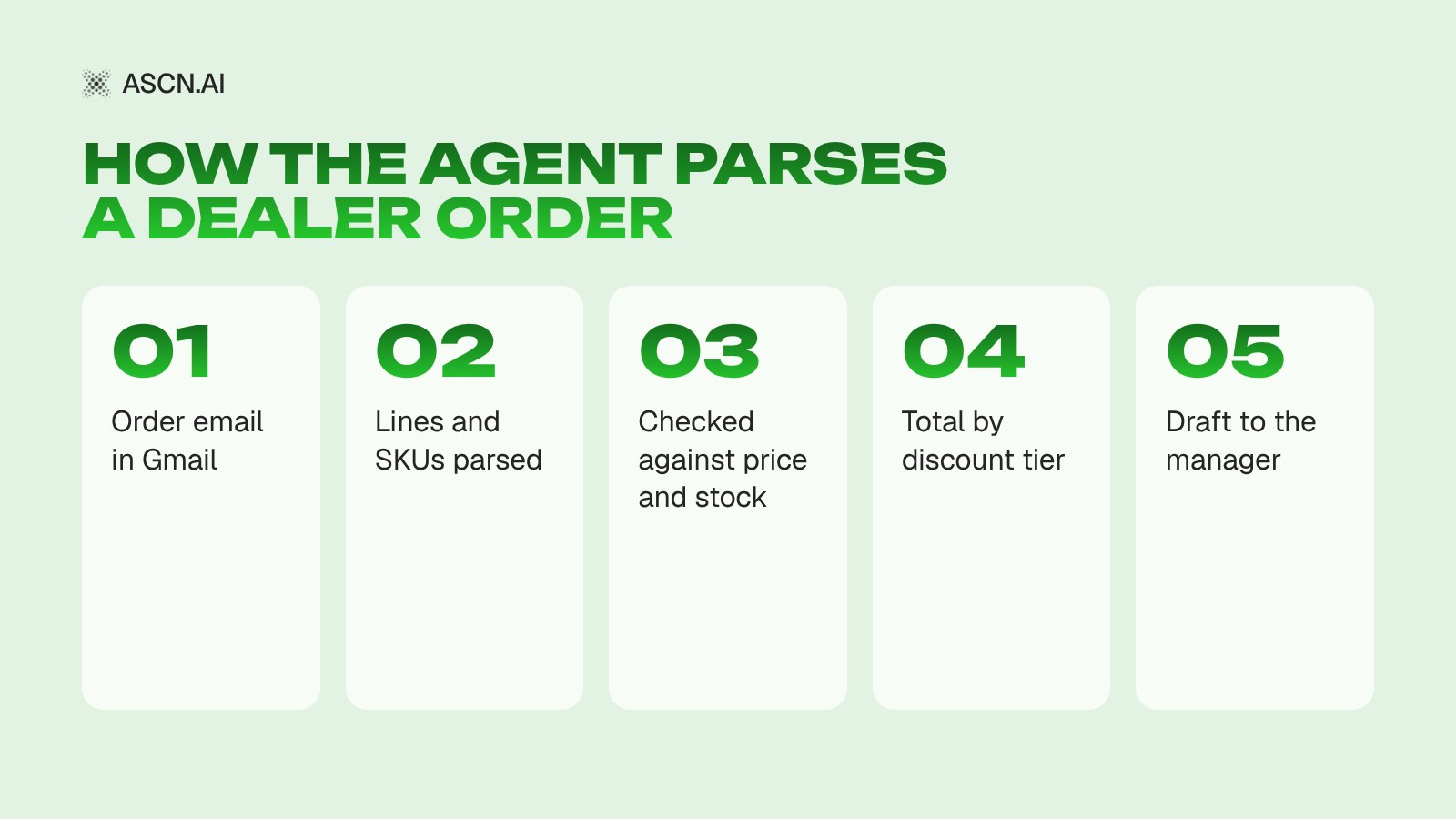
A new Gmail message is the trigger. The agent reads it and pulls out the lines: what, how many, which variant. It matches names and SKUs against the price list in the spreadsheet instead of demanding a particular format from the dealer.
Then comes the stock check. Items in stock go into a draft order priced at the dealer's tier; items out of stock are listed separately with the next delivery date where it is known. Ambiguous lines are not guessed at but flagged with a question.
The finished draft goes to the manager in Telegram: total, line items, open questions. The manager edits and sends the reply to the dealer.
What to connect
| Component | Purpose | Required |
|---|---|---|
| Gmail | Trigger on a new order email | Yes |
| Google Sheets | Price list, stock, dealer tiers | Yes |
| Telegram | Draft order for the manager | Yes |
| Google Docs | Generating an invoice or spec | No |
| Google Drive | Orders sent as files | No |
Gmail here is not just mail but the only real trigger in the setup: the agent fires on an email rather than waiting for a schedule. Stock has to refresh at least daily, or the availability check stops meaning anything.
Building it in five steps
- Get the price list into a spreadsheet with SKUs and name synonyms. The synonyms are the key part: they are what lets the agent resolve "that white wardrobe" without an exchange of emails.
- Add a sheet with dealer tiers and their discounts, and another with stock levels.
- Create the agent, connect Gmail and Google Sheets, and set the trigger on mail from known addresses or with "order" in the subject.
- Write the rules: what to do with an out-of-stock line, how to round, when to raise a question instead of guessing.
- Connect Telegram and check every parse for the first weeks. Synonyms and exceptions get written during exactly that period.
Setting up an email agent step by step is covered in the guide to an AI agent for email, and stock handling in the piece on agents for inventory management.
What it saves
A worked example. Assumptions: thirty orders a week, twenty minutes of manual parsing each, two wholesale managers.
| Metric | Manual | With the agent |
|---|---|---|
| Parsing one order | 20 minutes | 5 minutes to check |
| Hours per week | 10 | 2.5 |
| Reply to the dealer | within the day | within the hour |
| Stock errors | they happen | checked automatically |
This rests on the assumptions above. Reply speed often matters more than the hours: a dealer who gets confirmation within an hour is less likely to go looking for the item elsewhere.
Where you need a manager
Bespoke terms, payment deferral, a one-off volume discount are negotiations, and the agent does not run them. It also does not decide whether to ship to a dealer in arrears: those orders get flagged and go to a person.
One rule is worth setting on day one: on any doubt about a line, the agent raises a question rather than picking a similar SKU. Shipping the wrong item costs more than a clarifying email.
Frequently asked questions
Does the agent reply to the dealer itself?
By default no: it drafts and the manager confirms. That is the documented default behaviour for email, and it is worth keeping at least for the first few months.
What if the order arrives as an image or PDF?
The agent can read files from the email, but parsing quality depends on how legible the document is. A photo of a delivery note at an angle is an unreliable source, and those orders are better left to a manager.
Do you need an ERP integration?
There is none documented, so the setup rests on exporting stock and prices into a spreadsheet. A daily export is enough for most wholesalers.
How does the agent know the dealer's discount tier?
From the sender's email address, checked against the tier sheet. If the message comes from an unknown address, the agent raises a question instead of applying list price.
Does this suit ten orders a month?
The gain will be small. The setup pays off on volume, when parsing emails takes a visible part of a manager's day.
The bottom line
In wholesale a manager is valuable for negotiating, not for decoding emails. The agent takes over order parsing and the stock check, replies to the dealer within the hour, and raises an honest question wherever it is unsure.
Ready-made email and order agents are in the ASCN marketplace. For help setting one up around your price list, message a manager on Telegram.

AI Chatbot for Hotels: A Country Club Case and 40% Ancillary Revenue Growth

AI Agent for Real Estate: An Agency Case and 2-Minute Lead Qualification
AI Chatbot for Logistics: A Trucking Case and 75% Fewer Calls

AI Agents in B2B Sales: A Case of Conversion Growth from 12% to 34%
AI Agents for Inventory Management: Automation Solutions and Key Benefits

AI Agent for Email: The Complete Guide to Email Automation