- Русский
- English
- Português
How to Sync Statuses and Assignments Between Canvas LMS and Notion
Managing assignments across multiple courses in Canvas LMS is a recipe for confusion and missed deadlines. By automatically syncing your Canvas data to Notion, you create a unified "operating system" for your studies. In this guide, we break down the integration architecture, compare automation tools like Zapier, Make, and ASCN.AI, and provide a Python script to help you reclaim up to 40% of the time you currently spend on routine tracking.

Canvas LMS is a cloud-based learning management system used by thousands of universities and colleges around the world. Every aspect of student life comes together in one place: materials, assignments, grades, instructor communication, teamwork, and a unified calendar.
According to EdTech Magazine (2024), more than 6,000 educational institutions use Canvas. But there's a catch — the interface is built around individual courses: if you're studying across multiple programs, things get confusing fast, and you end up jumping between sections just to figure out what needs to be done today.
What is Notion
Notion is a universal database and note-taking builder. Set up correctly, Notion becomes an instructor's operating system: assignments, deadlines, materials, goals — all connected by a single thread of meaning.
Key capabilities:
- databases supporting any field types
- views as tables, kanban boards, lists, and calendars
- relations between databases, filters and sorting
- API for automation
Why Sync at All
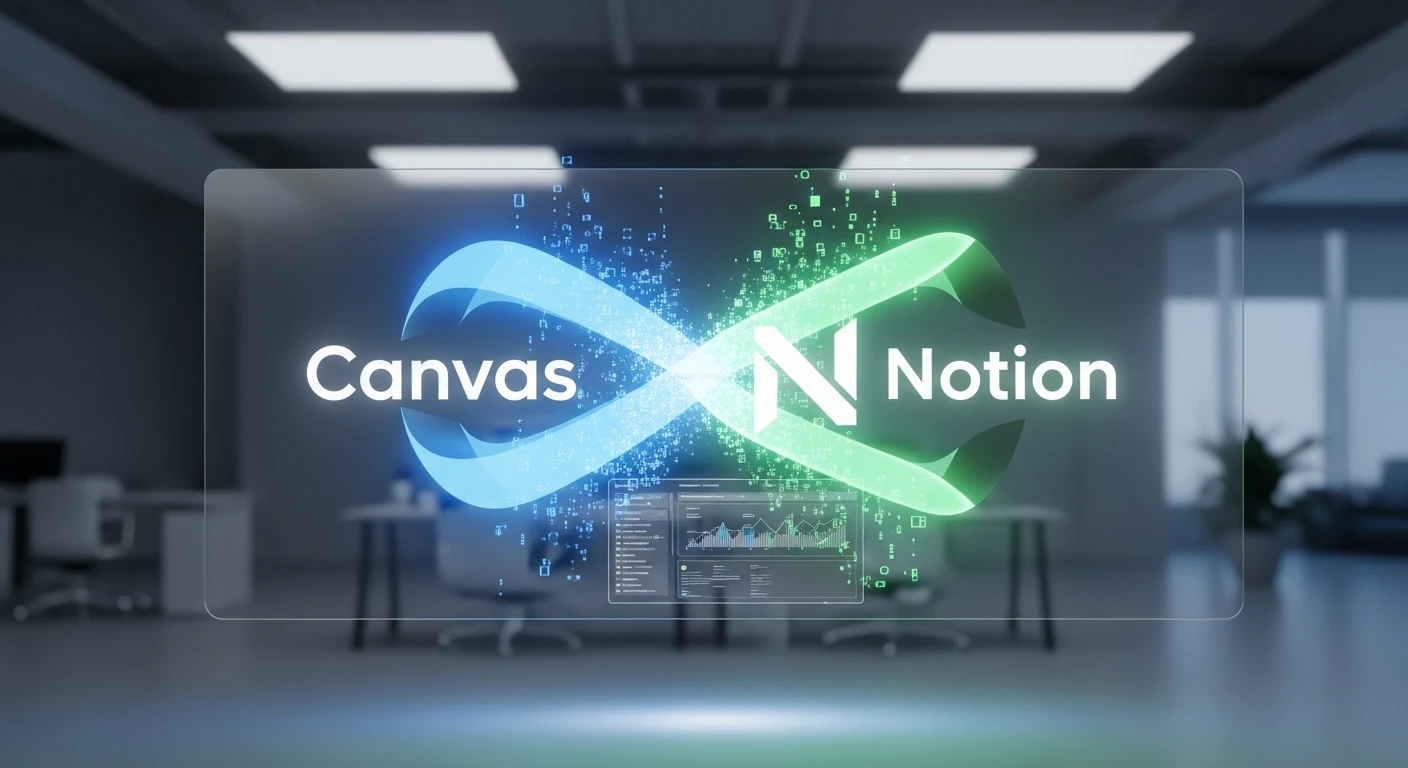
Keeping track of things manually in two places is impossible — you constantly forget to update, you miss deadlines. Automatic synchronization between Canvas and Notion solves the problem: all important information is pulled into a single window.
What integration gives you:
- unified control over all assignments
- integration pulls student stress down to below a third of its usual level and improves on-time submission rates by roughly the same margin
How the Integration Works
Integration Options
As of 2026, there is no official Canvas–Notion connection. No-code services like Zapier, Make and similar tools offer basic capabilities — transferring new assignments — but with noticeable limitations: no Canvas webhooks for instant data updates, no reverse sync from Notion back to Canvas, and not much flexibility in handling conflicts.
Custom API integrations are the magic wand that gives you full control: real-time status updates, any business logic you need, and a way around the rate limits of third-party services. The downside — you need technical skills and hosting.
Database Structure
Typical structure of an assignment record:
| Field | Source in Canvas API |
|---|---|
| Title | assignment.name |
| Course | course.name (linked database) |
| Deadline | assignment.due_at |
| Status | submission.workflow_state |
| Link | assignment.html_url |
| Points | assignment.points_possible |
Status mapping: not_submitted → Not Started, submitted → Submitted, graded → Graded.
Canvas API: Key Endpoints
A token is created in Canvas: Account → Settings → Approved Integrations → + New Access Token. It is passed in the request header:
Authorization: Bearer <your_token>Main endpoints:
GET /api/v1/courses/:course_id/assignments— list of course assignmentsGET /api/v1/courses/:course_id/assignments/:id— assignment detailsGET /api/v1/courses/:course_id/assignments/:assignment_id/submissions/:user_id— submission status
Rate limit — 3,000 requests per token per hour, which is enough for most tasks.
Notion API
You need an integration to get started — create one at notion.so/my-integrations. Once created, give the integration access to the required databases. All requests must include the mandatory version header:
Notion-Version: 2022-06-28Integration Tools
| Criteria | Zapier | Make | Custom Script | ASCN.AI |
|---|---|---|---|---|
| Programming skills | not required | not needed | minimal | not needed |
| Status updates | no | yes | yes | yes |
| Reverse sync | not available | via HTTP | yes | yes |
| Webhook support | manual | yes | yes | yes |
| Operation limits | 100–1,000/mo | 1,000–10,000/mo | low | unlimited |
| Setup time | 15–30 min | 1–2 hours | 5–10 hours | 2–4 hours |
| Scalability | up to 1,000+ req/min | up to 100,000+ req/min | unlimited | unlimited |
Zapier is the easiest starting point, but unfortunately doesn't support status updates or reverse sync! Make, on the other hand, handles complex logic, Canvas webhooks via Live Events, and advanced update scenarios. A custom Python script gives you full control and unlimited throughput, but requires hosting and technical skills. ASCN.AI is a visual no-code builder with support for statuses, webhooks, and reverse sync — no coding required!
Step-by-Step Setup

Step 1. Get Your Tokens
- Canvas: create an Access Token in your user profile
- Notion: create an integration, get your Internal Integration Token, grant access to the required databases
Step 2. Configure the Data Flow
- Retrieve the list of assignments via the Canvas API.
- For each assignment, search for an existing record in Notion by Canvas ID.
- If the record exists — update the fields; if not — create a new one.
- Set up a periodic run (every 15 minutes).
Step 3. Reverse Sync
Updating data from Notion back into Canvas is only possible with instructor or administrative rights. Students have read-only API access, so keep this in mind when setting up the sync.
A Python code snippet:
import requests

canvas_token = 'YOUR_CANVAS_TOKEN'
notion_token = 'YOUR_NOTION_TOKEN'
canvas_course_id = 101
notion_database_id = 'YOUR_NOTION_DB_ID'

headers_canvas = {'Authorization': f'Bearer {canvas_token}'}
headers_notion = {
    'Authorization': f'Bearer {notion_token}',
    'Notion-Version': '2022-06-28',
    'Content-Type': 'application/json'
}

canvas_url = f'https://canvas.university.edu/api/v1/courses/{canvas_course_id}/assignments'
response = requests.get(canvas_url, headers=headers_canvas)
assignments = response.json()

for assignment in assignments:
    # search for record in Notion by assignment['id'], update or create
    pass
Tips for Maintaining the Integration
- Log operations for diagnostics
- Regularly verify data accuracy through reconciliation
- Monitor Canvas and Notion API updates via their changelogs
- Test changes on a separate test database
- Set up error alerts via Telegram or email
Summary
A properly configured Canvas–Notion sync reclaims up to 40% of the time previously spent on routine tracking. The tools range from straightforward Zapier to custom scripts and ASCN.AI — for those who prefer flexibility without unnecessary programming.