



- Русский
- English
- Português
How to Collect and Analyze Meta Ad Library Ads with AI – Tools and Methodology
Learn how to automate data collection and analysis from the Meta Ad Library using scrapers and artificial intelligence. This guide will help you effectively monitor competitor strategies, classify creatives using OpenAI, and optimize your advertising budget using in-depth market analytics.

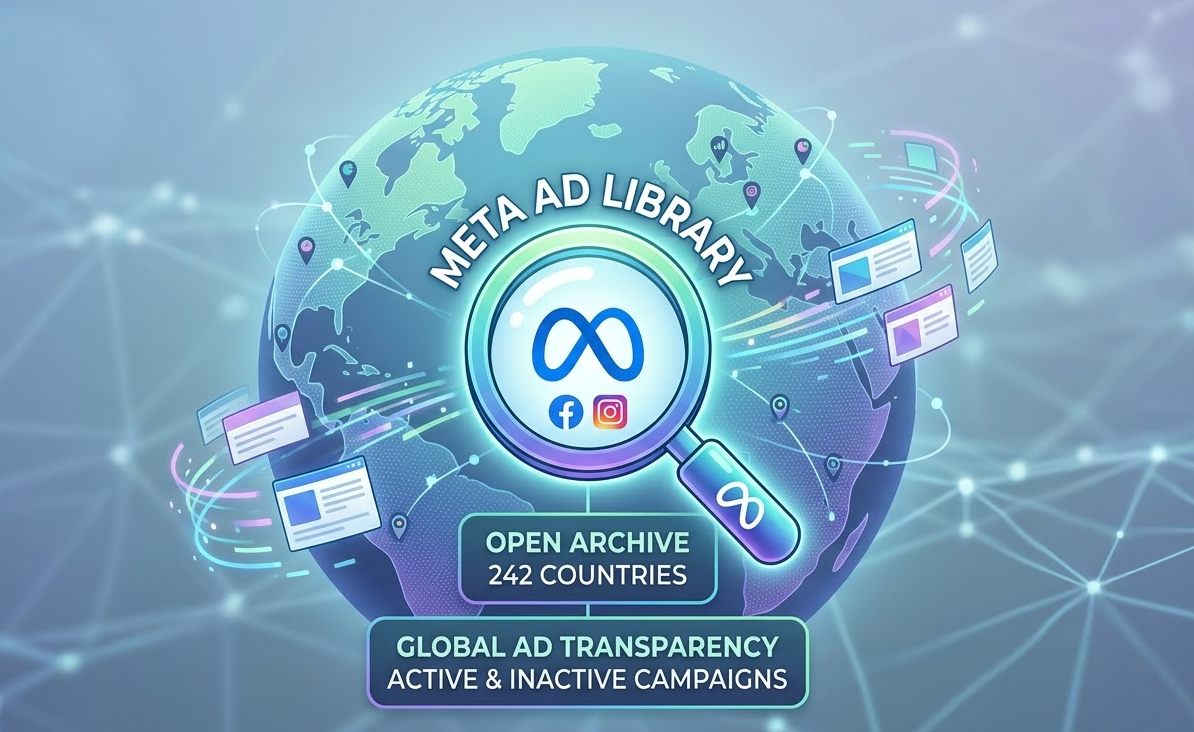
Meta Ad Library is essentially an open database of all advertisements across Facebook and Instagram—the ads shown to me, you, and everyone else. This tool was launched in 2018 following the Cambridge Analytica scandal, primarily for the sake of transparency. It currently aggregates data across 242 countries, including both active and archived campaigns, as well as political and social issue ads.
What this tool can do via its web interface and API:
- Search by advertiser or topic. Enter a brand name or a keyword, and you get all their ads.
- Filtering by geography, platform, and start date. For example, if you want to see ads from the USA over the last month—it’s easy.
- Viewing creatives and metadata. This includes text, images, videos, and the start date. For political ads, it also includes reach. However, exact budget data is not available.
- Page information. When the page was created, whether it changed its name, where its administrators are located, and what the page does.
But here is what is very important: the library shows what competitors are displaying, not exactly who they are targeting or how well it pays off in terms of ROI. In other words, it is only a starting point—you have to dig deeper yourself.
Benefits of Using Meta Ad Library for Business
Previously, to understand what rivals were doing, one had to manually copy texts and take screenshots. Meta Ad Library has turned this into a systematic process. Without it, you are either operating blindly or paying agencies large sums of money.
In practice, the library works as follows:
- Identifying winning creatives. If an ad has been running for several months, it likely pays off and generates profit. For example, in 2024, we noticed that several crypto projects were mass-using a "yield calculator" on the first screen. We conducted testing, and the conversion rate nearly doubled, from 2.1% to 3.8%.
- Tracking activity. Frequent campaign updates suggest aggressive scaling, while stability indicates conservatism or low competition. This provides market insight and helps in setting an advertising budget.
- Analyzing geography. If you see competitors entering new markets, it's up to you to decide whether to follow them or strengthen your current positions.
- Tracking seasonal trends. For instance, many retailers launched "Black Friday" campaigns not on the day of the event, but a couple of weeks prior, aiming to build marketing without surprises.
Businesses that regularly and systematically analyze the creative solutions of their competitive environment in the Ad Library find effective formats 27% faster, saving an average of 19% on leads in just one quarter.
Real-life example: In October 2024, after Facebook algorithm updates, the cost per click (CPC) spiked sharply. We analyzed 30 projects in the Web3 niche and noticed that most had shifted toward a "calendar" approach—a free guide requiring an email sign-up. We adapted our funnel, and the cost per lead dropped from $12 to $7.50 in just three weeks. Crucially, Meta Ad Library closes so-called "blind spots"—in Facebook Ads Manager, you only see your own campaigns, but here, you see the entire market.
Meta Ad Library Scraper — What it is and how it works
To avoid spending hours on manual data collection, scraping is used—automating ad collection through programmatic requests. Scrapers work either with the official Meta Ad Library API or through web scraping of pages.
The first method is legal and stable but limited in terms of historical data volume. Specifically, the API provides structured data such as ID, text, media, dates, status positions, and region, but does not provide precise targeting details.
The second method involves simulating a user's browser behavior using tools like Apify or Puppeteer, which allow for retrieving data not available in the API, such as the visual layout of elements. However, these scripts have a major drawback—they are fragile and can break when the interface is updated.
Apify is a very convenient cloud platform for solving tasks of this kind. You select the search parameters, set the region, define the date, and launch the "actor"—a headless browser that easily collects thousands of ads and neatly saves them in JSON or CSV format.
For instance, here is an example of a single ad's structure:
{
"ad_id": "120211234567890",
"page_name": "Example Crypto Exchange",
"ad_creative_body": "Receive 15% APY on stablecoins. No lockup. Get started now!",
"ad_snapshot_url": "https://www.facebook.com/ads/library/?id=120211234567890",
"start_date": "2024-10-15",
"end_date": null,
"platforms": ["Facebook", "Instagram"],
"images": ["https://scontent.xx.fbcdn.net/v/t45.1600-4/..."],
"region": "US"
}
To run this, you typically need an Apify account with free credits ($5 per month) and a proxy to bypass blocks if you intend to scan many pages. Data can be exported to Google Sheets or databases for larger projects.
We do not recommend running the scraper more than once a day, as creatives do not update instantaneously.
Legality and Ethics of Ad Data Collection
Legally, scraping exists in a gray area, but it must be done according to the platform's rules and with the collected data used for its intended purpose.
Regarding US and EU legislation, the collection of public information is considered legal if no security measures are bypassed. Meta Ad Library contains no personal data, meaning GDPR is generally not applicable here.
You can only use Meta data under a strict prohibition of reselling raw data or producing competing products—but it can be used for internal analysis and research. With web scraping (that does not attempt to bypass API protection), risks are minimal under moderate pressure. However, unethical industrial data collection and resale can lead to litigation.
Ethics: Use the data to improve the quality of your own marketing campaigns, not to deceive your competitors.
"A US court recognized that collecting public data without bypassing protection does not violate the Computer Fraud and Abuse Act."
"Industrial scraping and resale without added analytical value violate terms of use and may result in legal proceedings." – Meta vs. AdSpy, 2023
Top Tools and Best Practices for Data Collection
Choose the most suitable tools based on your tasks, budget, and experience.
Level 1: No-code solutions
- Apify: A cloud service with ready-made "actors" for collecting data from Meta Ad Library. Easy to start: free credits are provided; for large volumes, prices start at $49/month.
- Octoparse: A desktop parser with a visual interface, free tier up to 10,000 rows, Pro version from $75/month.
- Phantom Buster: A cloud-based browser automator with adaptation for Ad Library, starting at $30/month.
Level 2: Low-code solutions
- Scrapy: A Python framework for highly custom scrapers—free, but requires basic programming skills.
- Playwright / Puppeteer: Browser automation engines. These are a godsend for parsing dynamic content.
Level 3: Industrial solutions
- Official Meta Ad Library API: Basic free access with a limit of 200 requests/hour.
- Brightdata (Luminati): Proxy services for large projects starting at $500/month.
Comparative Table:
| Tool | Complexity | Cost | Speed | Stability |
|---|---|---|---|---|
| Apify | Low | $49+/mo | Medium | High |
| Octoparse | Low | $75+/mo | Low | Medium |
| Scrapy | Medium | Free | High | Medium |
| Playwright | Medium | Free | Medium | High |
| Meta API | Medium | Free* | Limited Availability | Ultra-high Availability |
| Brightdata | High | $500+/mo | Massive Availability | Ultra-high Availability |
*Basic access is free; extended access is paid.
At the start, it is recommended to collect a small amount of data and incrementally collect new data as results accumulate. Don't forget to monitor for failures and save data to backup storage.
ASCN.AI Experience: We track 15 competitors weekly using Apify and Airtable, classifying offers with OpenAI—saving over 12 man-hours per week with infrastructure costs of around $60 per month.
Facebook/Meta Ad Analysis Using Artificial Intelligence
The data provided by Meta Ad Library is only half the battle. It is more important to analyze it productively, quickly, and qualitatively. Manually sorting through thousands of ads would take weeks. AI handles it in minutes.
What does AI do in ad analysis?
- Creative classification. GPT-4 and Vision API identify the offer type, target audience, and tone. For example, if it sees "Download a free checklist," it categorizes it as a "lead magnet."
- Identifying semantic patterns. It studies the emotions that drive action—FOMO (fear of missing out), greed, and others.
- Visual assessment. It records the presence of faces, color palettes, and text on images. It is known that ads with faces increase click-through rates by 15-25% (Google Cloud Vision Ads Study, 2023).
- Synthesizing insights and recommendations. AI provides clear conclusions and advice—for example, to test lead magnets with FOMO elements.
Examples of Successful AI Use in Advertising
- For instance, GPT-4 tracked how a competitor's offers changed—they switched from free shipping to a loyalty program, which immediately adjusted the strategy.
- By analyzing 300 creatives using OpenAI Vision, a SaaS company found working patterns and increased CTR by 18%.
- A crypto project in a crisis adjusted its messaging based on AI recommendations and raised click-through rates by 40%.
Companies using AI in ad analysis reduce time-to-insight by 65% and increase the accuracy of performance forecasts by 31%.
Using OpenAI for Interpretation and Classification of Ads
OpenAI GPT-4 and Vision API are versatile—they understand both text and images simultaneously without additional training!
Tasks and prompt examples:
- Offer classification: "Classify this ad: 'Download a free guide on cryptocurrency investing'" — Answer: "Lead magnet."
- Extracting benefits: "Highlight the three main benefits from the text: 'Full automation, integration with 50+ services, 24/7 support'."
- Sentiment: "On a scale of 1 to 5, what level of aggression would you assign to the text 'Last chance! 50% discount'?"
- Visualization: "What does the image look like: faces, colors, text?"
- Recommendations: "What can you say about the keywords 'free', 'guarantee'?"
ASCN.AI Case: By analyzing 800(!) ads for crypto tools, with classification of both the offers and the target audience, we reduced the cost per lead by 40%.
Here is an example of Python code for sending a request to the OpenAI API:
import openaiopenai.api_key = 'YOUR_API_KEY'response = openai.ChatCompletion.create(model="gpt-4-turbo",messages=[{"role": "system", "content": "You are an expert in ad analysis."},{"role": "user", "content": "Classify this ad: 'Download a free SEO checklist'"}])print(response['choices'][0]['message']['content'])
$5-$7 is the cost for analyzing a volume of 1,000 ads.
Metrics and Ad Performance Indicators
Meta Ad Library offers indirect metrics to estimate an ad's success. Here are their key characteristics:
| Metric | Essence | Good Indicator | Bad Indicator |
|---|---|---|---|
| Longevity | Time the ad has existed since launch | Over 60 days | Less than 14 days |
| Velocity (Update frequency) | Number of new ads per unit of time (week) | 3-10 new ads | More than 30 or less than 1 per week |
| Format Diversity | Creative types (image, video, carousel) | More than 3 formats | Images only |
| CTA Share | Percentage of ads with a call to action | 60 - 80% | Less than 20% or 100% |
| Promo-word Density | Mentions of "discount", "free", "guarantee" | Less than 30% | More than 70% |
| Visual Consistency | Colors, fonts, style | Over 70% consistency | Haphazard creatives |
For example, high longevity and medium velocity usually mean things are moving steadily (stable), while high velocity with low longevity indicates testing or a crisis.
Competitive Ad Analysis on the Meta Platform Utilizing AI Capabilities
To understand what competitors are doing, the following tools are used:
- Temporal analysis. Since we look at how the number of new creatives changes month-over-month, we can see major spikes and seasonality.
- Offer clustering. AI clusters ads by offer type, finding the main directions of the competitor's tactics.
- Visual pattern analysis. We find frequently occurring formats and images (e.g., faces, screenshots) that affect CTR.
- Identifying target segments. Based on the text, the AI system determines the target audience: beginners or professionals, B2B or B2C.
- Monitoring reactions to events. Observing changes in messaging in response to crises or regulatory news.
The most popular tools for such competitive espionage:
- Meta Ad Library — free, but with limits.
- Commercial spy-tools — AdSpy, BigSpy — convenient but expensive services.
- Custom setups based on Apify and OpenAI — flexible and powerful solutions.
ASCN.AI Success Case: Monitoring AI assistants for crypto trading revealed popular offers and allowed us to occupy an untapped niche.
Integrating Scraping Data with AI Analysis for Deep Insights
A general 5-step sequence:
- Data collection via Apify or Scrapy.
- Preprocessing — deduplication and cleaning.
- Analysis with OpenAI — structuring and classification.
- Visualizing results using BI systems — Google Data Studio, Tableau.
- Generating insights using aggregated data — GPT-4.
Case Studies of Successful Competitive Analysis Based on Meta Ad Library
- SaaS Company. Preparing to enter the Brazilian market, they collected 800 competitor ads, adapted creatives for the local market, and doubled the CTR.
- Marketing Agency. Identified a "free masterclass + PDF cheat sheet" offer from online education leaders, which significantly boosted the client's ROI.
- Crypto Project. During a market crash, we quickly adapted the strategy based on AI analysis recommendations and maintained traffic levels.
Practical Guide to Collecting and Analyzing Meta Ads with OpenAI
- Free starting point: Register at apify.com and get $5 in free credits.
- Go to the Apify Store and select "Facebook Ads Scraper," then configure the search parameters, region, dates, and maximum number of collected ads.
- Launch the actor and wait for the data collection process to finish.
- Upon completion, export the resulting data to JSON, CSV, or Google Sheets.
- Set up regular execution via Apify Scheduler.
Recommendations:
- Do not neglect security and break large requests into blocks.
- Use incremental collection to track new ads.
- Use proxies if blocking occurs.
- Maintain documentation alongside launch parameters.
Automating Ad Analysis via OpenAI API
- Obtain an OpenAI API key.
- Request a set of ad offers—which category, which triggers, for which target audience?
- Create a script to send requests and receive OpenAI responses.
- Handle errors and implement retry logs.
- Save the result to a database or spreadsheet.
Visualizing Results and Creating Reports
To build a report, I recommend using tools such as:
- Google Data Studio (free online builder with Google Sheets integration)
- Tableau / Power BI (for complex and interactive visualization)
- Python (Matplotlib, Plotly) — for charts and PDF reports.
- Notion / Airtable — for simple database management and visualization.
Frequently Asked Questions (FAQ)
Is it legal to scrape Meta Ad Library?
Yes, if you use the official API and follow the rules. Web scraping is allowed for personal use with limitations. US law generally recognizes public data collection as legal if protection is not bypassed.
What AI capabilities exist for ad analysis?
Ad analysis capabilities include creative classification, insight extraction, visual image recognition, and optimization recommendation generation.
What is the accuracy level of ad analysis using AI-based technologies?
Accuracy for offers is 85-92%, for visual recognition 80-90%, and for insight generation around 70-80% relevance.
What data from Meta Ad Library is most useful for competitive analysis purposes?
Page name, launch and end dates, images and videos, ad text, and targeting geography.
Conclusion and Next Steps
The combination of a scraper and AI is the future of marketing, where automation of collection, analysis, and hypothesis generation allows for decision-making in minutes rather than days! Preliminary estimates suggest that by 2027, a large portion of all marketing decisions will be made by AI systems with almost negligible human participation.
Recommendations for Marketers and Analysts
- Start small: Take 3-5 competitor advertisers, collect their ads, and run them through AI. Initial insights are available immediately.
- Automate data collection and analysis.
- Use the obtained information to test and scale successful hypotheses.
ASCN.AI offers ready-made workflows and AI agents that combine scraping and analysis in a single interface without programming. The tool reduces work time from days to minutes.
Disclaimer: This information is for general purposes and is not a substitute for legal advice. Before using legally significant data, it is recommended to consult with a specialist.