



- Русский
- English
- Português
Automate Etsy Data Mining with Bright Data Scrape & Google Gemini
ASCN.AI automates Etsy data mining by pulling product listings, prices, and trend signals using Bright Data and Google Gemini AI. This scalable pipeline delivers structured market intelligence directly to your Google Sheets or database daily, replacing slow manual research with a setup that takes just 48 hours.

Etsy data mining automation pulls product listings and their prices, ratings, trends signals from Etsy and puts them all together at scale using Bright Data's Web Unlocker for JavaScript rendering along with Google Gemini for structured extraction powered by AI. This means that ASCN.AI can set up your entire pipeline in just 48 hours from $59/month and deliver data (via Google Sheets, Notion, or direct-to-your-sql database) automatically every day.
8,000,000 sellers. 450,000,000 visitors monthly. That's Etsy in 2026; yet, the majority of shop owners conduct their product research by hand, tab-by-tab, across category-retail pages; copying prices into spreadsheets; struggling to remember which listings received more than x# of reviews since last Tuesday… This is not scalable. It never was going to be.
ASCN.AI builds automatic Etsy data mining pipelines. The first step in this process is to extract information from Etsy's JavaScript-heavy pages using Bright Data's Web Unlocker. The raw HTML, once received by your ASCN.AI site, will then be processed using Google Gemini's AI technology to produce a structured report for your use. On a daily basis, your new report will be delivered to your Google Sheets, Notion or Postgres without the need for you to physically do anything.
You can expect to have your setup complete within 48 hours after you sign-up for a service plan. You can expect the cost for the analysis of each listing to be $0.001 or less (i.e., less than $1.00 per 1,000 listings). Additionally, nothing needs to be coded by you at any time.
What is Etsy data mining automation?
Etsy data mining automation is the systematic extraction and the AI (artificial intelligence) powered analysis of all product listing data for Etsy including: prices, numbers of reviews, bestseller badges, trending keywords, which are extracted and provided in structured formats that can be utilized continuously as your primary sources of market and competitor research and/or product validation.
An individual data analyst reviewing listings on Etsy manually may typically spend 15-20 minutes inspecting 15-20 products per hour and, therefore, will complete 1 week of work to evaluate 500 competitor listings. In contrast, the ASCN.AI automated pipeline can evaluate these same 500 competitor listings in less than 10 minutes total time. It takes less than two hours to process 5,000 listings. It is an entirely new level of capability, rather than just a slight enhancement.
Manual Etsy research is not suitable for use at scale due to a variety of reasons:
Etsy constantly changes how its search results will appear. The item that was "hot" on Monday can be buried on Friday. Competitors’ prices can drop overnight. Listings that are new with aggressive pricing may have already entered the niche by the time you wake up. Manual monitoring gives you a snapshot in time; automated monitoring gives you a historical time series of data — that’s how you make your business decisions.
Etsy's search results are created dynamically via JavaScript — look at the source of an Etsy listing page, and you’ll see mostly empty divs waiting for the page to be rendered by the browser. A standard HTTP request to Etsy gives you partial information. You’ll need a different approach for building your infrastructure if you're going to use automated processes and have your requests processed by Etsy through one of the many automated solutions available.
What type of data do I receive from an individual listing on an Etsy product page?
Etsy will give you structured data about the individual product based on the Etsy Scraper API data provided by Bright Data.
Marketplace Product Listing Field List
This is what I get per product listing:
| Field Name | Definition | Example |
|---|---|---|
| Product Title | Full Listing Title | "Personalized Wooden Wall Art" |
| Current Price | Current Price of Listing (with Sale Price {}) | $24.99 {was $34.99} |
| Review Count (Listing) | Total number of Reviews on the Product Listing | 1247 |
| Review Count (Shop) | Total number of Reviews for the Shop | 8903 |
| Average Rating | Star Rating (out of 5) | 4.9 |
| Seller / Shop Name | Etsy Store Name | WoodworksStudio |
| Listing URL | Link to the Listing | etsy.com/listing/123456789 |
| Category | Item Category and Subcategory | Home & Living > Wall Decor |
| Bestseller Badge | True or False: Whether the Item has Etsy's Bestseller Status | Yes or No |
| Star Seller Badge | True or False: Whether the Shop has Star Seller Status | Yes or No |
| Shipping Origin | Where the Item is Shipped From + Ship From Address | Country of Origin: USA |
| Tags | Keywords (Items listed will be tagged with these tags) | wall art, personalized, custom wood |
| Etsy Product ID | Etsy Internal Product Identifier | 123456789 |
Five steps, no human involvement once setup is complete.
- You can find the Etsy category, keyword, or specific competitor shop by entering the Etsy address into a URL that will allow you to search for the product that you are looking for.
- The Bright Data Web Unlocker will get you a rendered version of the Etsy page including all of the javascript, as well as handling the captcha and limiting the amount of data that is queried.
- The Bright Data Web Unlocker removes all of the duplicates from the listing and also takes care of pagination for you.
- The Google Gemini technology (Gemini 3.1 Flash-Lite (Future Version - 2026)) takes the html returned by Bright Data and extracts the product details out into a structured JSON format.
- The returned product details flow into your designated location (Google Sheets, Notion, Airtable, Postgres or via webhook).
Bright Data Web Unlocker - Getting through the Javascript "Wall" of Etsy.
Etsy is not a single static website - every single search results page has the contents of the page loaded using Javascript. Essentially a normal GET to an Etsy search address does not return any product data, it returns a skeleton. This is what causes the majority of DIY scrapers to get broken as they will never get product data from Etsy via a normal GET method request.
Bright Data has a large amount of headless Chrome browser instances running through residential (real) proxies from a pool of over 400 million IP addresses in 195 countries. Each headless Chrome browser rotates through different physical IPs between requests. Bright Data will wait for the Javascript to finish rendering, checks against captcha and returns the finished (fully rendered) version of the Etsy html. Pricing: $1.00 per 1,000 successful requests.
When doing research on specific geographical areas, like US sellers, UK buyers, or German handmade, the pipeline will request through an IP address that is in the target geographical location.
Google Gemini - From Raw HTML to Market Intelligence
Once Bright Data has passed you the finished (fully rendered) version of the Etsy html, Google Gemini will do the extraction. The pipeline will send each page's structure. This includes issues with different class names, A/B test layouts, and nesting of listing elements within a larger HTML structure. Before Gemini was implemented, Etsy would deploy website updates to their UI that were difficult to handle due to hardcoded CSS selectors that reference the layout and structure of the website. By using semantic reading of content, Gemini allows Etsy's users to maintain their listing success regardless of how often the front-end development team pushes updates to the UI.
Gemini 3.1 is expected to be released in late 2026 and will cost less than $0.00001 per listing. When combined with Bright Data at $0.001/request, the total cost of infrastructure will be approximately $0.001 per listing analyzed.
Complete Workflow Architecture
ASCN.AI has created a 19-node workflow automation architecture to complete the entire process of analyzing listings on Etsy. Each timezone can run multiple requests to multiple Etsy URLs simultaneously with each request pulling listings from different product categories, competitive shops, and different clients.
Output destinations include:
- Google Sheets — A new row is added for each listing with columns auto formatted
- Notion database — All records are saved as structured records that have the ability to be filtered
- Airtable — Each field from the listing is mapped to all views
- PostgreSQL / MySQL — Automatic insertion into the database for technical teams
- Webhook — A POST JSON request can be sent to any endpoint (HubSpot, Slack, or a custom dashboard)
- CSV / JSON files can be created and saved to either Google Drive or Amazon S3.
Manual Vs. Automated Etsy Research
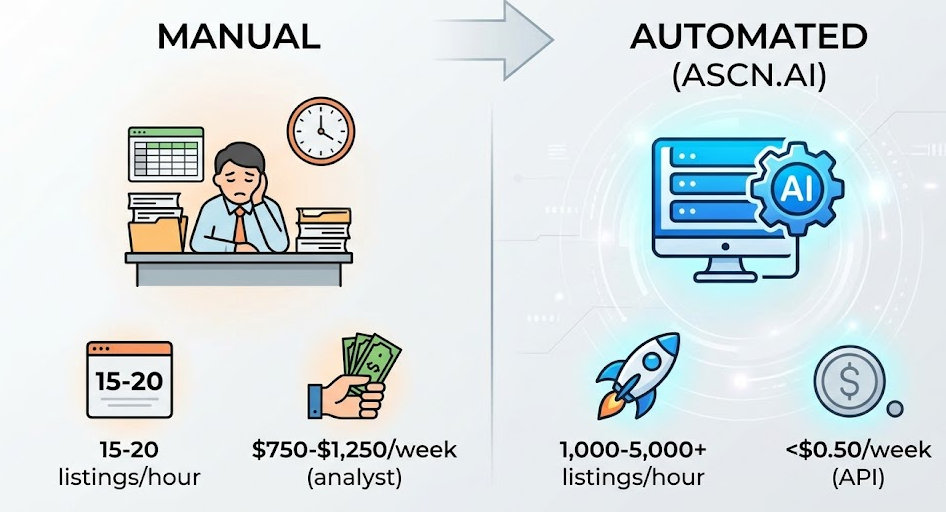
| Factor | Manual Research | ASCN.AI Automation |
|---|---|---|
| Listings/hour | 15-20 | 1,000-5,000+ |
| Cost/listing | $3-$5 (Analyst Time) | ~$0.001 |
| Consistency | Varies | 100% Consistent Schema |
| Availability | Business Hours Only | 24/7, Anytime |
| Freshness of Data | When Someone Remembers | Daily or On-Demand |
| Multi-Niche | 1 Niche | Multiple Niche |
| Historical | Manual Logging Required | Automatically Logged |
Based on analyzing 500 competitor listings per week using manual methods, the weekly analyst time cost would range from $750-$1,250 per week. Using automated methods, the costs would be about $0.50 per week in API costs plus ASCN.AI service charges.
Real World Case Studies: Discovering Trending Products Before They Peak
Etsy's strongest demand signals are determined by the number of reviews received by a listing. In the first 30 days, there is a 50-review listing that is outpacing a 3-year old 500-review listing due to daily automated snapshots making bookkeeping very easy.
3 weeks prior to seeing a trend in mainstream trend reports, a client discovered a trending personalized item - Custom Wooden Keepsakes - and launched their product, receiving 200 reviews in 45 days.
Monitor Competitor Prices at Scale
Most pricing changes occur without prior notice. Using the pipeline that tracks 500+ competitor listings every day, the pipeline detects overnight price changes and sends alerts directly to Slack prior to the opening of the business. Every price change is recorded with the date, price before the change, price after the change and the URL for the listing. This creates a price history datafile that has been created automatically.
Validation of New Etsy Niche Prior to Investment
It takes 15 minutes to analyze 1,000 listings in a specific niche (Print On Demand Home Decor Products, Personalized Pet Products, Custom Jewelry) to see if the 20 best sellers have 1,000+ reviews and Bestseller Badges to show demand exists, but competition is high. If the price of those items has been declining week to week, that particular niche could be becoming saturated.
Pricing and Deployment
- Infrastructure Cost: ~$0.001 per Etsy listing analyzed
- Bright Data Web Unlocker: $1 per 1,000 requests
- Google Gemini 3.1 Flash-Lite: < $.00001 per listing
- 1,000 listings/day: ~$30/month in API cost
- ASCN.AI service starts at $59/month; will be deployed within 48 hours
- Includes full process configuration, credential setup, custom query creation, destination output set up, testing, and ongoing support
You may set up a free consultation via ascn.ai; they will configure your pipeline and provide you with a live data feed in less than 48 hours.
FAQ
Is Scraping Etsy Legal?
The answer is YES – Since scraping publicly available product data (available for viewing without a login) is legal based on the precedent of US case law, scraping from Etsy is legal. While Etsy's ToS prohibits automated access to their data for consumers, limitations on automated access to public domains, in particular, are generally not enforceable against non-registered/consumer accounts. For ASCN.AI's pipeline, it only accesses publicly available listing pages. Bright Data is GDPR and CCPA compliant.
How will this Affect my Etsy Seller Account?
Using the ASCN.AI will not affect your Etsy seller account. The ASCN.AI pipeline will function independently of any Etsy seller accounts; therefore, no credentials from an Etsy seller account will be used to execute requests against Etsy’s public pages.
How Many Listings will be Scraped Daily?
At conservative settings for the ASCN.AI pipeline, between 1,000 to 5,000 listing pages per day may be scraped per account. Each listing page contains up to 64 products, thus meeting most research needs for sellers.
How will I Receive the Data?
After scraping the data, it will be sent in a structured JSON format that can be ingested into Google Sheets, Notion, Airtable, PostgreSQL, Webhook, or CSV – all of which are automatically formatted into row and column format.
Can I Filter for Specific Categories, Keywords, and Competing Shops?
YES – any Etsy URL can be used as an input. Multiple URLs can be executed at the same time, on independent schedules.
How Often is the Data Updated?
The ASCN.AI pipeline can be configured to scrape daily; the default setting is once per day; however, the user may configure the ASCN.AI pipeline to scrape multiple times per day for monitoring price changes on an account.
What Happens if Etsy Changes its Page Structures?
The Google Gemini reads semantic data (content), not hardcoded selectors, so minor changes to layout will not disrupt the extraction process. Minor maintenance of the ASCN.AI pipeline, if needed, is included.
Can this Work for International Etsy Markets?
YES – All requests made will be routed through IP addresses to targeted countries to obtain accurate pricing and inventory data.
Get Started with Automating Your Etsy Research
Etsy has over 8.76 million sellers and approximately 450 million monthly visitors; trends in the marketplace show tremendous spikes in newly introduced products. No seller can effectively perform manual research from this vast marketplace.
ASCN.AI will deploy your Etsy data mining pipeline within 48 hours, and Bright Data will extract your data daily while Google Gemini will analyze the extracted data so that the resulting clean and structured market intelligence report will be sent for free to the program you already have every day after deployment without requiring you to perform any manual tasks to extract or analyze any data.
To find out more, book a FREE consultation with ASCN.AI!