



- Русский
- English
- Português
Multi-jurisdictional monitoring and automation of smart contract compliance
Learn how smart contract compliance automation helps blockchain projects comply with MICA, the SEC, and other regulators in real time. This article discusses transaction monitoring tools that can mitigate legal risks and reduce reporting costs by over 70%.

Eight years of working in blockchain have taught me only one thing: projects fail due to poor programming, but they shut down because they never learned how they should function in the eyes of regulators. In 2023, we were building a compliance monitoring system for a DeFi protocol, working across seven jurisdictions simultaneously... The main lesson? Lengthy manual checks still kill speed and drain the last pennies from your pocket. Automation and real-time alerts are no longer just trendy toys; they are a basic requirement for survival.
Honestly, just Googling and slapping code together is so last century. In a project, selection is ongoing, and innovations are introduced every three quarters across a dozen countries at once. Monitoring everything manually? Disgusting! That’s why a tool for smart contract compliance automation has become as fundamental as servers or APIs—you simply can't go anywhere without it.
Preface
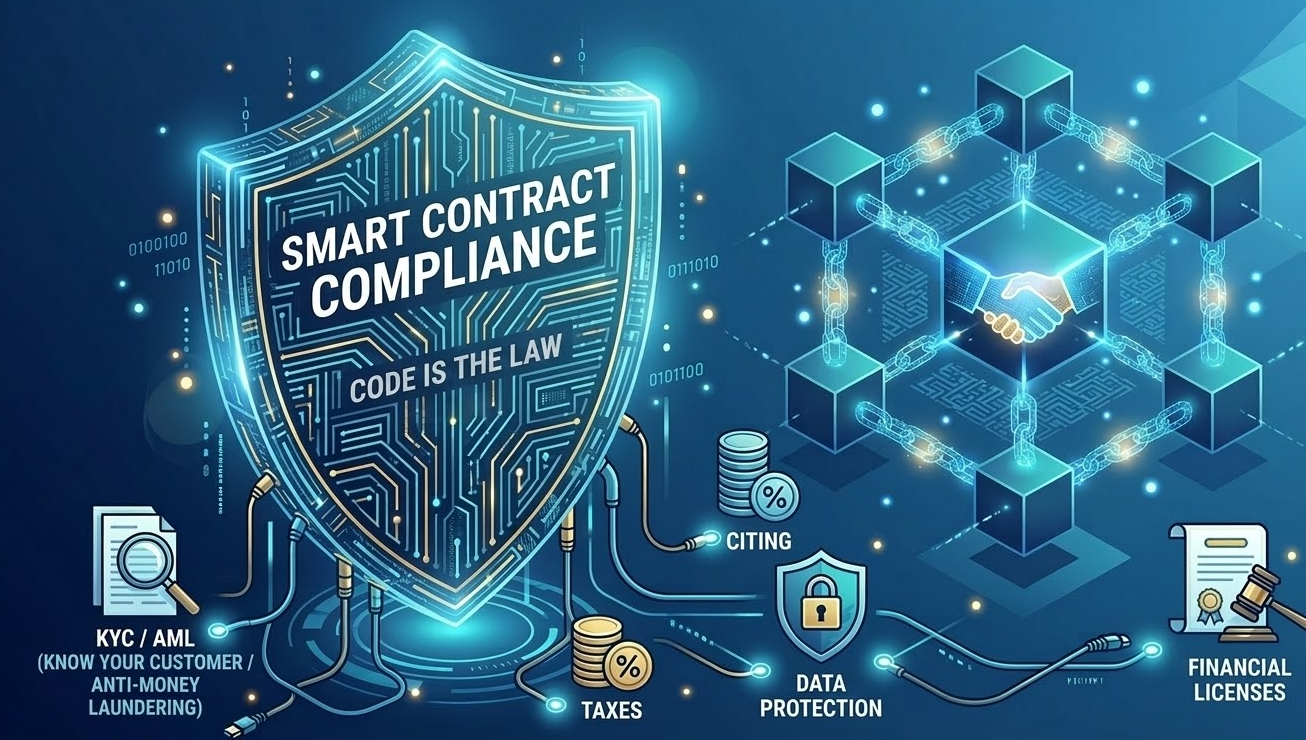
Smart contract compliance is when your on-chain code is legal. In other words, you must ensure that the contract complies with anti-money laundering (KYC/AML) rules and doesn't create issues with data protection, taxes, financial licenses, and more.
Why is this even necessary?
Blockchain is global, but laws are local. Here’s an example: a contract from Estonia processes transactions from the US, where the SEC requires tokens to be registered as securities, or from Singapore with its Payment Services Act. As a result, the same code falls under dozens of regulations at once. Approximately 68% of all DeFi projects in the world receive legal claims in their first year due to a lack of compliance monitoring. And the bulk of these problems arise because compliance is simply not checked during the development stage.
The "cherry on top" of multi-jurisdictional blockchain regulation is this: there is no single standard. Currently, MiCA is in effect in Europe; the SEC, CFTC, and FinCEN in America; and local licenses from MAS or FSA in Asia. Every country regulates smart contracts differently—as software, as a financial instrument, or as a hybrid.
Rules change rapidly. Regarding crypto regulations, they are released on average every 3-6 months. For instance, in January 2025, the SEC required DeFi protocols with a turnover of over $10M to register as virtual brokers. Failure to sign up means a ban on working with Americans.
Conflict of rules. One country asks to store data, while another demands sanction lists. OFAC announces the addresses of "fat" wallets in advance. A protocol processing transactions from them essentially breaks the law, even if the developers themselves are unaware. I can share a practical example: a DeFi platform launched a lending protocol in Estonia and was surprised two months later when it was fined €50,000 by BaFin—12% of its users were from Germany, and the platform lacked a license there. They had to restrict access from Germany and lose part of their audience. Manual tracking of such situations with thousands of deals a day? Ridiculous. Automation is the only way not to lose everything.
Overview of Smart Contract Monitoring Tools
A smart contract compliance checking tool is software that allows you to determine in real-time whether a smart contract has passed all necessary requirements. It analyzes code, transactions, participant addresses, and blockchain events, comparing them against a database of current requirements and notifying of potential bad-faith actions.
Key Functions:
- Static Code Analysis. Checking Solidity code before launch: investigating prohibited functions that allow for the anonymization of transfers.
- Dynamic Transaction Monitoring. This is where transactions are truly controlled: origin of the message, volume, sanction lists, limits (e.g., the EU limit of €1000 without requiring KYC). Ethereum, Solana, Polygon nodes, and others are used.
- KYC/AML Verification. Integration with verification services—Chainalysis, Elliptic, CipherTrace. If KYC is required, the ability to perform operations is disabled without its confirmation.
- Extensive Reporting for Regulators. Automatic generation of reports for specific jurisdictions, such as MAS in Singapore—transaction volumes, new users, suspicious operations—all with one click.
- Geo-fencing. Automated blocking of access from countries where licenses have not been granted. Determination by IP, RPC nodes, or KYC data.
Why? Speed of reaction. Alerts arrive within 10–30 seconds of an event; the system handles a million events per day without quality loss and, consequently, minimizes risks even before a regulator reads an email. Companies using automated tools reduce reporting preparation time by 73% and incidents by 58% compared to manual control. Integration happens via API or SDK with support for ERP, CRM, and billing systems. For example, during user registration in a CRM, data is automatically sent to the compliance module, which checks sanction lists and verification status. Fact: for an NFT marketplace operating in 5 countries, lawyers previously spent 2-4 hours checking a deal over $10,000. After implementing a compliance tool, that time was reduced to just 15 seconds, allowing them to switch to more important work.
Smart Contract Monitoring Software: Automation, Integration
This is a platform for 24/7 smart contract monitoring. Unlike one-time audits, monitoring tracks state changes, operational anomalies, hacking attempts, and regulatory risks. Automation is implemented in three layers:
- Data Collection. Connecting to nodes (Infura, Alchemy, etc.), indexing transactions, events, and function calls. All information in the database is up-to-date in real-time.
- Analysis. Rules (if-then) and machine learning find suspicious patterns: for example, a sharp increase in new addresses around a contract, Sybil attacks, or wash trading.
- Actions. Before rules are triggered—notifications in Telegram, contract suspension, address blocking, and incident logging in reports.
Various types of smart contracts are supported:
- ERC-20/BEP-20: Control over token issuance, transfers, and maximum volume verification.
- ERC-721/ERC-1155 (NFT): Verification analysis of metadata uniqueness, royalty mechanisms, and wash trading detection.
- Lending/Borrowing (DeFi): Monitoring of collateralization, liquidations, TVL, and interest rates. Alerts for sharp changes.
- DEX/AMM: Liquidity management, slippage, bot front-running mechanisms, order placement via flash loans, and flash loan manipulations.
- DAO Governance: Control of quorum, voting, and monitoring of over 50% of votes coming from the same addresses.
Integration is via webhooks, REST API, and GraphQL. For example, a Telegram bot notifies teams of various suspicious activities, providing a link to the transaction on Etherscan and recommendations. Analytics link blockchain events with user behavior on the frontend. From practice: a lending protocol checked the health factor of positions every 15 seconds. One borrower saw it drop below 1.1 and received a Telegram notification to increase collateral. As a result, liquidations fell by 34% in the first month.
Keep in mind: automation does not replace lawyers and auditors. It only filters the noise and points out anomalies, but the human makes the decision based on context.
Collective International Blockchain Compliance
Multi-jurisdictional compliance is the simultaneous adherence to the laws of many countries. It is critical for DeFi, NFTs, centralized exchanges, and services with global audiences. Key players and their rules of the game:
- European Union - MiCA, starting June 2024: Licensing for CASPs, timely disclosure of token information, KYC/AML procedures for transactions over €1,000. Only licensed platforms have the right to work with EU residents.
- United States - SEC, CFTC, FinCEN: The SEC applies the Howey Test (security token determination for registration). The CFTC is responsible for regulating all derivatives, while the Treasury’s FinCEN handles credit institutions for fiat and their operations. From 2024, DeFi derivatives with annual turnovers over ten million dollars will also be treated as virtual brokers.
- Singapore, PSA: A license from the relevant regulatory organization—MAS—is mandatory for exchanges, custodial, and P2P services. Strict AML control, rigorous reporting, audits!
- Japan: The general legislative picture for Bitcoin and tokens in Japan is also changing—PSA legitimizes crypto exchanges, FIEA requires security token registration, and cybersecurity is tightening after high-profile hacks.
- Switzerland: Since August 1, 2021, Swiss legislators and FINMA have established full clarity: they classified tokens and realized that blockchain platforms need a DLT trading facility license.
- United Arab Emirates (Dubai example) - VARA: Since 2023, licensing for crypto industry players, mandatory KYC, smart contract audits, and an immediate ban on anonymous tokens have been introduced.
- Russian Federation - Legislation on Digital Financial Instruments since 2021: Tokens are subject to mandatory state registration, cloud mining is taxed, and it is prohibited to legally pay for goods with cryptocurrency.
How to Execute?
- Geo-segmentation. Grouping users based on their geolocation, as discussed earlier—providing two different interfaces and two different sets of rules for users from the EU, the USA, and Asia. The tool for this is geo-IP and KYC.
- Multi-company/Multi-channel Structures. Different companies operating in different countries under a common strategy. Use a multi-level modular architecture. Smart contracts consist of two components: core logic and a compliance module, which are easy to modify without redeployment.
- Auto-reporting. Generating reports for different jurisdictions from a single data set.
- Partnership with Compliance Providers. Chainalysis, Elliptic, Coinfirm, Sumsub—databases are populated in real-time.
- Legal Opinion. Legal assessments from consultants at local firms regarding regulatory application.
Estimates suggest that projects in five or more jurisdictions will spend $200,000 — $500,000 annually on compliance, while without automation, it would cost over $1,000,000 due to manual labor and lawyers. Case in point: a DeFi aggregator with over 40% of its audience in Germany, France, and Italy introduced geo-blocking and simplified registration via the EU financial services passport. The operation took 4 months, but the payoff was huge! It prevented fines and market loss.
Automated Compliance Event Notifications in Cryptocurrencies
Automated compliance notifications are systematic real-time alerts for potential ideological or financial security violations. The system analyzes incoming data, applies the relevant verification algorithm, and immediately notifies the responsible officer if triggered. The system components are:
- Data Ingestion Layer. Streaming data from blockchains (Ethereum, Solana, Polygon), KYC/AML services, OFAC sanction lists, and external APIs.
- Rule Engine. If-then logic identifies suspicious cases: Transaction >$10,000 without KYC → alert. Address on sanction list → alert. Rapid emergence of hundreds of new addresses → potential Sybil attack. Transfer to a mixer → attempt to anonymize movement.
- Alert Routing System. Critical notifications (serious sanctions, large sums) go out instantly via Telegram, email, or SMS. Less critical ones accumulate in a dashboard for later review.
- Executor. Measures taken automatically: blocking an address, suspending actions, or logging an incident.
Setup and Research:
- Delivery Channels. Telegram bots, email, SMS, push notifications, Slack, Discord. We select the channel based on the event type.
- Prioritization. Levels from Critical (urgent action) to Low (continuous monitoring). This depends on the type of violation, magnitude, and address reputation.
- Dashboard. A web interface with alert history, statistics, and trend graphs.
- Incident Response Workflow. Clear instructions for scenarios: transaction verification, blocking decisions, documentation, and filing SARs for regulators.
- System Training. ML self-adjusts based on history: false positives decrease, and sensitivity to confirmed violations increases.
Automation has reduced the time to detect suspicious transactions from 4–6 hours to 8 minutes, which lowers losses. Real example: during the flash crash on October 11, monitoring spotted altcoin anomalies in 10 seconds. Read more in the case study "Flash Crash Profit Case Study". Remember: automation is not a replacement for humans, but an amplifier. The machine filters, while the final decision rests with the human.
Compliance Automation in DeFi
Compliance in DeFi differs from the financial sector as much as mammals differ from reptiles. The following distinctions are unique: decentralization (no single regulator), anonymity (no passport, just an address), autonomy of smart contracts (code is self-executing and hard to change without redeployment), and, by default, a lack of KYC. DeFi projects like Uniswap do not collect personal data, which contradicts AML in most countries. Regulators insist on either implementing KYC or blocking users from prohibited regions.
- Smart Contract as an Intermediary. In DeFi, the intermediary is code without legal status. Responsibility is distributed among developers, governance token holders, and users. The law has yet to provide clear answers to these questions.
- Front-running and MEV. Bots that see transactions in the mempool and jump ahead of them may be considered market manipulation. Compliance tools must record and correlate this data.
- Flash Loans. Uncollateralized loans within a single transaction. Used for arbitrage but also for attacks (oracle manipulation). Regulators view flash loans with suspicion.
- Governance and DAO. Protocols are managed by token holder votes. Recent US government developments treat governance tokens as securities, complicating regulation.
- Cross-chain Operations. Protocols run on multiple blockchains simultaneously—Ethereum, Polygon, Arbitrum. Each has its own rules, increasing control complexity.
- Composability. Protocols are like LEGO: a token from Aave goes to Curve, then as collateral in MakerDAO. If a violation occurs at one step, questions of guilt and responsibility arise.
Automation Tools Include:
- Compliance Layer in Smart Contract. For example: the transfer() function checks if the recipient's address is on a sanction list and if the sum is within limits. If everything is clear, it proceeds; otherwise, the transaction is canceled.
- KYC Integration via API. Users verify identity via Sumsub or Onfido, and only then is their address added to a whitelist. Only whitelisted addresses can interact with the protocol.
- On-chain Rating Expertise. Protocol for evaluating addresses based on transaction history: if a mixer was used or there are sanction links, the risk score rises, and access is restricted.
- Real-time Monitoring via Oracles. Chainlink and similar oracles allow the protocol to adapt in real-time to exchange rates, sanctions, and regulations.
- Auto-reporting for DAOs. Monthly full-scale reports on transactions and risks are published to IPFS and hashed to the blockchain—proof of transparency.
- Compliance DAO. A separate DAO manages compliance, sanction lists, limits, and blocking, distributing responsibility.
54% of DeFi applications have faced demands to implement KYC/AML; 38% did so on the frontend (by IP), 29% at the smart contract level, and 12% refused to work with certain countries entirely. We developed a compliance module for a lending protocol across three jurisdictions with different requirements—from KYC for the EU to simple sanction control for others. The module was placed in a separate contract, allowing rules to be updated without a full protocol reload. Automation doesn't aim to centralize DeFi but helps projects stay legal while preserving decentralization where possible.
Tables and Comparative Guides
| Tool | Main Functions | Blockchain Support | Multi-jurisdictional | KYC/AML Integration | Price (approximate) |
|---|---|---|---|---|---|
| Chainalysis KYT | Transaction monitoring, risk scoring, sanction alerts | Bitcoin, Ethereum, 15+ EVM chains, Solana | Yes (OFAC, EU, UN, local) | Definitely yes (e.g., Sumsub, Onfido) | Starts from $10,000/year |
| Elliptic | Fund source analysis, mixer detection, regulatory reports | Bitcoin, Ethereum, Tron, Litecoin, and others | Yes (MiCA, SEC, MAS) | Proprietary risk address database | From $15,000/year |
| CipherTrace (Mastercard) | AML, Travel Rule compliance, DeFi transaction analysis | Ethereum, Bitcoin, BSC, and 900+ tokens | Yes (FATF Travel Rule, MiCA) | Yes (KYC partnerships) | Upon request |
| Coinfirm | AML solution with C-Score and risk rating, audit reports | Bitcoin, Ethereum, Tether, 300+ tokens | Yes (global sanction lists) | Yes (API integration) | Starting from $5,000/year |
| TRM Labs | Fraud investigation, monitoring, NFT analysis | Ethereum, Solana, Bitcoin, Polygon, Avalanche | Yes (MiCA, VASP regulations) | Yes (exchange partnerships) | Starting from $12,000/year |
| ASCN.AI AI Compliance Module | No-code workflow, AI integration, real-time alerts | Ethereum, Solana, Polygon, Arbitrum, Optimism | Yes (rules customizable by jurisdiction) | Yes (Sumsub, Onfido, Jumio via API) | From $29/month, enterprise on request |
This highlights multi-layered transnationality. Chainalysis KYT is arguably the world's best service for automated sanction list updates and integration with custodians/exchanges. Elliptic excels in fund flow analysis, tracing funds up to 10 steps back—data usable by banks and regulators. CipherTrace specializes in the Travel Rule for data exchange between VASPs. Coinfirm uses C-Score for address risk assessment. TRM Labs focuses on fraud and NFT analysis (wash trading, rarity manipulation). ASCN.AI Compliance Module is a NoCode tool with a visual designer and AI agents for complex analysis, offering a startup-friendly price rare for the enterprise segment. 67% of users choose "out-of-the-box" multi-jurisdictional solutions. It is crucial to consider update frequency and integration capabilities. The choice depends on project size, budget, and criticality.
Frequently Asked Questions (FAQ)
What is smart contract compliance?
It is the verification and assurance that a smart contract adheres to the laws of a given state. It includes code analysis for illegal functions (mixers, lack of KYC, sanction addresses) and transaction monitoring with automated blocking. It’s important to distinguish this from a security audit—here, legality is the focus, not just vulnerabilities. Code can be secure but still violate AML requirements if it allows anonymous transfers.
How is multi-jurisdictional compliance monitored?
Each country has its own rules. The system uses IP or KYC to determine the user's jurisdiction and applies corresponding checks. For example, if a German user connects, MiCA rules trigger: limits, sanctions, and white paper requirements are checked. Technically, this uses modular contract architecture and middleware between the user and the blockchain, acting as an operator that handles events and messages.
What are the benefits of automated alerts?
There are four main advantages:
- Speed. Notifications of violations arrive in seconds, allowing for immediate risk blocking.
- Scale. The system can process thousands of transactions per minute—something humans cannot do.
- Minimal Human Factor. The program doesn't get tired and always follows rules exactly.
- Documentation. All alerts are logged with dates, details, and actions—proof for regulators.
By fully automating processes, companies find 84% more suspicious operations and cut response time from 4 hours to 12 minutes. Practice: ASCN's AI assistant caught an anomaly in Falcon Finance three hours before the crash. Users who followed the alerts managed to withdraw funds. More details in the ASCN.AI Falcon Finance Case Study.
Conclusions and Recommendations
When choosing, focus on three things: project geography, asset type, and business stage.
- Startups (up to 1,000 users): Start with free or low-cost options (ASCN.AI Basic, Coinfirm Start), focusing on geo-blocking and basic sanction checks. KYC isn't mandatory initially but should be planned for.
- Growing Projects (1,000 to 50,000 users): Use Chainalysis KYT, Elliptic, or ASCN.AI Enterprise. Integrate KYC with tailored alerts and segment users by jurisdiction at the contract or frontend level.
- Enterprise (50,000+ users, regulated services): Combine tools: Chainalysis for AML, Elliptic for fund analysis, TRM Labs for investigations. Build an internal compliance team, hire local lawyers, and automate reports for license maintenance.
Key Criteria to Consider:
- Supported blockchains (Ethereum, Solana, L2).
- Jurisdictional coverage and sanction censorship.
- Frequency of sanction list updates.
- API and SDK for integration.
- Quality of documentation and support.
- Price and payment model.
Implementation Best Practices:
- Audit current state. Analyze existing operations to identify violations. Obtain legal opinions for target jurisdictions.
- Minimum necessary compliance. Start basic: block sanctioned addresses, then add geo-blocking, then KYC for large sums. Expand gradually.
- Integrate without redesign. Use a modular approach—the compliance module should be separate so it can be updated without affecting the core code.
- Maximize automation. All sanction checks, risk assessments, alerts, and reports should be hands-free. Humans are for complex cases only.
- Documentation. Record everything—decisions, incidents, and rule updates.
- Test on Testnet. Run all possible scenarios to ensure everything triggers correctly.
- Team Training. Developers, support, and lawyers must all understand the how and why of regulations and compliance.
- Regular Updates. Laws change fast—subscribe to regulatory updates and keep your lists and protocols current.
Projects with early compliance reduce risks by 76% and save up to $300,000 in the first year. A real case: an NFT marketplace received "claims" from the SEC regarding "securities sales." Within 2 weeks, they implemented geo-blocking for the US and KYC for deals over $5,000. A legal opinion then cleared the claims—the lesson: build compliance from day one.