



- Русский
- English
- Português
Automate Competitor Research with Exa.ai, Notion and AI Agents
ASCN.AI automates competitor research by leveraging Exa.ai’s neural search and specialized AI agents to deliver a live, constantly updated Notion database. This solution eliminates manual work, saving teams up to 60 hours per month while providing deep insights into competitor pricing, features, and customer sentiment.


ASCN.AI makes your nerves (& competition) feel less anxious by automating competitor research via Exa.ai’s neural search platform, three AI agents, & a Notion database as the output. You gain competitor overview, product features, pricing, & customer sentiment data on an updated basis — daily or weekly — with zero manual work performed by your team.
Quick Facts
- Deployment Time: 48 hours from consultation to live pipeline
- Starting Price: $59/month (up to 10 competitors tracked)
- Data Sources Per Competitor: 8+ (Crunchbase, LinkedIn, G2, Capterra, Trust Pilot, Reddit, Pricing Pages, Change Logs)
- Time Savings: 85-95% Less Research Time (30-60 Hours Saved/Month)
- CI Market Growth: $0.87B in 2026, Growth to $4.03B by 2034 at 21.17% CAGR
- Revenue Impact: Companies that use Continuous Intelligence have 23% higher revenue growth
- Exa.ai index: Tens of billions of indexed pages with changes updated at minute intervals
What You Will Actually Get
With ASCN.AI's automated competitor research solution, your team receives a live and constantly updated Notion database that contains all the structured data for each competitor you track; company overview, product features/pricing/reviews, etc…
Most businesses check their competition like they do their smoke detectors — once a year, hoping they don’t discover anything new when they next check (which has become harder since many competitors are releasing new capabilities every other week).
ASCN.AI is providing a fully automated research pipeline that results in a constantly maintained live Notion database with all the relevant competitor information you care about being updated weekly or daily from your competitors.
No API key management, no workflow debugging, and no one will have to manually pull data from G2.
Company Overview
Company details are captured by the database from each of the following sources: Data from Crunchbase, LinkedIn, WellFound and AngelList. There will be a single row in the Notion database for each competitor; in the example taken from Notion, Klue has 180+ employees, $66M Series B in funding, is based in Vancouver and is an Enterprise SaaS Competitor Intelligence Platform. The Notion database will provide a single, clean, structured and automated source of information on each competitor.
Product and Price Analysis
In addition to the above, product and pricing information will be captured by the database; feature lists for each product, pricing tiers & positions, and any recent usability issues (e.g., bug fixes). The Product Offering Agents use the competitor’s pricing pages and product documentation every day as a part of their research routine; for example, Klue costs more than $15,000 per year as an Enterprise Product and has features such as a Battlecard Builder, Salesforce sync and Slack alerts. As of Q1 of 2026, Klue has released an update to their website with AI-generated summaries for use in that product.
Customer Reviews and Sentiment
The database captures what customers are saying on various platforms e.g., G2, Capterra, TrustPilot, Reddit, and app stores. The database captures both positive and negative customer sentiments. For Klue as of this time, the overall sentiment of customers is positive; positive attributes include: depth of Battlecards and usage by the sales force. Negative sentiments include: steep learning curve, too expensive for an SMB and a complex setup process.
All of the above information will be collected into a single Notion database with each competitor having a single row in the database. On every pipeline run, the Notion database rows will be automatically updated and all Product Managers, Sales and Founders will be able to access the latest data.
How the Pipeline Operates
There are three stages to the Competitive Research Pipeline; they are: Exa.ai “discovers” your competitors using Neural Search, AI-powered Agents conduct Research at least eight different places on each Competitor and the output of the AI Agents is then consolidated into a Structured Report which is then used to create the Competitors entry in the Notion database.
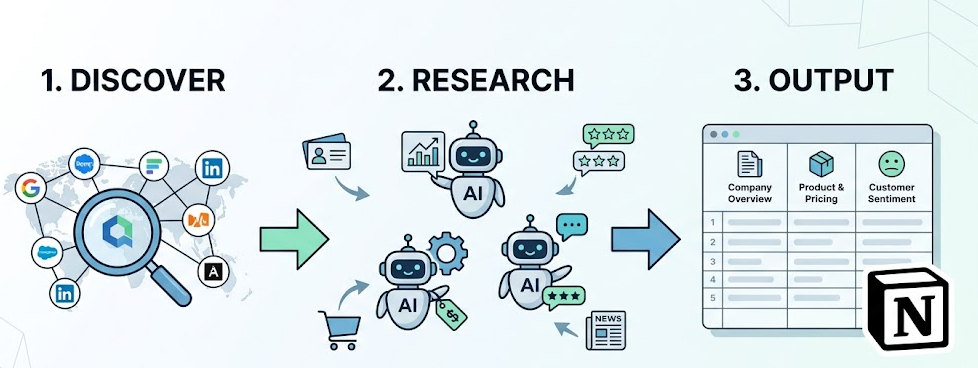
Stage 1 — Exa.ai uses your Company URL to Identify Your Competitors
The Exa.ai /findSimilar endpoint accepts your company URL and creates a Semantic Embedding Vector from it. Exa.ai then uses the semantic vector to identify competitors by searching for companies that are similar to your company but that were developed using different business models (e.g. both well-established and emerging competitors). For this purpose Exa.ai will search over 10 billion URLs for companies with similar market position as your company. The process begins with Exa taking a URL, creating an embedding vector from it, and then searching the web — over tens of billions of pages that are refreshed on a minute-by-minute basis — looking for companies that have a similar profile.
After all of that searching, it will find you a complete list of URLs, names, and descriptions for companies you may not have previously known.
This isn’t a general search like you might use on Google; you can use a keyword search in Google and find multiple pages that may contain any of the different words you typed in. Exa uses a neural search to find companies with a market position that is similar to other companies’ positions that use different terminology than you do. Exa.ai's neural search can find you a startup that has just launched six weeks ago, an enterprise company that is moving down market from where it previously was, or a point-solution company that is competing with you on 3 of your core functions.
Stage 2 — Research is done on Each Competitor by 3 AI Agents
Three specialized AI agents will perform research to gather the company data, product feature set and customer reviews of each company within your results; using SerpAPI and Firecrawl, this work occurs concurrently, and should take less than 5 minutes to complete for each competitor company.
Each company on your final list will go through 3 AI agents at the same time.
Company Overview Agent reviews the information from these sources: Crunchbase, LinkedIn, WellFound. For each competitor collected it will gather team size, funding history, founding team and business model data. This step should take less than 90 seconds per company.
Product Offering Agent will scrape competitors’ pricing pages, feature pages, changelogs and documentation. This agent will extract from the scraped data the following: pricing tiers, feature lists, recent updates, positioning claims.
Customer Reviews Agent will search for customer reviews on G2, Capterra, Trustpilot, Reddit, and the app stores. This agent will summarize the customer sentiment; indicate the strengths and weaknesses customers tend to mention about the product, and identify any patterns of significant review occurrences.
Stage 3 — Report Results will be Entered into Your Notion Database
The results of all of the 3 agents' research findings about each competitor will be inserted directly into your Notion database through the Notion API with each respective competitor being added in a structured row along with an associated field for the “Last Updated” date of all the data collected on that competitor.
Once the 3 agents finish their research on all of your competitors, the research results will be compiled. You can use ASCN.AI to capture competitor metrics directly into your Notion database. Each competitor receives one row; the fields update for each new execution.
If a competitor introduces a new pricing tier, you will learn about it when the updated row appears in your database. If there is an increased number of negative reviews about the competitor, that will generate a flag in your database. If a major executive is hired at the competitor, you will be able to capture that information in their company overview.
With the Starter version of ASCN.AI, you will execute your competitor research on a weekly basis. On the Pro version, you will execute your competitor research on a daily basis. If you enable your competitor alerts in the Slack app, you will receive immediate notification for significant changes that occur within the competitor data.
ASCN.AI’s automatic signals tracking runs four signals. There are four different signals tracked by ASCN.AI’s automated, ongoing signal monitoring:
- Product Signals: Pricing Page, Feature Page, Change Log, and Release Notes
- Market Signals: Funding Rounds on Crunchbase, Executive Hires on LinkedIn, and Press Releases
- Customer Signals: G2 and Capterra Reviews, Reddit Postings, App Store Reviews
- Content Signals: New Blog Posts, New Landing Pages, Keyword Ranking Changes
Why Manual Competitor Research Breaks in 2026
Manual competitor research will completely break down in 2026 due to 3 compounding issues; it will take 30-60 work hours a month to manage competitor research, 65% of sales representatives will not use outdated information, and new competitors will not be discovered through manual research methods.
65% of manual sales documentation is never used. The primary reason of this is due to sales reps trusting only current and accurate data in their sales documentation (as documented by Landbase research, which was cited by Klue). There are three specific failure points when attempting to manage competitors through manual tracking methods:
The Time Issue
Competitor research performed manually by the average organization, takes 30-60 hours per month. At the very least, each competitor requires 4-8 hours per quarter to track properly. AI automation can reduce this by 85%-95% or more. According to Klue's research, GTM professionals save an average of 12 hours per week on research-based tasks when using AI-based CI tools.
The Stale Data Issue
Manual competitor research is performed on a quarterly basis, while most competitors are performing updates to their business on a weekly basis. By providing continuous and automated updates to your competitor data, you will eliminate the stale competitor research problem entirely. The global market for Competitive Intelligence tools is currently $0.87 billion and expected to increase to $4.03 billion by the year 2034 at a compounded annual growth rate (CAGR) of 21.17% (according to Fortune Business Insights). By 2024, 68% of companies will be utilizing AI-based CI systems as part of their CI program.
The "Discovery" Challenge
CI programs generally capture the information on their existing competitor set, but don't typically capture additional new competitors that have just entered the marketplace. Through our Exa.ai /findSimilar tool, CI teams can input their company website URL and receive back a list of all companies that share similar semantics to them, including competitors they had never considered previously (e.g. new entrants to the market). The discovery process should be first, and the monitoring process second.
According to a recent benchmark study, companies that have and systematically utilize CI show a 23% faster revenue growth rate than non-CI companies and 18% greater profit margin.
Exa.ai Provides Dramatic Advantages Over Traditional Place-Based Search For Uncovering Competitors
Exa.ai provides better results than traditional place-based (keyword-based) searching for discovery of competitors because it focuses on the semantic meaning of the search term rather than the keyword itself; thus, allowing the retrieval of companies with similar market positioning even when the competitor does not use the same term.
Traditional search engines such as Google rely on the user knowing specifically what to search for, while Exa.ai converts the URL of the company being searched into a semantic embedding and searches for companies that have pages with similar semantics. A competitor does not necessarily have to use the same terminology that the company searching used, but simply provide products/solutions to a similar audience.
| Metric | Manual Research | ASCN.AI Automation |
|---|---|---|
| Time Per Competitor | 4-8 hours / quarter | 0 (automated) |
| Research Frequency | Quarterly | Weekly (Starter) / Daily (Pro) |
| Data Sources Per Competitor | 2-3 visited manually | 8+ automatically |
| Competitor Discovery | Only known competitors | Automatically via Exa.ai neural search |
| Output Destination | Scattered Google Docs | 1 Notion database (accessible by your team) |
| Say You Find Price Change | Only if someone reports it | Slack notice within 24h (Pro) |
| Monthly Cost | $150-$300 per month for employee(s) | Starting at $59 per month |
| Setup Time | None | Max. 48 Hours |
What ASCN.AI Sets Up And Maintains
ASCN.AI manages the complete technical stack including Exa.ai, SerpAPI, Firecrawl, and Notion API integration. All tool costs are included in the service fee, and ongoing support is also included.
Everything runs on the ASCN.AI infrastructure. All tools are bundled into 1 full stack:
- Exa.ai neural search for automated competitor discovery
- Multi-agent AI for workflow orchestration
- SerpAPI for targeted web searches by competitor
- Firecrawl for content extraction from competitor websites
- Notion API for database population and updates
- Optional Slack webhook alerts for major changes (Pro)
The Exa.ai, SerpAPI, Firecrawl, AI & model costs (and others) are all included in the ASCN.AI service fee. This will eliminate the need for separate subscriptions. When a competitor re-designs their site and the extraction stops functioning, we will fix it.
PRICING
Competitor research automation service from ASCN.AI starts at $59 / month for up to 10 competitors. Weekly Notion database updates, automated discovery by Exa.ai, and full maintenance of the pipeline are included. Setup takes 48 hours. Starter or Pro? Which subscription is for you? Find out below:
| Feature | Starter | Pro |
|---|---|---|
| Price | $59 | Custom |
| Competitors tracked | 10 | Unlimited |
| Update frequency | Weekly | Every Day |
| Notion database | Yes | Yes |
| Slack alerts | No | Yes |
| Custom Notion fields | Standard | Custom |
| Deployment | 48 hours | 48 hours |
Book a free 20-minute consultation to verify fit.
Prices (Exa.ai, SerpAPI, Firecrawl) are included in your service fee. Pricing subject to change. Results will vary based on how each competitor's site is built, how many pages are on their site, and how many they have indexed.
Frequently Asked Questions
What is Exa.ai and why use it for competitor research?
Exa.ai is a different type of search engine. Rather than simply matching your search term with something found on the web, Exa.ai finds web pages based on their semantic meaning, rather than keywords. When you search for your business with Exa.ai, it returns a list of companies that are similar to yours from a market perspective. This means that many of the companies returned may be ones you have never encountered previously. Traditional keyword searches rely solely on finding those companies that are already known to exist. Exa.ai finds competitors you didn't even know existed — startups, adjacent companies, feature-level competitors.
How long does it take to set-up?
ASCN.AI sets up a full competitor research pipeline in 48 hours. After a brief consultation to confirm your company URL and Notion database preferences, within two days, the pipeline will be live and operational. You do not need any technical ability.
What does ASCN.AI collect from competitors?
Three categories – company data (team size, funding, and executive from Crunchbase and LinkedIn), product data (features, tiered prices, and recent updates and changelogs posted on their website), and customer sentiment (G2, Capterra, Trustpilot, and Reddit reviews). All of the information collected will be written to structured fields in the Notion database that you designated when your pipeline is run.
May I add competitors to track that Exa.ai found?
Yes! When you use Exa.ai for the findSimilar feature, it creates an automated discovery layer of competitors for you. If you would like to track additional competitors that were not discovered by Exa.ai, ASCN.AI will manually add the URLs of those competitors to your tracking list as needed. Both automatically found and manually added competitors will be processed through the same three agent research process, and both will contain the same information written to your Notion database after each pipeline run.
What if a competitor changes its pricing?
When the pipeline runs on its next scheduled run, it will capture the new pricing. If you are on the Pro Plan and have enabled Slack alerts, you will receive an immediate alert when a significant change occurs. If you are on the Starter Plan, you will receive a summary of any changes made (including pricing) in the report within 7 days on your next weekly pipeline run.
Do I need a Notion account to use ASCN.AI?
Yes! ASCN.AI writes research data from your pipeline directly to your Notion database using the Notion API. The free account at Notion is all you need. ASCN.AI will do all database configuration, and field configuration, and handle API integration; all you need is a Notion account.
How is ASCN.AI different from Klue/Crayon?
Klue and Crayon are enterprise SaaS platforms and are generally priced at $15,000+ per year. They are built around large CI teams that have dedicated analysts and typically take months to onboard. ASCN.AI is a done-for-you automated solution that starts at $59/month, can be up and operating within 48 hours, and does not require an analyst or enterprise contract to operate. If you and your team are using Notion and need up-to-date competitor data, ASCN.AI is your best option.