



- Русский
- English
- Português
Automate regulatory compliance monitoring with ScrapeGraphAI and email alerts
ASCN.AI leverages ScrapeGraphAI to automate the daily monitoring and extraction of regulatory filings from agencies like the SEC, FDA, and GDPR. This service delivers prioritized alerts by 9:00 AM, helping compliance teams eliminate manual tracking while saving up to 82% of staff time and significantly reducing operational costs.

ASCN.AI uses ScrapeGraphAI for monitoring and extracting filings and amendments from regulatory agency websites daily (incl. Federal Register, SEC, FDA, GDPR, etc.), classifying filings/changes, assigning urgency, and sending prioritized email alerts to the compliance team by 9:00 AM, with setup time of 48 hours at a cost starting at $59 per month.
Key Info
- Setup Time: 48 hours
- Alerts are sent: Daily by 9:00 AM (4-hour cycles are available)
- Types of Agencies Monitored: Federal Register, SEC, FDA, FINRA, CFPB, FTC, GDPR DPA, plus additional
- ScrapeGraphAI Total Costs: ~$182 year for 20 URLs/daily (Growth tier)
- ASCN.AI Compliance Service: Beginning at $59 per month
- Compliance cost reduction: 45% Average (Ponemon Institute)
- Missed Filing Penalty Costs: $5,000–$60,000+
- Staff time saved: 82% Documented Savings (2026 study)
Last Tuesday, compliance staff manually checked Federal Register for compliance. 19 open tabs, color-coded spreadsheet, and 3 hours of painstakingly reviewing email forms was the result. So, by Thursday, when the compliance summary went into someone's inbox, comment period was already open.
This isn't due to negligence. It is due to manual mathematical processes.
ASCN.AI deploys ScrapeGraphAI to provide regulators with the tools necessary for tracking proposed filings/changes in order to have resolution by 9 AM. Setup in 48 hours, no developer needed.
The Manual Compliance Monitoring Issue
Compliance teams spend 10-20 billable hours on manual regulatory filing tracking, which costs $45,000–$55,000 per year for a full-time compliance coordinator, and penalties for missed filings are $5,000–$60,000.
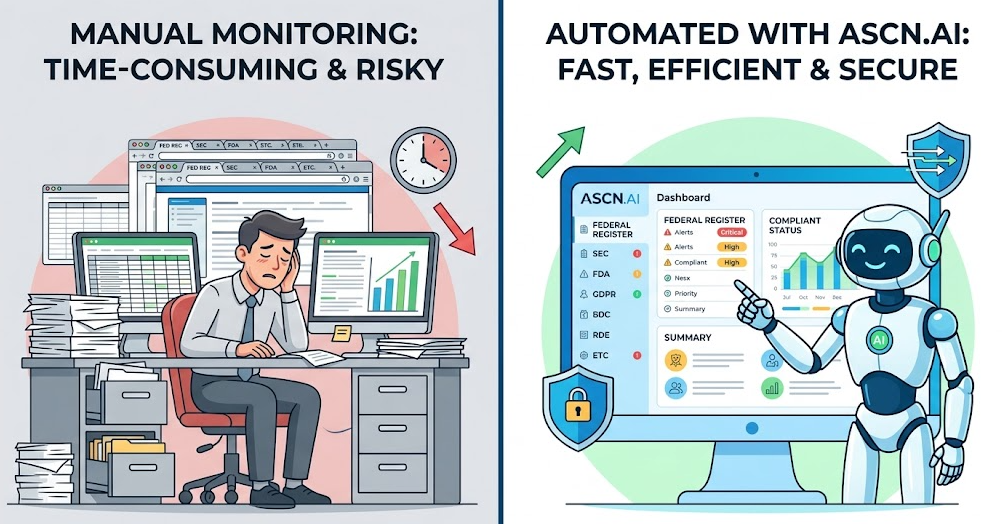
Costs for Manual Compliance Tracking
In total, compliance teams in the United States spend 10-20 billable hours each month manually tracking the regulatory agencies' filings for compliance through spreadsheet updates and sending confirmation emails (new regulations) that are often lost or buried in employee-inboxes. How to resolve conflicting information from 3 federal agencies that published different editions of identical guidance documents.
A case study for a firm with twelve employees in 2026 determined that regulatory tracking for this firm employed three members for 22 hours per week. More than half of one full-time equivalent worked reviewing federal agencies’ web pages without accomplishing any "work."
The average cost for a compliance coordinator is $45,000 to $55,000 yearly. Employees still miss many regulations by merely reading them. Attention spans wane. The majority of regulations publish around 11:00 PM. Very few people (if anyone) review the U.S. Federal Register at midnight.
Penalty Calculation
Missing a required regulatory filing exposes you to monetary fines from $5,000 to $60,000 per violation or $20 Million and 4% of your company's worldwide annual revenue pursuant to the European Union's General Data Protection Regulation, and similarly from the European Union for the "Artificial Intelligence Act" with penalties of $35 Million and 7% of a company's overall global annual revenue by August 2, 2026 for failing to comply with said regulations.
One audit finding will have remediation costs from $15,000 to $50,000 related to staff and follow-up audits.
Automation will not eliminate your company's risk of being non-compliant with regulations, but rather will eliminate the specific risk of missing regulations because you were not aware that the regulations exist until after the deadline had passed.
ScrapeGraphAI Capabilities
ScrapeGraphAI uses artificial intelligence (AI) and web scraping technologies, along with large language models, to reliably extract data and information from any website, including those required by law to be published by federal regulatory agencies. ScrapeGraphAI can read the text of every regulation through the same lens a human analyst would apply to interpret the published regulations, while automatically adapting to any changes made to the original format of the published material.
SmartScraper vs Extract API
There are two primary endpoints utilizing the ScrapeGraphAI application programming interface ("API") for regulatory compliance: SmartScraper (v1) — experienced with government websites and stable on Federal Register and agency web portals, and Extract API (v2) — which contains improved structured data and is utilized by ASCN.AI for regulation monitoring by default but is also available to meet other specific client requests.
The price structure for both of these product/service offerings is based upon total credits utilized with the cost of one credit equal to one page of content scraped will use ten credits. Tier of growth: For every page, there is a cost of $0.025. The approximate API cost for monitoring 20 regulatory URLs daily is $182 a year, but the cost is greater than that simply from missing one SEC filing.
Layout changes do not affect it
Redesigning government web sites. Class names change. Navigation changes. A scraper built using hard-coded selectors will break. ScrapeGraphAI is programmed to look for “the date this document was published,” not a specific CSS class; thus, it will find the document regardless of how the HTML is structured. When there are significant redesigns, ASCN.AI will modify the Extraction Prompt without any additional fees.
How Automation Works — Steps
The workflow runs daily via n8n: (1) schedule trigger fires at 9 am (2) ScrapeGraphAI Scrapes Configured Regulatory URLs (3) AI Extracts Structured Fields (4) 24 hr filter removes previously published documents (5) assigns Impact Classification; Critical/High/Medium/Low (6) the compliance team receives Prioritized E-Mail Alerts.
- The schedule trigger for ScrapeGraphAI to scrape regulatory URLs and return structured, extracted documents to compliance team, fires at 9 am. The schedule cadence can be customized (daily basis); for agencies with critical/high priority (intraday cycles may be added).
- The SmartScraper extracts the regulatory updates (one per URL) from ScrapeGraphAI. The structured extracted documents include: Title; Publication Date; Issuance Agency; 3–5 sentence summary; Affected Sectors; and Compliance Deadline if present.
- Once extracted from the URL, the previous 24 hr filter is applied to each regulatory update and only the previous 24 hours’ updates are extracted for compliance team’s use.
- The regulatory updates received by the compliance team will be assigned an Impact Classification of Critical; High; Medium; or Low based on their relevance to the sector they relate to; their urgency; and their potential for penalty.
- The compliance team will receive e-mail alerts that will be prioritized (Critical/High to Chief Compliance Officer and Legal Team directly, Medium/Low to receive a Daily Digest).
In practice
9:01 am Tuesday. At 11 PM the previous evening, the newly published supervisory guidance document of the CFPB is detected by the Workflow. From this, the title of the document, a four-sentence summary of its purpose, date of issue, and PDF link to the original file are extracted before ScrapeGraphAI identifies it as High impact — Client. A compliance officer will receive an email with, summary, impact level, pre-generated task at approximately 9:03 AM on this date. Both the compliance officer and legal lead of the company working with this particular client will have read the email by 9:30 AM the same day. The window for commenting on the new rule is 60 days after it has been issued, and both individuals are prepared to respond promptly.
Scheduling options
Default: once per day at 9 a.m. per day; additional updates will occur based on 4-hour cycles; during active periods of regulation (FDA comment period, SEC rule making), the frequency of updates will be increased until the regulatory period has closed; the frequencies can be adjusted after initial configuration was completed on each client site.
Which Regulatory Sources Can Be Monitored?
ASCN.AI can monitor all regulatory-related public resources. The “out of the box” list of regulatory sources includes the Federal Register, SEC EDGAR, FDA, FINRA, FTC, CFPB, EU Official Journal, and the GDPR Data Processor portals of the 27 member states of the EU.
Federal Regulator Agencies
| Agency | Website | What's Monitored | Sector/Industry |
|---|---|---|---|
| Federal Register | federalregister.gov | all regulatory changes (approx. 80K docs/yr.) | all sectors |
| EDGAR (SEC) | edgar.sec.gov | rule changes, no action letters, enforcement actions | Fintech, finance |
| FSS/FDA | fda.gov; Federal Register | drug approvals, device guidance, comment periods | pharma, medtech |
| FINRA | finra.org | rule changes, enforcement actions | fintech, finance |
| FTC | ftc.gov | privacy, competition, consumer protection | tech, e-commerce |
| CFPB | consumerfinance.gov | supervisory guidance; rule changes | fintech; lending |
| DOL | dol.gov | labor regulation | all sectors |
| EPA | epa.gov | environmental compliance | manufacturing, energy |
| CMS | cms.gov | medicare, medicaid, healthcare policy | healthcare |
For those fintech companies with FINRA monitoring, ASCN.AI provides monitoring on both rule changes and enforcement actions. For pharmaceutical companies, we are tracking both the FDA Guidance Documents and Federal Register FDA section at the same time using the same tool.
EU and International Sources
We scrape and summarize non-English regulations and directives from the European Official Journal (eur-lex.europa.eu), values from the General Data Protection Authority portals of all 27 EU member states, the FCA in the UK, and the European Banking Authority. Using ScrapeGraphAI, we are able to scrape the non-English sources (e.g. CNIL in France, BfDI in Germany, Garante in Italy), summarize them, and deliver them in English.
What Happens When a Change Is Noticed?
- Critical: Changes will impact core operations; changes require action within 30 days. Each chief compliance officer (CCO) or general counsel will receive an individual alert when there is a critical change, and teams must work within the 30-day timeframe. A pre-generated task description has been included for the CCO, general counsel and team leads.
- High: Changes will be significant; changes will require action within 30-90 days. Each CCO, general counsel, and their teams will receive a morning digest of all high-impact or urgent changes flagged for same-day review.
- Medium: Changes are relevant but non-urgent and all changes will be included in a daily digest emailed to each compliance department.
- Low: Changes are for informational purposes only and all changes will be logged in a tracking sheet. A weekly summary will be emailed to each compliance department.
All change reports will be tracked through an ongoing Google Sheets tracking system that records the time of detection, individual(s) notified and actions taken to correct the issue. For organizations utilizing Notion, Jira or Asana, any alert received will be integrated with the appropriate project management system.
Cost Comparison: ASCN.AI vs. Manual vs. Enterprise GRC
| Option | Annual Cost | Setup Time | Alert Speed | Customization |
|---|---|---|---|---|
| Manual (dedicated staff) | $45,000 – $55,000 | Immediate | 2 weeks – 4 weeks | Full (low-speed) |
| Enterprise GRC (Vanta, ServiceNow) | $600 – $6,000 / user | 2 – 4 weeks | Hours – days | Moderate |
| ASCN.AI • ScrapeGraphAI | $708 / year ($59/mo) | 48 hours | Daily at 9AM | Full (any public source) |
| DIY n8n | $240 – $600 (API costs) | 10 – 15 minutes | Daily | Full (you maintain) |
12-person Firm Case Study: 22 hours/week reduced to 4 hours/week. The costs of implementing an automated compliance system are estimated at $6,200, with an average 47-day payback and 82 percent reduction in compliance costs, according to the Ponemon Institute.
Who This Is For
Compliance officers, legal operations managers, and in-house counsel of regulated companies (with 10-500 employees) who have been affected by SEC/CFPB/FINRA laws such as those governing fintech in particular, FDA guidance cycles in pharmaceuticals in general, and the EU's AI Act enforcement in August 2026 will all benefit from ASCN.AI. However, law firms and compliance consultants who manage multiple clients will also benefit.
Getting started with ASCN.AI
The system can be deployed within 48 hours after a 30-minute scoping call with you regarding which agencies are being monitored, how alerts should be routed, what criteria should be used to classify the agencies, and how ASCN.AI integrations could work with your task management tool (ASCN.AI will configure everything). You will have a fully functioning, live, tested workflow to work from.
After the scoping call, no technical work (development or maintenance requests for routine layout changes) will need to be completed.
Costs for the service begin at $59/month. There is a free consultation available at ascn.ai.
This article provides a brief overview of automation tools used in regulatory compliance; consult with a qualified attorney regarding your particular compliance obligations.
FAQ — Regulatory Compliance Monitoring using ScrapeGraphAI
Does it violate any laws to scrape government regulatory websites?
In general, yes (it is legal). Most government regulatory data is considered publicly available and is not protected by copyright (17 U.S.C. § 105). ASCN.AI uses appropriate rate-limitations, and all monitored sources are compliant with robots.txt standards.
What regulatory agencies are automatically monitored by ASCN.AI?
There are five U.S. agencies where you can set up your ASCN.AI account: Federal Register; SEC EDGAR; FDA; FTC; CFPB. There are also multiple EU websites including the Official Journal of the European Union and the six GDPR Data Protection Authorities within each EU country. Any publicly available source can be added to your ASCN.AI monitoring list.
For example, if a regulation is issued at midnight on Sunday morning, when will I receive an alert of the new regulation?
If the regulation is issued at midnight, you will receive the alert before 9 a.m. on Monday. Therefore, you will receive the alert within eight hours of issuance. However, you may receive alerts every four hours (i.e., within two hours of issuance), depending on how urgent the regulations are for your particular area of business (e.g., high-urgency industries will have alerts sent every four hours).
What types of information will be extracted from each regulatory update?
Standard information will show the following: title; date of issuance; agency; AI-generated 3 to 5 sentences summarizing the regulation; reason why the regulation will have an "impact"; list of sectors affected by the regulation; date the regulation must be complied with, if applicable; URL of the regulation's source; recommended actions to be taken; PDF download link, if one exists.
Will I be able to customize the targets monitored by ASCN.AI as well as who receives the associated alerts?
Absolutely. During the scoping call, you will configure the following: targets to monitor, routing of alerts according to role and impact, and criteria for accounting for impacts in their industry.
How accurate is ScrapeGraphAI in relation to government regulatory websites?
ScrapeGraphAI "reads" all content semantically, so minor layout changes should not affect the system's ability to accurately extract regulatory updates. ScrapeGraphAI has consistently provided accurate data on the Federal Register and SEC EDGAR websites using its semantic reading capabilities.
If a government website undergoes a major layout change, what will happen?
If a major layout change occurs, ASCN.AI will revise the way it extracts data at no cost to the user.
What is the monthly subscription cost for ASCN.AI?
There are three subscription tiers, all of which include configuration of workflows, maintenance, and management of workflows:
- Basic: $59/month.
- Growth: $159/month plus ScrapeGraphAI API usage costs; on average, $182.00/year for daily access to websites. Growth tier subscriptions are available directly from ScrapeGraphAI.
Book your free consultation at ASCN.AI.