



- Русский
- English
- Português
Telegram Message Analysis with OpenAI — Automated Processing Service
In 2026, manual chat moderation is obsolete. This comprehensive guide explores how autonomous AI agents analyze Telegram data in under 10 seconds, saving 1,200+ hours monthly and providing real-time arbitrage signals for crypto traders.

Telegram Messaging Analysis is the ability of Artificial Intelligence (AI) to analyse messages received from Telegram chat rooms, groups, and channels and extract valuable information. AI enables automatic classification of user questions, understanding user sentiment, and automatic and immediate responses to users without human intervention.
How Does the Telegram Messaging Analysis System Work?
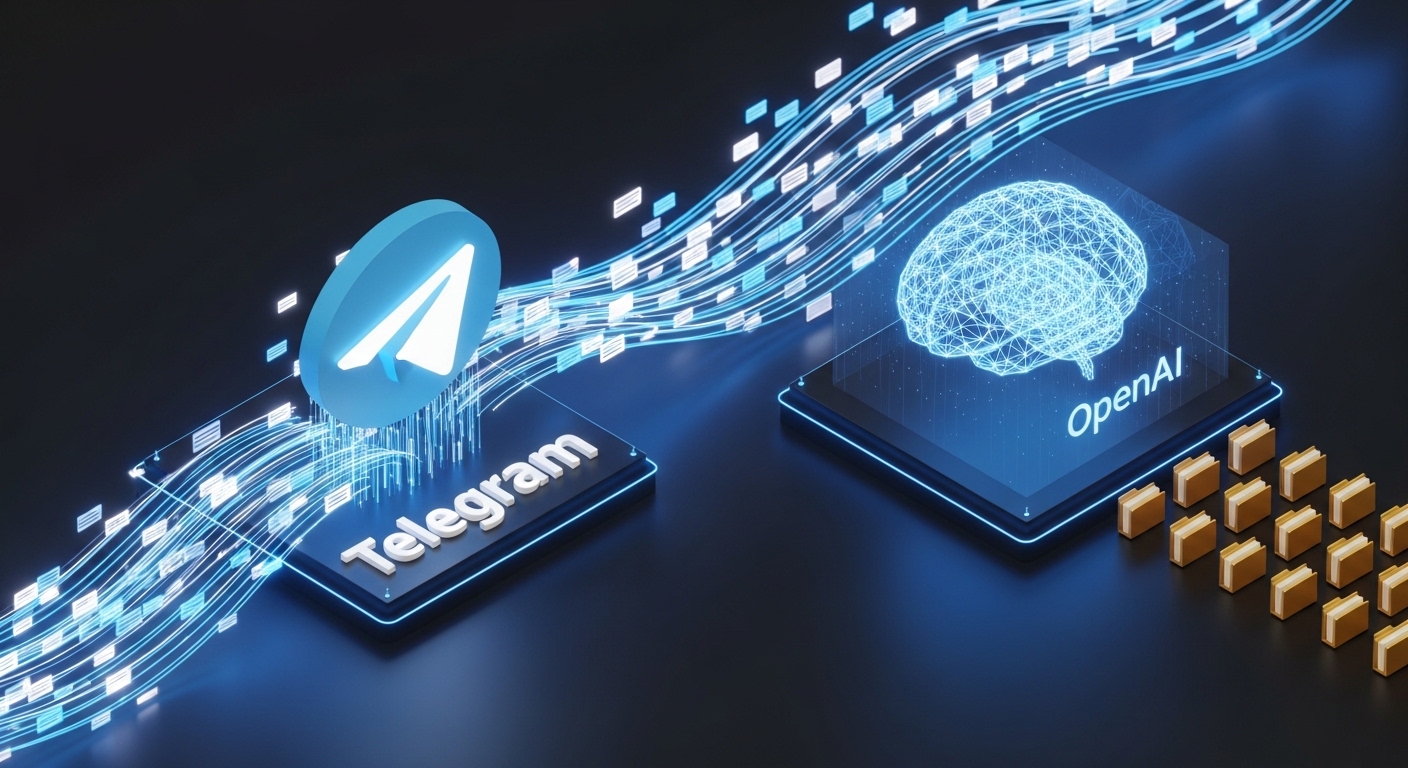
The Telegram Messaging Analysis service uses a hear–think–act model. The AI system connects to the Telegram API, receives messages as they arrive, sends them to OpenAI for analysis, and returns structured responses (i.e. User Responses, CRM entries, and Manager Notifications) to users, companies, or managers.
This service has proven to be extremely beneficial in the Cryptocurrency Market due to the volatile nature of the markets. During times of extreme market volatility, such as the Market Crash on October 11, 2024, which resulted in a 22% loss in Market Capitalisation, Messages posted in chat rooms, groups, and channels generated hundreds of messages every minute.
During these types of market crashes or extreme volatility, human labour is unable to keep pace with the number of messages. Our system was able to automatically retrieve user messages in real time, analyse the content of those messages, and provide our customers with Arbitrage Instructions, allowing them to execute profitable trades while other traders were attempting to sort through all of the messages manually.
Applications of Telegram Messaging Analysis include:
Ecommerce: The use of the Telegram Messaging Analysis service to assist Customer Service agents to automatically filter support requests by topic and direct customer inquiries to appropriate departments, or provide customer inquiries with templated replies.
Cryptocurrency Trading: The use of the Telegram Messaging Analysis service to monitor Tokens that are being discussed in chat rooms or message groups, and provide immediate alerts to traders about potential Scam, Rug Pull, or Dump Events when those events occur.
HR and Recruiting: The use of a bot to automatically screen job candidates and ask follow-up questions of each candidate during the screening process, and to send through relevant resumes to recruiters.
Finance & Accounting: The use of the Telegram Messaging Analysis service to automate receipt of inquiries from other companies, automatically create and send invoices, and monitor corporate spending limits through Corporate Chat Channels.
Why Should You Use OpenAI to Analyze Messages?
OpenAI's state-of-the-art Language Models, GPT-4 and GPT-4 Turbo, are able to interpret text in a way similar to humans. They have a very large Context Window of up to 128,000 Tokens (equivalent to approximately 300 pages of text) meaning they can analyze entire conversations while keeping track of the smaller details such as nuances, jokes, and slang. This enables them to create highly realistic responses that resemble those supplied by a human being during a live conversation.
Why are OpenAI's Models More Successful than Traditional Methods of Analysis?
High Accuracy of Recognition: OpenAI's models have been trained and fine-tuned to be able to deal effectively with typos and other subtle nuances of human language. These models provide accuracy in excess of 90% accuracy while traditional Rule based Systems are typically only able to achieve an average of 60 to 70% accuracy.
Large Number of Languages Supported: GPT-4's ability to understand and respond in over 50 Languages including; English, Russian, Spanish, and Chinese allows you to conduct Global projects much more easily.
Flexibility of Style for Communication: You have the ability to define the style and tone that you would like GPT-4 to use to create a response, including Friendly, Formal, or Technical styles - something that is not possible with traditional methods.
Ability to Combine with External Data: Integration with external data from your company includes CRMs, Knowledge Bases, and On-chain Metrics via the OpenAI API (Application Programming Interface). A question like "Why is my Token down?" is answered with real-time data including Exchange Rates and Whales (people with large amounts of cryptocurrency).
Method Comparison:
| Method | Accuracy | Processing Time | Cost | Flexibility |
|---|---|---|---|---|
| Regex and Keywords | 60–70% | <1 second | Low | Low |
| ML Classifiers (e.g. BERT) | 80–85% | 1–3 seconds | Medium | Medium |
| OpenAI GPT-4 | 92–96% | 2–10 seconds | Moderate (pay-as-you-go) | Maximum |
| Custom Fine-tuned LLMs | 90–94% | 3–8 seconds | Expensive | High |
OpenAI offers ASCN.AI the most desirable solution with an optimal balance between quality, speed, and cost. Establishing a proprietary model would require an estimated investment of $500,000+ in development and numerous machine learning engineers.
How Our Service Works
OpenAI Technology Capabilities:
The OpenAI training process begins by training the model on large collections of textual data, including books, articles, and computer code. Once trained, the models were capable of generating text with a very high level of accuracy, resulting in coherent and meaningful textual output. The primary functions of our message analysis assignments include classification of messages, generation of responses, and structured data extraction.
Primary Models / Tasks:
GPT-4 Turbo: This is the highest-level option. It is best for very complex conversations or cases (i.e., customer support) and legal text because it has an enormous context window.
GPT-3.5 Turbo: This model is generally faster and cheaper than GPT-4 Turbo, making it better suited for tasks that use templates than GPT-4 Turbo. The speed is approximately 2 to 3 times that of GPT-4, while the price is less than half that of GPT-4 Turbo; however, the quality is similar to that of GPT-4 Turbo.
Function Calling: The ability to call additional functions (via an API) from within the app to obtain the current market price of BTC, thus reducing complexity for integration and increasing efficiency in the case of simple execution.
Embeddings: These are used to identify the meaning of a message, as opposed to keywords.
Examples of Real-World Use:
Case Study 1 — Crypto Exchange Customer Support:
In the past, three operators would have handled an average of 120 requests per day, with an average response time of eight minutes each. Integrating AI powered by GPT-4 has enabled 70% of inquiries to be resolved without human assistance (through FAQs, status inquiries and rulings), with the average response time now only 45 seconds. Monthly salary savings from automated responses now total $4,800; however, the OpenAI API charge per month amounts to only $320.
Scenario Two — Sentiment Analysis of Telegram Channels
Using the GPT-3.5 model, over 50 popular crypto channels were monitored in order to determine each channel's sentiment at any particular time on a scale of negative (-1) through positive (+1). If there was a significant decrease in a channel's sentiment (i.e., < -0.6) within a five minute timeframe, the system will alert users to provide them with trading opportunities. For example, during the recent Falcon Finance crash, users who received short-term notifications (i.e., eight minutes) earned an extra $1,000 due to their early warnings about price declines.
Scenario Three — Information Extraction from Chaotic Requests
Clients' requests for information have been submitted to ASCN.AI in different forms. ASCN.AI was able using the GPT-4 model with Function Calling feature, to extract relevant details (e.g., client's name, request and budget) from all random submissions in the form of JSON and subsequently create leads with a workflow in the company's CRM. Consequently, the processing time associated with creating leads using this function was reduced from approximately three minutes to just fifteen seconds.
Integration with the Telegram API
The Telegram API allows for the sending/receiving of messages as well as bot functionality, which can be established using ASCN.AI's NoCode platform. To integrate the Telegram API using ASCN.AI's NoCode platform, a user must follow these three steps: Create a Bot via botfather SDK; Save the Bot Token in the Secret Key Vault for security reasons; Create an Automated Workflow utilising Polling event trigger (and another AI Agent Node to process the logic).
Reporting Stages and Analysis
Data Capture: Data captured via Telegram API consists of messages as they are sent in real time (text, user's name and media).
Data Processing: Text from the Data Capture source must be cleaned (removing emojis, correcting any spelling errors) and divided into separate lines on long messages. The classification of text and sentiment as well as the extraction of structured data via a prompt given by the system.
Report generation: Operators receive a summary of text; Analysts receive Google Sheets; CRMs receive a JSON format and Management receives a dashboard developed with Grafana or Tableau.
Benefits and Applications of AI
Automated Message Handling
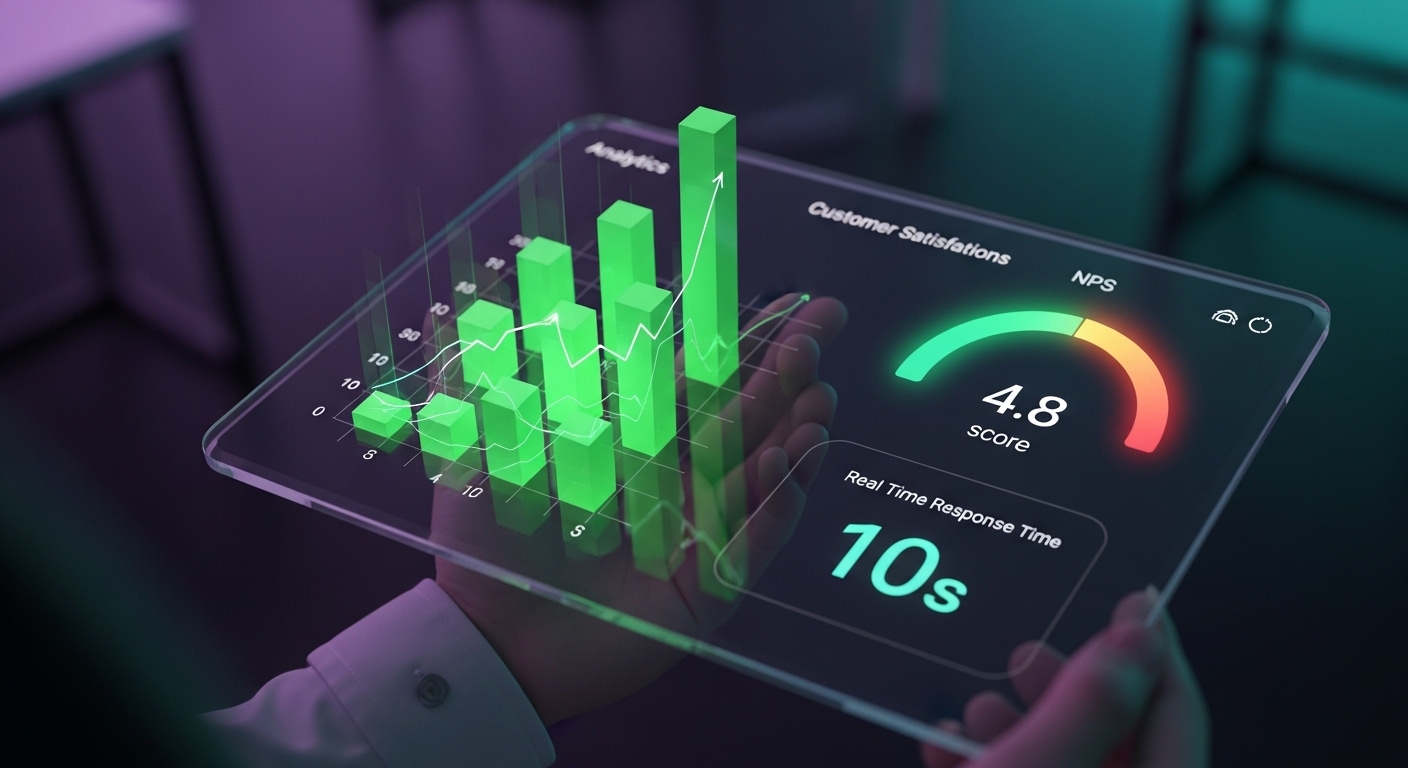
By automating this task, repetitive tasks are moved off people: they are sorted into groups, frequently asked questions are answered, data is extracted and sent. A standard request takes anywhere from three to five minutes to resolve, and for every 100 queries that results in 5–8 hours of work. AI was able to resolve 70–90% of questions within 10–30 seconds — a significant time saving.
Reduced operator workload through separating out the minor issues, enables the human operator to allocate more time to dealing with the higher complexity. This has allowed for a 40% increase in productivity.
Instant response time from the robot is 5–10 seconds. For traders who are trading crypto currencies, this is crucial. During the time of a Flash Crash last year the robot sent out 340 instructions within a 15 minute time frame; manually this task would have taken several hours.
Accuracy of the technology is 96%, with no error responses from AI.
Examples of Applications of AI
E-Commerce — Replacing 5 human operators (AI Agent). 82% of the questions received by the business are being processed by AI; therefore $7,200 savings per month.
Crypto Projects — Providing customers with support in 5 different languages; AI Agents were able to provide 75% of all customer requests without human interaction; CSAT rating rising to a 4.7 out of 5.
When employing AI to help with HR, an AI bot was able to ask candidates five essential questions and increased candidate quality from 40% to 75%, and decreased screening times from an average of 33 hours a week to 8 hours.
AI is being used to monitor Crypto communities: it scans 50+ channels and has decreased the response time from 6 hours to 15 minutes and has prevented a drawdown of token prices ranging from 20% to 30% on multiple occasions.
Technical specifications and requirements
Message formatting and data volumes
Our services are UTF-8 compliant and support all Unicode languages, including emoji. The maximum characters allowed are 4,096. Long messages may be broken into smaller parts to preserve meaning.
The text of the message will be sent directly to OpenAI.
Media: Media links (i.e., File Links) will be extracted. The text of images will be extracted from photos using vision API technology.
Voice: All audio will be transcribed with an accuracy level that exceeds 95%.
Performance levels and limits
1,000 messages/day: Free tier of Telegram, Bot API, & OpenAI.
1,000 to 10,000 messages/day: Paid OpenAI Subscription; preferred for standard tasks is GPT-3.5 Turbo.
10,000 to 100,000 messages/day: Requires Load Balancing; Processing times of 2 to 8 seconds.
100,000+ messages/day: Recommended to use Dedicated LLMs or Batch Processing with a Delay.
Security & Confidentiality
Our operations are in compliance with GDPR, the General Data Protection Regulation, and local data protection laws. Our key security measures include:
Encryption: All communication is encrypted using the highest level of security protocols, HTTPS (TLS 1.3). Tokens are stored and maintained in a secure manner, using Secret Keys and not stored or logged.
Minimal Storage — The messages are stored for processing purposes only; the metadata does not include text.
Identity Anonymization — Names and contact information are replaced by placeholders prior to sending data to OpenAI.
Access Control — Enforcement of Role-Based Access Control (RBAC).
FAQ
Can I use this if I've never used AI before?
Yes, ASCN.AI is a no-code platform with both a visual builder, and pre-made templates. We also have user guides located within the application to help you through it.
How long does it take to set up?
Depending on how complex the forum is, set up can take as little as 10 minutes for simple FAQ's, or several hours for complex integrations.
Is it safe to send my information to OpenAI?
Yes. As of March 2021, OpenAI has committed not to use data sent to it via the API for training. Connections are made over HTTPS, and we have included an identity anonymization process.
Can I integrate with my Customer Relationship Management (CRM) software?
Yes, we have supplied both a series of ready-made connectors, as well as a Universal HTTP request node you can use with any API you have.
What do I do if the AI makes an error?
You can continue to refine your prompt until it's the exact wording you want, switch to the more powerful GPT-4 model when working with complex tasks, or add a logic-check prior to transferring it to a live operator.
How much does it cost to process a message on average?
The cost to process one message is approximately $0.0001 for the GPT-3.5 model, and $0.002 for the GPT-4 model. Our subscription plans already include average processing costs.
What our customers say about us
Ecommerce Business (500+ orders daily): "Prior to ASCN.AI, we had 5 operators working the inbound email support line. The response times to customers were very long at night especially. Once we launched the AI agent, we were able to resolve 80% of customer requests in under 10 seconds. We saved $7200, and our customers loved getting answers to their inquiries so quickly."
Cryptocurrency Project (30+ countries): "We provide support in 5 languages, automate 75% of our requests, and see an 18% increase in conversions. Our customers no longer have to wait hours for a response."
Human Resources Department (50+ new hires a month): "We have automated the filtering and preliminary screening of candidates, resulting in the processing time being reduced from 33 to 8 per week. Candidates receive a response to their application in 2 minutes, rather than 2 days."