



- Русский
- English
- Português
Vera. GEO Analyst: Your Brand in AI Answers
Asks ChatGPT, Perplexity, Gemini and Grok your customers’ questions and shows who they recommend: you or your competitors. Finds errors about you and the sources behind the answers, prepares fixes, and repeats the measurement.
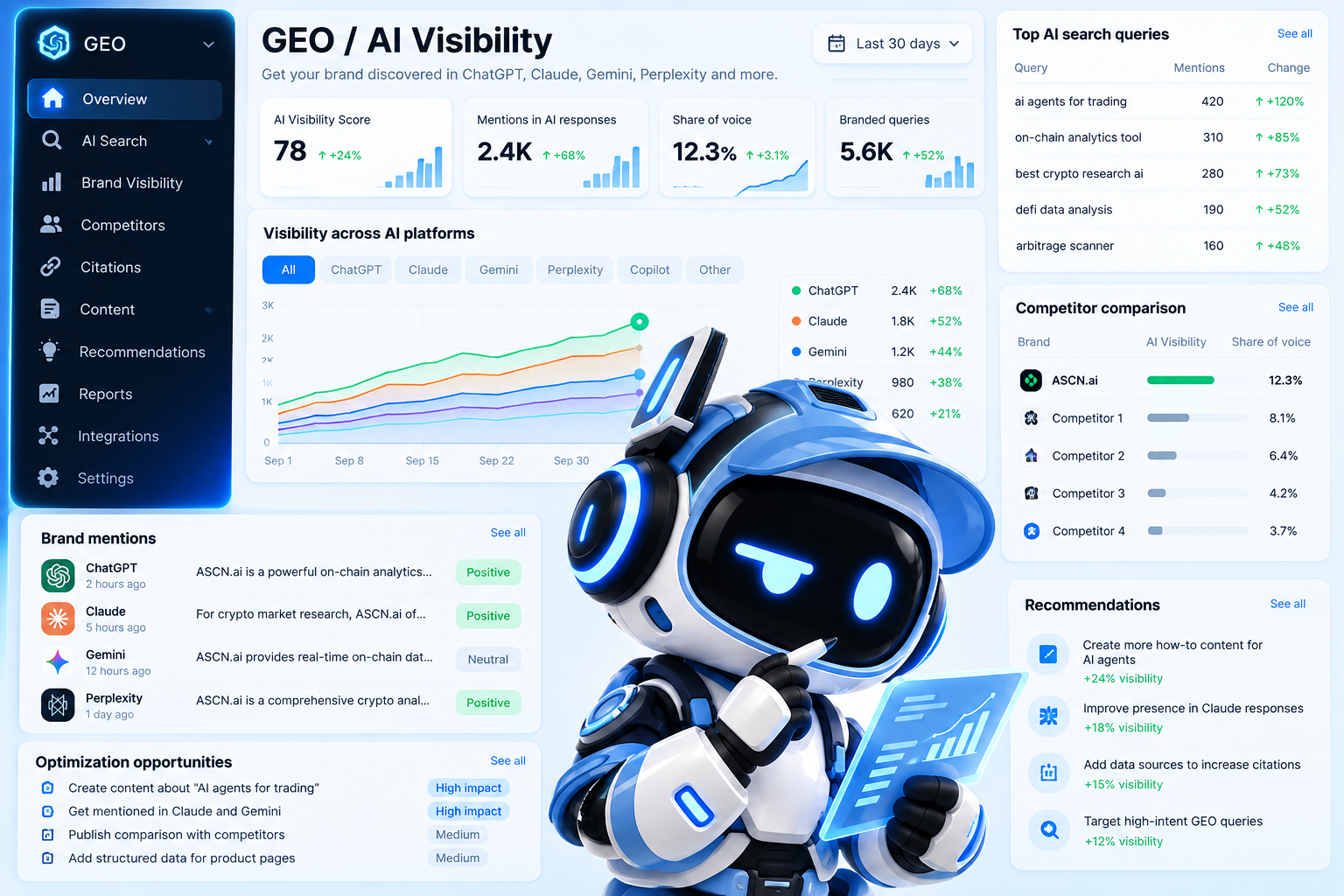

A customer asks ChatGPT: “Which CRM should I choose for a small store?” The AI names three of your competitors. You're not in the answer, and you don't even know it. Vera asks AI models your customers' questions, shows who they recommend, and prepares fixes. This work is called GEO: optimization for AI-generated answers.
What it looks like: we tested ourselves
In an internal ASCN test, we pasted ChatGPT's answer to “Which no-code platform should I choose for AI agents?” into Vera's chat. Vera broke it down right away:
The AI named Make, n8n and Zapier. All three are on your competitor list. ASCN isn't in the answer.
To record this measurement correctly, please specify: the date the question was asked, the region, and the links under the answer. AI answers change, and without this data the measurement can't be repeated and compared.
Yes, even for the company that builds Vera, the AI recommends competitors. That's exactly why one question in ChatGPT settles nothing: you need regular measurement, an understanding of where AI models get their answers, and concrete fixes.
Making changes but don't know if they worked? Vera repeats the measurement
You published a new page and updated your directory profile, but whether it helped is unclear. You asked ChatGPT once and it named you, and the next day it didn't. A couple of weeks later, Vera asks the same questions to the same AI models and compares:
“Three weeks ago, Perplexity named you in 3 answers out of 30; now it's 9. ChatGPT is unchanged: 1 out of 30. The growth coincided with publishing the comparison page, but a third-party review mentioning you came out in the same weeks, so the result can't be credited to a single change.”
They recommend a competitor and you don't know why? Vera finds what the answers rely on
AI models don't invent recommendations: they rely on specific sources like Wikipedia, reviews, directories, YouTube and review sites. Vera finds which sites the answers link to, where your competitors are present and you're not, and prepares the content: an answer page, FAQ, comparison, directory profile.
“In 14 of 30 answers, the AI models link to the same software directory. Three competitors have profiles there, you don't. Here's a ready-made profile: description, pricing, answers to common questions. You publish it.”
Selling GEO to clients? A measurement you can show them
For an agency, telling a client “we worked on your AI visibility” isn't enough. You need proof. Vera saves every AI answer with the date and a quote, and shows for the client and 3–5 of their competitors: recommended, mentioned, or not named at all. A repeat measurement a couple of weeks later gives you a before/after comparison you can put in a report, without crediting success to a single change.
AI telling customers things about you that aren't true? Vera finds the error and its source
Old prices, wrong facts, a product you discontinued two years ago. The customer believes the AI's answer and leaves without ever opening your website. Vera finds errors about you in AI answers and shows where they come from.
“Perplexity lists your plan at $49, though it's been $29 since March. The source is a 2024 review on a third-party site. I suggest updating your pricing page with an ‘as of’ date and writing to the review's author. A draft email is ready.”
Top of Google, but missing from AI answers? Vera shows you the gap
Years of SEO investment, first page of search results. But customers increasingly ask an AI instead of a search engine. SEO is about your position in search; Vera checks who the AI names in its answer. For example, here's a measurement across 30 customer questions:
| AI model | You were named | Main competitor was named |
|---|---|---|
| ChatGPT | 2 of 30 | 14 of 30 |
| Perplexity | 3 of 30 | 12 of 30 |
| Gemini | 1 of 30 | 11 of 30 |
| Grok | 1 of 30 | 9 of 30 |
The measurement comes with a list of questions where the competitor is named and you aren't, and what to add to change that.
How it works
Send your website and 3–5 competitors → Vera drafts 20–30 questions your customers ask, and you approve them → using an OpenRouter key, Vera asks these questions to ChatGPT, Perplexity, Gemini and Grok and saves every answer with the date and a quote → shows who's recommended, who's mentioned, who isn't named, and which sources the answers rely on → finds errors about you and prepares fixes as drafts → you publish → a couple of weeks later, Vera repeats the measurement and shows what changed.
How is this different from asking ChatGPT?
| Asking ChatGPT yourself | Vera | |
|---|---|---|
| How many questions | One or two, whatever comes to mind | 20–30 questions your customers actually ask |
| How many AI models | One | Four: ChatGPT, Perplexity, Gemini and Grok |
| Reliability | Tomorrow the answer will be different, and you won't know | Every answer saved with the date and a quote, so the measurement can be repeated and compared |
| Competitors | You only see what happened to appear in one answer | You and 3–5 competitors: recommended, mentioned, not named |
| Why | Unclear | The sources the answers rely on, and where you're missing from them |
| What to do | Generic advice like “improve your content” | Ready-made content: answer page, FAQ, comparison, directory profile |
Asking ChatGPT is a single snapshot. Vera shows how the picture changes and what to do to change it in your favor.
Who it's for
- Services that customers choose by comparing “which is better.”
- Product brands people ask about with “what should I buy.”
- Companies that have already invested in SEO and want to show up in AI answers too.
- Marketing agencies selling GEO to their clients.
How it went for others
Mattress manufacturer. Everything worked right away. They connected an OpenRouter key and approved 25 questions like “which mattress should I choose for back pain.” Vera found that ChatGPT and Gemini were naming a discontinued model and a two-year-old price. The source was an old review on an aggregator site. The brand updated its product pages, added an FAQ and wrote to the review's author. A month later, the error was gone from Perplexity and Gemini answers, and remained in 2 of 25 ChatGPT answers.
Digital marketing agency. This one took some work. At first they worked without an OpenRouter key: managers asked the AI models questions themselves and pasted the answers into the chat. It was slow, and Vera kept asking for the date and region, without which measurements can't be compared. Two weeks later they connected a key and agreed on a request limit. Now the agency runs a monthly measurement for four clients and shows them a before/after comparison with quotes.
CRM for beauty salons. It worked partly. Vera showed that competitors were being named because of two comparison articles and one software directory. The company published a comparison page and a directory profile. Three weeks later, Perplexity named it in 9 answers out of 30 instead of 3, while ChatGPT still named it in only one. A Wikipedia article wasn't possible: the company isn't well-known enough yet, and Vera said honestly that this route is closed for now.
What to connect
For measurements, you need an OpenRouter key. It's a service where one key gives access to different AI models: Vera uses it to ask ChatGPT, Perplexity, Gemini and Grok. Requests are billed at OpenRouter's rates, separately from ASCN. Before each measurement, Vera shows how many requests there will be and stays within the agreed limit. Without a key, Vera analyzes answers you paste into the chat.
What Vera doesn't do
- Doesn't promise you'll be named: nobody can guarantee that.
- Doesn't write fake reviews or hide instructions for AI models on pages.
- Doesn't publish on her own: content for pages and directories arrives as drafts.
Vera can also: check whether you're on Wikipedia, YouTube, review sites and directories that AI answers link to, and prepare a profile where you're missing.
FAQ
What is GEO optimization?
GEO (Generative Engine Optimization) is the work of making sure AI models like ChatGPT and Perplexity know about you, name you in their answers, and say true things about you. Vera measures who AI models recommend to your customers, finds what the answers rely on, and prepares fixes.
Is this the same as SEO?
No. SEO is about your position in search. Vera checks who the AI names in its answer.
How do I get into ChatGPT's answers?
Nobody can guarantee it. What helps is what AI models rely on: clear pages with answers, up-to-date facts about you, directories and reviews. Vera finds what's missing in your case and prepares the content.
Will Vera publish anything on her own?
No. Content for pages, directories and emails to review authors arrive as drafts. You publish and send.
Will Vera share my data with anyone else?
No. Vera works with your data only inside your ASCN account, to carry out your tasks. To get answers, customer questions are sent to AI models through your OpenRouter key. You can revoke access at any time in the integrations section. Learn more about how data is stored in the ASCN privacy policy.
How much do the AI requests cost?
Requests are billed at OpenRouter's rates, separately from ASCN. Before each measurement, Vera shows how many requests there will be and stays within the limit you've agreed on.
Can I use Vera without an OpenRouter key?
Yes. Ask the AI models questions yourself and paste the answers into the chat, and Vera will analyze them. But it takes longer, and for accurate comparison you need to include the date, region and links under each answer.
What about Alice and GigaChat?
Not yet. Measurements run through ChatGPT, Perplexity, Gemini and Grok.
How do I know what helped?
Vera asks the same questions after your changes and shows what changed. Success isn't credited to a single change: if something else happened in the same weeks, Vera will tell you.
What results can I expect after 3 months?
It depends on your niche, competitors and how many fixes you publish. Typically, after three months you have a dated history of measurements, an understanding of which sources AI models rely on in your niche, corrected errors about you, and profiles where you were missing. Nobody can guarantee you'll start being named, but you'll see the changes in the measurements.
What if I can't set Vera up?
Message ASCN support: we'll help you connect an OpenRouter key and work through your first measurement.
What if Vera gets confused?
Most often she's missing data: a competitor list, approved questions, or the date and region for pasted answers. Ask Vera herself: “What do you need for this measurement?” — she'll tell you. If she's still confused, start a new session: this clears the context, and Vera will start from a clean slate.