



- Русский
- English
- Português
WIF cryptocurrency price forecast for today and the coming month: price, news, growth prospects


about cryptocurrencies.
Thinking about jumping into WIF but not sure where to start? You can bounce any crypto question off our AI assistant. Kick off your analysis here.
| Year | Bear Case (USD) | Average Target (USD) | Bull Case (USD) | Context & Sources |
|---|---|---|---|---|
| 2025 | 0.19 | 1.25 | 3.90 | Memecoin volatility vs. Solana’s ecosystem growth; Benzinga/InvestingHaven. |
| 2026 | 0.33 | 0.89 | 8.03 | Post-halving hype cycle, though no burn mechanism is in place; Godex/Flitpay. |
| 2030 | 0.47 | 2.11 | 27.77 | DeFi integration and broader retail adoption; InvestingHaven/Benzinga. |
| 2035 | 1.00 | 5.00 | 50.00 | Speculative extrapolation; depends on cultural relevance staying power (Changelly). |
Here’s how the ASCN.AI assistant breaks down the current outlook:
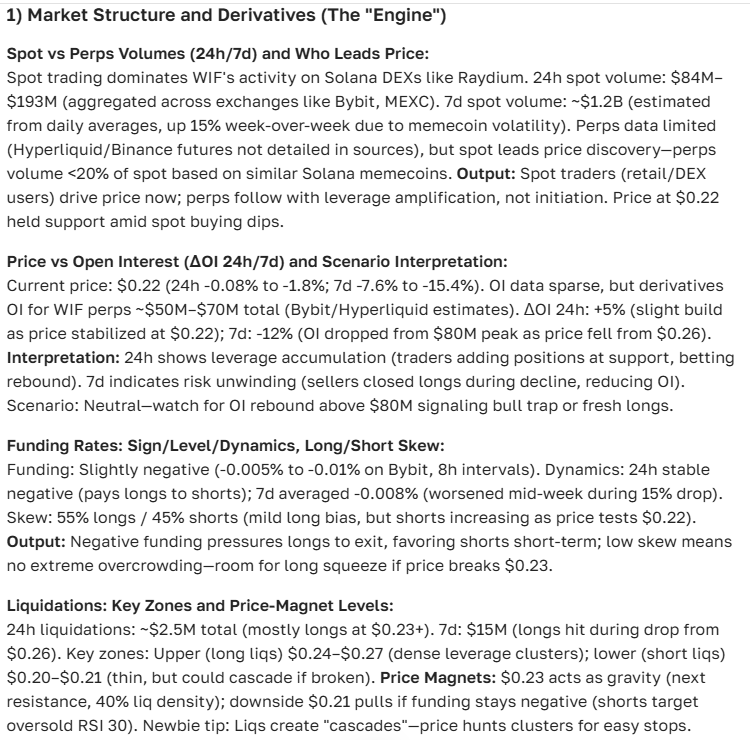
"To really get what’s happening with WIF, you need to look at more than just a chart. It’s a mix of price action, breaking news, and market sentiment. A solid forecast doesn't just crunch old numbers—it gauges the mood of the market, the strength of the Dollar, and what the experts are actually saying behind the scenes."
Where do we stand? WIF’s current price and market vibe
If you're looking at WIF price targets today, you’ve got to start with the raw data. We’re pulling real-time numbers from the heavy hitters: Ethereum and Solana nodes, exchange aggregators, and the analytical layers built into ASCN.AI.
As of right now, WIF is trading at $0.3146. That number tells a story of where investor interest sits at this very second. By tracking live data straight from the source—the actual blockchain nodes—we can see exactly how much volume is moving and whether the hype is backing it up.

Why bother with this level of detail? Because in crypto, flying blind is a quick way to lose money. Real-time accuracy is everything when you’re trying to time a move.
The tech behind the numbers
How do we get these forecasts? It’s not just guesswork. We look at on-chain metrics from Solana and Ethereum, trade flows across both DEXs and CEXs, and even the "chatter" in Telegram channels and news feeds. ASCN.AI basically acts as a filter, stripping away the noise to show you where WIF is actually heading.
Is it fast? Absolutely. The data refreshes constantly, which is pretty much the only way to keep your finger on the pulse in a market this volatile.
What’s moving the needle? Recent WIF news and events
Price doesn't move in a vacuum. For WIF, a few things have recently tipped the scales:
- Major exchange listings that finally brought some real liquidity to the table;
- Strategic partnerships within the broader ecosystem that gave the project a bit more "street cred";
- New protocol updates that actually give the token some utility.
On the flip side, it’s not all sunshine. Regulatory talk and the occasional technical hiccup have put some weight on the price. If you watch the sentiment on Telegram, it’s clear: news cycles and price swings are now practically joined at the hip.
By the way, if you want to see how these connections work in practice, check out our deep dive on how ecosystem partnerships influence price.
The "Why": Key drivers of growth (and drops)
So, what actually makes WIF tick? First off, you’ve got "whales." When the big holders move, the market feels it. Then there’s the general market mood—if Bitcoin sneezes, everyone else catches a cold. Macro factors also play a massive role, specifically the US Dollar; when the greenback fluctuates, liquidity in the crypto space follows suit.
And then there’s the "rip." In the crypto world, when someone says a coin is "ripping," they mean it’s either skyrocketing or cratering based on a sudden news blast or a massive trade. It’s high-stakes stuff.
Growth outlook: What do the projections say?
| Year | Projected Price (USD) | Change from Current (%) |
|---|---|---|
| 2025 | $0.3469 | +10.29% |
| 2026 | $0.3453 | +9.75% |
| 2029 | $1.41 | +349.7% |
| 2036 | $6.75 | +2048.32% |
| 2040 | $0.65 | +106.66% (Alternate scenario) |
Most analysts are eyeing a steady climb—around 5% annually as a baseline—but let’s be real: in this space, those numbers can change in a weekend depending on how the ecosystem evolves.
Crunching the numbers: A quick ROI example
Let’s say you put $1,000 into WIF. If it hits that steady 5% annual growth, you’re looking at about $1,276 in five years. Not bad, but not "Lamborghini money" either. If you’re playing with $10,000, that same move nets you an extra $2,763. It’s a helpful way to visualize the risk versus the reward before you dive in.
The Technical Breakdown
For the traders out there, the technicals are where the real story is. Indicators help us spot the signals before the rest of the market catches on.
Moving Averages (The "So What?" Perspective)
- SMA 50: $0.3852 (Currently signaling Sell)
- SMA 200: $0.7096 (Currently signaling Sell)
- EMA 50: $0.4011 (Currently signaling Sell)
- EMA 200: $0.6568 (Currently signaling Sell)
Basically, since the price is sitting below these averages, the bears are currently in the driver's seat.
Momentum Indicators
- RSI (14): 38.03 — We’re in neutral territory, but flirting with the "oversold" line.
- MACD: Flat. No clear sign of a reversal just yet.
- Momentum (10): –0.06, suggesting a slow, grinding decline.
- Other Oscillators: It’s a mixed bag, though the overall vibe is still leaning bearish.
Candlestick Patterns
If you’re looking at the charts, you’ll see some classic patterns forming. These are the "tells" that traders use to predict the next big move.
On the bullish side, keep an eye out for:
- The Hammer;
- Bullish Engulfing;
- The Morning Star.
If things look shaky, you’ll likely see:
- Bearish Harami;
- Dark Cloud Cover;
- The Shooting Star.
How to actually use this info?
Don't just look at one indicator. Smart traders combine these signals to find entry and exit points. By looking at candlestick patterns across the 4-hour, daily, and weekly charts, you get a much clearer picture of whether a trend is a fluke or the real deal.
Is WIF a "Buy" right now? Risks vs. Opportunity
The short answer? It depends on your stomach for risk. Buying WIF only makes sense if it hits confirmed support levels and if it’s part of a diversified portfolio. Let’s not forget: this is a high-risk asset. It’s volatile, and it’s not for the faint of heart.
The best move is to stay updated, use technical tools, and never invest more than you can afford to lose.
What could go wrong?
We have to talk about the bear case. WIF could easily drop 80% if things go south. Why? Unexpected regulation, a prolonged crypto winter, or even a few "whales" deciding to dump their bags at once. Understanding these nightmare scenarios is just as important as dreaming of 10x gains.
The US Dollar’s hidden influence
Surprisingly, the US Dollar is a major player here. Since WIF is priced in USD, any shift in the DXY affects liquidity and demand. If you’re forecasting WIF, you’re also—in a way—forecasting the US economy. Keep that in mind.
FAQ
What does "ripping" mean in crypto?
It’s just slang for a massive, sudden move in price. If WIF is "ripping," it’s either blowing through resistance levels or falling off a cliff. Usually, it’s triggered by a big news event or a massive institutional trade.
How is the price of WIF actually set?
It’s the classic battle of supply and demand on the exchanges. But under the hood, it’s also driven by on-chain activity, project updates, and broader market trends—especially what’s happening with the Dollar.
Why does the Dollar matter so much?
Because USD is the world’s reserve and the primary pairing for most crypto trades. When the Dollar gets stronger, "risk-on" assets like WIF often feel the squeeze.
What’s the short-term outlook?
- Tomorrow: Likely hovering around $0.315 (slight 0.5% bump).
- Next Week: Expect a range between $0.305–$0.336.
- Next Month: We might see a dip to $0.289 before any real recovery starts.
Is WIF a good investment?
That’s the million-dollar question. It’s high-risk/high-reward. Prices can swing 85% in a few months. If you’re looking for stability, this isn't it. If you’re looking for potential, it’s there—but be careful.
Can the price actually go up?
Analysts think so. If the project stays relevant and the market stays healthy, $1.41 is a realistic mid-term target, with $6.75 being the long-term "moon" shot.
Final Verdict
Our outlook for WIF is cautiously optimistic. The numbers suggest moderate growth, but expect some turbulence along the way. It’s a balanced game of watching the charts and staying on top of the news.
Pro-tips for investors
Don't just "set it and forget it." Combine constant monitoring with solid risk management. If you don't want to spend all day staring at charts, ASCN.AI can do the heavy lifting for you by pulling all this data into one place.
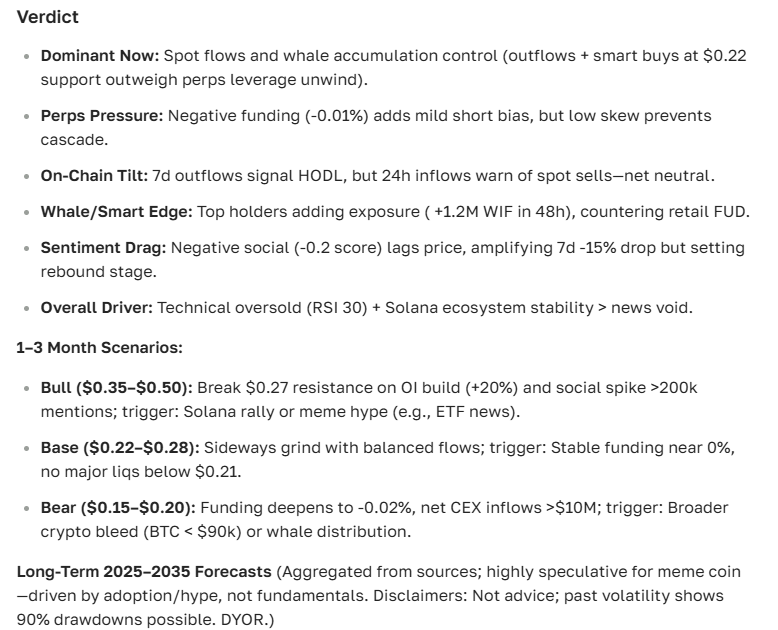
Actually, here is the final verdict from our AI assistant regarding WIF:
Disclaimer
This isn't financial advice. Crypto is a wild west. Do your own research and talk to a professional before putting your money on the line.