



- Русский
- English
- Português
Augur (RUP) Cryptocurrency Price Forecast – Price, News, and Outlook for 2025-2035

about cryptocurrencies.
Got a burning question about crypto? Our AI assistant is ready to help. Start your analysis right now.
| Year | Min Forecast (USD) | Avg Forecast (USD) | Max Forecast (USD) | Notes & Sources |
|---|---|---|---|---|
| 2025 | 0.23 | 1.10–18.32 | 30.80–252.40 | Volatility based on historical trends; CoinLore (max on uptrend), SwapSpace (min bear), Godex (avg growth). |
| 2026 | 0.23–73.51 | 1.09 | 1.89–238.10 | RSI-based algorithms; CoinLore (max), LBank (conservative avg), SwapSpace (min). |
| 2027 | 0.50 | 5.00–20.00 | 44.72 | Godex (max on adoption), ChangeHero (avg). |
| 2030 | 0.91–1.74 | 1.10–1.32 | 165.80–414.72 | Long-term growth driven by oracle tech; CoinLore (max), SwapSpace/LBank (avg/min). |
| 2035 | 0.63–65.39 | 275.49–348.49 | 499.53–503.09 | Extreme bull run on ATH breaks; CoinLore (max/avg), ChangeHero (min). |
Here is how the ASCN.AI assistant breaks down the Augur outlook:
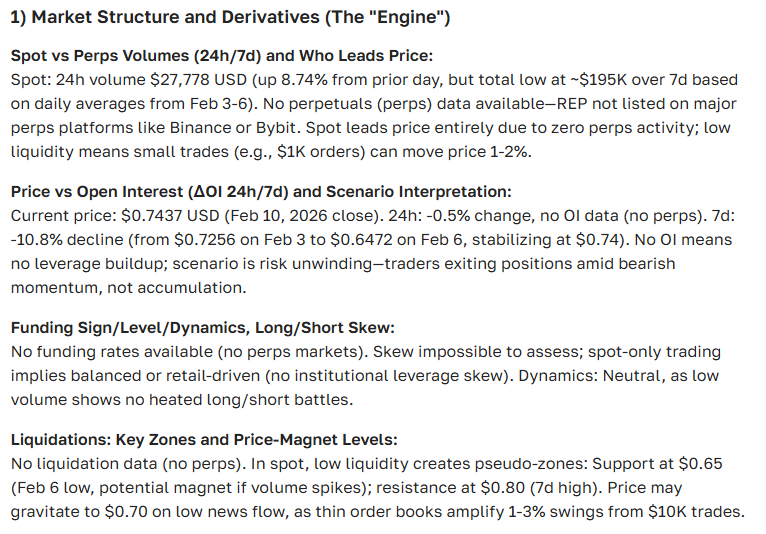
"The Augur price forecast highlights why you need to pair on-chain data with the latest news to see where an asset is actually headed."
What exactly is Augur?
In short, Augur is a decentralized protocol built on Ethereum that lets people bet on—or "predict"—real-world outcomes. Its native token, REP (Reputation), is the engine that keeps everything running. Users don't just guess; they report and verify event outcomes, which keeps the platform honest. Since its launch back in 2015, the project has remained a serious heavyweight in the prediction market space.
The real draw here is the freedom. You can set up a market for almost anything: elections, sports, or even cultural shifts. Smart contracts handle the heavy lifting, making sure everything is transparent and secure. Plus, the reputation-based tokenomics act as a built-in incentive for participants to stay honest, which helps keep market manipulation in check.
Technically, REP is an ERC-20 token with a hard-capped supply. This scarcity is a big deal for price stability. By balancing supply and demand, the project manages to stay relatively resilient even when the rest of the market starts acting up, making it a favorite for long-term players.
Where does the price stand right now?
Today, Augur is trading around $12.34. The volatility is there, but it’s manageable, reflecting both the broader crypto climate and specific shifts within its own ecosystem. It’s no surprise that it often follows the lead of Bitcoin and Ethereum, but it definitely has its own personality when it comes to price action.
Looking at the last 30 days
Over the past month, we saw the price take a bit of a breather. After hitting a local peak of $15.20 in June, it dipped to current levels. This is pretty standard for crypto. It’s not just global economics at play; internal updates and general community sentiment often dictate these swings.
The competitive landscape
Against the USD, Augur tends to move in sync with mid-cap altcoins like Chainlink (LINK) or Gnosis (GNO). While it might not have the explosive vertical spikes of some "meme" coins, it holds its support levels remarkably well. That tells us the investor interest is deep and the potential for decentralized prediction markets is far from over.
So, what’s next for the price?
In the very short term—think next 24 hours—we might see the price nudge up toward the $12.50–$13.00 range. This usually happens when protocol updates or positive community news start trickling through the headlines.
The one-month outlook
Analysts are leaning toward a potential climb to $16 or even $18 over the next month. Much of this depends on the integration of new features and whether the market remains in a "risk-on" mood. Of course, there’s always a catch: if external macro factors turn sour, those targets could shift quickly.
"Predicting Augur’s price for the next month is really about watching on-chain activity and technical signals. Right now, they point toward growth, albeit with some bumps along the way."
What’s actually moving the needle?
- Ongoing protocol development and network upgrades;
- Trading volume and community engagement levels;
- The general health of the broader crypto market;
- Regulatory shifts or new laws;
- Broad macroeconomic trends and currency fluctuations.
The news and data driving the market
Recent updates have focused on scalability and security—two things investors love to hear. These improvements have noticeably boosted market perception. On top of that, new partnerships with DeFi projects are expanding what the platform can actually do, which naturally brings in fresh blood.
What the experts (and the charts) are saying
Indicators like the RSI and MACD are currently hanging out in the neutral zone. Usually, that means the market is either consolidating or preparing for a steady climb. The fact that trading volume is picking up suggests that people are starting to pay attention again.
On the daily chart, the price is sitting comfortably above the key moving averages (10, 20, 50, 100, and 200 EMA). This is a strong signal that the uptrend is still intact and the market is ready to back the asset. If you don't want to dig through endless charts yourself, ASCN.AI can spit out the relevant numbers in a few clicks.
"Augur is proving to be quite resilient against corrections, keeping its growth potential very much alive."
By the way, if you want to stay on top of these shifts, it’s worth checking out our News Blog for the latest updates.
What’s the word on the street?
Over on Telegram and Reddit, the talk is all about Layer 2 integrations. Users are excited about the potential for lower fees and faster speeds. There's also been a rise in market-making activity, which is a good sign—it means better liquidity and fewer "flash" price swings that can ruin a trader's day.
Layer 2 is basically the holy grail for these protocols right now. It's seen as the primary driver for getting mainstream users on board.
Is Augur a buy?
The big risks are the usual suspects: high volatility, potential regulatory crackdowns, and technical hurdles. On the flip side, the growing community and expanding utility are hard to ignore. It’s a classic high-reward setup if the ecosystem continues to mature.
Strategies for the long and short term
If you're looking for a quick trade, rely on technical analysis and keep your stop-losses tight—maybe around the $10 mark to protect your downside. For the long-haulers, buying the dips below $12 might be the move, with an eye toward holding until the end of the year.
Properly managing your risk with stop-losses and take-profits is the only way to stay in the game long-term. For example, some traders using ASCN.AI managed to sidestep major losses by reacting to signals in real-time during market downturns.
Want to see how it works? Check out this: ASCN.AI case study on the Falcon Finance (FF) drop.
This is general info and doesn't replace professional advice.
You can sharpen your risk management skills by reading: "Everything you need to know about stop-loss and take-profit."
Frequently Asked Questions
What actually drives the Augur price?
It’s a mix of tech upgrades, token demand, news cycles, and where the rest of the crypto market is headed.
Where can I get some REP?
You’ll find it on most big centralized exchanges and DEXs. You just need an Ethereum wallet that supports ERC-20 tokens to get started.
How do people predict these price moves?
It’s never just one thing. It’s a combination of chart patterns, on-chain data, and keeping an eye on the news.
What are the common mistakes when analyzing Augur?
People often overreact to a single news story or ignore the on-chain data. Another big one is just following the crowd without looking at the project’s specific fundamentals.
Any specific tips for traders?
- Stick to technical analysis and use stop-losses;
- Watch the key support and resistance levels;
- Use signals from trusted platforms to verify your gut feelings.
Wrapping things up
Augur isn't going anywhere. It remains a standout in the prediction market niche, and while the REP token is volatile, the potential is clearly there. Its middle-of-the-road volatility makes it a solid candidate for both medium and long-term portfolios.
Final advice
Think of Augur as a piece of a diversified portfolio. It has its own set of risks, but using analytical tools like ASCN.AI can help take the emotion out of the equation and help you make moves based on logic rather than hype.
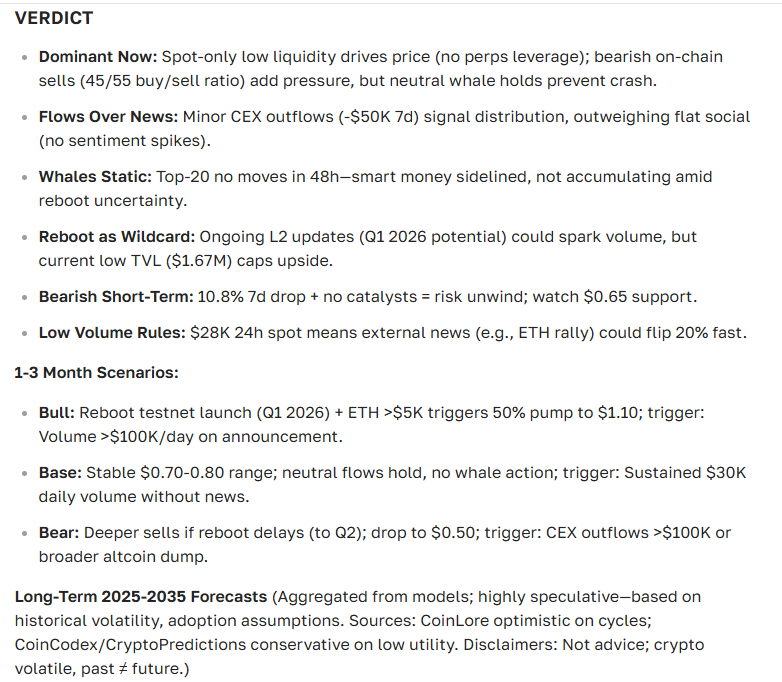
And here is the final verdict from our ASCN.AI assistant:
Disclaimer
This article is for informational purposes only and is not investment advice. Always do your own research and talk to a professional before putting your money into crypto. The market is incredibly volatile and you can lose your investment.