



- Русский
- English
- Português
Ardor (ARDR) cryptocurrency price forecast for today and the near future

about cryptocurrencies.
Got a burning question about crypto? Our AI assistant has the answers. Start your analysis right here.
| Year | Bear Case (USD) | Average Target (USD) | Bull Case (USD) | Context & Drivers |
|---|---|---|---|---|
| 2025 | 0.011 | 0.15 | 0.25 | Conservative view: technicals suggest a 98% move; bull market could push it higher. |
| 2026 | 0.055 | 0.067 | 5.01 | The "fork effect" meets adoption; could stay neutral or explode on pure hype. |
| 2027 | 0.06 | 0.10 | 2.23 | Expect a steady 45% climb, though much depends on the ecosystem's health. |
| 2028 | 0.064 | 0.12 | 0.144 | Market stabilization; the low end reflects a potential bear cycle. |
| 2029 | 0.137 | 0.20 | 0.432 | Utility kicks in; roughly 30% growth for the average holder. |
| 2030 | 0.06 | 0.32 | 6.13 | Long-term bull scenario: Ardor-chain sees massive real-world adoption. |
| 2031 | 0.10 | 0.40 | 0.79 | Post-2030 momentum; based on current technical trajectories. |
| 2032 | 0.11 | 0.45 | 1.00 | Extrapolation period; looking at roughly 20% annual gains. |
| 2033 | 0.12 | 0.50 | 2.00 | Scaling pays off; heavily dependent on corporate partnerships. |
| 2034 | 0.12 | 0.55 | 3.00 | The floor stays solid, but the ceiling depends on market sentiment. |
| 2035 | 0.12 | 0.60 | 9.77 | Full adoption target; high uncertainty but massive upside. |
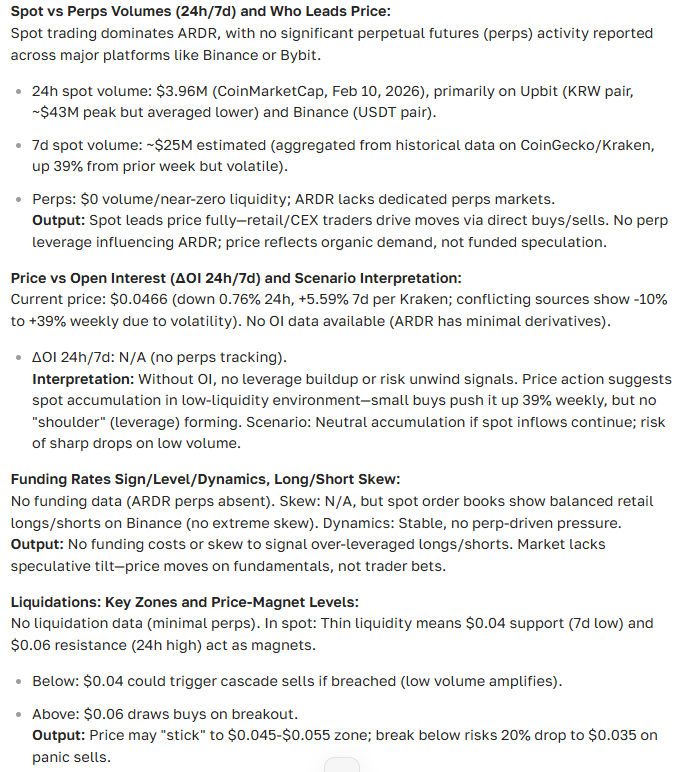
Here’s how the ASCN.AI assistant visualizes the road ahead for Ardor:
"Ardor is one of the few platforms tackling blockchain bloat with a parent-child chain architecture. It’s a solid foundation for long-term growth in an industry that desperately needs scalability."
What is Ardor anyway? A quick look at the tech
Ardor (ARDR) didn't just appear out of nowhere; it’s the evolution of Jelurida’s work, designed specifically to fix the scaling headaches that plague older blockchains. Instead of forcing everything into one cluttered pipe, Ardor uses a "parent chain" for security and "child chains" for everything else. This means you get the safety of a massive network with the flexibility to run your own custom features on the side.
The ARDR token is the fuel for the whole machine. It’s used for transaction fees, voting on where the project goes next, and keeping the network secure. Because the team at Jelurida has been at this for a while, the tech is surprisingly mature compared to some of the newer "hype" projects.
By splitting the workload between chains, Ardor manages to stay fast without compromising on security. It’s a clever balancing act that many other projects are still trying to figure out.
"The unique approach to child chains is really what sets Ardor apart from the crowd."
The nuts and bolts: Why it works
At its heart, Ardor runs on Proof-of-Stake (PoS). This keeps things fast and the fees low, which is a nice change of pace from the energy-hungry Proof-of-Work systems. It’s essentially a greener, leaner way to reach consensus.
The architecture is split into two parts:
- The Parent Chain: Think of this as the security guard. It handles the heavy lifting of consensus and network protection.
- Child Chains: These are the specialized workers. They have their own economies and business rules, letting developers build apps without slowing down the main network.
This setup makes it easy to spin up new apps for specific business cases. However, it’s not all sunshine—the Ardor ecosystem is smaller than the "big boys" like Ethereum, and lower liquidity for ARDR means the price can swing wildly when a big player enters or exits.
"Low liquidity is the catch—it makes the price jumpy and keeps some institutional whales on the sidelines."
What actually moves the needle for ARDR?
If you're wondering why the price moves the way it does, it usually boils down to a few key things:
- The general "vibe" of the crypto market (if Bitcoin sneezes, everyone else catches a cold).
- Partnership news and tech updates from the Jelurida team.
- Macro shifts—think interest rates or new crypto laws that change how people feel about "risky" assets.
- Whale movements. In a lower-liquidity market, a few big trades can change the chart instantly.
- The growing noise around Web3 and DeFi utility.
At the end of the day, the price is a mix of hard tech progress and how the community feels on any given Tuesday.
Read more on how global politics impacts your portfolio.
Ardor today: Recent moves and news
Over the last month, ARDR has been doing the usual crypto dance—some growth, some correction, and plenty of volatility. Most of these bumps come from announcements about new features or enterprise partnerships.
We've noticed that whenever a new "child chain" project gets announced, the price tends to spike. But like anything in this market, those gains are often tested by broader economic shifts.
Do headlines really matter?
In short: yes. When Ardor integrates its tech into a corporate solution, people pay attention. It proves the tech actually works in the real world, which is a big deal for long-term confidence. On the flip side, regulatory news can make investors take a step back and wait for the dust to settle.
"Partnership announcements are usually the primary catalyst for short-term price action."
See how partnerships drive value in other ecosystems
Where is the price going? Short-term outlook
Looking at the charts, a few things stand out:
- Moving Averages (SMA): Both the 50-day and 200-day lines suggest a support floor is finally forming.
- EMA: The exponential average is hinting at a potential "bullish" crossover.
- RSI: It's sitting in the neutral zone, which is actually good—it means there's plenty of room to run before things get "overbought."
For the next few days, we’re looking at a slow climb, potentially testing the $0.12–$0.15 resistance levels. If the market stays green, seeing $0.18 or even $0.20 within the month isn't out of the question.
"The technicals are lining up for a decent run, but as always, keep an eye on the volume."
How to actually use these indicators without getting lost
The "Big Picture" view
Beyond the charts, Ardor’s future depends on a few fundamental drivers:
- Expanding the child chain ecosystem (more chains = more utility).
- Growing interest from institutions looking for "layer-ready" solutions.
- The general shift toward decentralization.
Macro factors like regulation will act as a speed bump or a turbocharger, depending on which way the wind blows.
What’s the word on the street?
If you hang out on crypto forums, the debate around Ardor is pretty lively. The "bulls" love the architecture and the fact that it's a "working" product with actual corporate interest. They see it as an undervalued gem.
The "bears," however, worry about the competition. With giants like Ethereum and Solana sucking up all the oxygen, Ardor has to work twice as hard to get noticed. The consensus? It's a solid long-term play, but it’s not for the faint of heart.
Wait, what does "RIP" mean in crypto?
In the world of crypto slang, to "rip" usually means a sudden, painful crash in price. It’s that moment when everyone panics and the chart looks like a cliff. For ARDR, these "rips" usually happen during broader market sell-offs or when liquidity dries up.
Understanding the lingo helps you stay calm when the "doom-scrolling" starts. Just remember: volatility is part of the game.
Is Ardor a "buy"? Risks vs. Rewards
Let’s be real—investing here isn't a guaranteed win. You’ve got to weigh the risks:
- Extreme volatility (it's crypto, after all).
- Regulatory uncertainty.
- Brutal competition from bigger chains.
- Liquidity issues that make big trades tricky.
But the upside is there too: if the child chain model catches on with more businesses, ARDR's current price might look like a bargain in a few years. It’s all about the tech finding its home.
"Don't ignore the risks, but don't ignore the tech either. It’s a classic high-risk, high-reward scenario."
The "Before You Buy" Checklist:
- Check the liquidity on your favorite exchange.
- Check for recent news from Jelurida.
- Look at the RSI—is it overextended?
- Decide if you're holding for a week or a year.
- If you hate digging through raw data, let ASCN.AI summarize the trends for you.
Common Questions (FAQ)
Is the price going up tomorrow?
Probably a slow climb, but nobody has a crystal ball. Watch the support levels we mentioned earlier.
Do news events really change the price?
Absolutely. Tech updates and big partnerships are usually the biggest catalysts for ARDR price swings.
Where can I find the best Ardor analysis?
Official community channels are great for news, but for unbiased data, use professional analytical platforms or AI assistants that track real-time sentiment.
The Final Verdict
Ardor has the tech to be a major player, especially with its unique parent-child chain setup. While it carries the usual crypto risks—volatility and competition—the potential for growth is definitely there as the ecosystem matures. Success here requires a mix of technical patience and staying on top of the news cycle.
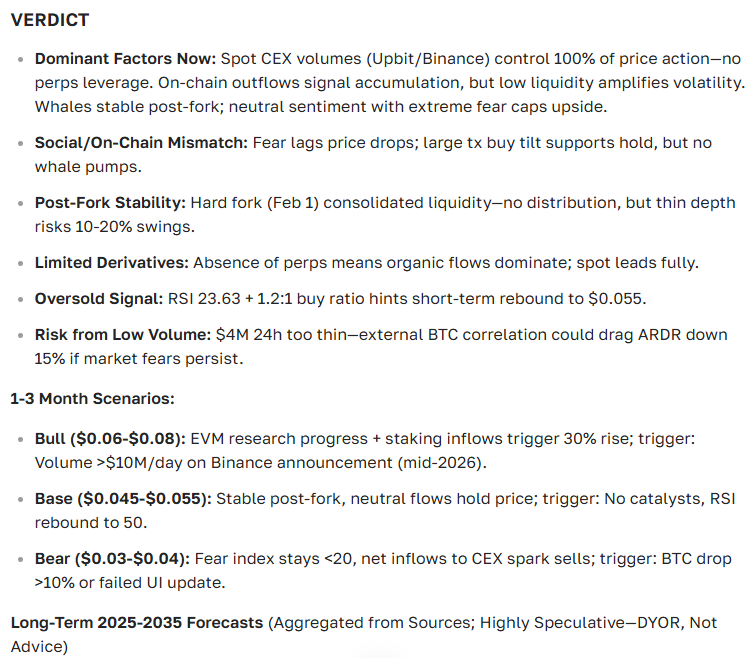
Our AI assistant, ASCN.AI, puts it this way:
How ASCN.AI helps you win
Take Falcon Finance (FF) as an example: our analysis helped traders spot the perfect entry points by tracking project news in real-time. We can do the same for your ARDR strategy.
Check out the Falcon Finance case study here.
Disclaimer
This is not financial advice. Crypto markets are a wild ride, and you should only invest what you can afford to lose. Always talk to a professional before making big moves.