



- Русский
- English
- Português
Cryptocurrency Futures: The Ultimate Walkthrough Guide for Risky People


about cryptocurrencies.
"With crypto futures, there is now an influx of new ways to trade digital currencies, but before you dive into the world of futures trading, you need to fully understand all the components of a future contract (or a 'futures contract'), including leverage and how volatile the market tends to be and everything in between!"
The Basics
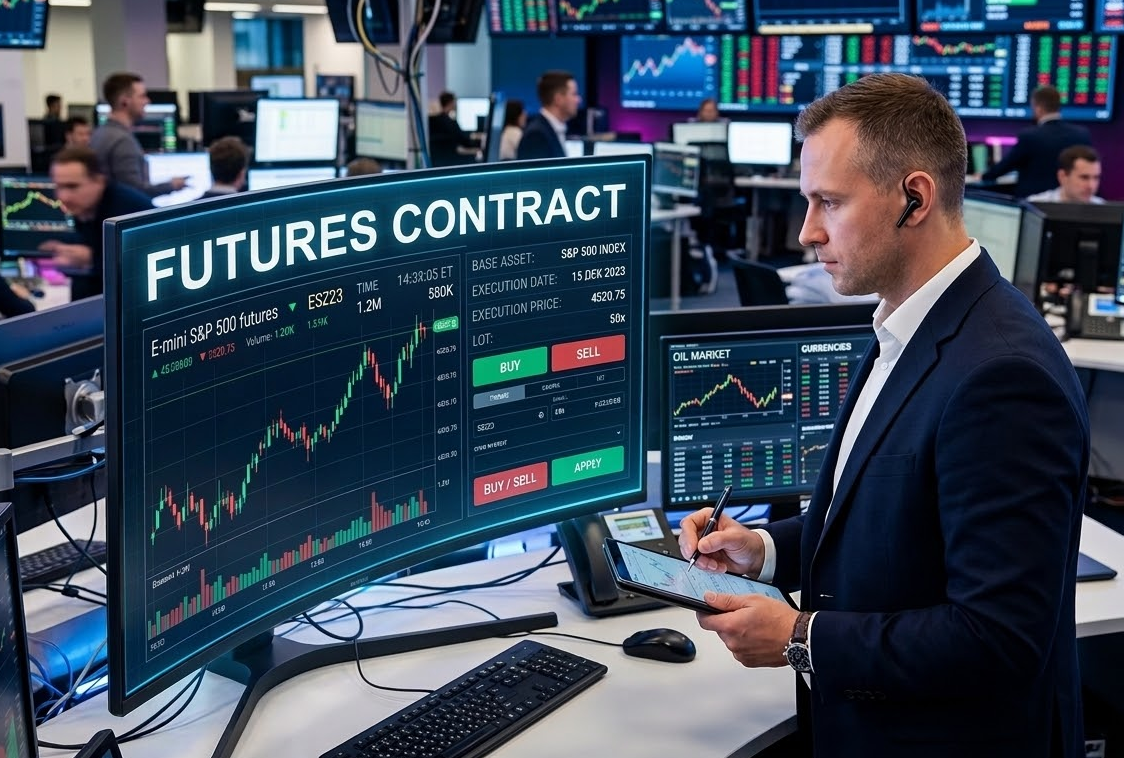
In layman’s terms, a futures contract is essentially a written agreement between two parties (a buyer and the seller) to purchase or sell a crypto asset at a predetermined price on the specified date. It permits you to lock in your future transaction price regardless of how much the price changes in the meantime. While this can be used as a hedge against risk in the crypto market, it is an enormous tool for many individuals to try and speculate on.
Why Are Futures Important?
Futures are the backbone of crypto trading, allowing traders to hedge against their HODL (Hold On for Dear Life) trade and making wagers on price declines (speculative short-selling) while allowing many traders to control a large percentage of the market without having to own the actual cryptocurrency.
What Makes Crypto Futures Unique
For those accustomed to working in traditional finance, throw away your work clock. Crypto futures trade 24 hours per day and 7 days per week, with the potential for a lot of volatility.
And then there's the "perpetual" contract, which is greatly favoured by traders in this space due to its lack of an expiration date. You may maintain your position for as long as you can continue to pay the associated fees.
Being able to trade uninterrupted and having the ability to trade perpetual contracts make crypto futures a one-of-a-kind trading environment where timing is everything. With the combination of very high liquidity and very high leverage, this is one of the highest risk trading environments available. Consulting a business or investment plan may seem simple enough initially ("Buy low; sell high"), however many differing factors complicate this scenario.
Mechanics: How Workings of Machinery Occur
Peek beneath the surface level at what makes this operation occur:
-
Position Opening: A long position means betting on increased value (pump), while short betting means betting against increased value (dump) based on an entry price.
-
Leverage: No need to have the actual capital necessary to make a trade; you put up fractional amount (or "margin") while exchange covers the remainder via loan. Use the leverage of a small amount of cash to create very large financial trades... But keep in mind that it works in reverse too.
-
Mark to Market: Exchange reconciles your updates to account for mathematical accuracy every few seconds. Each time your position value declines, a dollar amount will be deducted from your margin. In this way the exchange constantly updates your trading position.
-
Exiting Your Trades: Should not be confused with options expiration dates; Many traders close their positions early in order to secure profit or to minimize losses.
-
Final Settlement: Actual Bitcoin is rarely exchanged at the time of contract expiration. Cash difference will be provided during settlement process.
Two Types of Contracts
Standard Futures
Have explicit expiration date/time; once that happens or the contract becomes null and void (will rarely occur with Bitcoin).
Perpetual Contracts
Considered to be the dominant type of contract in crypto space because they do not possess an explicit expiration date/time. Exchanges implement "Funding Rates" to keep the value of the perpetual contracts trading near what they actually should on the market. When two sets of traders are in the market (long and short), the exchanges do this through periodic payments made by all traders to each other, which helps guide the Long vs Short ratio back to an equal level and maintain market stability.
Speculation and Market Dynamics
Futures are simply bets made on future performance of an underlying asset and, therefore, one doesn't actually buy ownership of the underlying asset when executing a futures transaction; they merely place a wager that the future price will be higher or lower.
Leverage is made available through the use of futures contracts to maximize the potential for profit should a trader bet incorrectly and/or execute an unprofitable trade. A trader could end up losing his/her entire investment if the futures contract is liquidated at such time that the position liquidates at a loss or no longer exists.
The future price of a futures contract is determined through a combination of supply and demand based upon the number of open orders (i.e., buyers and sellers who want to buy/sell the asset at a particular price) in the order book and more recently by events/announcements made concerning the underlying asset in relation to those assets' futures contracts on (X). The disparity between a future price and the underlying asset current or spot price can create arbitrage opportunities for traders.
Price Ranges vs. Single Price
Professional traders utilize the concept of price ranges instead of just using one price because they feel price ranges provide a more accurate representation of trading activity. Price ranges serve as support and resistance levels where an abundance of trading activity has occurred.
-
Example: One cycle of volatility, in terms of futures contracts found price ranges between approximately $27 and $80 while the corresponding spot price range was found to be approximately $17 and $47.
Thus, based upon these price ranges, traders utilizing these price ranges will generally succeed in entering/exiting positions executed by large traders. When you don’t monitor these ranges, you’re effectively flying blind.
Key Terminology
You will need to know the following:
-
Contract — This is how you will keep track of each unit you are trading by having defined size/rules associated with it in each contract.
-
Position — Long (bullish) versus short (bearish) position. There is no grey area.
-
Leverage — A multiplier. 10x would then be 1% change in the markets becomes now a 10% change in your wallet. Leverage is great for making a lot of money; however, it is also very damaging in terms of profit and loss.
Remember: Leverage is a tool! Not a magical tool. If you do not have a strategic way of utilizing leverage then leverage will simply speed up your account going to zero.
The “Liquidation” Ghost
When you are trading futures, you are also facing three major monsters:
-
Market Volatility — A random “wick” can take you out in a few seconds.
-
Liquidation Risk — An automatic exit from your trade when you have insufficient margin to fund unrealized losses.
-
Counterparty Risk — If the trading platform has an issue. (Generally doesn’t happen on large exchanges, but never discount sceptical of the risks associated with counter-party financial position.)
Risk Management: You must have sound risk management to survive as an active trader. Stop-Losses/Leverage are the only friends you have when trading.
Profit and Loss (PnL)
Your PnL is not simply calculated as exit price minus entry price. You need to consider all trading fees, funding rates, and end margin liquidation penalties to give you an accurate picture of how profitable you are. For your calculation of true PnL as a professional also differs from a hobbyist.
Trading Strategies
From rookie to pro-type strategies:
-
Hedging - When you have physical assets in the form of crypto, you can protect your crypto assets with short contracts if you think the market will drop.
-
Speculation - Betting on direction without regard for physical assets (crypto). High-Risk, High-Reward.
-
Spread Trading – A speculation strategy utilizing two different contracts to bet on the differentials in price.
-
Arbitrage – A method of profit/cash flow generation by finding price differentials across different exchanges.
All of the above theories are great forms of speculation; however, hedging and speculation should both provide an element of safety or minimized loss, whereas speculation should provide excess profits maximized by betting on price differentials over time. Select your level of participation based upon your personal risk tolerance levels.
Pro Tips for Leverage Use
-
Your current psychological state needs to be respected. Only use as much leverage as you are comfortable with losing.
-
Setting a stop-loss order up front is a must.
-
A margin ratio that is too low to be comfortable with should be an indication that it's time to either put additional funds in or exit your position completely.
-
Because the market can change quickly, if you have a trend reversal, it is time to revisit your position.
The Market Ecosystem & The News Factor
The different exchanges (ex: Binance, ByBit, CME) allow buyers and sellers to interact, and also provide an engine to fill those buyers and sellers’ orders. All the exchanges also provide liquidity, as well as hold all of the information (price feed, volume) that every trader uses to make a decision.
The News Factor: One Fed announcement; a cryptocurrency regulation rumor—one of these things could send futures prices to take a nosedive. If the macro-environment is not being watched, you are missing half of your market news. The only way to keep abreast of volatility is by good speed of information.
"Our ai tools at ascn.ai help to bridge this gap by using on-chain data integrated with the sentiment of the market to anticipate risks before they become known events in the news." – by ascn.ai.
Avoiding Pitfalls
-
Volatility Risk: Use Limit Orders. Don't let your profits slip through your fingers with a market order during a slippage event.
-
Liquidity Risk: Stick to major pairs like (BTC, ETH) to prevent getting trapped in a low-cap 'shitcoin' futures position.
-
Emotional Risk: FOMO and vengeful trading are why accounts get blown out.
“Rookie” Hall of Shame Examples:
-
Using 100x leverage on day one of your trading career.
-
Ignoring margin calls and hoping to catch a 'bounce back'.
-
Relying on a "hot tip" from Telegram trading groups without verifying the work.
If you avoid these pitfalls, you will be in the top 10% of traders globally.
FAQ
What are crypto futures?
Crypto futures are contracts that hold you accountable for either buying or selling a cryptocurrency at a defined date in the future at a predetermined price.
What do they do?
Futures allow you to arbitrage prices without holding onto the actual cryptocurrency coin in your wallet or basic account.
Are leverage trading accounts dangerous?
Yes. Leverage trading accounts will amplify both your profits and your losses, and they are the sole reason most traders end up getting liquidated.
What makes up the price of crypto?
Price is affected by supply, demand, news and on-chain movements. If you're looking for clarity in terms of what drives the price, you can use tools like ASCN.AI to help you figure it all out.
Quick Overview of Numbers
|
Contract Type |
Expiration |
Maximum Leverage |
Settlement |
Where to Trade |
|
Standard Futures |
Defined Date |
Up to 125x |
Cash or Asset |
CME, Binance |
|
Perpetuals |
None |
Up to 100x |
Cash (Funding) |
Bybit, Binance |
|
Quarterly Futures |
Every 3 Months |
Up to 50x |
Cash |
OKX, Huobi |
The Roadmap for Beginners
-
Find a good quality exchange (KYC often required).
-
Create a demo account to practice trading with real money.
-
Deposit small amounts of cash into your account and find out what your margin parameters will end up being.
-
Begin trading small positions. Using 2x or 3x leverage can put you in the position to continue to educate yourself as a trader.
-
Learn from your trades. Ask yourself why you won and ask yourself why you lost.
Case Study: How ASCN.AI Helped a Trader in 2025
In 2025, a trader used ASCN's real-time funding and on-chain alerts to identify an upcoming long squeeze on BTC and avoided liquidation due to the volatility spike. Instead, by reducing his leverage position, he was able to exit his trading position with a small profit, while thousands of others watched their trading positions evaporate. Ultimately, the right data can provide you with a competitive edge over the other trader at the time.
Please see the full case study here.
Final Thoughts
Crypto futures can be an incredible trading vehicle, but it's important that you don't be foolish. The pricing with these two instruments doesn't change quickly; however, both trading instruments will fluctuate without notice and without warning. With discipline and, in conjunction with technology such as ASCN.AI to assist you with your trades, it is possible to execute trades as quickly as possible while feeling confident about your trades.
Disclaimer
The information provided is general in nature and does not constitute financial advice. Investing in cryptocurrencies carries a high level of risk. You should consult with qualified professionals before making any decisions.