



- Русский
- English
- Português
Neural Networks for Customer Support: A Comprehensive Guide to Selection and Implementation in 2026

Currently, there are ongoing disagreements in the industry as to which LLM service will reign supreme in the way of support — GPT-4 or GigaChat. We at ASCN.AI have been developing our own AI assistants for the last 2 years; not only answering questions but managing some business transactions from "Hi how are you" through to when that transaction reaches your CRM. Additionally, a response within 10 seconds from a chatbot in any crypto project is not a feature; it's essential. A single error made by an assistant will cost an e-commerce company that customer, who will go to a competitor.
A neural network in the way of support handles 50%–70% of general/practical questions (general inquiries). Your team will then take on what is actually revenue generating: complex agreements, complaints and VIP clients.
"Over the last 3 years we have installed customer service resources for 14 companies in the ways of fintech and retail. The most critical part you will see in this process, the better and more precise your escalation procedures and knowledge base are set up will lead to a higher number of actual agreements made from an initial inquiry. Therefore, this article is not going to be 'Have a bot — make money.' This article will be about the functional characteristics of the overall system design that will bring a business/corporation through that process."
What is a neural network used in customer support and how does it work?
Let us get rid of some rose-colored glasses first. A neural network used in customer support is not a script with hard codes of a response to "Hi how are you." It is an AI model that will learn. It will read hundreds of gigabytes of the dialogue history, both of your customer data; knowledge base and routing rules, to learn the underlying meaning of the inquiry vs just searching for the two or three words in that inquiry. How to Implement AI Assistants Within Your Business.
The method of operation is quite straightforward but does have multiple areas of focus. A customer submits an inquiry through either a chat or call — this is called the process of 'requesting'. The AI system will evaluate the context of the request: what's the customer's tone of voice? Are they looking for a refund? Are they just trying to find out where their order is? If the inquiry is of a routine nature (i.e. "where's my package?"), then the AI system can offer a solution on its own. If the situation is not as simple, then the AI system will provide an operator with a pre-defined analytic report about the inquiry. This is automating inquiries from customers so that there are no wasted human resources on routine requests. If you're looking for insight as to how to create an AI assistant for the business, it's best to begin at the actual architecture as opposed to rushing to download the first app you find.
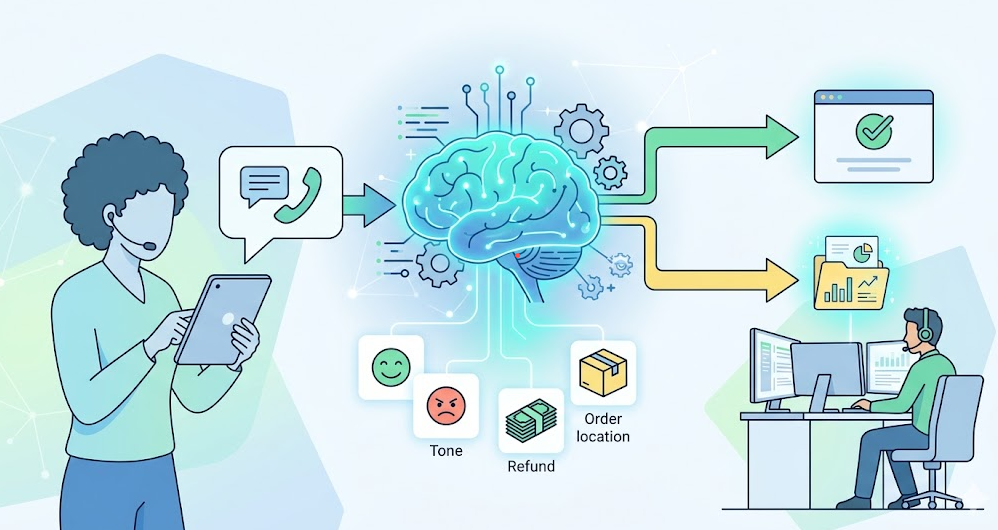
The customer submits an inquiry through either an online chat or by voice. The request is sent into the AI ecosystem where it is classified by: identifying the category of inquiry; sentiment analysis; and defining the priority. If the neural network has a high level of confidence in the response (i.e. if the inquiry is a routine inquiry classified as an exact match using your FAQ list), the neural network will return a response immediately. If the inquiry is non-standard and requires additional clarification, the inquiry will be transferred to the operator with the conversational history and problem tags intact. Therefore, there would be no need for manual determination of what information to provide to the customer; the operator will have instant access to the core issue. Therefore, the AI assistant will perform as a first-line filter for customer inquiries as well as being an assistant to the operator(s), not a replacement of these individuals.
RAG Technology: A Requirement of Modern Architecture
RAG (Retrieval-Augmented Generation) is an integral part of modern architecture. RAG may sound complicated but it is really just a crutch for the AI's mind. This technology allows the AI to retrieve facts from your knowledge base rather than creating them. If there is no RAG present, the neural network could hallucinate (or come up with an answer that sounds correct but is incorrect). This is detrimental to an agent's reputation; the agent needs to be able to know your pricing precisely, without any "imagination."
Key Advantages of Using Neural Networks for Customer Service
Simple. Money. Implementing AI into Customer Support offers direct monetary benefits to businesses, and the majority of companies are quickly transitioning towards automating business processes.
- 24/7 Support — Neural Networks work around the clock, without any breaks, holidays, or sick days; therefore, customers will receive a response to their questions 24 hours a day, 7 days a week, even if there are no operators available. They will have the same level of service as if they were receiving support from an agent live.
- Personnel Savings — One AI agent is capable of performing up to 5–7 times the amount of calls that a first line operator may handle. Replacing operators that earn 40,000₽/month will help to save 200,000₽–280,000₽/month. By automating the business processes, instead of hiring more employees, the organization can grow its business by employing a virtual AI agent.
- Response Time — Routine inquiries will be processed in seconds, resulting in a tremendous increase in speed. The average handling time (AHT) will decrease from 5–7 minutes to 30–60 seconds on average.
- Reduced Human Load — Operators will have a decreased number of routine calls ("Where's my order?") and be able to concentrate on problem-solving calls. This increases operator productivity significantly.
- Consistency — A neural network is never frustrated or exhausted so it answers every customer with the same level of accuracy and detail. The consistency of responses that each customer receives improves the overall service quality of an organisation.
- Scalability — During periods of peak traffic such as Black Friday, organisations can add server capacity or upgrade their service plan. Neural networks can process a volume of requests and will not require the additional staff to be hired unexpectedly.
The biggest benefit of using a neural network is predictability. A customer receives an equal level of service no matter whether an operator has been working a long shift or has come to work in the best of moods. Because of this predictability, the organisation collects data that can be analysed by neural networks and can be used to analyse and optimise the organisation's operations.
What Business Tasks do Neural Networks Solve in Support? (Types and Functions)
Neural networks perform functions in customer service across a variety of categories. Some examples of this include: direct interaction with customers through AI Agents for Business; assisting or supporting operators; or redistributing workload among departments. Below, we break down categories of tools available:
AI Chatbots for Instant Answers and FAQs
AI Chatbots serve as the point of first contact for customers. They are integrated with the website, messenger systems (such as Telegram, WhatsApp, and VK), or through a mobile app. If you are looking for a chatbot for your business, this would be a baseline example. For example, if a customer asks "How do I make a return?", an AI Chatbot will answer them based on the organisation's return policy. If a customer says to the AI Chatbot "Where is my order?", the AI Chatbot can pull that information from the organisation's Customer Relationship Management (CRM) system.
Auto-replies will be derived directly from an organisation's knowledge base that have been indexed. The chatbot uses the neural network to analyze the user's question in relation to current data/procedures. If the question does not fall within the knowledge base, then it will forward the chat to someone else. The amount of data available directly impacts the quality of responses. If we have no data in our knowledge base, then we have a bot that won't help anyone.
In our work, bots can handle up to 70% of customer requests by themselves. For example, when we used an AI agent for a crypto exchange, 80% of the inquiries were regarding verification status, fees, and limitations on withdrawals. These inquiries were able to be resolved without human assistance leaving the human operators available for other types of support. Our clients are also using a lot of bot integration with messaging applications, e.g. messenger automation with Telegram.
Voice Assistants for Call Automation (IVR)
Like a chatbot, voice bots function in the same way as a chatbot; however, they use the phone as their interface. A traditional Automatic Voice Response System provides the caller with the prompts (e.g. "Press 1 for...") while the voice bot is capable of understanding natural language speech in real-time. The voice bot integrates with the telephone system with SIP protocol as part of the overall call center automation process.
An example of how voice bots are used is one of our fintech clients who implemented a voice assistant to handle requests for forgotten passwords. Before the implementation of this technology, 60% of first-line calls to the call center were related to this specific task. Following the implementation of the voice bot, the total number of calls to the first-line operators was reduced by 66%; and the average wait time for a caller was reduced from four minutes to forty seconds. Our experience in the case of ASCN.AI.
Smart Routing and Ticket Classification
The neural network examines incoming requests, determines the classification (e.g. technical problem, complaint, sales) and the associated sentiment of the request (positive, negative, neutral) and then routes the request to the appropriate department. This is all performed as part of the document management automation process.
Sentiment analysis can be used to identify negative requests to help identify them for processing as high priority. Someone who expresses dislike will have their inquiry marked as urgent, and an urgent request will be made available to managers on duty. This will serve to protect the company's reputation.
Operator Assistants: Real-Time Answer Generation
A neural network (NN) will use a pre-constructed answer that is generated and recommended to the operator while he/she is engaged in a discussion. This assists in reducing the repetitive duties of the operator. The operator will be able to select the answer which fits the question and then send the email. This will increase the efficiency of newly hired operators and reduce the potential for error.

Examples of Using Neural Networks in Support: Real Cases
Though theory is important to have; business needs measurements of success. Here are real-life examples of how the use of NN's in customer support has improved the economics of service for different businesses.
Example #1: Financial Institution (FinTech)
Issue: 12,000 Calls Daily: 70% of the calls are related to balancing and blocking accounts. Traditional wait queue is 7-9 minutes.
Solution: NN Voice Assistant
Results: 65% lower load on operators. 1.5-minute wait time. 40 fewer first contact sales personnel required. 18% more sales from traditional telecommunication leads.
Example #2: Retailer (E-Commerce)
Issue: 8,000 Email Inquiries Monthly: 50% are Regarding Statuses and Sizes: 4-6-hour response times.
Solution: Chatbot via Telegram and a web portal with CRM Integration
Results: 72% of emails answered without an employee responding. A maximum of 30-second response time. 40% reduction in shopping cart abandonment. ANPS (Average Net Promoter Score) increased from 62 to 78.
Example #3: Telco Company
Issue: 12,000 Net Emails Monthly: 60% related to Internet Connections down. Response time 45 minutes.
Solution: Smart Ticket Routing and Classification
Results: 45 minutes to 12 minutes Problem resolution. 55% fewer transfers between departments. 23% increase in customer service ratings.
How to Incorporate a Neural Network into Support: A Step-by-Step Plan
Implementing AI is not a simple plug and play installation. You must prepare before you can put AI in as a customer support vector.
Step 1. Audit Your App & Data (2–3 days)
Look at the requests made to your CRM via email and chat. Determine how many of these types of requests you can automate. You will also want to check the documentation base. A neural network will be unable to correct your documentation issue. While completing this step, you should also use AI for keyword selection and SEO analysis on your high-frequency questions.
Step 2. Selecting Platform and Solution Type (3–5 days)
Decide whether you want to use a builder (fast but limited) vs. creating a custom API (more flexible, but also expensive). For Russia, GigaChat and YandexGPT are good options.
Step 3. Creating Your Knowledge Base and Training the AI Model (1–2 weeks)
Gather answers to standard questions you would get. Structure the data. Teach the neural network how to recognize intents. How do you train an AI agent? By using prompts.
Example of prompts used to teach:"You are a customer support worker for [company]. Please answer [product] questions in a [friendly] manner. If the answer to the"
Step 4: Integration with CRM and messaging apps (1 week):
Integrating the bot with CRM (Bitrix24 or amoCRM), plus messengers, setting up the API.
Step 5: Pilot launch & KPIs (2 weeks):
Start the AI services with a small group of bots. Look at the % auto-closed tickets and the CSAT results; collect feedback.
Step 6: Training and Extending Scope (Ongoing):
Extend the area where the bots provide services; train the operators to use the AIs.
Step 7: Continuously Monitor & Update
Continually review the errors of the AIs; you will need to frequently update the information for optimal performance.
Rating and Comparison of Popular Neural Network Platforms
| Name | Type of Solution | Language Flexibility | Supported Integrations | Starting Price | Recommended for |
|---|---|---|---|---|---|
| ASCN.AI | AI Agents and Knowledge Base | Yes | CRM, Telegram, API, MCP | $50/month | For companies with at least 5,000 messages per month; RAG Required |
| GigaChat | LLM API | Yes | API-Connected | $0.002 per Token | For 152-FZ-compliance; approximately ₽50,000/month for budget |
| Nextbot | Pay-By-Use Chatbot Builder | Yes | Messengers, CRM | ₽1,500/month | For startups launching in one day |
| Bitrix24 | CRM and Built-in Bot | Yes | Internal Ecosystem | ₽1,990/month | For people using Bitrix already |
| Zendesk AI | Help Desk and AI | Yes | Email Phone and Chat | $49/month | For enterprise companies with international sales |
The choice will depend on the size of the business. If a startup, choose Nextbot; if a complex services automation also ASCN.AI or create on GigaChat.
Cost of a Neural Network for Support: What Makes Up the Price?
Depending on the level of complexity, amount of traffic, type of solution, and the complexity of the cost structure; AI agents can be handled.
SaaS Subscribers are tiered according to how much they process:
- Economy - 1,500 - 5,000₽ (up to 1,000 inquiries)
- Pro - 10,000 - 30,000₽ (up to 10,000 inquiries, includes CRM)
- Enterprise - starting at 100,000₽ (custom, API-enabled, on-premise)
Turnkey Development:
- Small projects are typically in the range of 200,000 - 500,000₽
- Medium projects typically run between 1-3 million ₽
- Large projects will generally run 5 million+ ₽
ROI Calculation:Payback = (Operator Salary × Quantity) / (Implementation Expense + Subscription Expense)
Example: (40,000₽ × 5 Operators) / (200,000₽ + 30,000₽ per month) = 8-9 Months.
Therefore, if you've invested in AI agents from an earning standpoint (via cost savings) they will pay off / break-even after approximately 6 months.
Frequently Asked Questions about Neural Networks in Support
Will neural networks completely replace Support Operators?
No. Complete replacement isn't possible or practical. Neural networks are equipped to complete an estimated 50–70% of routine requests with operators available for complex requests, empathy, and selling. The best outcome is achieved with a hybrid model of AI + Human.
Is it safe to upload customer data to a cloud-based neural network?
The safety of customer data transfer will depend on the platform used. For companies in the Russian Federation, compliance with 152-FZ is critical. Seek a solution that uses some form of encryption, is FSTEC certified, or installed on-premise. ASCN.AI does not use customer data from their databases to train their public models.
What neural network should a small business use: GigaChat or a Telegram bot?
GigaChat will provide faster response times by using bots to assist in answering questions. API solutions such as GigaChat and ASCN.AI will provide greater flexibility and integrate well with existing systems. If your business requires coverage for only 10-15 questions, then the builder will be sufficient. If you need intelligent routing, then it is best to launch the API.
Do ChatGPT-based solutions work within Russia?
Since direct access to the service is limited, using API aggregators or local equivalents (such as GigaChat and YandexGPT) will provide a stable alternative. For most Support-related tasks, a Russian based LLM will provide you with sufficient accuracy and will be legal.
How long does it take to implement these solutions?
A pilot launch will require 2-3 weeks. However, if complex integrations are required, it could take up to 3 months for full implementation.
Will a programmer be required to configure the solution?
If you're using a no-code solution then no programmer will be necessary. If however, you're integrating a custom solution via API, then a developer/programmer will be required as well as the implementation team.