



- Русский
- English
- Português
How Neural Networks Understand Text: A Complete Breakdown of Principles and Technologies

We've entered an age in which conventional methods of searching for information on the Internet are becoming obsolete. Not that I recognized this immediately. I grew from marketing and arbitrage to crypto, and now to building entire ecosystems around AI technologies. Within that experience I've come to understand this: in order to influence the future, you first have to understand the technological foundations that are shaping it. Neural networks have revolutionized everything. Today alone, billions of pieces of text will be processed through neural networks, decisions will be made for people, and new text will be generated that gives you chills. If you want to truly harness this power, you need to understand how a machine actually "understands" text.
"Neural networks do not read or understand text the way humans do. They convert text into numerical form and look for patterns and relationships based on probability. This is not the same understanding that we have as humans — but for businesses, it offers a powerful tool for automation."
An Introduction to Text Recognition by Neural Networks
What does AI "understanding" of text actually look like?
When AI understands a text, it extracts structure and meaning from a sequence of characters. Unlike humans, who rely on life experience, emotion, and cultural context, neural networks operate with mathematical representations. Text is converted into numerical coordinates that can be used to recognize and categorize it based on statistical properties.
When a model "reads" a sentence, it doesn't actually see words — it sees a set of numerical coordinates representing the meaning of the sentence and the relationships between its words. That understanding is based purely on predictive probabilities. The model has no concept of "love" or "cryptocurrency" in a human sense; instead, it processes the frequency and proximity of words in its training data. For instance, "bitcoin" consistently appears alongside "blockchain" and "decentralization" — these relationships are what the model uses when generating or analysing text.
Natural Language Processing (NLP) is the foundational technology underlying the modern digital world. Without it there would be no voice assistants, no translation software, no chatbots, no sentiment analysis on social networks. According to Grand View Research (2024), the NLP market has already exceeded $20.9 billion and is growing at approximately 20% per year through 2030. This isn't a temporary spike — NLP has become a core infrastructure for automating communication and decision-making.
Natural Language as the Primary Training Material for Neural Networks
Natural language is the main source of data for training modern neural networks. The most widely used models — GPT, BERT, LLaMA, and other transformer architectures — have been trained on hundreds of terabytes of text: books, articles, forum threads, and social media posts. The quality of this data directly determines the quality of the model's outputs.
If the training data contains errors, bias, or outdated information, the model will reproduce those flaws. NLP has applications across a wide range of industries:
- Finance: automated user query processing; news analysis and market prediction.
- Marketing: text generation; personalised offers; customer feedback analysis.
- Healthcare: extracting key information from patient records; diagnostic support.
- Crypto: sentiment analysis in Telegram channels; automated token report generation.
ASCN.AI produces structured reports within 10 seconds by combining data from three sources: news articles, on-chain data, and social media activity. The models are trained specifically on cryptocurrency industry data — not on general text corpora.
Core Mechanisms: Transformers and the Attention Mechanism
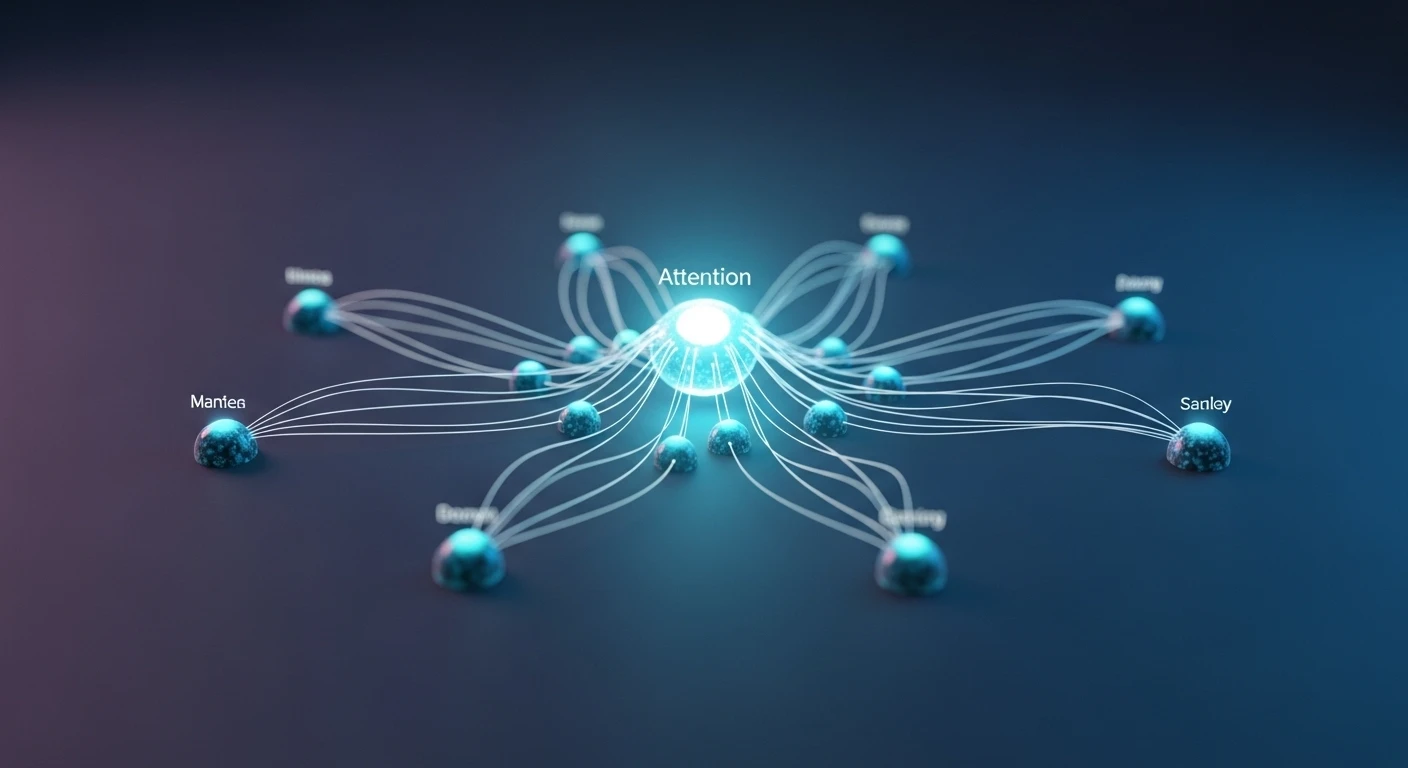
The Transformer architecture emerged from the landmark 2017 paper by Vaswani et al., "Attention Is All You Need," which marked a turning point in NLP. Transformers displaced RNNs (Recurrent Neural Networks), which had previously dominated the field. RNNs processed input sequentially, one word at a time, left to right — making them slow and weak at capturing long-distance relationships within text.
The Attention mechanism allows the model to examine all words in a sentence or paragraph simultaneously and determine how each word relates to the others. For example, in the sentence "I sold the bitcoins because they fell," the model understands that "they" refers to "bitcoins" and not to "I." This is computed using matrix operations that assign weights to the relationships between words.
Because Transformers process input in parallel, they train and run far faster than RNNs. All major language models — GPT, BERT, and others — are built on this architecture. At ASCN.AI, Transformer models process every trader query and generate responses drawing on the platform's extensive Web3 knowledge base. A query like "Why did token X go up?" receives a contextually rich, detailed answer — which would not be possible without the Attention mechanism.
"Transformers allow models to simultaneously consider the relationships between all words, improving both the speed and accuracy of processing."
Word and Phrase Embeddings
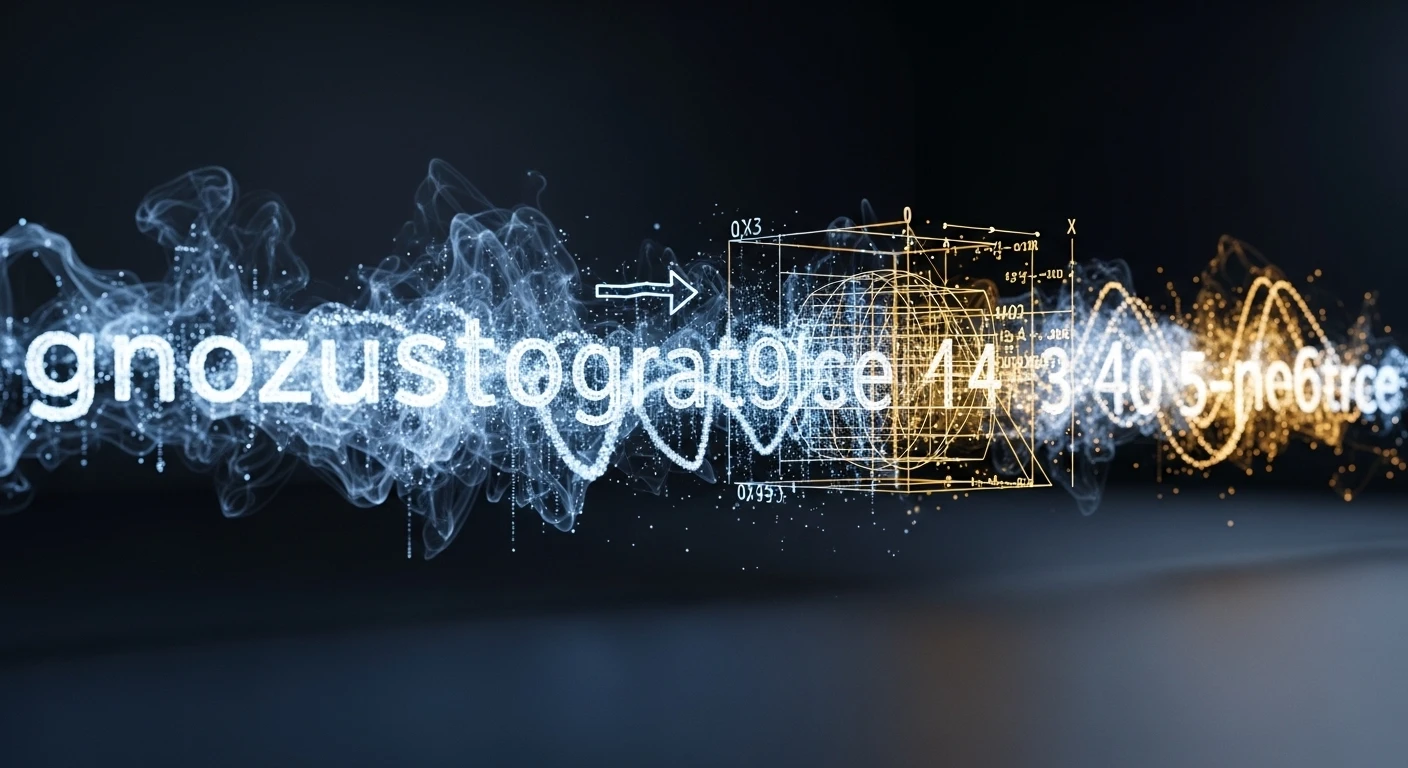
Embeddings are numerical representations of words and phrases. Words that are similar in meaning end up with similar vector representations. For instance, "bitcoin," "ethereum," and "altcoin" all have similar embeddings because they consistently appear in similar contexts.
Older methods — Word2Vec, GloVe — produced static embeddings: the same word always received the same vector, regardless of context. Modern models like BERT and GPT produce contextualised embeddings, meaning the same word can receive different vector representations depending on its surrounding words.
Embeddings are used for:
- Finding similar documents via cosine distance between vectors.
- Matching query vectors with product vectors in recommendation systems.
- Text classification using embedding-based classifiers.
At ASCN.AI, Web3 text embeddings are stored in vector databases such as Supabase Vector Store. When a user submits a query, it is converted into a vector and compared against the closest matches in the database — enabling faster retrieval of more relevant information.
"Modern models produce contextualised embeddings that change depending on the word's context."
Contextualisation in Language Models
A model's ability to contextualise determines how accurately it interprets the meaning of a word based on its environment. The word "bank" in "I went to the bank" means something completely different from "bank" in "The river burst its banks." BERT reads text in both directions — left to right and right to left — simultaneously. GPT reads only left to right. Both approaches improve the handling of ambiguity. "Apple dropped" in a tech context means a decline in Apple's stock price; in a kitchen context, it means a piece of fruit fell.
When ASCN.AI receives the query "What happened to SOL?", context determines whether the answer should address the Solana cryptocurrency or the Spanish word for sun. Contextualisation is the key to accurately answering specialised, domain-specific queries.
Semantic Parsing: How Neural Networks Extract Meaning
Named Entity Recognition (NER)
Named Entity Recognition is the process of identifying known entities in text — people, organisations, dates, currencies, and so on — using a training dataset of labelled examples. The neural network learns to classify entities based on the contextual meanings assigned to them in training.
Sample classification: "Vitalik Buterin" — PERSON; "Ethereum Foundation" — ORGANIZATION; "January 15, 2024" — DATE.
Sample entity extraction:
Text: "Vitalik Buterin spoke at Devcon in Bangkok on November 10, 2024."
Neural network identifies: PERSON — Vitalik Buterin; EVENT — Devcon; LOCATION — Bangkok; DATE — November 10, 2024.
NER is used in finance to identify companies mentioned in news; in medicine to extract symptoms from patient records; in crypto to track token and project developments. At ASCN.AI, NER automatically processes news and Telegram posts. From a message like "Binance lists the new token XYZ," the model extracts: Binance (exchange), XYZ (token), listing (event) — turning raw text into structured, reportable data.
"NER is a well-established technique for information extraction across finance, healthcare, and the cryptocurrency industry."
Ontologies and Taxonomies
An ontology is an explicit description of knowledge within a domain — entities, their properties, and their relationships. A taxonomy is a hierarchical classification of concepts.
Crypto ontology example: Token → exists on a Blockchain → operates via Consensus (Proof of Work or Proof of Stake).
Web3 taxonomy: DeFi → DEX, Lending, Yield Farming; NFT → Marketplaces, Gaming, Art.
Ontologies allow models to apply prior knowledge and perform logical inference — answering questions that are not explicitly addressed in the source data. If a model knows that Uniswap is a DEX, and a DEX is a decentralised exchange, it can infer what Uniswap does without being told directly. At ASCN.AI, we have built an extensive ontology of Web3 relationships — tokens, projects, exchanges, funds, and partnerships. Asked "Who is behind project X?", the model can surface the founding team, investors, and associated partnerships.
Handling Ambiguity and Context
Polysemy and Contextual Interpretation
Polysemy — one word, multiple meanings — is one of the hardest problems in NLP. Context is what allows the correct meaning to be identified. Examples: "mouse" can be an animal or a computer peripheral; "key" can be a physical tool or a cryptographic key; "token" can refer to cryptocurrency, in-game currency, or an API access token.
Neural networks resolve polysemy by analysing the surrounding words. At ASCN.AI, when an ambiguous query arrives, the system attempts to clarify intent and also considers previous queries in the conversation to avoid misinterpretation.
Probability and Predicted Meaning
Models learn from examples and predict based on the likelihood of each possible next word. Everything is built on probabilities rather than hard rules. For example:
Context: "I bought a car last month"
Word probabilities: "bitcoin" — 0.35; "stocks" — 0.25; "a car" — 0.15
The model selects the most probable option or introduces random sampling for variety. This is the underlying mechanism behind autocomplete, text generation, and text classification. At ASCN.AI, probability-based generation is used to produce responses that account for multiple possible interpretations.
Applications of Neural Network Text Understanding
Search Engine Query Processing
Modern search engines use neural networks to understand queries far more deeply than traditional keyword-based approaches. Google's introduction of BERT in 2019 improved search accuracy by approximately 10% for complex queries. From 2021, Google began developing SGE (Search Generative Experience), which generates detailed direct answers using neural networks.
Key capabilities enabled by this approach:
- Understanding long, conversational queries.
- Incorporating a user's query history when processing new queries.
- Working with natural language rather than just matching keywords.
Microsoft Bing with GPT-4 and Perplexity AI with aggregated sourcing have adopted similar approaches. At ASCN.AI, we built a dedicated crypto search engine: a query like "Why has token X increased?" returns a detailed answer drawing on news, on-chain data, and social media — not just a list of keyword matches.
"According to Google, the implementation of BERT led to a ten percent improvement in search accuracy."
Text Generation and Dialogue Systems
Generative models — GPT, Claude, Gemini — are capable of producing text that is nearly indistinguishable from human writing. Their applications include:
- Content marketing: article writing, product descriptions, social posts.
- Software development: code generation from plain-language descriptions (e.g. GitHub Copilot).
- Education: creating study materials and assessments.
Dialogue systems handle millions of requests — helping users learn and providing customer support. Models like Claude now support context windows of up to 200,000 tokens, making them well-suited for legal and scientific documents. At ASCN.AI, generative models automatically produce token reports by pulling from multiple data sources — saving analysts several hours of work per report.
"GPT-4 and Claude demonstrate the ability to analyse complex documents with long context windows."
Knowledge Graphs and Entity Relationships
A Knowledge Graph represents information as triplets: subject → predicate → object. For example: "Vitalik Buterin → founder of → Ethereum"; "Bitcoin → operates on → Proof of Work."
Neural networks extract these relationships through NER and contextual analysis, storing them for use in answering complex questions.
Example:
Text: "Binance invested in a Polygon project in 2021."
Triplets: Binance → investor in → Polygon; Polygon → received investment from → Binance; Binance → type → Exchange.
Knowledge Graphs are used in search engines, recommendation systems, and virtual assistants. At ASCN.AI, we have built a comprehensive Web3 knowledge graph covering relationships among tokens, projects, teams, funds, and exchanges — enabling analysis of how events affect the market and supporting forward-looking predictions.
"Google's Knowledge Graph improves search quality by linking entities and relationships to produce more accurate answers."
Frequently Asked Questions (FAQ)
How is neural network-based NLP different from traditional approaches?
| Criterion | Traditional Approach | Neural Networks |
|---|---|---|
| Training | Manual rule definition | Learning from labelled datasets |
| Flexibility | Low — difficult to adapt | High — can be fine-tuned |
| Accuracy | Good for simple tasks | Outperforms on complex tasks |
| Data required | Minimal | Large volumes |
| Interpretability | High — rules are explicit | Low — "black box" |
What role does the Attention mechanism play?
Attention identifies the most important parts of text and captures long-distance relationships. In the sentence "I sold the tokens I bought three years ago," the connection between "sold" and "bought" is critical — and the Attention mechanism preserves it regardless of how far apart the words are.
What are the limitations of current models?
- Hallucinations: models can generate outputs that sound plausible but are factually wrong — a consequence of their statistical nature.
- No genuine understanding: models operate on mathematical principles, not human-like comprehension.
- Data dependency: model performance depends heavily on the size and quality of training data.
- High resource requirements: training and running large models requires significant computational infrastructure.
- Context limits: models can only process a fixed number of tokens at once (GPT-4 handles up to 128,000 tokens).
- Security and ethics: models can generate harmful or misleading content.
"Hallucinations arise from the statistical nature of the model's output generation and do not guarantee factual accuracy."
The information provided here is general in nature and does not substitute for advice from qualified specialists.
What does the future of AI text understanding look like?
- Multimodality: simultaneous processing of text, images, audio, and video.
- Agent systems: AI that independently completes complex tasks without continuous human oversight (ASCN.AI NoCode).
- Specialisation: models purpose-built for specific domains — medicine, finance, cryptocurrency.
- Computational optimisation: smaller, faster models via quantisation and distillation.
- Interpretability: continued development of methods to explain AI decision-making.
- Real-time data integration: direct connection to live data sources (Perplexity AI, ASCN.AI).
At ASCN.AI, we are developing custom AI systems that analyse both blockchain data and social media, automatically generating structured reports within 10 seconds.
Conclusion
Neural network-based text understanding is the product of years of research at the intersection of machine learning and linguistics. Modern models convert words into numbers, identify patterns, and generate probabilistic predictions. This is not human-like understanding — but it is a highly effective tool for automating complex tasks.
Key takeaways:
- Neural networks rely on embeddings, transformers, and the Attention mechanism.
- They can extract entities from text, build knowledge graphs, and reason about relationships.
- Current limitations include hallucinations, data dependency, and high computational costs.
- The future lies in multimodal, specialised, and agent-based systems.
ASCN.AI provides unique AI solutions for the cryptocurrency market — enabling automated analysis of blockchain data, news, and social media, and helping traders and investors make better-informed decisions through structured, timely reports.