



- Русский
- English
- Português
Automating the Production Process has Never Been Easier


Automation allows people to work without interruptions and enables technology to operate at a much greater speed and with a lot more precision than a human can. The basic premise for all forms of automation is: Take away the human from the process and put in the machine. Monitoring is done by machines, which will react to any problems, send that information between stations in the factory without requiring a person to do so.
A good example of this happened in 2024. According to the Industry and Trade Ministry, more than two-thirds of all manufacturers in Russia were currently using some form of automation. Nearly two-thirds of the manufacturers had already implemented some level of automation. Of those fully automated facilities, only about 12% of them were completely automated. All remaining manufacturers were considered to be operating at a level just above that of being fully automated.
One of the big technological advancements occurring now is Artificial Intelligence (AI). In the past, automation systems followed strict protocols, i.e., "If the temperature gets over 80 degrees, turn on the cooling system." Today, AI systems take many variables into consideration, along with analyzing historical data, and then make decisions on the best actions to take.
AI platforms greatly increase the flexibility of manufacturing operations. A prime example of this would be Siemens' MindSphere, which collects real-time data and automatically makes adjustments to manufacturing equipment based on that real-time data. The result of using an AI platform is that downtime is greatly reduced, and the production process produces higher quality goods (Siemens MindSphere, 2022).
History of Automated Manufacturing
Automation is not a new concept in the world of manufacturing. The first automation systems were created in the late 1950s in the American auto industry. These automation systems were constructed to allow robots to conduct repetitive operations by following a fixed program. When Japanese companies started building robots (Fanuc, Yaskawa) in the 1980s, these robots were able to produce parts with an accuracy of one hundredths of a millimeter and, as a result, improved quality significantly.
With the growth of the 2010s, manufacturing in Russia began to grow rapidly. Rosstat data indicate that investment in industrial equipment surged 2.5 times from 2014–2023. However, slower than China (estimated rate of implementation lagging by 3.5 times — Chinese government subsidises 50% of implementation). Today, advanced manufacturers use IoT Sensors, Cloud Computing and preventive maintenance through AI. AI can predict equipment failure up to three days in advance. As a result, we reduce the risk of failure and increase efficiencies.
For example, Siemens MindSphere has reduced downtime by 22% across more than 1200 factories in Europe. Automated manufacturing processes require significantly fewer programmers to implement than they did in the past and can take weeks to implement. Companies have now developed no-code, automated manufacturing solutions such as ASCN.AI that allow companies to implement an AI-based Agent in less than two weeks without any programming skills.
We will now discuss the basic principles and stages of manufacturing process automation. To automate a manufacturing process, we start with an analysis (audit) of your current operations. Once we have an analysis, we identify and rectify manual tasks or repetitive tasks where people make unnecessary mistakes and poor organisational transmission of data. In one factory we analysed, they spent 40% of all working hours manually collecting and entering the factory's indicators, creating a significant reduction in their productivity.
Next, you need to install Sensors that can send real-time data to the control system, and the Control System will then use AI to analyse that data as it is received and will adjust the parameters automatically, or prompt the Operator for intervention when required. For example, we recently replaced Manual Weight Verification in a Dairy Packaging Line with Automated Weight Verification, resulting in an increase in Productivity from 120 to 180 packs per minute and a decrease in Defects from 2.4% to 0.3%. This process paid for itself within 7 months.
Automatic Production
- Partial automation of specific operations; e.g. CNC machines, manual feeding of workpieces.
- Complex automation is controlling an entire section, synchronizing all of its processes.
- Full automation, with no effective human input, encompasses the plant operating as one whole robot, e.g. Tesla.
In Russia, complete automation is very costly (from 500 million rubles) and much less common. Complex automation is less expensive (from 3 to 15 million rubles), and hence can be obtained by a wider segment of medium-sized businesses.
Automated Manufacturing Technology Processes
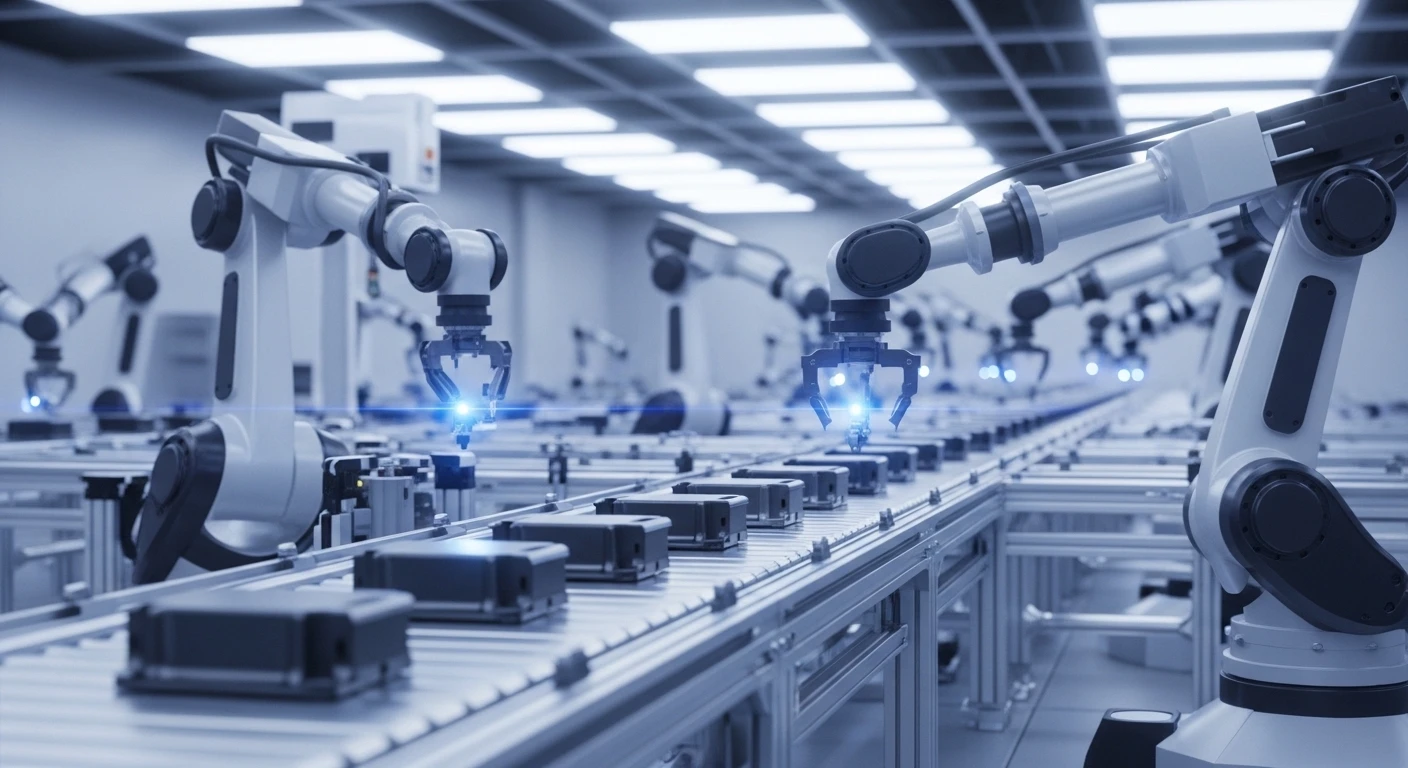
The raw materials are received via automatic conveyor systems and/or robots and their components processed on machine tools (CNC, etc.), separately through furnaces, and/or separately on manually operated presses. The quality of the manufactured products is monitored through machine vision and other sensor-based systems. The packaged products are labeled and shipped either through robots, automated labelers, or from automated warehouse systems and/or transport systems.
The entire process is controlled by a central integrated system that collects, analyzes, and corrects production information without operator intervention or assistance. For example, defects identified through the use of automated visioning systems would automatically modify the processing mode without an operator having to modify the mode.
Steps in Automating a Manufacturing Facility
- Audit Processes — creating a map of operational processes, identifying problem areas;
- Automation Prioritisation — identifying the highest volume, most resource-intensive areas;
- Selecting Equipment & Software — from sensors through integration with Enterprise Resource Planning (ERP) and Manufacturing Execution System (MES) software;
- Pilot Implementation — implementing test solutions in one manufacturing sub-division (i.e., electrical panel assembly) and then scaling to other manufacturing divisions.
Investing in the test solutions at the electrical panel assembly sub-division resulted in a 300% increase in unit productivity from 8 units per shift to 24 units per shift, a decrease in productivity errors from 12% to 1.5%, an investment of 2.8 million rubles, and resulted in a return on investment in less than one year.
How to Set up Automating Manufacturing Operations
- The first step in automating manufacturing operations is to install sensors to monitor the critical parameters.
- The second step is to connect the various departments within a manufacturing operation and allow for automated data transfer between all departments by means of a data transfer platform (API) and/or no-code solution provider.
- To improve overall efficiency, thirdly install AI agents to help automate everyday decision-making and provide feedback on what has gone wrong in terms of both process control as well as product quality. The agent would also notify workers if corrective action is needed.
- Fourthly, the introduction of Collaborative Robots will significantly improve the ability of manufacturers to perform physically demanding tasks in a more collaborative manner than has been possible with a traditional workforce and will offer a safe working environment between humans and machines.
- Lastly, Predictive Maintenance Systems will help in eliminating unexpected machine downtime by 30–40% over a 1–2 week period and allow for better planning of potential breakdowns before they occur.
A main area of concern with automation is that many manufacturers invest in high-tech machinery and then fail to optimize the processes that surround their new automated machinery. The main reason for this is due to the lack of a comprehensive approach to automating both the manufacturing and processes associated with the manufacturing operations.
Automated Manufacturing Management Systems and Process Control Systems
Automated Manufacturing Management (AMM)
- Equipment Level (PLC): A PLC controls the operation of the machines and equipment by means of a fixed algorithm, therefore controlling the machines and equipment by using the information provided by the AMM System.
- Workshop Level (SCADA/MES): The workshop level of a manufacturing facility provides a platform from which to monitor and control the execution of the manufacturing processes as well as the planning of all associated activities at the workshop level.
- Enterprise Level (ERP): The enterprise level ERP system provides a framework for the overall management of the manufacturing enterprise. It is used to identify and plan all business processes (manufacturing, procurement and logistics) associated with the enterprise.
The integration of the Automated Manufacturing and Process Control Systems together provides for a significant reduction in the time frame from when an order is received to the launching of production from three days for traditional manufacturing to four hours for automated manufacturing. This significant reduction in time frame is critical to maintaining a manufacturing company's overall competitiveness.
Automated Process Control Systems (APCS)
The Automated Process Control Systems (APCS) represent the core of a manufacturing company's operations. The APCS serves to collect all of the data produced by the various sensors used in the manufacturing process, monitor that data for compliance with the specified or predetermined operational parameters for the various manufacturing operations, and operate (control) the different pieces of equipment (mechanisms) to accomplish the specified operations. An example of the use of an APCS is the operation of the pasteurizing process at a dairy processing facility. The APCS monitors the pasteurization process to maintain the pasteurization temperature (as specified) and to activate emergency shutdown as required or necessary during an emergency.
In addition to monitoring and controlling the temperature for the pasteurization process, the modern APCS also includes AI technology that enables predictive management. The introduction of AI technology allows for the APCS to make corrections to the pasteurization process prior to it causing any adverse impact on the final product due to changes in the raw materials or conditions of the pasteurization process.
Automated Management of Manufacturing Operations and Processes

The Automated Management System (AMS) enables users to divide roles between maintenance management systems:
- APCS — technologic parameters, i.e. temperature and pressure, for controlling the pasteurizing process;
- MES — production task and quality control;
- ERP — business processes and resources planning.
Coordinated efforts of the various types of manufacturing system help to eliminate any opportunity for delays and gaps between processes, while fostering more transparency and responsiveness in the management.
There are five main types of systems used at different levels of manufacture:
- SCADA: Supervisory Control and Data Acquisition (SCADA) is used to monitor and control the equipment that is being manufactured.
- MES: Manufacturing Execution Systems (MES) are used to manage tasks and ensure that quality is properly maintained.
- ERP: ERP systems enable the management of all enterprise resources, such as production, sales, marketing, and inventory.
- PLM: Product Lifecycle Management (PLM) systems help manufacturers to oversee the entire product lifecycle, from conception to disposal.
- WMS: Warehouse Management Systems (WMS) are used to manage the movement and storage of products and stocks.
For businesses that are small in size, SCADA combined with an integration with 1C provides an adequate level of system management. For medium-sized manufacturers, both the MES and ERP systems are required. Large or multi-facility manufacturing enterprises will have a complete manufacturing automation solution configured with a single database that manages all of the enterprise's operations.
Control and Software
Recent developments in machine vision technologies have enabled manufacturers to reduce production defects from 4% (average defect ratio) to 0.1% (defect-free production). These technologies also allow for the reduction of control time from 30 minutes (in the case of manual control) to seconds (using machine vision). (Fanuc Robotics, 2023).
Machine learning technologies allow artificial intelligence to analyze many variables simultaneously to help identify the root causes of any production failures and provide manufacturers with recommendations for improving productivity and efficiency, thereby saving time and money.
Production Lines & Automated Production Line Solutions
A variety of Automated Production Line equipment is available for manufacturing:
- Raw Material Feeding: Automated loaders and robots for the feeding of raw materials.
- Processing: Computer Numerical Control (CNC) machines, hydraulic presses and injection mould machines for the processing of raw materials.
- Transportation: Conveyors and autonomous guided vehicles for transporting materials throughout a facility.
- Quality Control: Automated machine vision systems for the automatic quality inspection of manufactured goods.
- Unloading: Automated robots for the unloading of manufactured goods and pallets.
Automated production lines generally have higher rate of productivity than conventional production processes, providing greater consistency in the production process and lower average costs of production and changeover times, but represent a high capital investment, require highly qualified personnel, and a failure of any component in an automated line can result in the entire line being down.
Another interesting trend is the development of an automated production line for the management of the production automation itself. A furniture manufacturer has developed an Automated Production Management system that automatically generates the programs needed for the operation of CNC machines and has reduced the amount of time required to generate these programming files from several hours down to 15 minutes, resulting in a 35% increase in production efficiency.
Equipment Costs
- CNC Machines — from 1.5 million roubles;
- Industrial Robots — from 2 million roubles;
- Sensors and Control Systems — from 5k to 500k roubles;
- PLC Controllers — from 30k to 1.5 million roubles;
- Transport Systems / AGVs — from tens of thousands to 1 million roubles;
- Automated Storage Systems — from 5 million roubles.
Modern Automated Technical Solutions
- Collaborative Robots — Cobots;
- Machine Vision Systems — AI;
- Predictive Maintenance;
- Digital Twins;
- No-Code Platforms for Automating Business Processes, e.g. ASCN.AI.
No-code platforms that automate inventory management in automated warehouses and minimize material shortages have eliminated downtime due to material shortages.
Manufacturing Process Automation Specializations
Manufacturing Process Automation Specialization Code = 15.03.04. Students will study the concepts associated with Automatic Control Theory, PLC Programming, Industrial Networks, Machine Vision, and APCS Design. Graduates may pursue careers from Automation Engineers through Project Managers, or Entrepreneurs.
Starting salary approximately 60k and up to 250k for Project Managers. The demand for Automation Engineers continues to increase (according to 2023 data, there was a 34% year-over-year increase in job openings).
Common Specialist's Duties
- Design, implementation, and maintenance of automated production systems;
- Ensure continuous operation of production machinery;
- Optimize technological processes;
- Maintain and support existing systems.
Common Areas of Employment
- Oil/Gas, Metallurgical, Food Industry, Chemical, Machine Manufacturing, Energy/Power;
- Technical/Engineering Management;
- System Integration and Support/Maintenance;
- Development of Proprietary Solutions and Consulting Services.
What Manufacturing Sectors Have Automation? Industries / Examples of Automation
Industrial / Manufacturing Sectors
- High Automation (70–95%): Automotive, Electronics, Oil Refining, Pharmaceuticals;
- Medium Automation (40–70%): Food Industry, Metalworking, Furniture Manufacturing;
- Low Automation (10–40%): Sewing Factories, Building Materials Production, Small Businesses.
Manufacturing Automation Implementation Examples
- Double Glazing Plant: increased productivity x3, reduced defects from 7% to 1.2%;
- Meat Processing Plant: increased productivity x3 as well as increased shelf life of product by 30%;
- Casting Production: increased production by x2, reduced defects from 15% to 3%.
Stages and Ways of Implementing Manufacturing Automation
- Analysis of current process and collection of data;
- Setting of clear automation goals;
- Selection of equipment and software;
- Design and development of system;
- Installation and commissioning of equipment;
- Training of personnel;
- Start-up and monitoring;
- Scaling up and continuous optimisation.
Typical Manufacturing Automation Solutions
Typical mistakes made during automation of manufacturing processes are: automating a process that is not efficiently operated, lack of involvement from operators, insufficient training, and lack of redundant equipment.
Industrial Automation Process Control and Management
Analysing processes and managing their quality continuously helps to maintain process control and management by using new systems and methods.
Manufacturing Automation Equipment / Techniques
Key Manufacturing Automation Equipment
- CNC Machines;
- Industrial Robots and Collaborative Robots;
- Control and Measurement Sensors;
- PLCs;
- Conveyors and AGVs;
- Automatic Storage and Retrieval Systems.
Modern Technical Tools
- AI Machine Vision Systems;
- Predictive Maintenance;
- Digital Twins;
- No-Code Platforms for easily implementing automation.
Industrial Solutions
The objective of manufacturing automation is to increase production, increase quality and reduce costs. Additionally, we will contribute to increasing flexibility of production and speed up changeovers between products.
Human Contribution and Responsibility in Automated Manufacturing
The human presence is crucial to the future success of automation. As automation grows, humans will continue to fulfil the role of monitoring the performance and state of automated systems, supporting decision making in non-standard operating environments, and providing technical capabilities for maintaining the automated systems.
Duties and Oversight of the Manufacturing Process
Humans will have a vital role to play in monitoring the performance and condition of automated machines and systems, interpreting and using data to implement system improvements, to produce a reliable, flexible manufacturing process.
Automation and Business Processes
Automation reduces the potential for human error through optimising the use of resources. Additionally, it enables businesses to get new products into the market quickly.
The Future of Software and Control Systems Used to Automate Manufacturing
Software Tools
- SCADA (WinCC, Trace Mode, Ignition);
- MES (1C:MES, Phobos, Siemens Opcenter);
- ERP (1C:Enterprise, SAP, Microsoft Dynamics);
- No-Code Platforms (ASCN.AI, Zapier, Make).
Control Systems
The technology of machine vision, process control, energy resource monitoring, and predictive maintenance are used to improve product quality and reduce defects.
Case Studies on the Application of Automation and Control Technology
- The machine vision system used in a cable manufacturing operation reduced the defect rate from 5% to 0.2% with a 6-month payback.
- Reporting automation at the furniture factory reduced the report preparation period from 4 hours to 0 hours.
- An automated maintenance reporting and control system at a building materials manufacturer reduced unexpected machine downtime, yielding a labour savings of 1.5 million roubles, with an average payback period of 4 months.
Automation Levels of Manufacturing Operations and Future Direction
Automation Levels
- 0 — Manual Manufacturing;
- 1 — Partial Automation;
- 2 — Complex Sectional Automation;
- 3 — Workshop Level Automation;
- 4 — Plant Level Automation;
- 5 — Digital (Industry 4.0) Manufacturing with system integration and AI.
Main Directions of Development
- Integration and digitalisation;
- Robotisation;
- Predictive analytics;
- Autonomous industrial transportation;
- Production personalization;
- No-code automation;
- Cybersecurity and eco-friendly automation;
- Innovative technologies: quantum algorithms, biomimetics and autonomous planning.
Frequently Asked Questions
1. What types of automated systems are available?
SCADA, MES, ERP, PLM, WMS, and APCS are all integrated systems for comprehensive business management.
2. What work roles are related to manufacturing process automation?
An Automation Engineer will be involved, as will a PLC Programmer, SCADA Specialist, Robotics Engineer, Machine Vision Specialist, Predictive Maintenance Specialist, and Automation Consultant.
3. What are the benefits of automating manufacturing processes?
Increase production, reduce defects, improve quality, save labour, predictable and flexible manufacturing processes, reduce costs, increased safety. Your investment will typically be repaid in from 6 to 24 months.
Conclusion
Today's manufacturing automation systems will become more sophisticated; the future of automation will include the use of AI agents that will replace the rigid algorithms of yesterday. We will have no-code platforms that will enable manufacturers to design and develop the solutions they need efficiently on their own.
The primary areas for the future of manufacturing automation will be AI, autonomous manufacturing plants, eco-friendly automation, personalised production, and global system integration.
The combination of an integrated systems approach, employee training, and ongoing optimisation of systems will achieve higher efficiency and competitiveness in manufacturing operations.