



- Русский
- English
- Português
How to Create a GPT Agent: A Step-by-Step Guide for Those Looking to Implement AI in Their Business

The automation market has grown by 30% over the past two years. That is a fact. But there is another interesting circumstance: traditional methods are already stalling. Internet searches, manual development... it all works too slowly. And the market won't wait!
I have been working in automation for eight years. I have seen companies that simply lost to their competitors because they continued to develop solutions "the old-fashioned way." Finally, GPT agents arrived—and everything changed. They make decisions themselves, taking context into account. No rigid scripts required.
"Over three years, we built an ecosystem of AI tools that processes millions of requests. The main thing I realized is that GPT agents work exactly where flexibility and contextual understanding are needed. Rigid scripts simply won't work here."
What exactly is a GPT Agent?
A GPT agent is a software module built on generative language models (Generative Pre-trained Transformer). Sound complicated? I’ll explain the core concept right now.
Imagine, for example, a regular chatbot. It works on the principle: "If the user writes A, then answer B." Everything is hardcoded. A GPT agent is different—it parses the request, understands what the person wants, and dynamically constructs a path of action. Without pre-written scenarios.
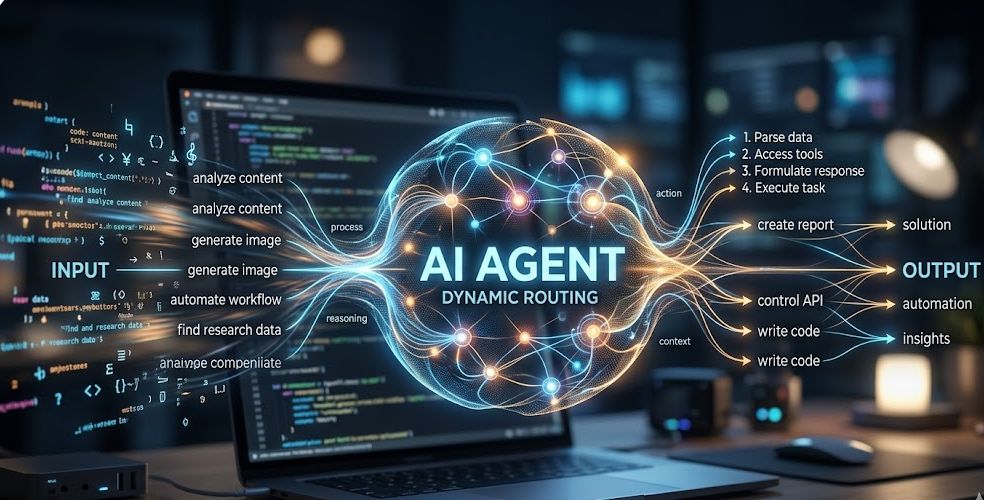
Here is what it can do:
- Contextual understanding — it remembers previous messages and links requests into a single context and dialogue chain.
- Adaptability — it chooses solutions depending on the situation. This is critical for business processes that are constantly transforming.
- Response generation — unique text for every request. However, it sometimes "hallucinates"—producing beautiful but incorrect information.
- Integration with external systems — it can access APIs, databases, and call functions within a company.
How does it differ from a classic chatbot? Compare them in this table:
| Parameter | Classic Chatbot | GPT Agent |
|---|---|---|
| Logic | Rigid script-based (if-then, regex) | Probabilistic, transformer-based |
| Handling unexpected requests | Errors or fallback | Understands thanks to context |
| Development cost | Cheap at the start, high at the end | Higher initially, but scales without rework |
| Response accuracy | 95%+ for canned responses | 70–90% for open-ended tasks |
GPT agents are particularly good where requests are diverse. Customer service, virtual assistants, and recommendation systems are their forte.
Where this actually works
Business Automation
In banking support, GPT agents have reduced request processing time by 40%. Customer satisfaction increased by 25%. During automation, about 70% of routine cases were filtered out—only the remaining complex issues were handled by operators.
In logistics, agents track shipments, communicate with customers and suppliers, and predict delays. One ASCN.AI client from the crypto industry reduced manual labor by 60%—the agent analyzes on-chain metrics and sends out risk notifications.
Education
AI tutors tailor learning to the student's level and explain material concisely and accessibly.
In corporate training, agents facilitate the onboarding of newcomers. For instance, marketers mastered Web3 tools in five days instead of three weeks.
Leisure and Content
Gaming NPCs based on GPT react based on the player's actions—changing their attitude and behavior.
Content creation (articles, product descriptions) requires validation. Errors are possible here. For example, unreliable agents in crypto cases sometimes generated fictional quotes—which highlights the need for oversight in such matters.
Key facts about GPT model principles
GPT stands for language models by OpenAI, created based on the transformer architecture (Vaswani et al., 2017). The key element is the self-attention mechanism, which processes all words in a text simultaneously.
- GPT-1 (2018) — 117 million parameters, proved the viability of pre-training.
- GPT-2 (2019) — 1.5 billion parameters, capable of generating several paragraphs of coherent text.
- GPT-3 (2020) — has 175 billion parameters, forms the basis of ChatGPT, and is capable of few-shot learning.
- GPT-4 (2023) — exact parameter count not disclosed; improved factual accuracy and reduced response toxicity (reduced by 82%).
ChatGPT uses RLHF (Reinforcement Learning from Human Feedback) to better match human expectations. Text is broken down into tokens, which are fed into the model. The model analyzes them and predicts the next word in the sequence. However, there is a limitation—the context window size (4,096 tokens in GPT-3.5 and up to 128,000 tokens in GPT-4). This means up to 128,000 tokens can be processed in a single request.
How GPT agents differ from simple chatbots
Classic chatbots are state machines with fixed scenarios. They are trigger-dependent. GPT agents are not limited by rigid scenarios; they process dialogue dynamically, their conversations are non-linear, and topic switches occur with full understanding.
Dialogue Example:
- User: "What is the current Bitcoin price?"
- Agent: "$43,250 right now."
- User: "Will it be higher tomorrow than it is now?"
- Agent: "It's hard to predict, but..."
- User: "How do I buy Bitcoin on your platform?"
A classic bot would have lost the context and failed to link the requests. A GPT agent remembers the entire dialogue.
Modern GPT agents already have function calling capabilities, allowing them to directly call external functions via API. This is crucial for integrations.
Take ASCN.AI as an example—an agent in the cryptocurrency analytics space that uses Ethereum and Solana nodes to extract on-chain data and quantitative market indicators, combining them into a response in 10 seconds. In a classic approach, this would have required dozens of hard-coded scripts.
The memory management process is implemented through two levels:
- Short-term — the conversation history with the user, i.e., messages remembered during the current dialogue.
- Long-term memory — vector databases (Pinecone, Chroma) and structured databases containing user data.
The key task is finding a balance between full context preservation and performance. A combined approach—using GPT on one hand and rule-based mechanisms on the other—reduces errors by 90%.
How to create a GPT agent: A step-by-step guide
Where to get the GPT itself?
There are several options available.
OpenAI GPT-3.5 Turbo
- Response time: 2–3 seconds.
- Cost: approximately $0.0015 per 1,000 tokens.
- Optimal for simple and high-volume requests (e.g., FAQ, classification).
- Accuracy: around 75%.
- In ASCN.AI, processing 10,000 requests a day saves $800 per month compared to GPT-4.
OpenAI GPT-4 (Turbo and optimized)
- Response time: 2–5 seconds.
- Cost: $0.01–$0.03 per 1,000 tokens.
- Context: up to 128,000 tokens.
- Suitable for complex tasks: analytics, law, medicine.
- In ASCN.AI, used for parsing whitepapers 50 pages in length.
Open Source Models — Llama 3, Mistral, Falcon
- Full control and customization.
- Requires a strong ML team and high-end GPUs.
- A clear advantage for high loads and strict security requirements.
- Licenses allow for commercial use.
Recommendation:
- For MVPs and prototypes — choose GPT-3.5 Turbo.
- For production with high requirements — GPT-4 Turbo.
- For tasks with personal or confidential data — open source solutions.
- Hybrid schemes — mixed setups that combine different approaches based on functionality and price.
Technical requirements and environment
Development:
- Local: 4-core CPU, 8-16 GB RAM, 20 GB free disk space.
- Production via API — VPS with 2 vCPUs and 4 GB RAM.
- For open source models — NVIDIA T4 GPU or more powerful.
- Python 3.10+, Poetry or pip + venv for dependency management.
Tools and Libraries:
- Official OpenAI SDK.
- LangChain — for creating complex agents.
- Vector DBs: Pinecone, Chroma.
- Asynchronous libraries: aiohttp, asyncio.
- Logging via Loguru, monitoring via Prometheus and Grafana.
Regarding hosting:
- Cloud platform solutions — AWS, Google Cloud, Heroku (Lambda, Cloud Run).
- Outsourced managed AI services — Replicate, Hugging Face Inference.
- Self-hosted hosting for projects with significant traffic volume and increased privacy compliance requirements.
Setting up API access and key management
Register on the platform.openai.com platform, create a secret API key, and store it in a .env file rather than in the code. It is recommended to rotate keys as often as possible and use secret managers (e.g., AWS Secrets Manager, Vault).
OpenAI imposes Rate limits on incoming requests:
| Plan | Requests Per Minute (RPM) | Tokens Per Minute (TPM) |
|---|---|---|
| Free | 3 RPM | 40,000 TPM |
| Tier 1 | 500 RPM | 1,000,000 TPM |
| Tier 5 | 10,000 RPM | 30,000,000 TPM |
To handle 429 errors (rate limit exceeded), exponential backoff schemes and task queues (Celery, RabbitMQ) are used.
GPT Agent Structure — Components and Connectivity
[User]
    ↓ (request)
[API Gateway / Frontend]
    ↓
[Dialogue and Routing Module]
    ↓
[Context and Memory Manager] ←→ [Vector DB]
    ↓
[Prompt Engineering]
    ↓
[GPT API]
    ↓ (response)
[Post-processing]
    ↓
[Integrations and Tool Use] ←→ [External APIs, Databases, Functions]
    ↓
[Return Response to User]
The dialogue and routing module understands what the user wants and directs their request to the appropriate service—knowledge base, CRM, or operator. Short-term dialogue history is managed by the memory manager, which uses embeddings, semantic search, and vector databases for long-term data. Prompt engineering generates combined requests consisting of system instructions, context, and user text. All integrations are implemented via function calling technology—GPT calls the API and then processes the result. Post-processing handles filtering, moderation, and formatting of final responses.
Simple code example for launching a GPT agent
import os
from openai import OpenAI

client = OpenAI(api_key=os.getenv("OPENAI_API_KEY"))

SYSTEM_PROMPT = """
You are a business automation assistant. Answer concisely and to the point. If you don't know the answer, say so honestly.
"""

def chat_with_agent(user_message, conversation_history=None):
    if conversation_history is None:
        conversation_history = []
    conversation_history.append({"role": "user", "content": user_message})
    response = client.chat.completions.create(
        model="gpt-3.5-turbo",
        messages=[{"role": "system", "content": SYSTEM_PROMPT}] + conversation_history,
        temperature=0.7,
        max_tokens=500
    )
    agent_reply = response.choices[0].message.content
    conversation_history.append({"role": "assistant", "content": agent_reply})
    return agent_reply, conversation_history

if __name__ == "__main__":
    history = []
    print("Agent: Hello! How can I help you?")
    while True:
        user_input = input("You: ")
        if user_input.lower() in ["exit", "quit", "выход"]:
            print("Agent: See you later!")
            break
        reply, history = chat_with_agent(user_input, history)
        print(f"Agent: {reply}\n")
This code is easily expandable—for example, by adding external function handling to retrieve weather or other information via API.
Configuring dialogue logic and memory management
Dialogue context is managed in two ways:
- Sliding window — storing the last n messages.
- Summarization — periodic simplification and shortening of the history.
Short-term memory resides in vector databases (e.g., Chroma), where semantic embeddings are stored for relevant searching.
For complex, multi-level business processes with state, management is done manually—example:
class OrderState:
    def __init__(self):
        self.step = "initial"
        self.cart = []
        self.address = None

user_states = {}

def handle_order_flow(user_id, message):
    state = user_states.get(user_id, OrderState())
    # Implement order step logic here
Tools and Technologies for Creating GPT Agents
| Framework | Language | Abstraction Level | Integrations | Learning Curve | When to Use |
|---|---|---|---|---|---|
| LangChain | Python, JS | High | OpenAI, Anthropic, Vector DBs, 50+ integrations | Medium | Complex prompt chains, memory, retrieval |
| AutoGPT | Python | Very High | GPT-4, file handling, web search | Low | Experiments, task autopilot |
| Haystack | Python | Medium | Elasticsearch, FAISS, HF Transformers | Med–High | Search systems and QA on documents |
| ASCN.AI NoCode | No-code | Very High | Telegram, CRM, Google Sheets, HTTP API | Low | Automation without code, rapid launch |
| Rasa | Python | Low–Medium | Custom NLU, dialogue policies | High | Privacy support and regulated industries |
Programming languages and libraries
Python is the most common language for GPT agent development because it provides a rich ecosystem that allows for convenient integration with ML tools. The main libraries used are the OpenAI SDK for official OpenAI services, LangChain for building complex agent chains, and tools for working with vector databases like Pinecone and Chroma.
Deployment and hosting options
There are several hosting and deployment options:
- Cloud services (e.g., AWS, Google Cloud, Heroku) — for quick start and scalability.
- Managed AI platforms (e.g., Replicate, Hugging Face) — for simple launches with minimal configuration.
- Self-hosted solutions — for companies with high loads and strict privacy requirements.
Implementation Examples of GPT Agents
A crypto exchange processing over 500 requests a day implemented a GPT agent based on GPT-3.5 Turbo, linked to Telegram and a vector database of 150 FAQs. 70% of cases are closed without operators, average response time decreased to 8 seconds, and NPS rose from 45 to 68 points in a quarter.
Protection against prompt injection is handled using filters that cut off malicious external requests.
Advisors and Virtual Assistants
A GPT-4 based financial advisor combines Ethereum and Solana on-chain data, market analytics, and social sentiment statistics. It aggregates data on major market players (whales) and key events, including links and warnings about investment risks, responding to queries within 10-30 seconds.
Integration with Business Processes
ASCN.AI automated lead processing using a NoCode workflow: a trigger on a Telegram message, an AI agent extracts budget and urgency, then integrates into the CRM while notifying the manager. Manual time was significantly reduced—from 5 minutes to 15 seconds per lead. Over a month, 300 leads were processed without human intervention.
Tips for GPT Agent Optimization and Security
For optimization and security, it is recommended to limit the number of requests and monitor performance quality. It is also advised to set limits at the API Gateway level and track expenses.
from collections import defaultdict
import time

request_counts = defaultdict(list)
MAX_REQUESTS_PER_MINUTE = 10

def is_rate_limited(user_id):
    now = time.time()
    request_counts[user_id] = [t for t in request_counts[user_id] if now - t < 60]
    if len(request_counts[user_id]) >= MAX_REQUESTS_PER_MINUTE:
        return True
    request_counts[user_id].append(now)
    return False
Response Validation
- Censorship via OpenAI Moderation API to block toxic messages.
- Requirement for source citations for claims.
- Limiting maximum response length for better readability.
User Behavior and Preferences
User behavior and communication preferences allow us to tailor the agent to the conversation style and format prompts according to parameters stored in the profile. This includes a formal style for B2B communication, a friendly and simple tone for B2C, an empathetic approach for support services, and multi-language support with automatic language detection.
Security and Confidentiality
Key protection measures:
- Sanitization and filtering of user inputs.
- A separate layer for system and user instructions.
- Secondary verification of outputs for policy compliance.
- Anonymization of personal data before sending requests to the API.
- Use of self-hosted models to comply with GDPR and HIPAA requirements.
Logging of all requests and responses is mandatory for audits; request logs are stored for at least three years in encrypted form.
Frequently Asked Questions (FAQ)
Why doesn't the agent understand the task?
Try refining the prompt, adding examples (few-shot learning), or use GPT-4 for tasks requiring more complex reasoning.
How to ensure data privacy?
Encrypt data, anonymize personal information, and use self-hosted solutions for highly sensitive data.
Can GPT agents be used for commercial purposes?
Yes, provided you comply with OpenAI's Terms of Use, including restrictions on resale and fine-tuning.
Conclusion and Recommendations for GPT Agent Development
GPT agents have already changed the principles of automation—now it's enough to describe a task in natural language, and the system adapts. They are undoubtedly worth applying when requests are diverse and contextual understanding is required.
- Memory must be managed intelligently.
- Integration with the outside world must be ensured.
- Response validation and filtering are mandatory.
To expand your expertise, master prompt engineering, work with vector databases, and study function calling. In the near future, we will see multimodal agents, fully autonomous systems, and specialized industry models. Those who implement these technologies today will gain a strategic advantage.
Disclaimer
The information in this article is for general purposes and does not replace investment, legal, or security advice. The use of AI assistants requires a conscious approach and an understanding of the functions of specific platforms.