



- Русский
- English
- Português
Delivery automation: how to stop losing money on routine tasks

Old methods of delivery organization are like trying to outrun a Tesla in a Zhiguli. You could try, but why?! Today, businesses don't need pretty presentations and loud, figurative promises. Businesses need solutions that actually save money and time. Delivery automation isn't about the "wow factor"; it's about not flushing your budget down the drain. Over years of working with various projects, I've realized one thing — everything comes down to speed and accuracy. If you don't automate your processes, prepare for constant failures, downtime, and cash leaks. And the leak is quite serious.
“I’ve seen many companies crash not because they came up with some nonsense, but because developers, reaching into the client's pocket, weren't doing what the client actually needed. Delivery automation isn't about hype. It's about cost calculation and route optimization. If that’s missing, the project is essentially giving away someone else's money every month.”
Delivery automation is when routine tasks are handled by software — from routing to customer notifications. As a result, the business gets a transparent process with minimal errors, and the ability to react quickly to changes makes it more competitive.
What is delivery automation and why is it needed?
Automated delivery is when logistics are managed not manually by people, but by various software and equipment. Courier services, online stores, and food delivery services all use these technologies to eliminate manual data entry and speed up order processing. The foundation lies in the integration of accounting programs, CRM, warehouse software, and mobile applications for couriers.
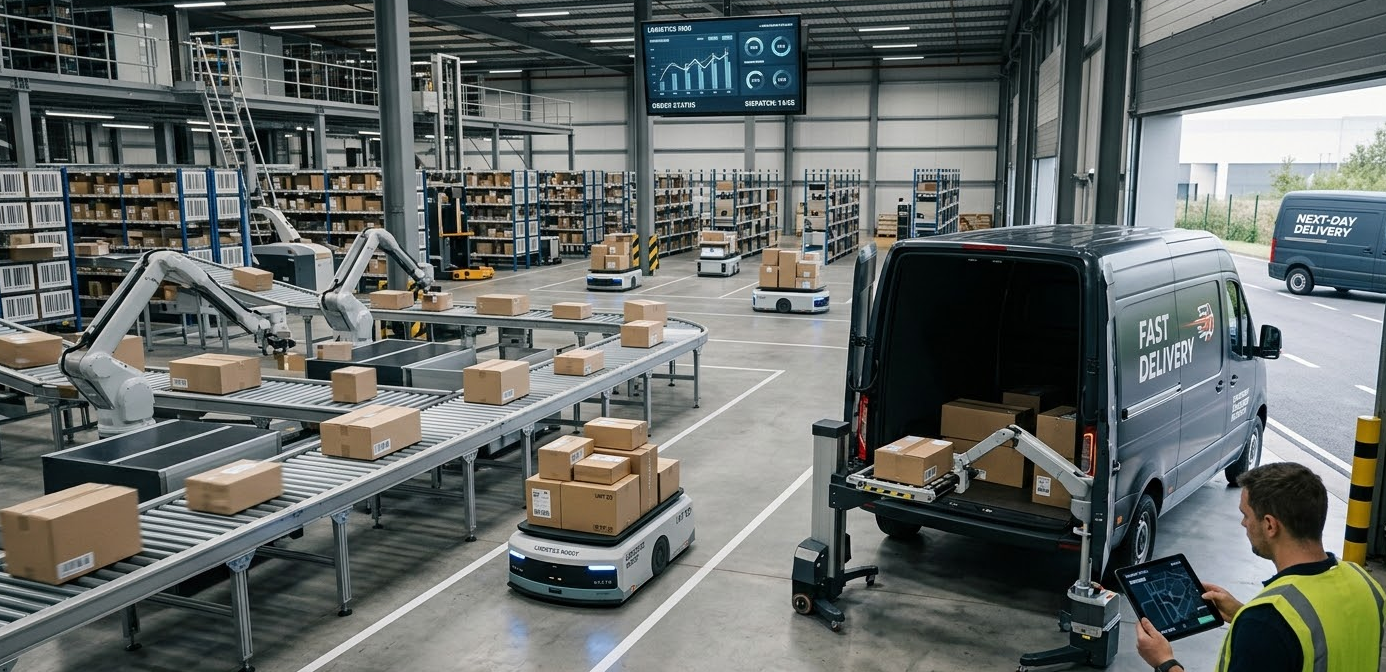
Companies that have implemented logistics automation have reduced costs by 15–30%, simply by eliminating errors in order processing. In our projects, we have utilized both AI agents and No-code platforms. For example, in one case involving cryptocurrency, the use of route automation reduced processing time by 40%.
So why automate delivery?
The answer is simple — the main goal is to create a system that works on its own and generates income on its own. It is equally important for those investing money as investors and those managing as executives to realize this. Automating for the sake of automation itself is just throwing money away, no matter how it’s justified. If your courier expenses are 50,000 a month and the system doesn't reduce them, what’s the point? Where is the indication of necessity?
Main competitive advantages:
- Wage reduction. Automation takes over the functions of dispatchers and operators.
- Faster order processing. Routes are generated in seconds.
- Quality control. Every stage is recorded — from picking up the goods to delivery to the client.
- Scalability. The system handles both 100 and 10,000 orders without increasing staff.
During the implementation of a project involving AI-based agents, we automated the process of scheduling couriers by geolocation and notifying customers of delivery. This reduced dispatching time by up to 60 (!) hours per month.
Types and systems of automated delivery
The most basic and important part of automation is the software. It manages orders, builds routes, monitors couriers, and generates reports.
Overview of popular programs
DM.Delivery Pro — a tool for courier services. It distributes orders, builds routes considering traffic jams, and tracks shipment statuses. It works with 1C.
1C:Delivery — a module for 1C that automates absolutely everything: routes, expenses, and waybills. It is ideal for companies operating on the 1C platform.
Yandex.Delivery — a well-known service with integrations for Insales, Ecwid, and WooCommerce. It automatically creates orders and notifies customers. Already 68% of all companies use cloud solutions for delivery management.
Integration with online stores and accounting systems
Automation only reveals its potential if the delivery system is integrated with e-commerce, CRM, and ERP. This function allows for updating statuses and creating routes without manual entry.
Without integration, the process turns into chaos with long and error-prone data movements. No-code platforms like ASCN.AI allow you to connect CRM, warehouse, and delivery without programming. Launching takes place within a few days. More details — ASCN.AI NoCode.
Equipment and integration with transport
Mobile Data Terminals (MDTs)
MDTs are mobile devices with barcode scanners. They are designed for couriers to quickly record order statuses and transmit data to the system.
These devices feature:
- IP67 protection and higher.
- Ability to work in temperatures ranging from minus 20 to plus 60 °C.
- Resistance to drops from a height of 1.5 meters.
- GPS support.
Mobile applications for couriers
Apps have made paper lists obsolete. They show the route, notify of new orders, and record the moment of delivery. Integrations with Yandex.Maps account for traffic jams. Comprehensive automation covers the entire logistics and warehouse cycle: receiving goods, forming sheets, warehouse management (WMS), assigning couriers, route planning (TMS), and notifying customers.
How to automate the delivery process: step-by-step instructions
To implement automation into workflows effectively, you need to understand exactly which parts of the chain have blind spots, flaws, and bottlenecks where processing can and should be sped up — but not with the first software you find. Without a systematic approach, new software will only speed up the errors.
What needs to be done for analysis:
- Determine the duration of order processing.
- Identify bottlenecks and typical errors.
- Calculate the costs for each operation.
- Identify critical moments for the first phase of automation.
For example, a food delivery service was processing orders in Excel and spending 5–7 minutes per order. With 200 orders a day, that’s 20 hours of work. After automation, this time was reduced to 30 seconds.
Selection and implementation of systems
When asking which system we are lacking, you need to consider:
- Integration with all current systems.
- Scalability.
- Total cost of ownership.
- Interface simplicity.
- Integration with ERP, CRM, and other systems.
System integration means a unified space and no duplication. For small and medium enterprises, no-code platforms (e.g., ASCN.AI) allow integration in a matter of days.
Staff training and support
Technology doesn't work without staff preparation. Training plan:
- Detailed instructions for everyone.
- Practice with test scenarios.
- Technical support service in the first weeks.
- Feedback collection.
Companies that invest in training reach ROI 40% faster.
Delivery automation checklist
Step 1. Define and set up software. Assess order volumes and geography. Cloud consumption for small businesses — 1C:Delivery, SAP TMS for medium ones.
Step 2. Integration with accounting systems. Organize automatic data transfer. Check order transmission and status updates.
Step 3. Implementing mobile applications. Provide couriers with necessary apps featuring navigation. Issue MDTs if necessary. Train personnel.
Step 4. Automation of cash operations. Integrate with online cash registers according to 54-FZ. Automate sending electronic receipts. Set up EDI for reporting.
Key technological solutions and tools for delivery automation
GPS monitoring makes it possible to track vehicle movement in real-time, monitor supply routes, and driver behavior. This system helps save on fuel.
Robotization and drones in delivery
Delivery robots and drones can be an alternative to couriers for short-distance deliveries. For example, Yandex.Rover is already operating in several cities.
Drones are capable of delivering cargo up to 24 km away, but wide-scale application is hindered by regulatory barriers.
Route optimization using machine learning
AI algorithms that analyze data, traffic, and customer preferences build dynamic routes. As a result, AI systems save customers 20–30% on delivery time.
Automatically notified customers
Customers receive notifications at every stage: confirmation, assembly, departure, arrival. Messages are sent via SMS, email, and push. The system allows customers to choose a convenient delivery time.
Food delivery automation: differences and examples
- Food products. Control of expiration dates and temperatures.
- Electronics. Proof of receipt, quality packaging.
- Medicines. Compliance with transportation conditions.
Case studies and successful examples
- Food delivery service. Processing time for a batch of 1.5 million items dropped from 6 hours to 30 minutes. Payback date — 4 months.
- Electronics web store. Integration reduced errors by 60%.
- Crypto project with AI agents. Automation reduced labor costs by 40 hours per month. Details — in a separate case study on how to profit from a flash crash.
Problematic and challenging aspects of delivery automation
- Technical: system incompatibility, unstable connection.
- Organizational: employee resistance, budget constraints.
Security and quality control
Systems process personal data, which requires compliance with 152-FZ and GDPR. Quality control involves targeted monitoring and photo verification.
Legislative and ethical aspects
- Compliance with 54-FZ (online cash registers) and 152-FZ (personal data) must be taken into account.
- A balance must be maintained between courier monitoring and privacy.
How automation improves courier service performance
The courier's task is now simplified — the route and contacts are provided in the app, and communication with the client is reduced to chat interactions. Customers track the courier's movement on a map.
78% of customers believe that courier tracking is the main factor.
Route optimization and control
Automation takes into account distances, traffic jams, and order priorities.
Management and accounting in automated systems
- Receiving orders from different channels.
- Distribution among couriers.
- Route planning and monitoring.
- Reporting on revenue and efficiency.
Electronic Document Interchange (EDI)
EDI significantly reduces costs, speeds up invoice processing, and minimizes the risk of errors. Documents with an electronic signature have legal force (in accordance with 63-FZ).
AI, no-code platforms, and earning opportunities with ASCN.AI
AI agents are virtual assistants that perform tasks such as taking orders, answering questions, mapping routes, analytics, and more.
- A client writes in Telegram — the agent creates the order.
- Support via chat.
- Route optimization.
- Report generation.
How no-code platforms simplify implementation
The ASCN.AI platform allows you to quickly create automations even without programming, thanks to artificial intelligence.
Here is an example workflow:
- Trigger — a new question in Telegram.
- AI agent analyzes the question.
- Records it in a Google Sheet.
- Courier assignment.
- Confirmation to the client.
Implementation — 2–3 hours. Price — from 10,000 rubles, payback period — 1–2 months.
Ways to earn with ASCN.AI
- Automating your own business — saving 70,000 rubles per month.
- Selling automation as a service — scalability of solutions.
- Training and consulting — training on AI agents.
- Affiliate programs — rewards for bringing in clients.
Why ASCN.AI
- Focus on AI and no-code.
- Integration with Telegram, Google, CRM.
- Minimal entry threshold.
- Support from 10 to 10,000 orders.
For more details — official ASCN.AI website.
FAQ
What is an automated delivery system?
A set of software and hardware that organizes logistics automatically without human intervention.
How to choose an automation solution?
Look at business scale, integration, and price. For small businesses — cloud services; for medium ones — 1C, SAP. Automation consists of the following stages: process analysis, software selection, integration, app implementation, and user training.
Can small businesses automate?
Yes, cloud and no-code solutions are available.
What technologies reduce costs?
GPS monitoring, routing, machine learning, EDI, and mobile applications.
Conclusion and recommendations
Delivery automation is not a trend, but a necessity. It helps reduce costs, speed up execution, and improve quality.
Main trends:
- Robots and drones for small orders.
- Increasing importance of AI in optimization.
- Omnichannel ecosystems.
- Eco-friendly solutions.
Recommendations:
- Try to understand your processes.
- Choose solutions that can be scaled.
- Ensure system integration.
- Invest in staff training.
- Monitor effectiveness.
- Use no-code platforms.
Remember: automate your processes, not the chaos. Then the investment will pay off in 3–6 months.
Disclaimer
The information in the article is of a general nature and does not replace investment, legal, or security advice. The use of AI assistants requires an informed approach and an understanding of the functions of specific platforms.