



- Русский
- English
- Português
The Best AI for Searching the Internet: 2026 Rankings


We have been spending the last two years to index nodes and blockchain data as LLMs don't have live real-time access to the blockchain; hence, GPT will not see real-time actions occurring on the network. Thus, the ideal AI for searching is the one marrying a language model to a live index rather than relying on 2023 truncated knowledge base.
As much as I hate reading long walls of text, I am fully aware of the scarce amount of time people have and as such, I will provide a very simple summary of resources needed for anyone looking for immediate answers to their inquiries:
- For detailed research with reference sources: Perplexity Pro is the only way to go if you want factual and credible information.
- For daily users at no charge: You.com or Bing Chat are sufficient options that are basic and work well.
- If you are working with documents and content in the Russian language: Yandex (using neural networks) or MashaGPT (the aggregator) are superior as they will more accurately understand the local context.
- If you need to locate academic articles: Study24 or Andi; for when you need actual scientific resources as opposed to Wikipedia.
- For routine automated activity (anything beyond searches): ASCN.AI Assistant will allow you to automatically have data deposited into a spreadsheet.
- The cardinal rule: Do not trust any numbers that do not have a legitimate source noted below them.
The best AIs for searching for information on the web depend on the type of work you want to accomplish; there is no one-size-fits-all solution, only specific tools that meet the needs of a given intention. Following is an outline stating how each AI has functioned during actual working projects, quite frankly.
Best Search AIs for Different Types of Jobs
The AI-based search space experienced a dramatic shift that occurred sometime between 2024–2026. It changed quickly. Standard Google provides search results by returning ten "blue" links, whilst search AI (artificial intelligence) searches for the best results and summarizes them in a prepared answer with citations to all sources used. This allows users to no longer have to open five tabs and look for the value in SEO inspired text.
At ASCN.AI we test these systems out every day to help analyze tokens, competitors and run our daily automation processes. Boring? Probably. But works. Below are 7 services that have passed the test in real-life projects along with new entrants to the market — aggregators.
Perplexity Pro — for deep research with sources
Verdict: The best AI solution for obtaining information and follows best practices.
Key Feature: Pro Search mode. Pro Search mode will ask clarifying questions before presenting answers and not only "googles" but runs a "mini" investigation before returning answers. I utilized Perplexity Pro in a recent project with a crypto agency where I gathered information on over 40 crypto entities' tokenomics, and saved myself at least 6 to 8 hours of time per report.
You.com — The best free AI search tool
Verdict: The ideal combination of maximum functionality and a price of zero (free).
Provides multiple models on a single site and offers a Research mode for advanced queries. Unlike competitors; You.com allows users to customize their preferred source of information by allowing you to block specific domain(s) or by adding your own RSS feed(s) therefore allowing the best free search AI solution that's available to anyone needing access to an "AI" search engine at no cost. I absolutely encourage anyone looking for an AI search engine to sign up and start using it.

Google SGE (AI Summary) — For the mass user
Verdict: Part of google's searching system but does not provide the depth that you may be looking for.

Bing Chat (Copilot) — For working with documents
Verdict: Bing Chat has the best integration capabilities for Office and allows users to upload files.
When users upload a document (PDF, Excel, PowerPoint, etc.) and ask Bing Chat questions about the content, Bing Chat provides them with excerpts for their answer. For analysis of partner reports — which is often how the ASCN.AI team uses this — it is much easier than having to do a copy/paste of the content.
Yandex — Neural Networks for Russian-language content
Verdict: Yandex has the best ability to understand the context and local context in the Russian Federation.
Yandex recently integrated AI-generated content into their core search offering. For searches in Russian, specifically for Russian businesses, laws and services, Yandex outperforms all other international search engines. However, in our tests, Yandex did not identify any information on regulations about blockchain in 2026, while Perplexity did. Yandex has no competition on this front.
Andi — Great for visual search and privacy
Verdict: Andi has a minimalistic interface with absolutely no tracking capabilities.
Andi promotes itself as being a search engine that does not track users. It does not keep search history nor does it provide personalized search results. Andi provides visual searches, using "cards" rather than "links," as results from search.
Study24 / Syntx — For academic articles
Verdict: Specialization in scientific sources and citations.
If you need publications from peer-reviewed journals, dissertations, or conferences — Study24 indexes academic databases. Regular search engines often give you a Wikipedia summary; here, you get direct links to PubMed, arXiv, and IEEE. For students, researchers, and analysts. When you need science, not a blog.

Neural Network Aggregators: Everything in One Place
MashaGPT and Study24 are ideal for students, writers, and anyone else who needs to access multiple neural networks, such as ChatGPT, Claude, or Google Gemini, all under one subscription.
Both MashaGPT (up to 200,000 words of context) and Study24 (from 199 cents/month) allow users of their services to use numerous models from multiple suppliers in one place. MashaGPT is well-suited for working with lengthy documents, while Study24 is optimized for use in education and creating presentations.
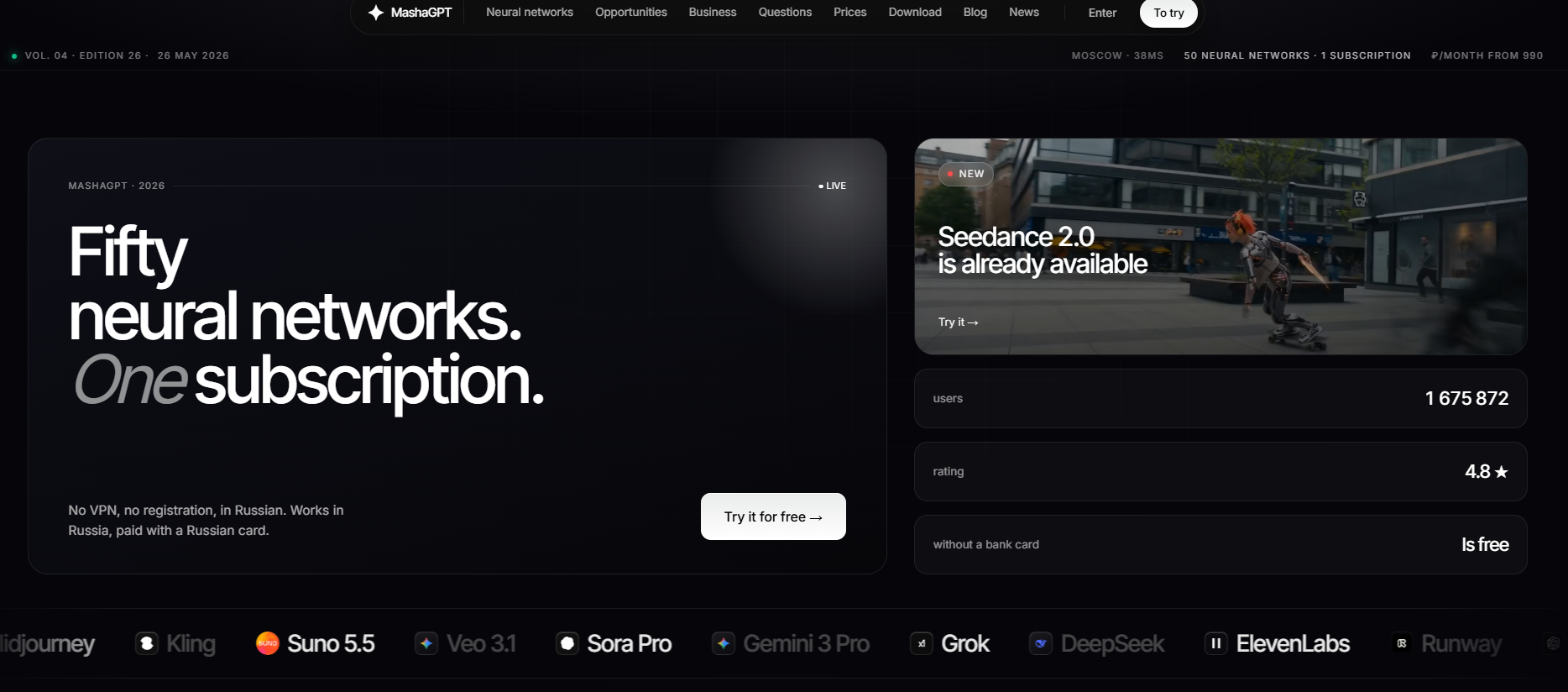
- Benefits: All these services provide one central invoice, unlimited usage, and support for local cards. That's important.
- Target Customers: Students, authors, and those who need to switch between models frequently to compare answers.
ASCN.AI Assistant: AI is Going Beyond Searching and Now Automating!
Frequently we hear from you wanting to have the AI do your monitoring of news and generate your reports for you instead of you having to do a search every time. This is where we get into the use of AI agents as opposed to AI search engines.
ASCN.AI Assistant is an example of how UVE is enabling automation of repetitive searches (this includes news) to not only one-off searches but to actually use real-time tools by having the ability to monitor for specific entities (i.e., currency rates, competitor news, etc.) and integrate them with your tools. The difference in what you are able to accomplish is significant.
"I’ve been in the industry since 2017. I’ve seen only a few instances of this type of arbitrage, the type of opportunity that creates wealth and prosperity – When the market squeezes lower, that’s it, you’ve lost all your money. There is no replacement for this."
Automation Case: To create an agent that will perform market data collection it takes approximately ten minutes – simply select the “Data Collection” template, enter the ticker/keywords you want to monitor, and the system automatically generates the report in a table format, providing a way to accomplish the intent of those that desire to convert searching into an executive-level function. It simply works!
Best Free AI Tool(s) For Searching: Tariff Comparison Tool
Just because a tool states it’s free, doesn’t mean it’s a stripped down version of the complete tool. There are many tools that will offer 90% of their functionality free of charge, limiting the number of attempts or the amount of time you have to wait before you can retry the query. For most people this works perfectly. Why would someone pay for something they can get for free?
| Service | Free Limit | Model Access | API / Export | PRO Cost |
|---|---|---|---|---|
| Perplexity Pro | 300 queries/day | GPT-4, Claude 3 | Available in Pro | $20/mo |
| You.com | Unlimited (with exceptions) | GPT-4, YI-34B | Available (Paid) | $15/mo |
| Bing Chat | Unlimited | GPT-4 Turbo | No (Copy only) | Free (Microsoft account) |
| Yandex | Unlimited | YandexGPT 2 | Via Yandex Cloud | Incl. in Plus |
| Study24 | 10 queries/day | Specialized | Export to text | from 199¢/mo |
| MashaGPT | 7 queries/day | 50+ models | Available in Pro | from 990¢/mo |
If you're looking for a way to automate processes (e.g., exporting information to CRM/Notion), having access to an API is critical. API access is key for using ASCN.AI and You.com.
AI Investigation Breakdown by Entities and Domains
No one solution fits all. The decision-making process for determining the solution you need is based on whether or not you're trying to find information regarding an entity (i.e., the object you're searching for) and whether that entity may be found globally or locally (i.e., the operational environment). You cannot select the same solution for each object you are interested in investigating.
| Entity (Goal) | Domain | Tool |
|---|---|---|
| Scientific article | Academic | Study24, Andi |
| Code / Debugging | Development | Phind, Bing Chat |
| News / Events | Media | Perplexity, You.com |
| Local business | Maps | Google, Yandex |
| Crypto / Blockchain | Fintech | ASCN.AI Assistant |
| Documents / PDF | Office | Bing Chat, ChatDOC |
| Routine Agent | Integration | ASCN.AI Assistant |
| Private search | Personal | Andi |
The Best AI for Collecting and Analyzing Information: Instructions
To collect data, you need to gather it; however, what you need to do next is organize it, check its validity, and then keep it. This second step is where most of your time is lost. Here’s how we collect, build, and organize data at ASCN.AI, including how we produce reports for our clients.
Step 1. Choose the best search option: When using Perplexity or You.com, select pro/research mode in addition to chat mode so that you can search many resources at once. This is an important feature and you should not skip it because it makes a huge difference in terms of results.
Step 2. How to create effective prompts: The prompt you create has as much effect (up to 75% found here) on your final answer as the source of the data you receive in response. The example below illustrates how to improve an average prompt.
- Bad Prompt: "Please tell me about crypto arbitrage."
- Good Prompt: "How many cryptocurrency arbitrage strategies exist today; please provide five of the best arbitrage strategies identified in 2025–2026 by listing their respective exchanges, spreads (between both exchanges), and any associated risk(s). Also, please provide sources for each strategy you provide."
Your prompt should always be as specific as possible. It will enable you to avoid going through 2–3 rounds of clarification before you get the answer you are looking for; therefore creating a more accurate response.
Step 3. Confirming the sources: You should click on 2–3 of the links associated with this article and verify that the information has not changed and is current. In other words, do not use a link to a 2023 article as a reference for current information. If you intend to use an outdated or a dead data source in your research, it is of utmost importance that you request it again with a year filter.
Step 4. Save Your Report: You can export a query to a PDF file or markdown (remember that Perplexity allows you to download the entire conversation) for auditing purposes 1 month later and to have records of where the numbers came from (and in regards automation export to report templates via ASCN.AI).
Scenario: Client requested a competitor analysis for the crypto space within 48 hours.
Action: Set Perplexity Pro to collect data on 15 projects; Exported the data to Notion via automation.
Result: Report delivered in 6 hours, client continuing contract for another year (evidence of efficiency).
FAQ: Frequently Asked Questions about AI Search Engines
Q1: Which neural network is the best for performing searches in Russian?
A: For in-depth analysis, use Perplexity (switched to Russian); Yandex or Bing are better suited for searches done daily; For document processing and model aggregation, use MashaGPT or Study24.
Q2: Is it safe to provide personal information to AI search engines?
A: AI search engines could potentially save the user's search queries and provide results based on the user's profile; it’s better to do anonymous searches / use incognito mode, especially if the user is in a regulated industry; better to be safe than sorry.
Q3: Are AI search engines a complete replacement for traditional Google search engines?
A: No way; particularly in the areas of local and image searches; both should be used concomitantly and complement each other.
Q4: Can one trust the numbers provided with AI-generated responses?
A: Responses with no source links are not verifiable; ensure you verify your answers manually against primary sources; If a response is not returned from a source, there is a statistical risk of 68% that the data is an inaccurate fact (per Stanford HAI).
Q5: Is there an AI search engine on mobile?
A: Both Perplexity and You.com have native mobile apps compatible with both iOS and Android, including the ability to sync history across multiple devices; this makes it convenient for use on-the-go.
Q6: Can I use the ASCN.AI Assistant to automatically collect data?
A: Yes, using the “Market Data Collection” template, you can input tickers or keywords, and the ASCN agent will monitor for changes automatically. This process will only take minutes to complete.