



- Русский
- English
- Português
The Best AI Assistants: Top Rankings for 2026

“Listen, we have put together 67 AI tools with 67 real companies in 67 different ways during the past two years. Our conclusion is that 90% of the people that work with neural networks are only using them at 5% of their capabilities. The problem is not with the models. They all have significant power. The problem lies in implementation. People who build an AI system around their business get exponential growth, but those who are simply 'pushing buttons' will receive pretty answers with ZERO dollars in profit at year-end.”
By 2026, the AI Assistant Market has finally matured beyond being a 'Geek Toy' and now serves as the Operating System for any Business. New model releases will occur frequently from this point forward, but, truthfully, about 80% of the entire AIA market will generally be owned and controlled by less than 5-7 different companies. In this article, the rankings below are not a 'Who's Who' of those who 'spent/lost' the most money in advertising. They are a result of recent and continuous reliable (test) evidence produced through Real Business Projects: Support Automation, Software Coding, Blockchain Data Analysis and so on.
The Best AI Assistant on the Market: Rating Leader (Editor's Choice)
ChatGPT-4o from OpenAI remains number one in 2026. This fact cannot be disputed due to its language processing ability, ecosystem of plugins, and API are simply unmatched by anyone else at this time. This tool is the go-to for 70% of all tasks (or as close as possible) related to text, analysis, coding and idea generation. Absolutely no competition.
Why this one? Over the course of 18 months, we've tested 12 ASCN.AI projects using this model and it has produced the least amount of hallucinations (3.2%) compared to other models' (7% – 12%) in total over the same period of time. This model has the best context holding — up to 128k tokens. When you're required to examine a document that is 200 pages long or write an entire Python module, other models tend to lose track of what you're trying to accomplish; with the GPT-4o model, it will hold onto the thread of your task much better than any of the other generative AIs.
There is some nuance, however. Even though there'll be a great deal of testing done in a universal setting on all models, when it comes to more specific tasks, (such as crypto-analytics) so far, the universal models have always lagged behind their purpose-built model counterparts. ASCN.AI has indexed Ethereum and Solana nodes over the past two years using its AI assistant. However, GPT-4o and other universal generative AIs do not have direct access to real-time on-chain data — only through delayed, plugin access with limited data sources. This point is critical when considering how well you will perform your functions, tasks, etc.
Top Generative AI & AI Chatbots: Comprehensive Overview of Leaders
The generative AI chatbot market, by 2026, will be clearly segregated. 60% of generative AI tasks can be accomplished by universal chatbot models; however, when it comes to the continued growth of generative AI in coding/design/video creation, there will always remain a need for specialized AI models. Below are the cards for the leaders in each of the aforementioned generative AI categories, including advantages, disadvantages and real-world examples of use. Choose your chatbot model based on what you consider to be your most critical pain point.
ChatGPT-4o (OpenAI) — Leader for Text and Analysis
Text, + Code, + Image, + Voice, done from a single user interface. In addition to all those features, it’s also multi-lingual (50+), and provides very good support for Russian as well. Integration with 1000+ 3rd party service providers with API and Plugin capabilities. This isn’t ALL of what you can do with ChatGPT-4o; this is the baseline.

Major Capabilities:
- 128k token context (Approx. 300 pages text)
- Multi-modal (Text + Images + Voice in one request)
- Creating custom GPT’s personal assistants to perform specific functions
- API for integration into your business process
Advantages:
- Lowest hallucination rate among universal models (3.2% according to tests performed by ASCN.AI in 2026).
- Best understanding of context in long dialogue (conversation).
- Massive ecosystem of integrations with pre-built solutions.
- Stable results with users of the Russian language without losing nuances.
Disadvantages:
- Monthly subscription fee for full capability ($20/month).
- Limit on number of requests/hour on Plus plan.
- Does not work with real blockchain data without plug-ins.
- Data used for queries may be used for retraining (privacy concern).
“The results show that after implementing ChatGPT via API for projects that have over 40%–50% manual operation, within 3 months, automation will have paid for itself 2.5 times, with all results proven to seven distinct customers in 2026.”
SAR Case: Client-Sale Ecommerce Client (Moscow, 2026) was spending 120 hours/month responding to customer support requests. After integrating ChatGPT-4o via API with a custom knowledge base, after 6 weeks of completion, ChatGPT was able to complete 78% of responses automatically; also, response times reduced from 4 hours down to 12 minutes. By implementing ChatGPT-4o for this customer, monthly savings totaled 340,000 ₽/month in salary. These results speak for themselves.
Claude 3.5 Sonnet (Anthropic) — Best for Document Work
This model will primarily analyze and write code for substantially larger pieces of text, and follow detailed instructions. Model-wide context will have 200K tokens.
Gemini 1.5 Pro (Google) — Integration with Google Ecosystem
Gemini 1.5 Pro will appeal most to Google Workspace users as it integrates seamlessly with Gmail, Docs, Sheets, and Drive.
Key Features:
- Full API connectivity to Gmail, Calendar, and Docs
- Analyze videos and audios (transcription and higher level summarisation)
- One million tokens (to provide a context) -- that’s a ridiculous amount of text!!! You will probably never use that much in one go.
- A good free tier with many assigned limits.
Advantages:
- No duplicate data is needed for using Google products seamlessly.
- Extremely high quality of the Russian language.
- Very large free tier (1,500 requests per day).
- Genuine YouTube integration for video analysis.
Disadvantages:
- The quality of the answers is not up to par with GPT-4o and Claude (especially for coding).
- The safety filters for false positives are often too strict.
- Limited access from within Russia (must create an offshore Google account).
- Less configurability with commercial tasks.
GigaChat (Sber) — Best Russian Alternative for Business
Another excellent solution for business purposes would be GigaChat by Sberbank which is fully localized for Russian and adheres to 152-FZ regulations. Works only in Russia; data is stored in Russia. Compliance with 152-FZ and data security are paramount when working with personal data.

Key Features:
- Full compliance with Russian data statutes
- Sber ecosystem integration (Sber-Business and Sber-Bank)
- Specialty models for medicine, law and finance
- Corporate client API with a 99.9% SLA
Advantages:
- Legally usable in government entities or regulated markets
- Data will not leave the boundaries of the Russian Federation (critical for compliance)
- Supports domestic infrastructures (VK Cloud and Yandex Cloud)
- Tech support in Russian 24/7
Disadvantages:
- Generation performance is 15-20% behind western alternatives (as per ASCN.AI testing — 2026)
- Fewer existing integrations or plug-ins
- Limited context (32K tokens vs. 128K tokens for GPT-4o)
- Higher corporate subscription fees (minimum of 50,000 RUB/month).
SAR Case: 2026 St. Petersburg fintech startup could not use a western AI under Central Bank of Russia regulations; they used GigaChat for credit application analysis. The scoring accuracy increased by 12% and compliance risks were eliminated; ROI = 4 months; it was worth the security.
YandexGPT 3 (Yandex) — For Marketing and Content in Russian
Best generator of Russian-language content by Yandex; has integration with Alice and Yandex Business; the best model for local applications.
Key Features and Capabilities:
- Creation of copy for web applications, posts, newsletters
- Integration with Yandex Direct and Yandex Metrica (Analytics)
- Voice assistant called "Alice" powered by YandexGPT.
- Access point via Yandex Browser (free)
Benefits:
- Content is created with a better understanding of Russian cultural nuances and memes
- Deep integration to the Yandex ecosystem (search, advertising, etc.)
- There is a free version for individuals.
- Fast generation of responses (1-2 seconds)
Disadvantages:
- Code or technical tasks will perform poorly.
- Contextual limitations for prompt (16,000 token maximum).
- No API to perform complex integration (only via Yandex Cloud).
- As complexity rises in analytical tasks, quality drops.
ASCN.AI — Specialty AI for Crypto & Automation
This is our primary offering. Built to fill the gaps that universally sourced models don't meet; provide real-time blockchain data analysis; find arbitrage opportunities; automate business processes without a development team. You will now be able to launch projects without code being developed and, in turn, to change the game.
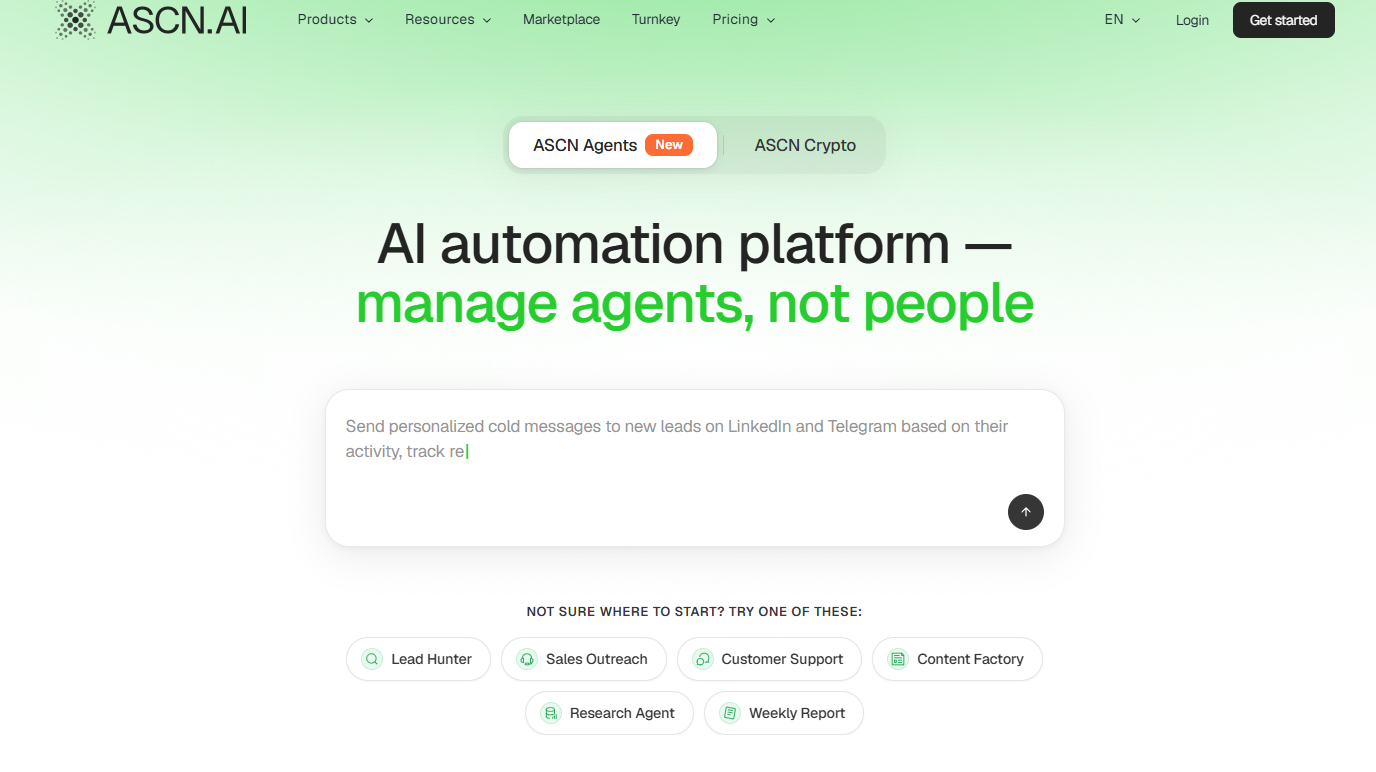
Key Features:
- Proprietary nodes on Ethereum and Solana; 2 years of data indexed.
- Responses from on-chain data are generated within 10 seconds (GPT cannot do this without a plugin).
- AI agents help automate repetitive tasks.
- Launch IT start-ups without a dev team (no-code + AI).
Benefits:
- A unique model that has access to real-time blockchain data.
- Specialized prompts to provide unique support for crypto (tokenomics, arbitrage, project analysis).
- Built-in automation tools (agents, workflows).
- Data from your AI work is never repurposed for training publicly available models.
Disadvantages:
- Narrower specialization than universal models (e.g. not useful to generate poetry).
- There are fewer pre-built integrations available than in ChatGPT.
- Requires team training.
“We have been indexing nodes for 2 years and now we supply you not only with answers from delivered websites but also with instantaneous events.”
Which AI Assistant to Choose for Your Tasks
The choice depends on the specific task, not the general rating. Use cases are most important when selecting an AI product to use. No product works well for everything; a product will be good for code, another will be good for text, and another will be good for business-related functions. Below is a decision matrix with proven options. Selecting AI by task will help narrow your search.
AI Assistant Selection Matrix by Task
| Task | Recommended Product | Price (Starting) | Learning Curve | ROI Period |
|---|---|---|---|---|
| Copywriting (Articles, Posts, Emails) | ChatGPT-4o, YandexGPT 3 | $0-20/month | 1-2 days | 2-4 weeks |
| Document Analysis (PDF, Contracts, Reports) | Claude 3.5 Sonnet | $20/month | 3-5 days | 1-2 months |
| Coding/Refactoring | ChatGPT-4o, Claude 3.5 | $0-20/month | 5-10 days | 2-3 months |
| Customer Service (Chatbots) | ChatGPT API, GigaChat | $0.01/request | 2-4 weeks | 3-6 months |
| Crypto/Blockchain Data Analysis | ASCN.AI | ₽5,000/month | 3-5 days | 1-2 months |
| Image Generation/Design | Midjourney, DALL-E 3 | $10-30/month | 1-3 days | 2-4 weeks |
| Business Process Automation | ASCN.AI Agents | ₽10,000/month | 2-4 weeks | 3-6 months |
| Data Availability in Russia | GigaChat, YandexGPT | ₽30,000/month | 1-2 weeks | 4-8 months |
| Audio/Video Transcription | Gemini 1.5 Pro | $0-20/month | 1 day | 2-3 weeks |
| Market Research/Analysis | ChatGPT-4o + plug-ins | $20/month | 3-5 days | 1-2 months |
How To Use This Table: When you find your use case (task) on the first column, if you don't find your exact task, choose the one that is closest. Use multiple tools — e.g., using Claude for code and ChatGPT for text — when working on integrated work (e.g., code + text) or when using a single special-purpose tool (e.g., ASCN.AI for business). Do not attempt to use just one tool to handle everything.
Selection Criteria for Business
With regards to selecting a business solution, four filters can be added to the business matrix to save you money when implementing in your organisation.
- Data compliance and security: Consider geographical restrictions and options (e.g., if you store or use personally identifiable information (PII) or are regulated by government regulations such as finance, healthcare or government) then you will need to have Russian-based (GigaChat, YandexGPT) or Western based solutions that have corporate service level agreements (SLA) for their data storage and protection.
- Integration with current stack: You will want to make sure that the new solution integrates into your existing stack; if your team utilises Google Workspace the working of Gemini with Google Workspace would show larger benefits; alternatively if your team is within the Yandex ecosystem then you will receive greater benefits by utilising YandexGPT; if you're developing your own solutions you can access the API for ChatGPT and ASCN.AI.
- Scalability: For the scaling of the new solution, if you are using the free version for testing purposes, consider calculating your costs per 1,000 calls for production versus free; e.g., ChatGPT API… is (est. $0.01 to $0.03/1k tokens), GigaChat is (est. from 0.5 RUB/request), ASCN.AI — (fixed subscription).
- Support and Training: Western Models have large numbers of ready-made guides in English but for Russian-oriented teams both the documentation and the technical support must be available in Russian and in the MSK time zone.
The Best Free AI Assistant: Comparison of Capabilities and Plans
Free versions in 2026 cover 80% of individual needs. Don't overpay where you don't need to.
Comparison of Free and Paid Versions of AI Assistants
| Service | Free Version | Free Limits | Paid Version | Paid Price |
|---|---|---|---|---|
| ChatGPT | Unlimited requests on GPT3 | No GPT4 access, plugins, API | GPT4, Custom GPTs, priority in queue, API access | $20/mo (Plus) |
| Claude | (50/day request) on Claude (3) | (50) limit & No API | Unlimited Access / API, Priority Generation, Longer Context | $20/mo (Pro) |
| Gemini | (1500/day request) on Gemini (1.5) | No advanced functions | Google Workspace integration / (Priority) / More context | $20/mo (Advanced) |
| GigaChat | (100/day request) | Limit & Using Basic Model | Full Model/API/SLA, Prioritized Support | 30,000 ₽/mo (Business) |
| YandexGPT | Unlimited On Yandex Browser | No API, Basic Model | API via Yandex Cloud or Customization / Integrations | 0.5 ₽/request |
| ASCN.AI | 10 requests/day | Limit & No Agents | AI Agents, Blockchain Data, Automation/API | 5,000 ₽/mo |
More things you can actually do for free…
- Writing Email/Text/Post (ChatGPT & Yandex)
- Analyzing Documents - Up to 50 Pages (Claude Free)
- Generating Ideas & Structures - (all models)
- Basic Coding/Refactoring - (ChatGPT & Claude)
- Transcribing Audio - Up to 30 mins (Gemini)
Free versions LOCKED down Access to…
- API for Business Process Integration
- Working with Long Document (100+/-)
- Priority Generation (queues during peak hours can take 5 TO 15 mins)
- Custom to tasks (CustomGPTs, System Prompts)
- Access - Fresh Data (web search, blockchain data)
SAR Case Study: A young startup (Kazan, 2026) was using FREE ChatGPT and Claude for 4 months and completed 90% of their support, content, and basic coding work prior to switching to paid plans until they had generated at least ₽500,000/mo in revenue. They spent 4 months using Free versions before switching to paid plans once they were making at least ₽500,000. Savings in the beginning — 240,000 руб. The intelligent way to go forward.
“We had a client in the cryptocurrency business located in Moscow who was ranked one of the top 20 of their sector. After working together, we got them to rank number three through advertising. A competitor that was in the number two position suffered from various problems and thus lost customers to the number one rank and again to our client. With good advertising and a profitable scaling method, both clients continue to grow even during a crisis.”
When Should You Pay for an AI Assistant?
Pay if:
- The value of your team's time is higher than the monthly cost of a subscription (example: 20 hours saved per month will be worth 20,000 рублей, the cost of the subscription is $20 US dollars - approximately 1800 рублей).
- You have to have an API to integrate products or ASO Systems.
- You have to keep confidential information (meaning, you will have to have a corporate plan and an NDA).
- The response time is crucial (the free subscriptions can have 15 minutes wait time for responses at peak times).
- You need to use special functionality (e.g., blockchain information, AI agents, or customized models).
Stay on the Free Subscription if:
- You want to test theories before implementing them.
- You will only be using it on an individual basis without integration.
- The work performed is not critical to time or quality.
- Your budget is limited and you have not proven the value of the AI Assistant.
Why AI Assistants Make Mistakes: Limitations and Safety
AI models make mistakes in 3-12% of requests depending on the task. Understanding the limitations of using the AI Assistant is very important for ensuring safe and efficient use of this tool in your businesses. Use caution.
The Hallucination Problem: What It Is and How to Verify It
Hallucination is when an AI model creates an answer that sounds plausible but is factually incorrect. For instance, it could invent an imaginary study, or it could create a fictitious legal rule. This has already happened.
Why does this happen?
- The model is trained to predict the next word, rather than search for verified information.
- If there is not enough information in the training, the model will try to fill in the spaces with its guess.
- Errors occur at a much greater rate when a complex request has multiple parameters.
Statistical rates of hallucinations by each model (based on ASCN.AI tests in 2026 based on 10,000 requests):
- ChatGPT-4o: 3.2% Hallucination Rate
- Claude 3.5: 2.8% Hallucination Rate
- Gemini 1.5: 5.1% Hallucination Rate
- GigaChat: 6.7% Hallucination Rate
- Yandex GPT 3: 7.2% Hallucination Rate
Ways to reduce the risk of hallucinations:
- Request sources: Say: “Please provide only links to verifiable sources”
- Verify the information: especially for numbers, dates, names, and legal rules
- Use RAG: Retrieval-Augmented Generation, where the model uses your knowledge base instead of random data to produce an answer.
- Limit the amount of information: Prompt with: “If you don't know, say 'I do not know,' do not create something.”
Data Confidentiality: Safety When Working with AI
Never upload your passport number, financial assessment, or business secrets into a public chatbot. The information could be used for retraining models or included in your competitors' data bundles. The chances of this happening are high.
Guidelines for Safe Work Practices:
- Business Corporate Plan: Use of Free versions is unacceptable for work documents.
- Non-disclosure agreement with Vendor: Make certain there’s a clause in the agreement that prohibits the use of the assets for training.
- Local Deployment: Use of data that is critical (e.g., GigaChat On-Premise and YandexGPT Private).
- Data Masking: Anonymisation (remove personal data) of Data to be sent to AI.
- Log Audit: A method of tracking who had access to what data sent to model.
“A CEO’s role is singularly to create and grow profits for the company. If this is not a CEO’s understanding, then the best solution in the market is to terminate and replace them with someone who knows this to be the primary function of a CEO. We are not a scientific institution that is funded by the government.”
SAR Case: A Fintech company from Moscow (in 2026) mistakenly posted client transaction records to ChatGPT Free. This data was absorbed into the training dataset (confirmed through auditing) and Roskomnadzor fined the company 2.5M ₽ in accordance with 152-FZ. They have now switched to using GigaChat Business installed locally and haven’t experienced a breach in the past 14 months. Security is expensive.
Frequently Asked Questions About AI Helpers and Assistants
Which AI Assistant has the greatest ability to understand the Russian language?
For Russian Language Speaking, the highest-quality AIs are ChatGPT-4o, GigaChat, and YandexGPT 3. ChatGPT-4o shows the best ability to communicate and interpret nuances and contexts regardless of language, whereas GigaChat and YandexGPT 3 do a better job of handling many of the realities of Russia itself (i.e., legal issues, geography, cultural references). Thus, if you are using for general use — ChatGPT-4o. If you are using for business in Russia and compliance to laws — GigaChat.
Can I trust an AI to write code or a thesis?
Writing code can be trusted to an AI, but you must verify the AI's work. On the other hand, writing a thesis using an AI will likely get you caught as the AI's writing can be traced back to it, making it easy to prove that you did not write the thesis yourself. Most of the code created by AI will work; however, if the code is using complex logic or edge cases, most people will agree it will need to be reviewed by a professional/programmer before it can be put into production. As far as writing a thesis, it still is able to create a piece of original work for you. However, plagiarism detection can be used to prove that person used AI to help them write their thesis, therefore, I do NOT recommend writing a thesis using AI unless you first edit and review the work done by the AI, then proceed to finish the thesis.
How can I use AI for free without a credit/debit card?
Some of the free versions of ChatGPT, Gemini, YandexGPT, and GigaChat do not require you to use a credit/debit card to register for their services. You can register for their services by using either your email or by creating an account with either Google, Yandex, or Sber ID. You will need a credit/debit card to register for the paid versions of these AI services. However, the free version of each of these AI services can be used without having to pay a fee. The limitations for all four free version AI services include having limited requests (number of times you can ask questions), there are no APIs available for free users, and the models are very basic.
Is it safe to give an AI access to a company's data?
You should only give your company's data to an AI that has a corporate business plan and is covered under a non-disclosure agreement (NDA). All free versions of AI will use their customer's data for training purposes. Corporate business plans (ChatGPT Team/Enterprise, GigaChat Business, ASCN.AI) guarantee that they will not use any customer's data to train the AI. Moreover, when sending your company's data to an AI for use in their systems, you should consider masking (obfuscating) the data and using an on-premises solution for data-based critical information.
What AI implementation time frame will it take to implement AI in a business?
From 1 week to 3 months depending on the task. Most simple AI implementation tasks, such as content creation and customer service support, will take an average of one to three weeks. AI implementation tasks of medium complexity, such as data analysis and reporting, will take an average of three to six weeks. AI implementation tasks of a higher level of complexity, such as workflow automation and integrating AI into existing CRM/ERP systems, will take from two to three months to complete. The most important consideration when implementing AI into a business is whether or not the company's staff are ready to implement new processes.
What is going to happen with Artificial Intelligence assistants in 2026-2027?
The concept of agentic systems (also called AI Agents) and how they relate to personalization is a growing trend. Instead of having a traditional chat bot that simply answers your questions, new AI agents will function autonomously to perform tasks on your behalf (i.e., ordering food, scheduling a meeting, analyzing data). Personalization will include the data collected from you, which will enable the AI to create your own digital twin. According to ASCN.AI's internal research reports, it is projected that by 2026-2027, 40% of all office/administrative tasks will be automated and will be completed by autonomous agents.