



- Русский
- English
- Português
Neural Networks for Students: Top Services and a Practical Guide to Using AI in Your Studies (2026)

There are currently two distinct groups in the educational world. One group spends about five hours searching multiple sources using Google before starting their term paper while taking another week to rewrite all the published information in their own words. The other group spends 40 minutes developing their outline and then uses artificial intelligence (AI) to quickly verify the facts they have included in their paper. They submit the final draft of their work at least one day in advance of the due date. The first group believes the second group is committing "academic dishonesty" and cheating. Conversely, the second group believes the first group is simply choosing to do manual work instead of utilizing automated machinery.
The reality is that utilizing artificial intelligence in school may help you survive. While you spend 30 minutes debating how to format your reference list, your classmate has already formulated three hypotheses via AI and located sufficient resources to play soccer for 1.5 minutes.
I am very passionate about this issue; we have spent over two years working on developing our innovative solutions ASCN.AI. We have created a large library containing hundreds of pre-written scenarios and have discovered several uses for neural networks. Unfortunately, many students are under the impression that artificial intelligence will replace their brainpower. I can assure you that artificial intelligence will not replace your brain. It will assist you in streamlining your routine tasks as well as speeding up your research process. However, you will still need to make the ultimate decision regarding whether or not to move forward with your work; you are still responsible for critically evaluating all of your sources. If you allow the AI to drive you to make a quick decision, you could end up going off course! This article will demonstrate how to utilize neural networks as a powerful tool for your studies rather than being dependent on them in order to create even a single conversation.
Benefits of Utilizing Neural Networks in Relation to Higher Education
When most people first come across the idea of utilising AI to assist in their studies, they tend to think, "Well, I might gain 15 minutes or even 20 minutes of time." In actuality, the gain is monumental. It is not about finding a few extra minutes; it is simply a different way to learn. You will no longer be a textbook "re-writer", but a true editor of your own learning.
A neural network is not going to write your degree, but it will help you with every single part of the technical basis involved with having to create it—speed, format, verification—within seconds.

To illustrate the importance of having a well-designed personal AI assistant there are six instances where an AI has the ability to save you time and frustration:
- Time savings from routine tasks. Formatting, checking for plagiarised material, and sourcing synonyms are all considered to be grunt work, or non-creative work. An AI can perform these types of tasks in 30 seconds each while it would often take you 3 hours to achieve the same results. This represents a time savings ratio of 100:1.
- Generating ideas. Stuck on a blank page? An AI will provide you with 10 different structural options and five different perspective angles on your selected topic as well as a short list of keywords related to your selected topic. Once you have identified what resonates with you, you can expand on it in your own writing style. One of the most difficult things to do is come up with a place to start; this is where an AI can be most helpful.
- Structuring your mess. You have 20 tabs open, a bunch of pdfs, and your lecture notes on your desk – how are you supposed to find a way to connect all of those pieces together? The neural network makes sense of your jumble of thoughts, determines what the main ideas are, and proposes a logical outline for you. You can then simply fill in the outline.
- Logic and Spell Checking. AI does more than simply point out typos like Microsoft Word does. For example, it will say "You contradict yourself in the 2nd paragraph and the 5th paragraph" or "Your 2nd paragraph does not finish your 1st." It provides an around-the-clock editor for you for free.
- Searching for Information. Instead of looking through a textbook containing 300 pages to find one definition, you upload a copy of the book to the neural network, ask your question, and the AI gives you an answer with a page number. This is true custom learning: you have the opportunity to adjust the material to match you instead of having to adjust yourself to fit the textbook.
- Big Data Analysis. A person cannot read 50 articles in one hour. A neural network can and it can find patterns, contradictions, and the most current statistics among those articles. This will give you a significant advantage in your research.
How Neural Networks Perform Specific Academic Tasks for Students
We've talked about the theory of how AI can be used in academia, but lets now look at actual examples of where AI is working today. We at ASCN.AI have seen dozens of examples of how AI is currently making improvements in education, and you can start using those examples today.
Help with Essay Writing, Report Writing and Writing Term Papers
You choose a subject, do a Google search for snippets of other people's research, try to reword them (so that they are not identified by a plagiarism checker), format all of the research and then you've wasted a week of your life and produced ten pages of content. Using AI in an academic or student setting has changed the process of creating academic work into a systematic process. The entire process can be summarized with the following algorithm:
- Plan generation: Feed the topic into the AI to get a structure (with chapters) for creating the written content; this is the foundation—you cannot build a house without a frame.
- Drafting: Use the generated plan to adjust to your liking and then write drafts (with the help of the AI) of the sections using either facts or your key points.
- Proofreading: Use your brain with your analysis in conjunction with the paraphrasing done by the AI and use the grammar checking by the AI to proofread the work.
As a result, you will have a working draft with what appears to be a complete draft in 4-5 hours. The time savings will be enormous.
There is a nuance to this process, and it has to do with how you write your prompt to the AI; if you wrote, "write a marketing term paper," then you will receive fluff. However, if you wrote, "to create a plan for digital marketing with a focus on SEO for small business, please create three chapters and include statistics in the US/EU/RF," you would receive a drastically different result. This is not cheating; it is managing an assistant.
Analysis and Information Retrieval for Research and Presentations
The worst part of writing anything is finding information; you utilize Google Scholar to find 30 different articles to download, start reading them, and find out that half of them are not related to your topic. If you did this, you would lose three days of productivity. However, this is not true when you use an AI:
- Upload all 30 PDFs to a neural network (one that actually can read PDF documents).
- Type into the AI, "can you highlight the methods of evaluating efficiency and list the author and the date about each item."
- The AI will produce a table with a summary of the information requested. It takes 2 minutes.
- Then you can select five of the relevant documents and request a summary (with the exact quote made in the document) from each of the five documents.
- The "Literature Review" section is completed.
This is NOT to say that you will not be reading documents. You do! But only the most relevant, filtered material. Machine reading is a way to save your eyes and time by filtering content.
Another example is from one hundred-fifty slides or the lecture you’ve created for your students. You upload it to AI and say, "What is the key takeaway from this?" The AI will provide you with 7 key points. If you do not understand a term, you can ask, "What is the simple definition of price elasticity of demand?" The AI will provide you with an easy-to-read answer. These are like your student assistant for AI that helps to fill knowledge voids whenever you want.
Speedy Presentation Creation and Creative Ideas
Presentations are difficult. You’ve put all the effort into writing the content; now you must create slides from that content, fit images, and format the headings. You can easily waste a few hours working on the design. AI takes care of the design for you. You provide it with the text/ bullet points, "12 slides, minimalist theme, emphasis on numbers." The neural net then organizes the information and chooses where the graphics are (i.e., where the graphs go, where the diagrams go). You can use what the AI gave you and make some changes. You will have gone from a 4 hour project to 40 minutes.
There are services like Gamma or Tome that operate like PowerPoint AI. Upload your content, choose your theme and receive a completed deck. You will not have to be a designer to make your work look great. The only thing you need to worry about is what you are going to say, not how you are going to say it.
What if I have zero ideas? Say, for example, you have been given the topic of "Blockchain and Logistics," but you do not know where to begin? AI will give you five different and unique ways to approach the topic; from a review of implementation/roll out with large corporations to a look at the hindrances and where it will be in the future, 5 years down the road. Now that you have an idea of what to write about, find a way to continue. It saves a lot of mental effort.
Mathematics and Computer Programming
Mathematics and computer programming - this is where the AI has the advantage. The logic behind both is straight forward and you can verify the answer. You can simply take a picture of your calculus problem and receive a step by step solution to your problem. You will not only see the answer to your problem, but you will also see how they solved it using logical reasoning. If you are confused as to why they used this reasoning to solve your problem, you can ask the AI to explain why they used that method on that particular problem.
In coding, AI will save you an enormous amount of time on fixing your bugs. Whenever your code is not functioning properly, you can input your code into the AI, and the AI will find the specific line of code that contains the error, explain to you what is wrong with that line of code and give you a solution for fixing it. You can even ask the AI to write you a quick sort algorithm in C++ with comments, and the AI will give you a perfect example of how to use that algorithm.
Important: stay sane. If you are just copying code from the AI without understanding where it came from, then you will be sitting there like a statue during an exam. Using AI to complete tasks that are not very complicated (i.e., templates, test cases) and learning will allow you to understand the logic behind each line of code, but you need to understand where each line of code came from. If you don't understand where the line of code comes from, it will not be of value to you, and you will be committing career suicide in terms of being a professional.
TOP AI TOOLS AND NEURAL SERVICES FOR STUDENTS
Let's go to the hardware now. I could provide you with a list of 50 different tools, but I'm going to share with you the best five or six that will take care of 90% of the headaches or pain points students experience: text, code, search, verification. All of these have been tested and provide the capability of working.
| Service | Function | Free Version Limits | Access to Service | Key Features |
|---|---|---|---|---|
| ChatGPT by OpenAI | Universal Assistant – text, ideas, code, and analysis | No Limit (for GPT-3.5/4o-min) – 3-5 messages per hour (for GPT-4o) | Worldwide Access (may need VPN for some locations) | Largest knowledge bank; understands context, file assignments; most widely accepted in industry. |
| Claude (Anthropic) | Long text, document analysis | Approximately 50 messages per day (depending on load) | Available globally (may need VPN for some regions) | Ability to process entire books or dissertations (up to 200,000 tokens) and write with more "human" quality. |
| Notion AI | Integrated AI within Notion apps | 20-30 requests per month (free plan) | Direct access | Easy to use if you are using Notion for your notes; saves time on automation. |
| QuillBot | Rephrasing text and grammar check | Up to 125 words (in basic mode) | Direct access | The rewasher of rewashing. Best for increasing uniqueness or rephrasing complicated ideas. |
| Consensus | Research database searches | 10 requests per month | Direct access | Searches ONLY scientific databases (Pubmed, arXiv) and provides links to sources. |
| Scispace | Reading and analysing scientific PDFs | 5-10 articles per month | Direct access | Upload the PDF and chat with it; "What's new?" Very fast. |
| Gamma/Tome | Automatically creates presentation slides | 400 credits to start (3-5 presentations) | Direct access | Provides a visually designing, spectacular presentation; saves a ton of time. |
| GitHub Copilot | AI assistant for programmers | Free for students via Github Student Pack | Direct access (registration needed) | Auto-completing code within VS Code based on current process. |
| Grammarly | Grammar, style, and tone checker | Unlimited levels of usage for basic checks | Direct access | Consistency and accuracy in English writing. |
| ASCN.AI | Platform for creating AI agents | Free tier available | Direct access | Automation, custom agents for data processing and scheduling. |
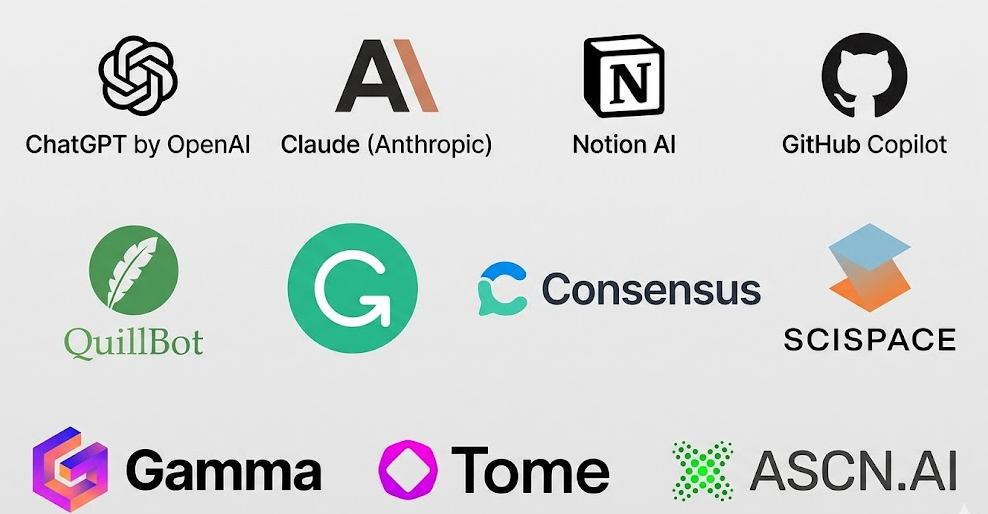
Make sure you don’t try to implement everything at the same time, as you could get hugely overwhelmed. Choose 3-4 tools, with some examples being ChatGPT (or Claude) to assist with thinking/ideas; Quillbot to assist with rewriting; Consensus to help you find scientific articles; and Gamma to help create great presentations. Copilot if you are programming does almost 100% of the work to get something built out.
If you have bigger projects (for example, a thesis project with lots of data, consistently collecting recent news articles, creating reports on a set schedule, etc.), consider looking into an automation platform like ASCN.AI, where you can create your own custom agent and have it do what you want.
Rules for Proper and Ethical use of the AI Assistant for Students
The AI assistant is supposed to help you with your studies, but one of the most common mistakes people make is thinking the AI will do every task for them; it won’t! The computer is a calculator, not an expert at math. Just because the answer appears correct on the computer screen doesn’t mean it’s true! I’ve seen many students print out whole sections from ChatGPT, and the next day their instructor could easily locate incorrect sources within 5 minutes! Students can be caught doing plagiarism from the AIs, which results in academic sanctions and can also be detrimental to their future career.
You must manually verify your facts. Neural networks can create fictitious claims and statistics. Any time you use AI for factual information verify that information with the original source. When you find a link but do not have access to the document, do not use it in your paper. If you "borrow" from AI then you have committed plagiarism. Universities will be using software such as Turnitin and GPTZero to detect this in your work; they will be able to distinguish machine vs human created work. The best approach is for an AI to create a draft for you and then you can enhance/extend sections and edit it to sound like you.
Prompt Magic - One of the primary issues with poor quality generated content is the poor quality of the request to the generator. For instance, if I request "Tell me About Marketing", the response will likely contain much less specific information than if I asked "Explain the Differences Between Inbound and Outbound Marketing by Providing Examples for Small Businesses". The more experience you have with requesting specific information from AI, the better your results will be. Here are some suggestions for what to include in your requests: Style, Format, Length.
Ethics & Responsibility - You are only lying to yourself if you think you are deceiving your professor. The advanced degree you are earning now is meant to assist you in your career; if you do not learn to think critically you will end up the same as everyone else when machines "out-think" you (remember, humans built AI). Colleges/universities are there to help you build your skills, not just to give you a degree.
Frequently Asked Questions About Using AI for Academic Purposes
Can I use neural networks to complete my thesis and are neural networks allowed by accredited universities?
There are currently no laws preventing the use of AI, however, individual colleges/universities do have policies regarding how students may use AI. It is expected by the 2025-2026 school year, that most colleges/universities will allow the use of AI to assist with finding sources and structuring/writing papers. Submitting work written entirely by a bot is not allowed and is viewed as plagiarism and/or deception. Penalties for submitting this work can vary from being required to retake classes to being expelled. There are many services available to check for plagiarism in submitted work. It's recommended that students use AI as a draft tool, and prepare the final essays as their own, and be prepared to answer any questions posed to them by the committee on what they have submitted. If the student does not understand what they are submitting, it will not be accepted.
There are no tools that claim to be The Universal Soldier when it comes to writing a thesis or term paper, however, there are leaders.
The following three neural net tools are considered to be leaders in their own right:
- ChatGPT - Is a great all-around tool, can provide ideas, structure and even code.
- Claude - The king of long-form writing and document analysis. If you need to "digest" a long textbook.
- Consensus / Scispace - Used specifically for the scientific portion of your paper and includes finding real articles to read and reviewing PDF documents.
For technical universities, you may wish to add GitHub Copilot (used for creating code), or Wolfram Alpha (used for creating mathematical problems). If possible, use a combination of these tools, rather than a single tool. I use ChatGPT for writing, and I use Consensus for factual research. It works great.
Are there any AIs that are completely free?
Yes. There are many free Apps that can be useful for students, and that will help them avoid paying for subscriptions. There is a free service that will provide 80% of the services you need to accomplish your goal.
- ChatGPT 3.5 / 4o - mini - Free and unlimited. Will provide enough service for your basic requirements.
- Claude - Free tier is available, has request limits, but is free and provides good text support.
- Notion AI - Limited free service are available, are included in your free Notion account, is user-friendly to take notes in.
- QuillBot - Provide free limits for rewriting and allows an increase level of uniqueness when creating works.
- GitHub CoPilot - Students may sign-up for a free account by providing proof of their current student status.
- Wolfram Alpha — the regular version is available at no cost.
- ASCN.AI — there are agents available on a free tier subscription.
To produce something of great length (thesis) or require extremely complex reasoning, you need to be subscribed to a membership with access (ex. Chat GPT Plus). If you just need grades of A or B, then free memberships are sufficient.
How do I avoid being charged with plagiarism and AI detection when working with AI?
To understand the difference: Anti-plagiarism programs search for matching in a database; AI detector programs search for machine-like styles.
Methods to pass verification:
- Do not copy 1 to 1. Even though the text from GPT is unique, it looks suspicious to a professional.
- Rewrite the text. Reorder the structure of the sentence, add examples from your life, and include personal reflections on your thoughts ("In My Opinion…", "Practice Shows…").
- Look at the style of the sentences. AI created text sounds polished, however, it lacks emotion. Incorporate a natural language tone into the text. Provide variable sentence lengths.
Trick: "Hiding characters" - no longer work and are easy for a professional to detect. The only reliable method of rewriting text is to honestly rewrite the original text.
How AI Agents and No-Code Systems Allow Students to Make Money
An agent (program) works on its own. E.g. Monitor competition, auto-reply to customers, and parse pricing. A company uses a lot of money and time to perform these processes, and you will be paid for the agent set-up. If you are a student and know how to build an agent through no-code applications (Make.Voratio, Zapier, ASCN.AI) then you can earn a large amount of income for each individual agent. This is a one-time setup typically and will provide you with a working agent for many years.
Examples include but are not limited to:
- Automation of small businesses. Processing of requests via Instagram, collection of sales reports. The student will set it up and then get paid.
- Content machines (blogs and other media). A blog will use an agent to find news, write about it, and post it to their channels. Sending many agents will allow for many examples of how to earn income via AI agents.
- Parsing and analysing. Price, review, and rating monitoring, businesses love numbers but do not like to collect them on their own.
- Personal assistants. For entrepreneurs; emails, calendar, and alerts. Saving time and allowing more focus to be put on more important tasks is more than worth it.
Students at ASCN.AI that start learning will start freely and work towards becoming freelancing. This helps them generate real money - not just as a bonus income.
For example; a student studying marketing created an agent for a real-estate business. This student's agent monitors listing websites, compares prices, and outputs reports in Google Sheet format. The real-estate business owner paid the student $1,000 to develop the agent. After the agent has been set-up, there will no longer be a need for an analyst on payroll with the real-estate company. Our case study on making money from the Friday (FF) crash shows further evidence of how automation saves in budget; but in a different context than a different stimulus support system (helping people live with more money in their pocket).
Another case study; a student studying journalism produced an agent for her telegram channel that analyzed crypto-charts and created a summary to send to her subscribers. This resulted in a growth of over 200 subscribers within 3 months (Tom-5,000 subscribers). The student generates money by accepting advertising fees and donations. Our case study on Friday (FF) crash provides further evidence of the result of the speed of information is business’ money.
If you want to do what was described above, then you must learn 3 things: how (RESTful) APIs and models work and integrate together; how to create agents using no-code applications; and how to sell value (setup) of your agents to companies that you have built them for. You will not create agents over night, however, there are many ways to build wealth.