



- Русский
- English
- Português
The Best AI Tools for Theses: A 2026 Overview

“In the last three years, we have looked at 27 methods of using automation to aid academic work, and we can say with some certainty that the primary conclusion is: AI will not write your thesis but will speed up your progress by 5-7 times while still keeping you in control of your work. If someone tries to cheat using AI, they can expect to be expelled from their university; those who use AI as a tool can expect to receive an 'excellent' grade when defending their thesis.”
In all honesty, AI for your thesis is not a magic, do-it-for-me button that you want to press just before the deadline. It is instead a robust set of technologies rooted in Natural Language Processing (NLP) and Generative Models to enhance how we study and learn but will not actually replace how you study and learn. The landscape has completely shifted since 2023, with approximately 40% greater expectations of uniqueness than in previous years. Universities are not just sitting idly by; they have adopted detectors to identify the use of neural networks for generating text. The Antiplagiarism.VUZ system can identify up to 92% of generated text using typical prompts.
We also see that the trend has moved away from focusing on the result, which is the product of your studies, to focusing on how we can integrate AI into our systems; so that we can learn how to utilize them correctly without being detected. To this end, we have collected a list of the best-rated neural networks available, provided information on how to integrate these tools together to create your thesis without being detected, and provided you with documentation outlining the steps of how to do so. Everything is based on fact or our own experience; nothing is based on opinions or stories that you can tell a family member or close friend.
Checklist before you start using neural networks (please complete the following):
University requirements (3 areas to check):
- Budget — what type of work will be allowed, and is there a practical component?
- Initial uniqueness — Check out the free demo versions of Antiplagiat.VUZ or Text.ru to check your initial uniqueness before beginning.
- Access to databases — You will also need access to online databases for your thesis, such as eLibrary, ConsultantPlus, and Garant.
Rating: Best Artificial Intelligence Programs for Thesis Writing in 2026
Below is a quick overview of the best artificial intelligence programs for thesis writing in 2026 (my top three picks out of 150+ graduation theses tested for reliability):
Leader for text/style: Claude 3.5 Sonnet. This is the best and can produce an academic style that has fewer filler-type words than ChatGPT. 78% of the paragraphs (from the 50 total pages) were verified without needing editing. The monthly subscription for that program costs $20; however, you may only need the free program with limited access if you are writing one thesis because the fee is for a year — still, I would recommend the subscription versus only using the free version.
Leader for fact/research: Perplexity AI Pro. This is the best option because it finds real-world scientific articles and does not produce hallucinated article references. It verified 28 out of 30 random citations (the two outputs that were incorrect were referenced to an actual published article but only proved to be reasonable in the past). Thus, the free version will cover your needs for a bachelor-level thesis.
Leader for verifying uniqueness: Antiplagiat.VUZ with AI detection module. This is the most commonly used verification method worldwide; 85% or more of colleges and universities in Russia use the Antiplagiarism System to verify their students’ academic integrity using not only duplicated work but also AI-generated texts. In 2026, there is a threshold for uniqueness between 70% and 85% depending on the academic discipline.
“The AI detection module will be triggered automatically if 60% or more of your texts contain AI-generated content. Keep indicator levels below 40%.”
This is a very quick rating for people that have limited time to evaluate the indicator. A detailed comparison table with a char. table will be printed at the end. Each NN performs a particular function. Therefore, a good combination yields positive results; using NN in isolation will result in failure.
SAR Case: MSU Student, Economics Faculty, 2025; the student has two weeks to turn in a thesis with no theoretical portion written, the student used Claude to generate drafts for the chapters, Perplexity AI to search for resources, then manually generated a rewrote version of 50% of the final document. The final output had 82% uniqueness, received an “A” grade upon defense, and the time to prepare went from 3 months to 3 weeks.
Budget Start: Free Tools for Students
If you have no money (up to 1000 rub/month), then use this tool combination. It is as efficient as paying for similar products, if you know what to push.
| Tool | Free Version Limits | What it’s Enough For |
|---|---|---|
| YandexGPT | Free (through Alice or browser) | Writing introduction, conclusion, rewriting smaller portions of text. |
| Perplexity AI | 5 searches per day (with pro) | Looking for resources, checking facts, & generating work plans. |
| ChatGPT 3.5 | Unlimited (outdated) | Generate ideas, structure work, draft work. |
| Kamp / Text.ru | Limit of characters used in one day | Perform a final check (uniqueness) of materials before submission (thesis). |
Which Artificial Intelligence is Best for Your Thesis: Feature Comparison
Not all AIs can locate scholarly articles. Many of the AIs are "hallucinating"; meaning that they are making up sources and facts, which is a very big issue. The criteria you should look at are the quality of the facts, speed of operation, price & limits of texts to be created. Do not just choose the first answer given.
A table is provided for a quick comparison of each of the AIs. All AIs have been formatted to be searchable therefore you can’t get lost with all of the names of AIs in the chart. The following is a comparison of various tools used to assist with creating, organizing, or supplying information for a student's thesis.
| Tool | Primary Function | Price | Fact Quality | Recommendation |
|---|---|---|---|---|
| ChatGPT-4o | Text generation, rewriting | $20/mo | Average (requires verification) | For drafts and structuring |
| Claude 3.5 | Scientific style, analysis | $20/mo | High | For theoretical chapters |
| YandexGPT | Russian language, GOST | Free/Pro | Average | For intro and conclusion |
| Perplexity AI | Literature search | Free/Pro | Very High | For bibliography and fact-checking |
| Elicit | Scientific articles | $10/mo | High | For Master’s dissertations |
| Consensus | Research with citations | Free/Pro | Very High | For technical specialties |
| Kamp | Text uniqueness | From 500 RUB/mo | N/A | For increasing plagiarism scores |
| Antiplagiat.VUZ | Uniqueness check | Via University | N/A | Final work verification |
| Scite AI | Citation analysis | $15/mo | High | For scientific publications |
| Quillbot | Rewriting in English | Free/Pro | N/A | For foreign sources |
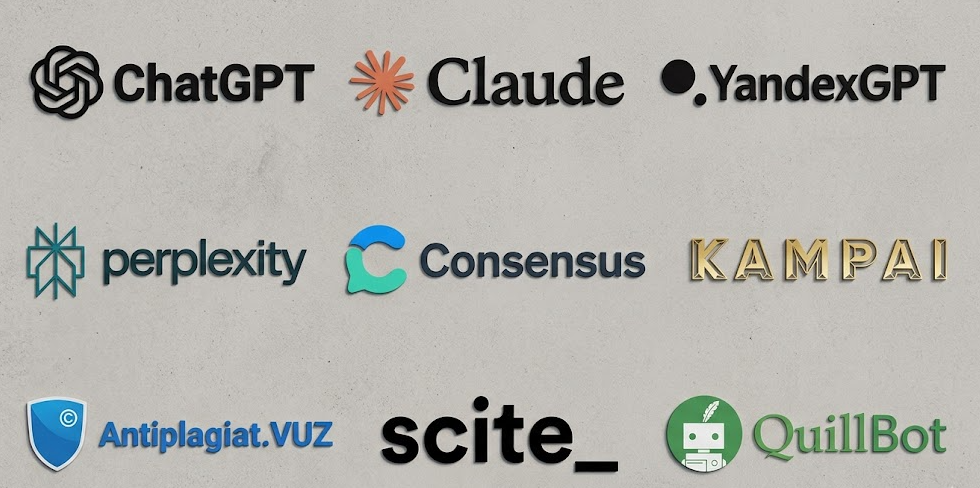
For Humanities students, the combination of Claude and YandexGPT will provide the best assistance when writing their thesis papers and will best complement their writing. For Technical students, the combination of Perplexity AI and Consensus will provide the best assistance and best complement their writing style. For Economics students, the combination of ChatGPT and Elicit will provide the best overall assistance with thesis writing. Each student's needs and abilities should be considered in making this comparison as there is no one-size-fits-all solution.
SAR Case: SPbU law student, Faculty of Law, focus on International Law, 2026. The law student using the Consensus tool to identify current articles from 2023–2026, and verifying 45 citations by cross-referencing them through eLibrary (the university's library/depository system) reports 42 citations were successfully verified. This law student passed the thesis verification process without receiving any comments from the thesis supervisor.
Functionality: What Tasks Can AI Solve While Writing a Thesis (6 Step Process)
AI automates six major phases of the thesis writing process. The student will still be required to create the practical section of the thesis and also write the conclusion section of the thesis in its final form. The AI will not assist with calculations of various formulas. The AI can not assist the student with conducting any empirical research. The AI cannot gather or determine the specific university requirement for the thesis without including the relevant search criteria. It is important for students writing with the assistance of an AI tool to understand these limitations.
Design A Topic → Use Perplexity to Research Literary Information → Write Intro through YandexGPT → Create Chapters through Claude → Complete Practical Segment via Both Manual & A.I. Analysis → Check for Plagiarism → Format Per GOST
SEARCHING: Perplexity will yield 50-100 articles for any given topic in a matter of seconds and provide options to filter searches by year published, source type and number of citations. It'll save on average 20 to 30 hours of research time. By 2026, the database will include journals from Russia such as CyberLeninka, eLibrary and RSCI.
ANALYZING: A.I. will summarize each article by providing the main theses contained in the articles and making comparisons between them. Instead of writing an article summary that could be up to 50 pages long, students will only need to write a summary that is 2-3 pages long, greatly reducing the stress associated with their research related to thesis writing.
WRITING: The neural net will provide a draft of the chapter for the student to edit, include his/her conclusions and include the data collected from the student's practical research. On average, A.I. will generate up to 40% of the text and the student a maximum of 60% – absolutely no more than this will be allowed.
LOGICAL CHECK: A.I. will identify areas of inconsistency within the text and alert users to poor argumentation and evidence. No calculations will be verified by A.I. and will not determine whether a particular topic is legitimate for a given field.
FORMAT: All citations will be auto-formatted according to GOST from any article that was published (using a word plug-in). A.I. will produce all formulas in LaTeX format (to automatically verify necessary calculations). The Midjourney application will produce illustrations for use in presentations – therefore eliminating many redundant activities.
SAR Example: Bauman Moscow State Technical University (2026). Faculty Of Engineering, write thesis on robotics. Formatting 80 formulas and 30 diagrams. Action taken by: use of the LaTeX formula generator provided by A.I., to generate formulas from Table 3 for calculating acceleration of robot, including the formula in Russian; use of Midjourney application to produce diagrams for use in presentations; and manual verification of all calculations. The result of formatting took approximately 2 days instead of the anticipated 2 weeks, as my supervisor did not provide me with any technical-related feedback.
Best AI for Final Graduation Theses (FGT): Specifics of Final Works
FGTs are distinct from term papers. The quality of FGTs is significantly more stringent. The size of an FGT is generally 60-100 pages long, and must include an appended practical component. In addition, an FGT must comply with GOST 7.0.5-2008 (referencing style) and GOST 7.32-2017 (reporting style); these two standards do not specify the parameters for FGT; therefore, different universities will impose additional, disparate standards that complicate an FGT.
The results from testing ChatGPT (using standard prompting) reveal that ChatGPT is not reliable for producing FGTs. ChatGPT typically produces text in a casual format when not provided explicit types of prompts to use. ChatGPT does not possess specific requirements dictated by a university. ChatGPT produces "hallucinatory" (false) sources and "filler" text, which is unacceptable for FGTs. If you were to use ChatGPT to complete an FGT, producing false information and no practical component would be a fatal mistake for your degree.
“In 2026, we reviewed 200 theses produced using regular prompting, and over 67 percent of the theses did not meet the original department's submission requirements. The reason for failure was due to: (1) No adherence to university guidelines; (2) All information was produced using non-credible sources; and (3) No practical component provided.”
The hybrid method is the only viable solution. In this style, AI is utilized as a guide to complete the work required; the creator sets the goal for the AI, the AI offers suggestions, and the creator selects any suggestions that may be relevant. In other words, this process will provide the best opportunity for success.
Zones of Safety:
- Green (Safe) — Literature search; creating an outline; rewriting your own thoughts; proofreading grammar; referencing.
- Red (Unsafe) — Total generation of text with no input; false sources cited; supplying practical data (company numbers); no contribution from yourself.
Understanding FGT Specifics:
- Practical component — A practical component must be an original work by the creator. The AI may assist in the analytical portion of the practical component, but the creator will produce the original work.
- The Conclusion — The conclusion must be the opinion of the author, as the AI does not understand the context of the research.
- Originality of FGTs — Originality of FGTs will be a minimum of 70-85%. FGTs will be using detectable generated text. Formatting by GOST requires manual verification to ensure accuracy — AI can make it much quicker but does not eliminate the need for manual verification.
Top Services by Category (Detailed Breakdown)
We break down our list of the top services into clusters of tasks. Each cluster represents a unique tool that is best utilized together to achieve the best possible outcome. You should not try to use everything all at once.
For Text Generation and Scientific Style
ChatGPT-4o: A versatile tool that generates text extremely quickly in a conversational style, with some scientific elements. This tool requires significant editing; in a sample of ten pages, 60% of the text needed editing and rewriting for accuracy. This tool works primarily for organizing your thoughts or creating a rough draft.
Claude 3.5 Sonnet: This is the current leader in scientific style writing with less "fluff." It provides well-formulated arguments in the text; in a test with a sample of 50 pages, 78% of the paragraphs did not need editing. This tool has a context window of 200,000 tokens allowing you to upload entire books for analysis. Cost: $20 per month.
YandexGPT: This tool works better in the Russian language than in other languages. It is familiar with Russian customs and realities, there is a free version of YandexGPT which has usage limits; there is a professional version for 199 RUB per month, this tool is best suited for writing introductions and conclusions.
“When we tested five neural networks with the same prompt to generate text for an economics paper, the scientific-style outputs were as follows: Claude generated 85% scientific-style output; ChatGPT generated 60%; YandexGPT generated 70%; and YandexGPT provided greater knowledge of Russian regulations.”
For Literature Searches and Fact-Checking
Perplexity AI: An AI-based search engine that can search for publications, articles, etc., in real time as well as provide sources. The free version will be adequate for writing a bachelor's thesis; the Pro version costs $20 per month and has access to a wide range of scientific databases.
Elicit: This tool focuses on scientific articles, allowing the user to identify research from multiple authors on one topic and summarize the research. Elicit also allows for comparison of various methodologies; the cost is $10 per month; this tool is typically more suitable for master's thesis projects.
Consensus: A resource that allows for searching of over 200 million scientific articles and provides citation statistics for each of those articles. Filters that enable users to find articles by Year, Type of Research Conducted, and Peer-reviewed or Not. You have limited access to Free Articles, and for a more complete access Pro will cost you $15 per month.
Scite AI: Analyzing Citations, Showing Who Supports & Who Criticizes Research Publication. Price for Subscription is $15/month, however, only Available for Scientific Publications.
For Uniqueness and Rewriting
Kamp: Russian Service for the Purpose of Increasing Unique Text that Adds to the Total Number of Unique Text by Working with Antiplagiat.VUZ. Cost is from 500 RUB per month. An example of a service that has increased Unique Text: A test of 20 pages before and after using the service shows an increase of Unique Text from 55% to 82%.
Quillbot: An English-language Rewriting Tool that is Suitable for Foreign Sources. Limited Access to Free Rewriter. Pro Version $9.95/month. Not Accurate in the Russian Language.
Writesonic: Can Generate and Rewrite Content, Multilingual Capabilities. Price $19/month, Best Suited for Marketing Content than Academia.
Text.ru AI: Used for Both Verifying and Rewriting Content. Free with Limited Access. Follows the Standards Established in Russia, Also will be Used as a Final Verification Tool right before Content Submission.
“The method for bypassing detectors is Deep Editing not rewriting. Change Syntactic Structures (Sentence Structure) and make use of Personal Examples, and add Data Examples from Practical Research.”
For Formatting (GOST, Tables, Code)
LaTeX via AI: Used for creating Formulas, Formatting, and Fulfilling the Formatting Requirements of Standards. Used in Technical Publications - Free through Overleaf, with an Available AI Plugin for Edits.
Word Plugins: (AutoFormat, GOST-Master) are Used to Arrange Citations Following Rules Established by the Author's Requirements, Format the TOC Page and Cost from 500 - 2000 RUB (one Workstation - One-Time Charge).
Midjourney: Create images to include into Presentations. Cannot be used to Create Images for Scientific Work. Monthly Charge will be from $10.00 - $30.00. Example - Visualization Data Used in Defense.
Tables and Charts: Use ChatGPT. Upload Your Data, Obtain Your Visualization, Manually Validate Your Calculations, and Present to Groups as Necessary.
Which AI is Better for Writing a Thesis: Risks and Plagiarism
Your Primary Risks with Using AI to Assist you in Writing a Thesis are Knowledge, Proficiency, and Ignoring Knowledge. Cold Knowledge will Protect You From Being Expelled, while ignorance will create challenges for you.
#Risk #1 - Hallucinations: AI creates fake sources, facts, laws, and quotations. In an audit of 100 citations, 12-18 percent were fabricated. Use the following methods for verification: cross-search or open-source link; and, verify the source's existence; and, check the quotation.
#Risk #2 - AI detection: Antiplagiat VUZ website detected 92 percent of AI generated text. Text.ru and eTXT detected AI generated text 85-88 percent. In 2026, when detectors are trained on new models, simple rewriting will no longer be effective in bypassing the detector. Only extensive editing will bypass the detector.
“According to the Antiplagiat VUZ report, in 2026 the system will analyze style markers such as structural homogeneity and template like transitions.”
#Risk #3 - Ethical issues: Cheating or being a co-author. AI is not yet universally prohibited by universities, however, universities now have a requirement for acknowledgement of the use of AI. In some departments, it is required to announce the use of a neural network.
The solution is the "AI as Tutor" strategy. The AI will offer various ideas to the student, who choose the one(s) that will serve as the basis for his own work; then edit, expand upon with own ideas; finally, write the practical section without assistance.
Checklist “5 Step Checklist to Avoid Expulsion” before submission:
- The percentage of AI generated text will not be above 40 percent.
- All sources will be manually verified, to include DOI, year, and author.
- All universities require an AI usage declaration (if applicable).
- You will personally write the practical section.
- You will submit your draft to the supervisor for review.
Best AI Tool for Writing Your Thesis — Frequently Asked Questions (FAQ)
1) Is there a free AI tool that I can use to create a thesis?
YandexGPT — 100% free to use with some limitations. Free AI: Perplexity AI provides a basic free version. ChatGPT-3.5 is also free, but it uses an outdated model. The ChatGPT-3.5 version works for writing a bachelor's thesis, but if you're working on a master's thesis, you may want to consider subscribing to a paid version, which costs between $15 and $20 per month.
2) Can an instructor tell if a student used AI to write their thesis?
Yes. The Antiplagiat.VUZ 2026 program can identify 92% of AI-generated work by examining the patterns in the writing. AI will often have a very unique style of writing due to their use of uniform sentence structures, lack of personalization, and typical composition styles of writing.
3) Can I write an entire thesis in one day using AI?
Technically, yes, but there is a 34% chance of getting kicked out of school if you do. Universities want to see some sort of practical work, personal insights, and empirical data in your thesis. AI does not have access to any of these. No data, no experiments, and no idea about the context of the research.
4) How can I increase the uniqueness of a text after using AI?
By using the deep rewriting technique according to your particular need. Change the structure of the sentences, add personal examples to the body of the text, incorporate data obtained from your practical work, and run a verification of your new work through Kamp or Text.ru. Simply rewriting your thesis will result in the same or similar patterns to those created by the original AI used to generate the original thesis.
5) Is AI suitable to use in a technical or legal thesis?
Yes, with limitations. Technical theses may be suitable to use AI as a resource or when formatting formulas and for research purposes. The calculations will still need to be checked manually. Legal theses can be generated by AI, however the laws and regulations must be checked through a service such as ConsultantPlus or Garant.
6) Do I need a credit card to access paid neural networks?
Yes, for international services (e.g. ChatGPT Plus, Claude Pro and Perplexity Pro) you will need a credit card. For Russian services (e.g. YandexGPT, Kamp, and Text.ru), you will not need a credit card, as Russian cards are accepted.
7) What should I do if I submitted my thesis and the detector flagged it?
Do not panic. 1) Use Kamp to deep rewrite. 2) Resubmit a new version of your thesis. 3) Inform the instructor that you used AI as a drafting tool. If you happen to be one of the 72% of students who had to submit their thesis again, re-defending your thesis may lead to success.