



- Русский
- English
- Português
How to Make an AI Trainer – A Complete, No-Bullshit Guide

If you are still wasting valuable time researching workouts or creating your own strength training templates on Google, then I’m happy to tell you there is a much faster way. An AI trainer is constantly monitoring your performance 24 hours a day and automatically adjusting the load as needed based on your current state and at a fraction of the cost of a personal trainer.
Unlike basic apps with pre-made templates that are found in the app store, the AI trainer will monitor all of your data captured by your watch or mobile device to know when you are being overtrained and will automatically modify your workout routine accordingly.
“For 8 years, I have worked with automation in various areas of the cryptocurrency market as it relates to marketing and on-chain analytics. The most important lesson learned: when a process can be defined through an algorithm, an automated system should execute that process. The same goes for fitness; a neural network processes millions of transactions every second, so we should apply similar principles to workouts as they relate to repetitions and sets.”
The AI Trainer Deep Dive
An AI Trainer can function like a personal trainer, as it provides the same essential functions: lifts, tracking, and adjusting your weight based on feedback received from your wearable(s). However, unlike the dumb apps with standard pre-made template style workouts, the AI Trainer will track your actual activity rather than just your nominal workout. Examples of this include heart rate, sleep history, movement history. It determines automatically based on your heart rate if you are "over-trained" or not.
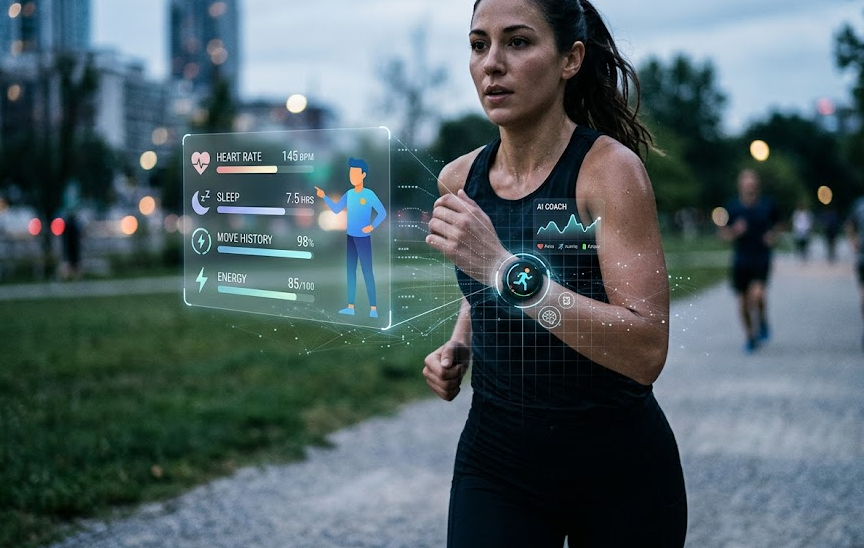
If over-trained, it reschedules the strength workout to the evening and recommends stretching in the morning. It even tracks your engagement; if you haven't opened the app, it might send a proactive notification: "No iron today, let's work on flexibility." Behind the scenes, AI algorithms automatically recalibrate your routine by comparing your completed pull-ups to your scheduled goals for that day. You have no idea you are about to get a notification telling you that, because you can’t see your app, only the notification.
When/why do you need to consider using a chatbot trainer?
A chatbot trainer allows you to access AI via messenger apps, such as Telegram or WhatsApp or Discord. They eliminate the need for bulky mobile fitness apps and endless surveys. Suppose you want to accomplish a specific fitness goal, for example, you want to do 10 pull-ups in two months. In that case, you can simply write to the bot, and within seconds, it will build a program based on that request.
Pros:
- Low barrier to entry. There are no complex terms to learn; the bot will ask questions in simple, easy-to-understand language.
- Immediate feedback. You log your sets and submit photos or numbers of sets, and the bot provides feedback immediately.
- Workspace integration. If your bot is in a messenger app like Telegram, it can also pull in data from different services, including meal plans, sleep, and pedometer.
A real-world example of the workings of the chatbot trainer is this: our cryptocurrency analytics chatbots receive more than 40,000 requests a day, and the logic behind the chatbot trainer works in much the same way. If you send a message to a chatbot and ask why your knee hurts after squats, the bot will look up the three areas to focus on and make a recommendation, all in under eight seconds. It may take an hour for a human trainer to respond, if they respond at all, while using a Fitness Bot on Telegram is not a luxury but rather a significant savings. One AI Trainer can replace up to ten trainers, managing hundreds of communication channels without getting tired, on vacation, or off for the day.
How are AI trainers built?
AI is built on a three-tier neural network architecture, the latest in AI trainers today:
- Pattern Recognition. Recurrent neural networks (LSTM and GRU) will examine time series (i.e. heart rate, race pace, how often you work out), these trainers can identify patterns; for example, performance declines at the same time every Wednesday, and therefore can flex that workout day to another.
- Program Generation. Transformer models (GPT-4 and Claude) will take biometrics and goals and generate tightly constructed programs; such as, a male who is 30 years old, with a sedentary job and is training to race in 6 months, will generate a 24-week program, including mileage, pacing, and recovery days.
- Natural Language Processing. GPT trainers will be able to identify context around the user; when you say to the trainer "I'm dog-tired" your trainer will not only reduce your workout load, but he will also ask questions such as, "Hi, do you mean physically or emotionally?" or "Did you sleep well last night?"
How are they made? Quite simply, ASCN.AI uses its own Ethereum and Solana nodes to train its model and index its data in real-time. ASCN can be made for fitness trainers by connecting the API of smartwatches (such as Garmin, Fitbit, or Apple Health) so that the data on heart rate, sleep, and steps can be used to train the neural network used for the fitness trainer. For example, if a person has less than six hours of sleep, their strength metrics could drop as much as 12 percent.
A fitness assistant built on GPT uses engineering principles rather than marketing methods. This model uses over 50,000+ reusable fitness programs and over 200,000+ reviews of athletes' workouts as well as biomechanics textbooks to help develop your fitness routine. Its database is verified, so nothing it produces is created out of thin air, and all exercises will have been reviewed at least 50 times by other users before being placed in the system for others to use.
Data Processing and Individualization of Workouts
A personalised plan accounts for more than just weight & age; there are hundreds of variables, too:
- Static Variables: Anthropometry (physical testing), Injury History, Genetics; especially if DNA tests are available.
- Dynamic Variables: Resting Heart Rate and Heart Rate under load, Recovery Speed & Heart Rate Variability (HRV).
- Contextual Variables: Stress Level (SURVEY), Sleep Quality & Nutrition Quality.
Data Collection Methods:
- Manual Input. Filling out questionnaires, Responding to bot.
- Auto-Sync. Bluetooth smart devices attached to the internet using APIs such as Garmin Connect, Strava, or MyFitnessPal.
- Parsing Indirect Signals. If the user doesn’t respond to the bot or show up for their workout for 3 consecutive days, system flags potential burnout.
Example: Two people, both 25 years old, 75 kilograms; however, 1st person is an office worker and has an HRV of 40 milliseconds; the 2nd person is a delivery driver who has an HRV of 80 ms. The AI system will assign the first person a training routine 30% lower than what is assigned to the second, even though both users will be assigned an identical routine based on their age and weight. A standard calculator would produce the same result.
Automating Cases: At ASCN.AI, the system performs calculations using multiple data sources via token analysis; for example, it takes 10 seconds to perform calculations using tokens across 30+ separate fitness metrics! The AI bot that integrates with wearables provides information through analysis to provide a recommendation. For example: "Your perceived exertion for today's workout should be at 85% intensity (4 sets, not 3)."
How to Integrate with Wearables & Activity Trackers
When there's no ability to integrate with wearables, an AI trainer is simply a chatbot and is therefore not a full agent. True-personalization begins by utilizing personal biodata, and the process of syncing technologies offers a well-defined solution:
- OAuth 2.0 for Authorization and Authenticating with APIs for Garmin, Fitbit and Polar.
- Webhook for getting instant notifications from devices (e.g. heart rate or workout completion).
- REST API for getting historical workouts over a given period of time.
Here are some examples of those integrations:
- Garmin Connect API - the neural network tracks the training load and overall Aerobic Training Effect - if they are above threshold, it indicates a reschedule of a planned workout.
- Oura Ring API - the neural network uses data such as sleep-phase data and body temperature to determine if the person is ready to continue training, if sleep depth drops 40%, change to active recovery.
- Apple HealthKit - aggregate data on heart rate, steps and calories - if 15,000 steps walked in the day, reduce the time of cardio by 20 minutes in evening.
Advice for trainers developing their products: If your budget does not allow for integration through code, you can build your application using a no-code platform such as ASCN.AI No-Code. You can easily connect to Garmin via API. Set a trigger for "workout complete", then the neural network will analyze that workout and send recommendations via Telegram. This can all be accomplished without any code and can be up and running in hours.
Stages of Developing an AI Personal Trainer
When developing an AI fitness assistant, it's important to consider that a beginner at-home fitness enthusiast needs a different level of support than someone who is advanced and experienced with working out regularly.
Here are some considerations on how to successfully implement an intelligent assistant for use in fitness:
- What level of sophistication will you build into the intelligence for the user? Are you developing specifically for beginner athletes, advanced athletes, or elite athletes?
- What does this user's workout actually need to accomplish? Weight loss, muscle building, endurance improvement, rehabilitation, etc...?
- Where will this user's workouts take place? Home, gym, outdoor, some combination of the above?
- How much demographic information do you have about your user? For example, do you only have the height and weight of your user or are you able to access biometric information?
- What is the budget for the project? ($5k budget: use available APIs and only bodyweight exercises to get started; $10,000+ budget: add in nutrition, sleep and dietary information; $100,000+ budget: use in-depth fitness management software to incorporate onboarding processes, make user assessments to develop individual fitness plans, monitor progress of users and provide analytics on user data).
If you have the budget, consider adding the following additional features:
- Video examples of proper exercise performance;
- Techniques that can be referenced with a camera's video-feed;
- Social networking features including leaderboards, competitive challenges and cooperative teams.
I have spent time creating an artificial intelligence application for cryptocurrency evaluation (at ASCN.AI) and learned that while many users may want to find a price forecast for a particular cryptocurrency, most users are much more interested in finding out how much risk they are taking, all in less than 10 seconds. Regarding sport, this is also true – most of the time people are not interested in reading 10 pages of theoretical background; they want an easy way to perform a particular action in a defined period (e.g., “Do this activity today,” “Do this other activity in 1 month.”)
Overview of the AI Models (e.g. GPT Transformers, Machine Learning)
| Model Class | Task | Advantages | Disadvantages | When Applicable |
|---|---|---|---|---|
| Classical ML (e.g. Random Forest or XGBoost) | Load Forecasting / Plan Optimization | Fast, Low Resource Use | Requires manual Data Labeling | Structured Final Workout Summaries |
| LSTM/GRU (Recurrent Network Models) | Time Series Analysis of (e.g. Heart Rate, Results) | Capture Long-Term Relationships | Medium Difficulty to Train; Large Datasets needed | Overtraining / Injury Forecasting |
| Transformers (e.g. GPT-4, Claude) | Production of Plans and User Interaction | Ability to Understand Context and Produce Human-Like Speech | High Cost of Using API and Can Create False Interpretations | Discussions for Motivation |
| Computer Vision (e.g. CNN) | Assessment of Exercise Technique | Very High Accuracy in Pose Capture | Need For Camera; High Resource Use | Video Analysis of Movement |
Recommended Budgeted Amounts:
- $5K - If budget is constrained, utilize existing APIs and pre-set rules for generating plans based on the available information. Do not attempt to create new ML Models.
- $10K - $50K - Train LSTM Models On Existing Open Fitness Datasets; Then Use GPT To Interact With Clients.
- Over $100K - Collect Your Data, Recruit ML Developers And Create Your Solutions.
An example: build an MVP of a Telegram chatbot using an API connected to GPT-4 at a cost of $0.03/1,000 tokens, populate it with 50 verified programs, and establish rules. For example: “Beginner - 3 workouts/week max” or “Knee pain - no high squats.” It should be possible to create a prototype within one week without the use of an ML development team.
Training a Model with Workouts + User Integration
Assuming you're using a custom-model design, there are three main steps:
- Collect and sort your own workout data for aggregation (you can gather this information from open-source content, including; Kaggle; Fitbit API with generalized inconclusive user profiles (from millions of active users); academic studies).
- Label the user profiles for use with the model (using supervised or semi-supervised techniques to label data with words such as "plan = progress" or "plan = injury").
- Prepare the workout profile for the model (by removing outliers such as 300 BPM heart rate; convert the workout profiles to use common metrics with similar units of measurement (e.g., miles = kilometers, calories = kilojoules)).
Building and Training your New Model
Using the datasets produced above you should first divide the data into three groups: 70% are training data sets; 15% are validation data sets; and 15% are testing datasets. A technique called 'cross-validation' can be performed to help prevent the model from fitting to the training datasets or exhibiting overfitting. Your first attempt at the model could yield 60% accuracy (very good); but, if you increase your dataset size and/or performance parameters, your accuracy will improve with repeated attempts. By completing three to five iterations, you may achieve 85% or greater performance.
Examples of Use Cases:
- User completes three weeks of workouts as stated in fitness plan and skips a workout for the fourth week - sends an alert message as a method of motivation and offering challenge to a friend.
- 28-year-old female weight loss - uses the model to create a correlation for periodization based upon monthly cycle, as well as adjusting volume and load according to each.
ASCN.AI Case: A previous fitness-based approach to predicting overtraining (3-days before symptoms appear) based upon 50,000 users achieved 82% accuracy. The ASCN.AI implementation is based upon algorithms including all transactions on Ethereum and Solana over several years using 87% accuracy to predict anomalies. Critical: If your target audience is beginners, do not only train the model with data from professional athletes. Your dataset has to be aligned with who your target audience will be.
Creating the Bot Interface and Feedback Loop
The interface does not just include buttons. Usability is very important in fitness, and if the bot is difficult for the user, they will stop using it very quickly.
Main Principles:
- Minimal Input. Instead of providing 50 different exercises in one day, simply ask the user how many ‘Bench Presses’ they want to do on that particular day.
- Contextual Help. Each time a user enters an incorrect entry three times in a row, the bot will show the user how to make their entry, e.g. "Please write your attempt as: 10KG; 12 Reps".
- Visualization of Graphs. Show the user what they have achieved through graphical representations of progress; such as using dynamic graphs or a bar graph to show the user what they achieved this past week compared to the previous week.
Feedback:
- Workout Rating. After each workout session, the bot will ask the user how they feel about that particular workout on a scale of 1-10. If the user rates three workouts at a 9-10, their load will be decreased for the next workout.
- Mood Surveys. Allow you to adjust the users program according to their sleep, energy and motivation levels based upon their responses to you.
- Text Analysis. If a user sends you a text message indicating that they are “sore for the third day running” and by using GPT, you are able to determine whether the user is experiencing “normal” soreness or “over-training”.
Technological Stack: Telegram Bot API for functionality/WhatsApp Business API. No-Code Platforms (ASCN.AI). ASCN.AI created a bot to analyze crypto in two to three hours: A trigger sends a message to the AI, which then sends an HTTP request to a blockchain API which returns a response back to the AI. Same concept applies with personal fitness.
As a recommendation, don’t digitize all aspects of fitness at once; for example, digitize only the workout component first and slowly add other areas such as cardio, diet and sleep over time because launching everything at the same time may result in user dropout.
Examples Of AI Fitness Trainers
1. Freeletics (Germany)
Provides customised workout plans based on the user's goal (for example, build muscle / lose fat, etc.), and feedback on how well they follow their custom workout plan; uses machine learning technologies/computer vision, advanced features available; 50M app downloads and 5M active users. Users rate their workouts after each workout; their ratings impact future workout load (for example, a user rating a workout as light will result in a lighter future workout load).
2. Tonal (U.S.)
Allows users to do weight (resistance) workouts using a smart mirror; weight automatically adjusts to user at time of workout; uses force sensors & algorithms; 200+ exercises. Manufacturers reported that users gained, on average, 25% more muscle mass in a 12-week period; takeaway: users can have weight adjusted dynamically during a workout.
3. Vi Trainer (Biosensory Headphones)
Goal is to provide voice instructions along with biometric data via headphones; uses biometric sensors, speech synthesizer, performance tests focused on aerobic zones; study showed users using a vi trainer are 34% more likely to achieve their fitness goal; takeaway: vi trainers allow users to track their workouts outdoors without having to use a smart device.
The Bottom Line: A successful digital trainer will not replace personal trainers but will allow for routine tasks to be automated (counting repetitions, adjusting resistance, sending reminder); trainers stay as coaches / mentors.
Guidelines To Incorporating Digital Trainer In At-Home/Gym Workouts
In Gym:
- Integrate With Equipment. Check for APIs in gym equipment connecting each piece of equipment to your artificial intelligence (AI) to automatically gather data on every set completed by an individual.
- Scan QR codes associated with a client to view the workout routine from today on any piece of equipment.
- Create team challenges for your clients. AI combines results from all participants and then ranks and pushes motivational messages to their smartphones.
In the home:
- Minimal equipment needed. Bodyweight exercises, resistance bands, and light dumbbells work very well for many different types of movements. AI will show you bodyweight and band options based upon each of the exercises listed above.
- Short duration of workout sessions. Sessions less than 30 minutes are optimal to keep clients from quitting; while longer workout sessions frequently are reasons for clients quitting.
- Technique analysis using camera. Have a client shoot video of him/her doing any of the exercises; the neural network compares and calculates angles of the knees and the low back position for improvement/evaluation.
Adaptation: ASCN.AI has created an arbitrage scanner for cryptocurrencies that displays price ranges for the same cryptocurrencies on the same or different exchanges. The same process also allows AI to create personalized options based upon your time, the equipment available to you, and your physical conditioning and create the best workout to be performed for your individual needs.
Tips for gyms: Gyms should not replace all of their trainers; rather, trainers should use AI as an aid in the training process. Trainers will be responsible for determining the proper technique to use in conjunction with their client's weight, but AI will be responsible for tracking and optimizing weights and loads based on the client's progress. Therefore, trainers will be able to train more clients while maintaining the same level of service.
Frequently Asked Questions
What makes an AI trainer better than a human personal trainer?
Advantages of an AI trainer:
- 24-hour access to training—while a human trainer sleeps, your AI trainer is always available for use.
- Cost—most human personal trainers charge an hourly rate ($50-$100), whereas, an AI trainer can provide you with the equivalent level of training for between $10-$30 per month.
- Scale—AI enables trainers to scale their efforts; in comparison to a trainer working with 10-20 clients at a time, AI can serve thousands of clients at one time.
- Objective—AI is objective in nature, meaning that fatigue and bias will not interfere with AI-based training.
Limitations of AI-based training:
- The lack of real-time feedback during workouts due to the absence of physical contact.
- Complex situations such as rehabilitation require an expert human.
- An actual trainer is much more motivating psychologically than a text in a chat.
As a result, AI can provide a partial solution to a trainer, and for beginners through intermediate users, AI can provide 80% of the solution to their needs for the lowest cost. For advanced users, only a human can provide the specific expertise required.
62% of users of AI-based fitness apps continue using the app after 6 months, compared to only 23% for traditional fitness apps continue to use them after 6 months, because of the high level of personalization and adaptability available through AI.
What do we need to personalize workouts?
The minimum requirements:
- Age, Sex, Weight, Height;
- Target Personal Goal (Fat Loss, Muscle Gain, Conditioning);
- Level of Experience (Beginner, Intermediate or Advanced);
- Any Limitations (Injuries, Illness).
Additional context: Biometrics (Resting Heart Rate, Max Heart Rate, HRV, Body Fat Percentage), previous training history, lifestyle factors (sleep, stress, nutrition), and equipment availability.
How do we gather the above? Enter data manually during onboarding, use wearables (syncing Apple Watch, Garmin, or Fitbit), and use indirect signals (lack of activity as a sign of fatigue).
Tip: Do NOT collect all this information at once. Ask for 1 thing at a time.
How does GPT help with motivation and adaptation?
The core of motivation:
- Tone of communication - If the user was feeling down and said to GPT "I'm tired, I didn't want to work out today", GPT will not push them to workout but will suggest a lighter day where they get rest and relaxation.
- Success Story - If a user was able to add 2 more pull-ups the week before, GPT will naturally ask "do you want to attempt 9 today?"
- Personal triggers - Offer challenges to compete against a friend for those who enjoy competition.
Plan adjustment: GPT can review the number of missed workouts and provide a re-build plan based on reality WITHOUT GUILT. If results plateau, GPT will recommend using periodization by alternating between strength and conditioning.
- User: "I can't do 10 push-ups."
- GPT: "How many push-ups can you do now?"
- User: "I was able to do 6 push-ups before."
- GPT: "That's Great! Let's increase that to 7 next week. Today you can do your push-ups from your knees."
Disclaimer
The information provided in this document is for educational purposes only and should NOT be construed as investment, legal or safety advice. Users must be aware before using AI assistants and must understand the functions of AI assistants.